Private Equity Is Taking Over Your Veterinarian
Private equity is taking over veterinary services, driving up prices, and putting the pets we love at risk through its relentless pursuit of financial extraction.
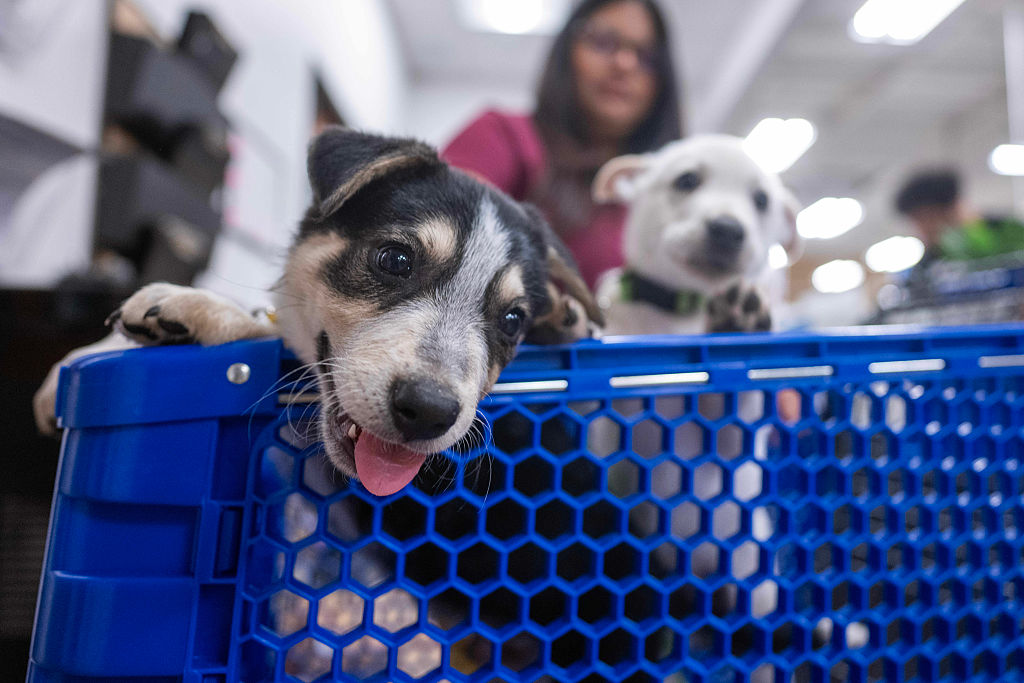
The website Private Equity Vet keeps a running list and map of corporate- or private-equity-owned vets around the world. By the latest count, there are over 12,000 such outfits in the US and Canada, and over 2,000 in the UK — and the list is growing. (Hans Gutknecht / MediaNews Group / Los Angeles Daily News via Getty Images)
In the world of money managers and big capital, anything that doesn’t belong to the ultrawealthy is a temporary inconvenience, an aberration waiting and begging to be set right. Private equity (PE) specializes in using its immense hordes of capital, leverage, and networks to buy up everything in sight before jacking up prices, lowering service standards, stripping companies of assets, or some combination of the above. It’s a cynical and destructive strategy, and those behind it don’t care what it costs you. Indeed, costing is the whole idea for private equity’s depredations. If they don’t get to you one way, they’ll get to you another.
Short of a book-length disquisition on the subject, it’s impossible to properly catalog the extent to which PE’s extractive proboscises have inserted themselves into the infrastructure of our day-to-day lives. But a quick roundup of some of its more nefarious greatest hits can give some sense of PE’s scale: operators are dipping their fingers into the tens of billions in taxpayer dollars spent on nursing homes every year, and studies show that homes in which they’ve invested have higher mortality rates and lower standards of care. PE has helped push aside the nonprofits that used to oversee youth sport, where families have seen a 46 percent cost increase for their child’s primary sport since 2019. Through “development finance,” PE has disguised predatory financial extraction as foreign aid in the Global South.
The list of PE depredations goes on and on, from exacerbating the housing crisis to provoking health care bankruptcies to jeopardizing the airplane repair business and fire truck manufacturing (some critics claim that PE consolidation of the emergency vehicle market played a part in worsening the 2025 Los Angeles fires). It’s fair to say that PE’s touch is a disgusting inversion of King Midas’s. While everything he touched turned to gold, for consumers, everything PE touches turns to shit.
Last year, private equity put Canada’s oldest retailer into the ground. Years before, foreign capital had started sniffing around Canadian health services, looking to import the American model across the forty-ninth parallel at scale. The strategy was simple: big capital would enter the market by buying up practices in the fields of dental care, optometry, and pharmacy and turn them into chains obsessed with maximizing profit and minimizing service. Nothing is out of bounds.
If all this was not bad enough, PE has recently turned its dead-eyed gaze on our pets. The private equity push into health care services throughout Canada and the United States has included veterinary medicine. This means that not even humanity’s best friends will be safe from the vultures who will never have to worry about whether they can afford to take their beloved pet — or, rather, pay someone else to do so — to receive the care it needs.
All Things Bright and Beautiful
In December 2024, Alice Teller warned that private equity in the United Kingdom was encroaching on veterinary services, raising prices and bullying workers, closing up shops whenever anyone had the utter temerity to ask for something as absurd as decent working conditions and a fair wage. And as the private equity push accelerated, pushing out smaller operations and independent outfits, what was a worker or consumer to do? Where could one go?
Private Equity Vet keeps a running list and map of corporate- or private-equity-owned vets around the world. By the latest count, there are over 12,000 such outfits in the United States and Canada, and over 2,000 in the UK — and the list is growing. Stateside Mars alone owns over 2,000 practices across three brand names (with another 128 north of the border), while in Canada Berkshire Partners controls 375 under the Vet Strategy brand, the largest of a handful of operators in the country. The Private Equity Vet numbers suggest that as much as 75 percent of the veterinary market in the US and Canada is corporate- or private-equity-owned.
The costs of consolidated, corporatized, or private-equity-controlled vet services add up fast. As per the iron law of monopoly and oligopoly, concentration in the market tends to produce higher prices and poorer service. Without countervailing and competing options, it will become harder and harder to find a veterinary clinic whose prices and standards aren’t set by a handful of corporate owners, the former high and the latter low. That’s likely to mean not only high costs for visits and procedures but also lower pay for workers, scant benefits, and diminished working conditions.
As wretched as the PE capture of an industry can be, the takeover of vet services is particularly disconcerting because of the nature of what vets do: they care for animals, usually pets whose owners are very fond of them or, at the very least, don’t wish to see the creatures suffer. This dynamic creates highly inelastic demand such that pet owners will be stuck paying inflated prices and receiving poorer service because they refuse to see the animals they consider part of their family descend into poor health and misery. So, they’ll pay. Or, worse, in extreme cases they won’t because, despite desperation and devotion, they’re unable to, and their helpless and blameless pets — who can’t count to one, let alone understand what private equity is — will suffer or die.
Breaking Out of Our Cages
Far from inevitable, the flow of private equity into every last crack and crevice in the economy is a political choice by governments captured both by the stories we tell ourselves about the “free market” and by the capitalists who keep them alive through networks of influence and class alignment.
As capital accumulates in the hands of the few and inequality grows, it becomes easier for PE to consolidate its hold over entire industries and expand into new ones. The result is a cycle of growing inequality and shrinking competition, and suffering among the many — the vast majority of us — who remain on the outside looking in while both literally and figuratively paying the price.
Dismantling the private equity apparatus across industries requires a public-policy solution; changing the way consumers spend their money won’t do it. You can’t leverage consumer choice in a rigged system. If we are to inhabit a capitalist world for the time being, governments ought to be able to insist that it abides by its own purported rules. That means preventing PE from consolidating entire sectors of the economy and wielding its market power to extract profit from workers and consumers alike.
Such a system would be better for workers, consumers, and, in the case of veterinary medicine services, the pets we care for and love.
These reforms require a fight, but it’s one worth taking on. And if we won’t do it for ourselves, we ought to at least do it for the creatures that we love and care for as family. As Nicole Aschoff has put it in these pages, we need to ban private equity.