The Damage Caused by Private Equity Is No Accident

Defenders of the private equity industry cast it as a bold force driving economic dynamism. But its record of destroying public services is no accident: private equity is essentially an elite project to profit from asset-stripping.
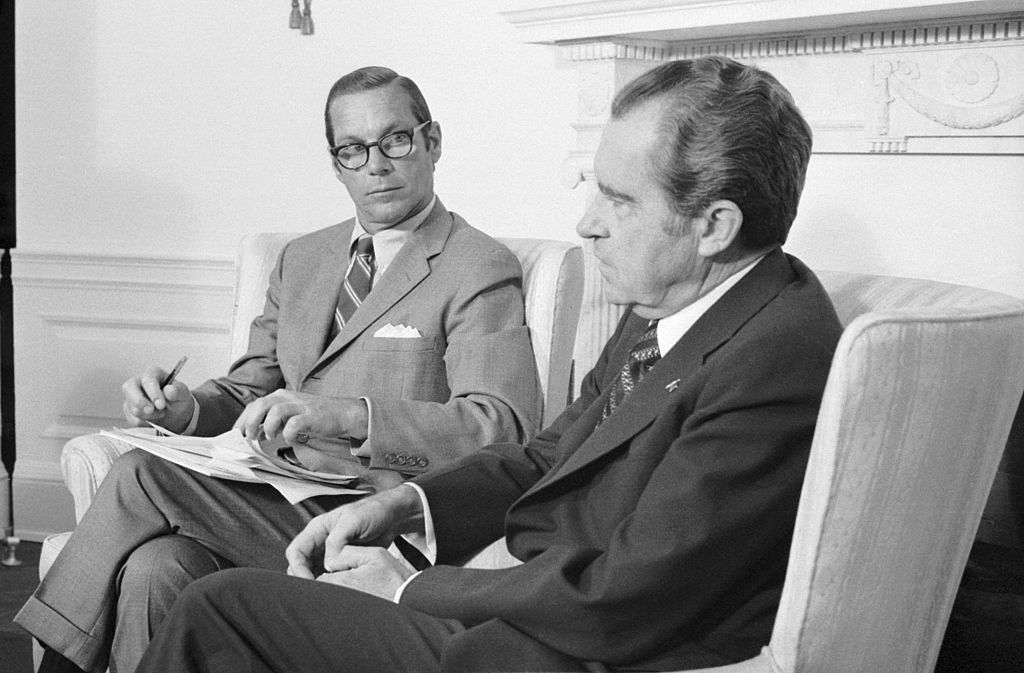
Treasury Secretary William E. Simon speaks with President Richard Nixon.

Nixon’s Treasury Secretary, William E. Simon, the “father of private equity,” saw his turn to asset-stripping and leverage buyouts as a moral crusade to restore the United States to its old vigor and dynamism. (Bettmann Archive via Getty Images)


Of all the schemes devised by the rich and powerful to rip off workers and escape democratic accountability, private equity might be the most brazen and destructive. Born out of the conservative backlash of the 1980s, it was pitched as a way to save moribund Western economies and wrestle capitalism free of the hands of a complacent postwar managerial class. Yet fast forward four decades or so, and these secretive funds hardly live up to their billing as a vanguard of risk-takers who smashed up bloated corporations in the name of creative destruction. They instead operate more like parasites that, having run out of businesses to load with debt, have ended up razing essential services regular people cannot live without, from housing to health care, education, and utilities.

The chasm between stated purpose and reality is the subject of Hettie O’Brien’s new book The Asset Class. Blending history with firsthand reporting, the book is an excellent account of how private equity emerged out of an attempt by the propertied class to escape democracy and reassert their control over capitalism. More importantly, though, it is a chronicle of the disparate ways in which private equity has become one of the main drivers of enshittification and erosion of the welfare state as we know it, using workers’ hard-earned pensions and savings to make their everyday lives worse.

Billionaire Factory

The first chapters are dedicated to the rise of private equity on the two sides of the Atlantic. O’Brien starts by discussing William Simon, a financier who had been President Richard Nixon’s treasury secretary, whom she singles out as “the father of private equity.” Simon was as much a businessman as an ideologue, who saw his turn to asset-stripping and leverage buyouts as a moral crusade to restore the United States to its old vigor and dynamism. Together with figures such as Michael Milken, the inventor of “junk bonds,” and Michael C. Jensen, a business professor convinced of the miraculous power of debt to discipline underperforming managers, Simon provided much of the thrust behind the 1980s boom in hostile takeovers.

O’Brien then observes how the same business orthodoxy — which sacrifices everything, including jobs, on the altar of shareholder value — migrated to the UK. This happened mainly thanks to figures such as James Goldsmith, the free-marketeer tycoon turned opponent of globalism who is most famously portrayed in Adam Curtis’s Mayfair Set.

She notes that the flood of foreign capital that subsequently washed over the City of London was aided by significant tax breaks, such as the 1987 agreement that allowed so-called carry — payouts received by fund managers as a cut — to be taxed as capital gains rather than ordinary income. To the dismay of the self-professed free-marketeers of the Thatcher government, it was recognized even then that the resulting exorbitant profits hardly went into any sort of productive investment. Already in 1987, the Financial Times was reporting that “those who benefitted were ‘avoiding the high-risk, high technology investments’ of their US counterparts.” On the contrary, the tax break contributed decisively to creating what financial economist Ludovic Phalippou has recently called private equity’s “billionaire factory.”

In the same chapters, O’Brien provides a detailed account of the industry’s operating model. She explains private equity’s basic method of generating returns through leveraged buyouts. Here, private equity firms finance the acquisition of a company by borrowing, and then dump the debt thus incurred on the acquired firm’s own balance sheet. She describes the industry’s infamous “2-and-20” fee structure, charging a 2 percent annual management fee and 20 percent on profits, which create strong incentives to maximize short-term gains at the expense of long-term investment and ultimately the company’s viability. (20 percent of companies acquired by private equity fail within ten years, compared to a 2 percent average.) Finally, she examines the practices by which private equity managers further enrich themselves while running companies into the ground. These include sale-and-leaseback transactions, in which company-owned real estate is sold to raise funds and then rented back, and dividend recapitalization, in which additional debt is incurred in order to pay dividends to shareholders.

Self-Destructive State

The author is a financial journalist and regular contributor to the Guardian. The rest of the book is not so much a linear history of private equity’s meteoric rise as a catalogue of egregious examples of private equity in action. Among these, O’Brien tells the story of Copenhagen, perhaps one of the few instances of successful collective organizing discussed in the book.

As one of the world’s most desirable cities, with a solid welfare state and lots of affordable housing stock to boost, the Danish capital had been singled out by Blackstone to do the same things it did in places such as Spain and Sweden. Through a subsidiary called the 360 North, Stephen Schwarzman’s firm — up to 2019, the largest landlord of single-family rental homes in the United States — started to work its usual playbook: buying rent-controlled properties, kicking out tenants, renovating the buildings, and reletting them, sometimes at double the price. This time, however, it crashed into Danish citizens’ outraged response. The backlash culminated in the passing of the 2019 “Blackstone Law,” which prevented landlords buying a new property from raising rents for five years or paying tenants to leave. Rather than a success story, O’Brien notes, the episode showed that the safety nets of the Danish welfare state extended only so far, as social housing — much of it occupied by immigrant communities — was later sold to a Danish investor.

Other chapters discuss how private equity, because of its intrinsic opacity and Russian-doll complex structure, is a great vehicle for money laundering and influence peddling in the Global North as well as forms of neocolonial extraction in the Global South. The chapter devoted to Nairobi Women’s Hospital — a private hospital owned by Dubai-based private equity and impact investing firm Abraaj that would detain patients who could not pay extortionate medical bills — is perhaps the most shocking example of the industry’s callousness and disregard for human dignity. However, the chapters that best relay the extent to which private equity has infested all aspects of life in the developed West are the ones in which O’Brien reports from Britain.

Indeed, the UK stands in a league of its own when it comes to the sheer influence of private equity. In the British case, this industry’s “cradle-to-grave” business model is not a metaphor, but a faithful descriptor. (As O’Brien hints at in the book, it is not that inconceivable for a British person to go a whole life moving through institutions owned by private equity, from nursery to nursing home.) On the other hand, this scourge was largely self-inflicted.

O’Brien dedicates two different chapters to eldercare homes and water companies, making clear that private equity’s various forms of rent-seeking never improve these services. If anything, they push them toward astonishing levels of malpractice and negligence. Yet if private equity has had a field day with the UK’s essential services, it is largely down to the bankrupt free-market ideology that has ruled the country since the Margaret Thatcher era. Through privatizations, the state asset-stripped itself. Through austerity, it hollowed out its capacity to act as watchdog. The result? Repairing its sewage system, which discharges ungodly amounts of untreated waste into its rivers, would cost the country approximately £260 billion as a result of missing investment and malpractice. At least part of this money in the case of companies such as Thames Water — which until 2017 was owned by Macquarie Group and is now burdened with unpayable debt — has instead gone to pay out in dividends to shareholders.

Deeper Roots

O’Brien remains largely agnostic whether the nature of capitalism is itself to blame. The book’s subtitle seems to suggest private equity to be an anomaly, a mutation turning the system against itself. However, many points in the book appear to belie this claim. Indeed, both the way O’Brien discusses private equity as the effort to dismantle the checks and balances established by the New Deal and her portrayal of the Trump administration as a “patrimonial” state in which owners of capital are given free rein suggest not a detour from the smooth running of capitalism but a return to its most rapacious, unadulterated form. This is what capitalism is when it wasn’t dampened or constrained by twentieth-century social democracy.

Toward the end of the book, O’Brien suggests that, although by now private equity has a seat at the table of the US and UK governments, its rise might be the product of a specific time and place where equity markets were rising and debt was cheap. She tells the story of Nate Koppikar, a San Francisco–based so-called shorter who considers the whole industry a Ponzi scheme and, in 2022, had the gall to short Blackstone. In that instance, the firm managed to bounce back, its share price more than doubling in the following two years. However, the signs are difficult to ignore. Donald Trump’s move to open 401(k)s to private equity assets, the industry’s turn to retail investors, the growing difficulties in selling its assets, and the practice of borrowing against existing portfolios are all symptoms of a system that might soon run out of steam.

This is little consolation, though. The real paradox is that much of the money with which private equity has run companies into the ground, laid off workers, and turned essential services into cash cows actually comes from pension funds and university endowments: that is, institutions of the welfare state originally intended to provide workers with a safety net. Not only has private equity made the life of many of them significantly worse; if and when it goes bust, it will be regular people who will ultimately bear the cost. Better to dismantle the system before that happens.