Private Equity Is Making Firefighting Unaffordable
Twenty cities and municipalities are suing private equity firms whom they allege have cornered the market in fire truck manufacturing, creating artificial scarcity and degrading the quality of emergency services.
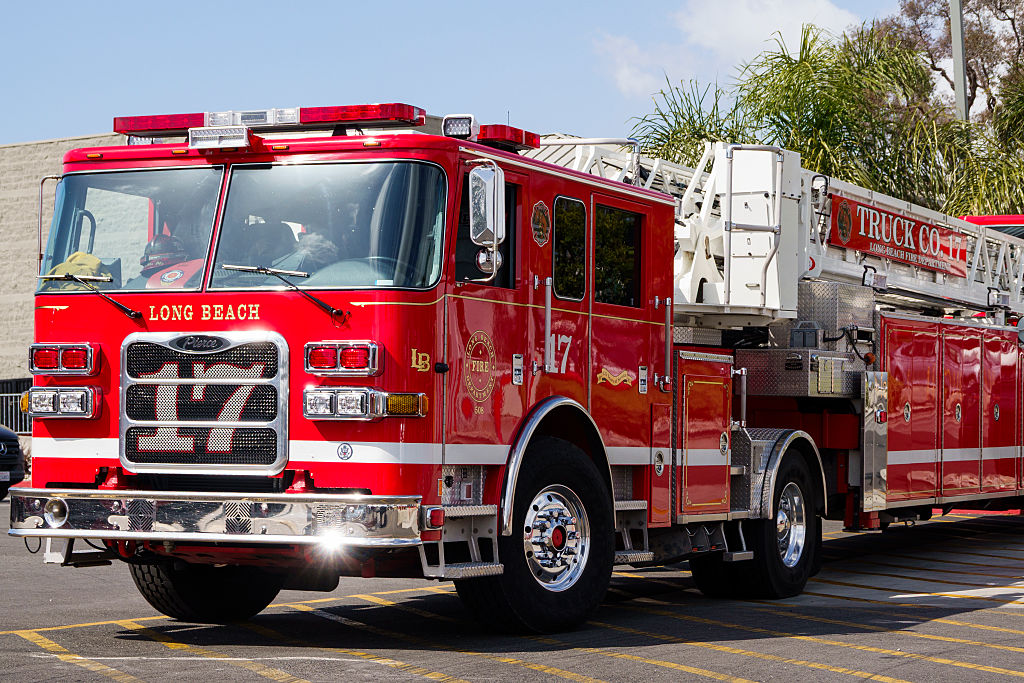
While the 2025 wildfires in Los Angeles raged, dozens of fire trucks sat in lots awaiting replacement parts from manufacturers. Private equity consolidation of the industry has led to production backlogs with destructive, even deadly consequences. (Kevin Carter / Getty Images)
A Bay Area city is joining at least nineteen other municipalities from multiple states in suing private equity firms for allegedly cornering the fire truck manufacturing industry and using their market control to shut down factories, create artificial scarcity, and dramatically hike prices for vital emergency-service machinery.
On May 21, the City of Emeryville, a mid-sized city near San Francisco, filed a federal lawsuit in the Northern District of California over the matter against three private equity–backed companies that together have come to control roughly 70 percent of the fire truck manufacturing industry: the REV Group and its former parent company American Industrial Partners, the Oshkosh Corporation and its subsidiaries, and Boise Mobile Equipment, Inc. and its subsidiaries.
“Through their illegal schemes, Defendants have reaped extraordinary profits on the backs of fire departments, taxpayers, cities, and counties,” the lawsuit states. “Defendants have shut down plants, substantially increased prices, and severely extended delivery timelines.”
Catherine Simonsen, a lawyer for the Simonsen Sussman law firm, which is working alongside the firm Baron & Budd to represent the twenty municipalities, said the lawsuits are “important because they concern timely and affordable access to lifesaving apparatuses and parts.”
“We seek not only damages but also injunctive relief — namely, the unwinding of the alleged unlawful mergers to restore a more competitive marketplace,” Simonsen told the Lever. She was alerted to the antitrust issues after reading a piece by Basel Musharbash, an anti-monopoly attorney.
Last year, Musharbash detailed how American Industrial Partners, a private equity firm focused on industrial businesses, began buying up fire truck manufacturers in 2008. By 2017, the private equity firm had combined more than a dozen companies into a single entity, REV Group, which controlled more than 40 percent of the industry. By 2021, REV Group owned more than twenty-five separate companies, and by 2025, it accounted for 33 percent of all fire truck sales.
During that time, the cost of a fire truck used to pump water through hoses rose from roughly $300,000 to $500,000 in the mid 2010s to nearly $1 million today, Musharbash noted.
In 2024, American Industrial Partners sold its controlling stake in REV Group, and earlier this year, REV Group was acquired by Terex Corporation, a specialized work truck manufacturer that counts two of the world’s largest asset managers, the Vanguard Group and BlackRock, among its top investors. Terex did not respond to a request for comment.
American Industrial Partners’ two largest competitors are also facing scrutiny for their business practices. According to Los Angeles County, which has filed a similar fire truck antitrust lawsuit, the Wisconsin-based Oshkosh Corp. (not to be confused with the children’s clothing brand OshKosh B’gosh) allegedly required customers to purchase proprietary parts from one of its subsidiaries, even though the same parts were cheaper from competitors.
A spokesperson for American Industrial Partners wrote in an email that the firm “disagrees with the allegations in the complaint and intends to defend itself vigorously.”
Boise Mobile Equipment, Inc., meanwhile, allegedly “eliminated competition between themselves to supply wildland fire apparatuses while entrenching their dominant market positions,” according to the lawsuit.
Boise Mobile Equipment did not respond to a request for comment.
According to the various lawsuits — which courts are working to consolidate so they’re heard by a single district court — the fire truck conglomerates have also intentionally shut down multiple factories, creating a backlog of orders for machinery and parts that has led to higher prices.
“This deliberate output reduction had its intended effect — backlogs skyrocketed to a record $4.2 billion in undelivered orders by fiscal year 2024, and the REV Group Defendants hiked prices on the order of 50–100% or more,” the lawsuit states. “REV Group executives cheerfully celebrated these price increases and related ‘price realization’ to Wall Street investors and analysts, as they translated into spectacular returns for their shareholders.”
In the first quarter of 2022, Oshkosh’s CEO boasted to shareholders that the company’s $660 million backlog was “another record backlog.” Later that year, the CEO again stated to shareholders that the company’s backlog “is at an all-time high, up more than 80 percent compared to the prior year, highlighting excellent demand for our products as evidenced by our leading market share.”
An Oshkosh spokesperson said that the allegations in the lawsuits “are without merit, and we are defending ourselves in court. Oshkosh remains focused on delivering safe, high-quality fire trucks while continuing to reinvest in our US operations to meet record demand.”
But such backlogs can have extreme consequences. Musharbash noted that during the 2025 wildfires that devastated parts of Los Angeles, dozens of fire trucks sat idle in a lot awaiting repairs and parts.
“The ultimate harm of [the] monopolization of the fire apparatus industry, of course, is not something that can be measured on a spreadsheet,” wrote Musharbash. “It’s a hundred fire trucks sitting out of commission while a disastrous wildfire burns whole neighborhoods of Los Angeles to the ground. It’s lives lost, homes destroyed, communities gutted.”