America’s Empire Is Ending Much Like Spain’s Did
As the US celebrates its 250th, it has begun to resemble the decadent Spanish Empire it replaced: producing nothing while collecting rents, sacrificing its interior to enrich a bloated elite, and embracing exclusionary nationalism to exploit its underclass.
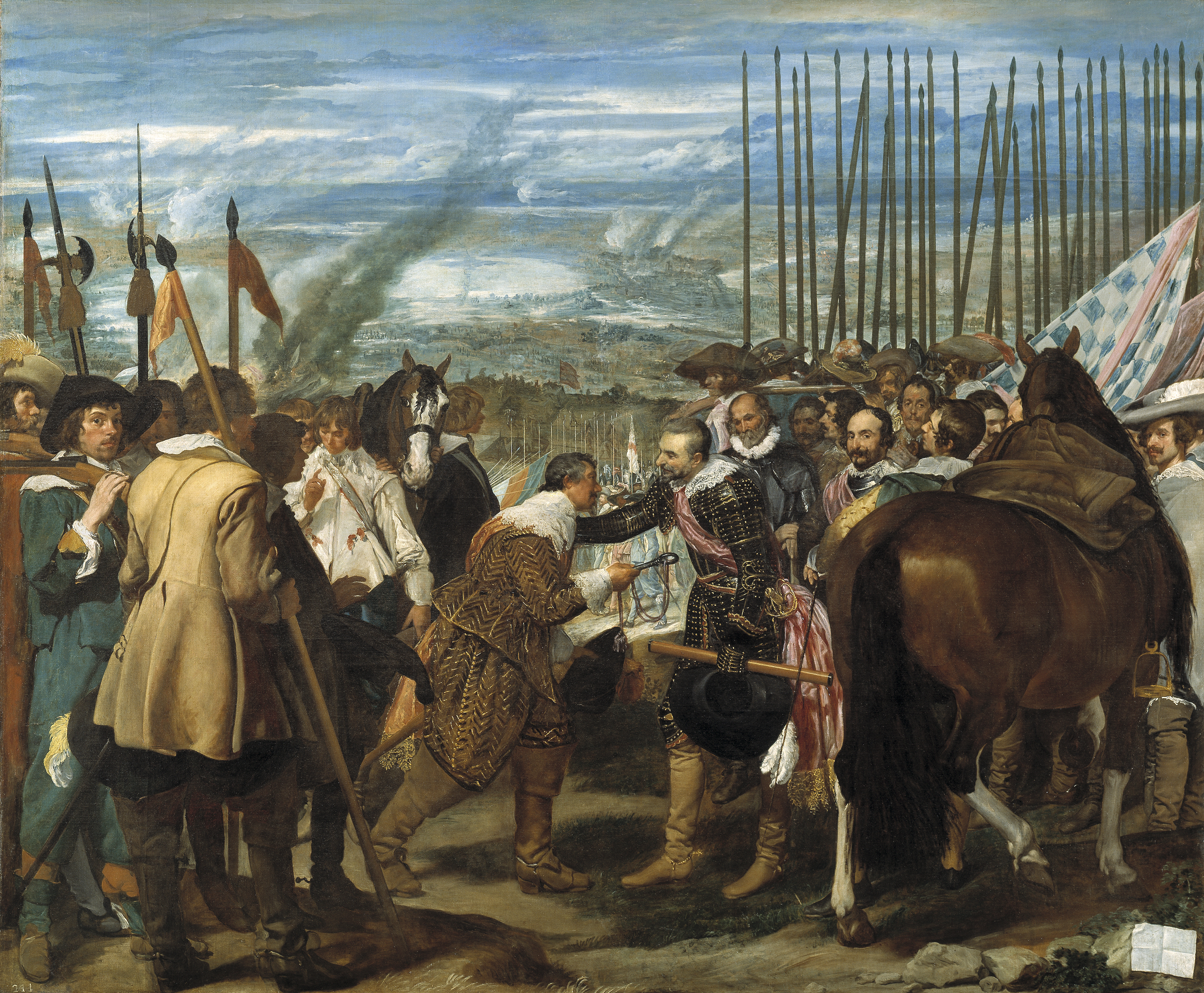
Diego Velázquez’s 1635 painting The Surrender of Breda depicts the Spanish General Ambrogio Spinola graciously accepting the keys to the Dutch town in 1625. This moment was the crowning achievement of imperial Spain’s so-called Annus Mirabilis.
An often forgotten historical truth about the American Revolution is the crucial role that Spain played in providing financing, logistical support, and supplies. As Greg Grandin details in America, América, in late 1776, Benjamin Franklin entered secret talks with the Bourbon Court to plead support for the revolutionaries’ cause. Spain eventually agreed, sending envoys “to manage the distribution of its aid, supplying the Continental Army with blankets, boots, gunpowder, and other necessities.” By 1779, Spain itself had declared war on England, launching naval campaigns up the Mississippi and along the Gulf Coast.
In 1782, at the negotiations that eventually produced the Treaty of Paris, the Spanish diplomat the Count of Aranda was among the first to recognize the Crown’s strategic blunder. Spain would have been better off, Aranda argued, had they left England and its colonists to fight one another. Instead it had financed a power that would eventually threaten its possessions in Florida, New Orleans, and Mexico. Today the United States has a lot in common with the declining Spanish Empire that it eventually replaced.
A Golden Age?
In the century before, Diego Velázquez’s 1635 painting The Surrender of Breda depicts the Spanish General Ambrogio Spinola graciously accepting the keys to the Dutch town in 1625. This moment was the crowning achievement of imperial Spain’s so-called Annus Mirabilis. In the span of just a few months, King Philip IV’s forces achieved a string of stunning military victories: relieving Genoa, defending Cádiz, recapturing Bahia, and winning a ten-month siege at Breda. This proved to the Habsburg Court that Spain had shaken off the cobwebs of the Twelve Years’ Truce, leading royal favorite Gaspar de Guzmán the Count-Duke of Olivares (who led a notoriously hawkish faction) to pen one of the most famous pronouncements from early modern history: “God is Spanish and fights for Spain.”
But the canvas belies a more complicated truth. Spinola remained with the Army of Flanders for three years following the surrender of Breda, advocating to the Council of State for a negotiated peace with the Dutch. As a military realist, Spinola knew that what we now call the Eighty Years’ War was unwinnable and that the treasury was empty.
When he returned to Madrid in 1628, Spinola was blamed by Olivares for unpreventable setbacks (including the Crown stiffing his soldiers) and was reassigned to the governorship of Milan — leading Spanish forces in the War of the Mantuan Succession. This regional war with France over a small Italian duchy was a strategic disaster for the Habsburg Court, contributing to a local outbreak of the bubonic plague, which then tore through Spinola’s forces. Olivares stripped him of his diplomatic authority in 1630, and Spinola took refuge at a nearby castle, where, on his deathbed, he is said to have screamed relentlessly about his honor being stolen from him.
When he commissioned Velázquez to paint The Surrender of Breda a few years later, Olivares was facing intense domestic backlash against what we might now call his “total war” policies under the 1626 Union of Arms. Olivares demanded a permanent standing army of 140,000 men, with every province and kingdom contributing under a strict proportional tax quota. This broke with centuries of tradition under the system of fueros, whereby local elites exercised a great deal of political and economic autonomy. To distract the Habsburg Court from this political disaster, Olivares quickly financed the Buen Retiro Palace by regressive taxation, the sale of noble titles, and the shaking down of local municipalities.
It was constructed out of cheap materials, with some contemporaneous accounts referring to it as a chicken coop. In an ornate Hall of Realms, the coats of arms for each of Spain’s twenty-four provinces and kingdoms were prominently displayed, along with twelve patriotic battle scenes, including The Siege of Breda. Here Spinola is immortalized as the embodiment of chivalrous Spanish virtues, which did not protect him from the conspiracies of his chief political rival or the foreign policy missteps of his king.
As America celebrates its 250th anniversary, the Trump administration is force-feeding the public a sort of chauvinistic, dime-store version of the Buen Retiro Palace, complete with drywall monuments, schlock art, and military brass playing patriotic songs to an empty National Mall. So as we celebrate the Fourth of July weekend, it is worth reflecting on the decline of the empire that the United States replaced in the Americas, a descent that began long before the American Revolution.
By 1637, two years after Velázquez’s painting was commissioned, the town of Breda was back in the hands of the Dutch; the Habsburg Court was bankrupt and alienated from its regional allies; France had officially entered the Thirty Years’ War; and Olivares was putting down a local rebellion in Catalonia. These crises boiled over, and by 1640–41, Catalonia had officially seceded from Spain and named King Louis XIII of France the Count of Barcelona. Spain eventually won the Reaper’s War in 1652, but amid the chaos permanently lost Portugal’s territories and, with it, its status as the uncontested hegemon in the Americas.
By 1670, the siege of Breda was a distant memory. The Netherlands was an independent state, Olivares had been banished from the court and died, and the Regency Council of King Charles II (Phillip IV’s son and the last of the Spanish Habsburgs) was forced to recognize England’s claim to Jamaica. This, in turn, led to the economic and legal integration of the Thirteen Colonies with the British West Indies, and the events that gave rise to the American Revolutionary War and the state so many of us call home today.
From One Declining Empire to Another
For over a century, galleons groaning with the weight of Andean silver from Potosí, in modern-day Bolivia, were shipped into the port of Seville, bringing the Habsburg Court previously unimaginable wealth. The quantity of precious metals was so vast that it triggered the first ever wave of global inflation. Foreign imports, which were comparatively cheap, slowly bankrupted domestic manufacturers and, specifically, Spain’s once famous Merino wool and textile industry. Manufacturing centers entered long declines, and Castile, the heart of Spain, was depopulated.
The modern US equivalent of Potosí silver isn’t any single commodity but the US dollar itself, given its function as the world’s reserve currency. For decades, the American empire has relied on dollar hegemony to absorb global surpluses, forcing its trading partners to subsidize American consumption. Wall Street’s mind-boggling array of financial instruments function a bit like the Spanish treasure fleets: they conjure vast centralized wealth that is actively hostile to domestic production, which — when combined with contractionary monetary policy — has led to the sort of abstracted economic and class warfare whose results are visible as day in the former industrial towns and cities of Rockford, Flint, Youngstown, and countless others across the Midwest.
To maintain its hegemony over trade in the Americas while simultaneously fighting ideological wars far from home, the Spanish Empire adopted financially ruinous military policies. The Army of Flanders was the world’s first permanent mercenary force, and it had to be continually resupplied in the Spanish Netherlands by way of a highly contested road that started in northern Italy and wound through Switzerland and Germany. The Spanish treasure fleet and armadas were frequently targeted and sunk by state and nonstate actors alike, including Ottoman, Dutch, and British privateers. To finance these expenses, Philip IV relied heavily on the asiento system, issuing short-term, high-interest bonds to foreigners. Genoese bankers loaned the Habsburg Court cash to pay for mercenaries and shipbuilders, securing the debt against future Castilian taxes and inbound silver from the Americas.
By the 1620s, virtually all of Spain’s new wealth was consumed by debt service. The United States is currently locked in a similar debt spiral, functioning as a sort of garrison to secure supply chains for transnational capital. The US military’s over eight hundred overseas bases, command structures (like AFRICOM and SOUTHCOM), as well as its subsidization of sub-imperial proxies (like Israel and Saudi Arabia) drive the Pentagon’s staggering annual budget, which is almost entirely financed by debt issuance.
To state the obvious, the United States does not deploy carrier strike groups to the Strait of Hormuz because it’s close to America’s borders. It’s the logistical requirement of the neoliberal economic order and is used to enforce dollar dominance and police maritime choke points to keep global capital flowing. Today a rapidly growing share of America’s tax revenues (19 percent in 2026) goes to service the interest on its debt.
By the 1620s, the Spanish Empire, like the United States today, was dealing with a crisis of elite overproduction. The ranks of the aristocracy and letrados swelled as its bases of local industry and the peasantry shrank, a process accelerated by the aforementioned practice of selling noble titles to raise quick cash. The number of elites vastly outpaced the empire’s ability to provide the land and patronage they expected, giving rise to the hidalgo, the lower noble, a unique class synthesis famously immortalized in Don Quixote.
The contest between Olivares and Spinola played out in the upper echelons of this conflict. Slowly, the bloated overclass turned on itself, triggering factional wars for control of Spain, then a composite state of multiple provinces and kingdoms, and leading to its brief establishment as a semi-unitary state under Olivares.
Contemporary America is contending with a similar crisis. Over the last four decades, the neoliberal order has given rise to a massive debt-encumbered and downwardly mobile white-collar class. Increasingly, this class has resorted to cannibalizing the state through austerity policies and graft to maintain its status. Institutional rot has become a polite fiction to ignore, as elite competition has devolved into a factional war over the United States’ decaying economic and political consensus.
As the Spanish Empire’s economic engine sputtered, its ruling classes also retreated into exclusionary nationalism. Incapable (or unwilling) to improve local fortunes, the Crown obsessively regulated who was afforded economic and political rights, manifesting in the development and enforcement of blood purity laws. By redefining citizenship, the semi-unitary state strictly limited internal migration and social mobility to protect the privileges of the “Old Christian” Castilian elites. Entire communities were marginalized to ensure the few remaining spoils of empire flowed to increasingly narrow subsets of the population.
Today the United States is using a strikingly similar approach by way of aggressive immigration enforcement (“surges,” raids, etc.) and lawfare against individual communities (think Haitian Temporary Protected Status holders, who were recently stripped of their status, and the recent failed challenge to birthright citizenship). As the neoliberal economic model continually fails to deliver broad-based prosperity, the state must actively weaponize the concept of citizenship to manage domestic fallout. By expanding the definition of an “illegal” resident, the federal government can strip economic rights from millions of workers, further depressing wages while handing a useless symbolic gift to the privileged “real Americans” (what W. E. B. Du Bois called a “psychological wage”).
To state the obvious, an empire producing nothing while collecting rents, sacrificing its interior to enrich a bloated coastal elite, and barricading the doors to exploit a vulnerable racialized underclass is not on a positive trajectory. Today the Trump administration is consumed by the same delusion that gripped the Habsburg Court four hundred years ago, leading to a rapid decline in the Spanish Empire as an uncontested global hegemon.
A forty-five-year-old hidalgo in 1670 would have lived through the whole sequence: the Annus Mirabilis, the establishment of the Union of Arms, the loss of the Eighty Years’ War and the rise of an independent Netherlands, the Reaper’s War and the loss of Portuguese territories, and the legal recognition of English territory in the Americas. This hidalgo could have even traveled to Madrid to see Velázquez’s Surrender of Breda, conceived in a proud two-year blip of an otherwise downward historical trend.
Yes, the United States could somehow reopen the Strait of Hormuz for global capital on favorable terms. Yes, it might succeed in stealing assets from Venezuela and Cuba. But continued imperial violence will not usher in a new American century, lift up the political and economic fortunes of its people, or live up to the best values the American Revolution inspired.
Recent events have shown us that socialism in America is a big tent, supported by everyone from progressive reformists to anarcho-communists (and everything in between). One thing they appear to have in common on America’s 250th anniversary is the following: the belief that We the People have the absolute right to dismantle a failed economic and political order that has immiserated the domestic working classes while killing, displacing, and otherwise victimizing millions abroad. This is a consensus not of decline but renewal.