Filmed in Western Sahara, The Odyssey Endorses Colonialism
For five decades, Morocco has illegally occupied Western Sahara. The shooting of part of Christopher Nolan’s The Odyssey in the territory, backed by state subsidies, serves a far-reaching effort to normalize Morocco’s colonial rule.
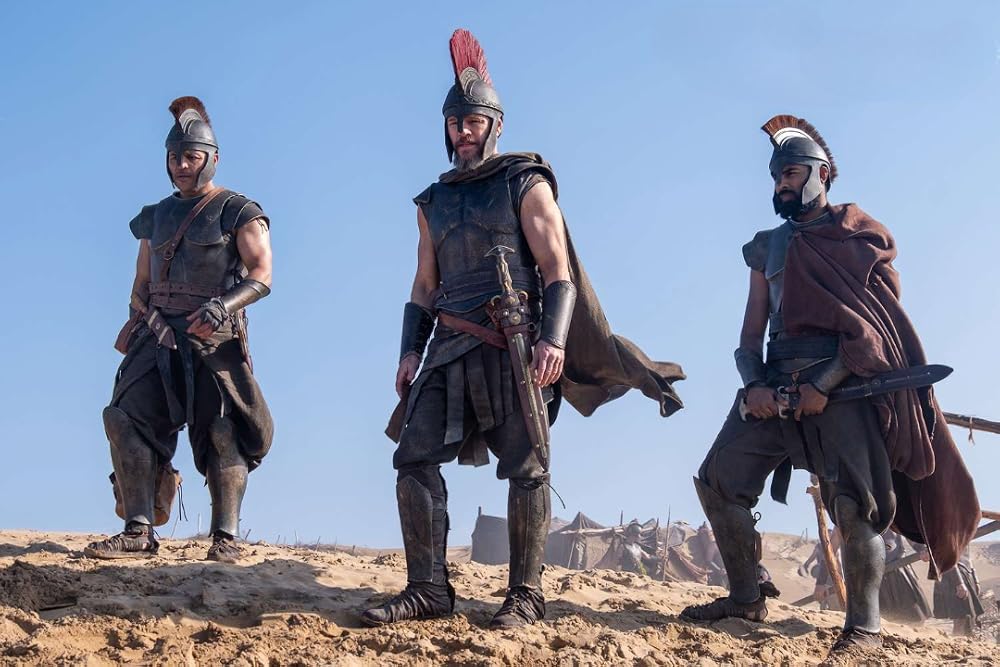
Much controversy around Christopher Nolan’s new Odyssey movie focused on the identity of the cast. Yet the real problem was its production, and the shooting of the film in Western Sahara under illegal Moroccan occupation. (Syncopy Inc)
In the run-up to its theatrical release, Christopher Nolan’s The Odyssey became embroiled in online polemics after Elon Musk attacked the movie’s supposed “woke” casting. Yet beyond this contrived spectacle lies a far more important criticism to be made of the filmmakers: their decision to shoot part of the movie in Africa’s last colony, Western Sahara. Enjoying generous subsidies from the Moroccan state, they lent legitimacy to its illegal occupation regime.
As Nolan and his crew filmed along the coast around the port city of Dakhla last summer, an open letter condemning the move was signed by prominent figures in world cinema, including Javier Bardem, Pedro Almodóvar, and Paul Laverty. “Mr. Nolan filmed there without the consent of the Sahrawi people,” it read, in reference to the majority nationality in Western Sahara. “The only consent he received came from the occupying force: Morocco.”
In particular, Oscar-winning actor Bardem did not hold back. As he posted the letter on his Instagram account, he added: “For 50 years, Morocco has occupied Western Sahara, expelling the Sahrawi people from their cities. Dakhla is one of them, converted by the Moroccan occupiers into a tourist destination and now a film set, always with the aim of erasing the Sahrawi identity of the city.”
Covering an area the size of Britain, Western Sahara is designated as a “non-self-governing territory” by the United Nations and remains on its official list of territories still awaiting decolonization. Retained by Francisco Franco’s Spain even as other European colonies won their freedom, it did not gain independence even after the dictator’s demise in 1975. Instead, neighboring Morocco and Mauritania invaded — with at least 40 percent of the Sahrawi population at the time fleeing to neighboring Algeria to escape the Moroccan air force’s bombing campaign. Half a century later, 173,000 Sahrawis still remain in Algerian refugee camps. The native Sahrawis living under Moroccan occupation are subject to what Freedom House categorizes as among the least free political systems on the planet.
The Odyssey is the first major Hollywood production to shoot scenes in Western Sahara. This would have been unthinkable prior to 2020, when President Donald Trump broke with decades of US foreign policy and recognized Morocco’s illegally established sovereignty over the territory. The decision was part of a quid pro quo in exchange for Morocco’s normalization of ties with Israel. Now Nolan and crew’s four-day shoot in Dakhla illustrates how quickly Hollywood studios have moved to exploit the opportunities created by Trump’s transactional diplomacy. This subsidized occupation cinema is yet another symptom of the breakdown of whatever remained of a rules-based liberal order.
Creating Facts on the Ground
For Moroccan officials, the presence of The Odyssey crew was a propaganda coup. They have made it clear they see it as just the beginning of Dakhla’s development as a base for international film productions. This is despite the fact that the wider Western Sahara remains the site of an ongoing armed conflict between the country’s military and the Sahrawi pro-independence movement, the Polisario Front. Last month, three Polisario fighters were killed in a Moroccan drone attack close to the 2,700 kilometer sand berm that separates Moroccan-controlled territory from the desert areas held by Polisario.
If the construction of the vast defensive berm in the 1980s was Morocco’s attempt to entrench its military control over Western Sahara, the transformation of Dakhla into a tourist destination and green energy hub in recent years aims to consolidate the occupation as an irreversible economic reality. From the Moroccan leadership’s perspective, Sahrawi independence will look increasingly unrealistic if it can develop the territory in conjunction with international investors. It is also incentivizing Moroccan settlers to move to the territory with generous subsidies and jobs.
The clearest expression of this strategy is Morocco’s Atlantic Initiative, which looks to provide landlocked countries in the Sahel region with maritime access to the Atlantic via a new €1.3 billion port facility currently under construction in Dakhla (and set to be operational by 2028). Positioning the occupied city as a key logistics hub for northwestern Africa, the project aims to further integrate Western Sahara into regional trade networks.
Tourism is also key to normalizing Moroccan control, with Dakhla in particular recast as an international destination for kitesurfing and ecotourism. On a 2022 visit, Ivanka Trump and Jared Kushner were photographed at one of the growing number of high-end hotels on Dakhla peninsula, as well as on the sweeping Atlantic coastline that would later attract the film crew shooting The Odyssey. The couple’s holiday photo shoot offered a vision of luxury resorts and leisure in which the military occupation and indigenous Sahrawi population were erased from view.
Airline Ryanair’s announcement in 2024 that it was opening new direct routes connecting Spain with Dakhla and the Sahrawi capital El Aaiún marked a further expansion of this model of occupation tourism — even as the European Commission informed airlines that routes involving Western Sahara would not be covered by the terms of the EU-Moroccan aviation agreement. At the same time, international journalists, trade unionists, and human rights defenders have looked to break the Moroccan media blockade by boarding these low-cost flights over the last eighteen months, only to be detained at the airport or arrested when they made contact with local Sahrawi activists. Footage from last year even showed a left-wing delegation from the European Parliament being physically blocked from disembarking a Ryanair flight by Moroccan security forces.
Occupation Cinema
The Odyssey’s subsidized production forms part of this same effort to establish Dakhla as an international — but firmly Moroccan — destination while limiting scrutiny of the occupation itself. Yet as news of the Dakhla shoot emerged last summer, Sahrawi filmmakers, journalists, and activists took to social media to contrast the free rein afforded to Nolan’s Hollywood production with the systematic repression they faced in trying to document the Moroccan state’s human rights violations, or simply in exercising creative freedom.
“I grew up in the Sahrawi refugee camps in Algeria and today, as a Sahrawi filmmaker from the occupied city of Dakhla, I cannot freely enter my homeland to tell my own stories”, director Brahim Chagaf posted as part of the online campaign organized by The Western Sahara International Film Festival. “That is the great contradiction behind this landscape: while a few privileged people like Nolan can turn it into a movie, others are still waiting for the day when we can simply return to it”.
Campaigner Ghalia Djimi’s message was even starker: “Mr Nolan: I am a human rights defender. Morocco disappeared me for 3 years and 7 months in a secret prison in occupied El Aaiún.”
Her experience is far from exceptional. In its latest 2024 report, human rights NGO CODESA catalogued dozens of abuses carried out by Moroccan security forces that year. These included the repeated violent suppression of peaceful protests, the harassment and arbitrary detention of activists, and the suspicious deaths in custody of three Sahrawi civilians. In November 2023, the UN Working Group on Arbitrary Detention concluded that the detentions of two dozen Sahrawi activists and journalists, held ever since the Gdeim Izik protest camp in 2010, were illegal. It also found that in the case of eighteen student activists detained in 2016, torture was used to extract confessions.
As The Odyssey opens at the global box office, one of the Gdeim Izik prisoners, Enaâma Asfari, is currently in the fourth week of an indefinite hunger strike. In calling for his immediate release last month, Frontline Defenders said it was “concerned about reports describing medical neglect, reprisals and other forms of ill-treatment against Sahrawi human rights defenders in prison.”
“When Christopher Nolan steps on the red carpet on his way to the premiere’s screening, he will also be stepping on International Law”, insisted María Carrión, executive director of The Western Sahara International Film Festival, last month. “We ask the public to treat this film as they would a movie made in occupied Ukraine with [Vladimir] Putin’s permits, or in the illegal settlements in Palestine with [Benjamin] Netanyahu’s blessing.”
A series of rulings from the European Union’s highest court back this claim. Over the past decade, the Court of Justice of the European Union has repeatedly found that Western Sahara is a territory with a “separate and distinct” status to Morocco and that legally its resources cannot be exploited without the consent of the Sahrawi people. Those judgments concern specific EU-Moroccan trade agreements, which the EU has tried to revive despite successive rulings from its own courts that they contravened international law. But the rulings raise broader questions about the responsibilities of international companies operating in the occupied territory, including film studios.
Given his back catalogue, Nolan’s brilliance as a writer and director is unquestionable. Yet with The Odyssey, he and Universal Pictures have set a dangerous precedent as they pioneered a new form of filmmaking for our Trumpian age: occupation cinema. A country subject to a brutal colonization and a system of effective apartheid is not a legitimate backdrop for either international tourism or a Hollywood blockbuster.