In Morocco, Royalist Authorities Silence Critical Rap Lyrics
Moroccan rapper El Mahdi Lyoubi, aka Mehdi Black Wind, was arrested this month on charges of defaming the king in his lyrics. The trumped-up charges reflect the monarchy’s trouble coping with the youth revolt expressed in last year’s GenZ 212 movement.
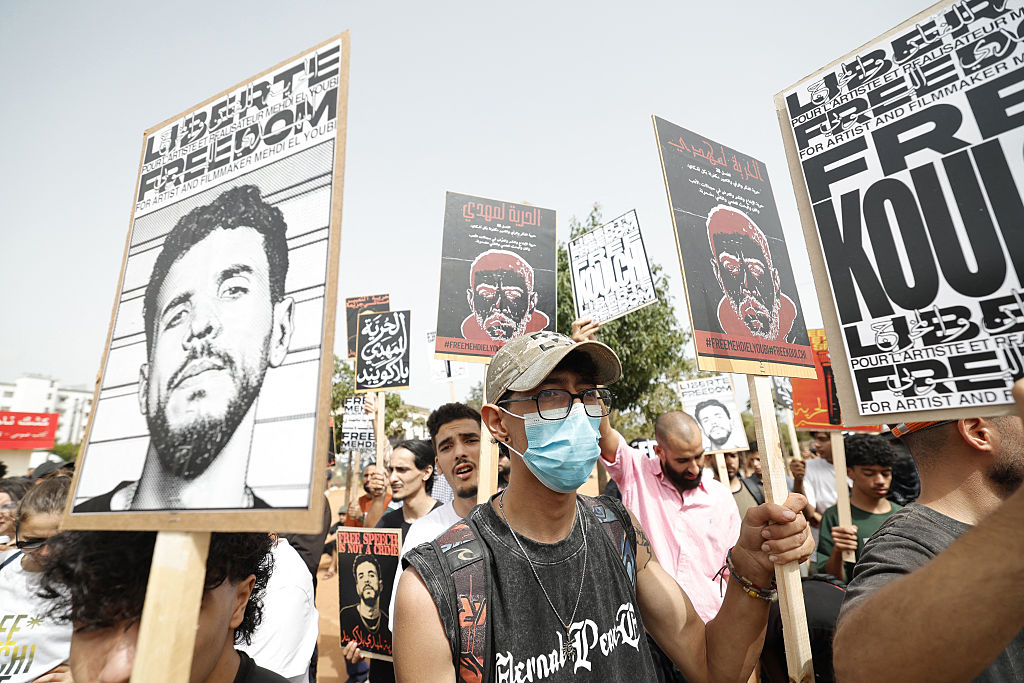
Moroccan royalist authorities have long repressed dissent. The recent jailing of rapper Mehdi Black Wind points to a state crackdown on music that expresses youth grievances about deprivation and the spirit of last year’s GenZ 212 protests. (Abdel Majid Bziouat / AFP via Getty Images)
El Mahdi Lyoubi, aka Mehdi Black Wind, the Moroccan filmmaker and rapper, is currently being held in pretrial detention in Casablanca’s Oukacha prison, charged with defaming the king. His arrest has provoked international outrage, with multiple open letters signed by artists, filmmakers, and rappers, a viral social media campaign, and demonstrations in twelve cities calling for his immediate release.
Mehdi, a star of the Moroccan underground, is thought to be being singled out for the content of his music and for his support for last year’s GenZ 212 movement, the youth-led anti-government protests that erupted in Morocco in late September 2025. His arrest is part of a new wave of repression in the North African country.
Arrest
The filmmaker and rapper, who has lived in France since 2017, had flown to Morocco in late June to see his family and scout locations for his new documentary. But when he tried to head back via Rabat-Salé Airport on July 10, police told him that he was officially forbidden from leaving Morocco.
No explanation was given. But after he underwent a full-day police interrogation on July 13, his family was informed that he’d been taken into custody.
Lyoubi had no recourse to a lawyer, amid the now over-month-long general strike called by the Moroccan Bar Association to protest a government bill. After his first hearing, without legal representation, he was swiftly transferred to Casablanca’s infamous Oukacha prison. Appearing before a prosecutor on July 22, as lawyers were still on strike, Lyoubi refused an immediate trial, and the demand for his release on bail was also refused. His next court date is July 31.
Lyoubi is being charged under the controversial Article 179, a part of the penal code that many consider unconstitutional and at odds with international human rights conventions ratified by Morocco. Concerning defamation of the king — Morocco’s head of state — and the royal family — the ruling Alawi dynasty that has governed the country since the seventeenth century — the article is a tool for suppressing freedom of speech. The Moroccan monarch holds supreme executive, military, and religious authority, and not just a ceremonial role.
“In Lyoubi’s case, there’s everything to indicate he’s been arrested for his opinions expressed in art, like other rappers who’ve been prosecuted,” Khadija Ryadi, former president of the Moroccan Association for the Defense of Human Rights (AMDH) and United Nations Prize in the Field of Human Rights laureate, told Jacobin. “Our current context is one of repression, bans, and restrictions, targeting critical voices: those of artists and journalists, activists and human rights defenders.”
This same association has called for Lyoubi’s immediate release. It considers the case emblematic, also because of the implications it will have for other prisoners of opinion and for human rights abuses. The conditions of the artist’s detention and interrogation already represent a violation of “presumption of innocence,” the basis of a fair trial and Article 23 of the constitution.
Ryadi adds that although repression is rife, this specific provision has itself rarely been used in recent times:
In recent years, the cases we’ve followed routinely used other articles, like offense or harm to a public official while performing their duty, or defamation of personalities other than the king. Very few of those currently detained in Morocco as prisoners of opinion have been prosecuted with this particular article.
Black Wind
As a rapper, Lyoubi — Black Wind — made a name for himself in the early 2010s with his bold and erudite New York–influenced rap. An understated and revered figure of the underground hip-hop scene, songs like “Nashid,” “Nashid II,” “L’Koul fer3oun kin Moussa,” and “N’biyech” became instant classics but also drew the attention of the authorities.
According to his support committee, interviewed by Jacobin, Lyoubi often travels between France and Morocco. However, the thirty-three-year-old artist had noticed in recent years that he — like many others harassed by Moroccan authorities — was receiving special attention during airport screenings. Police also called the hotels he stayed at on holiday to ascertain his presence.
For people who know Moroccan rap, Black Wind is considered one of “the real ones,” as the support expressed by other rappers attests. According to several Moroccan artists interviewed by Jacobin, Black Wind has also chosen not to play the “game” of hip-hop: he doesn’t engage in online clashes or follow pop trends. Social critique is at the forefront of his music. He steps between different registers, mixing Darija and French in his lyrics, slipping from the audacious rhyme of “Karl Marx” and “Air Max” (in “Chavez,” from 2022) to vicious and deeper critiques of social deprivation in materialist terms in the space of a beat.
Without the intermediary of a lawyer, little is known about what Black Wind’s charges pertain to. Some have speculated that the lyrics of “Nashid II”, referring to authority figures, may have been linked to Article 179, but this is unconfirmed:
Our country is trailing behind / Even the old mattresses are torn up / We’re burying children for a mere T-Max motorbike / Go and watch their funerals / A soul is precious in the eyes of God / But I don’t believe / In sheikhs / Or kings / Or anything like them.
The critique in “Nashid II” is very clear, but it doesn’t dwell on specific persons: the word “kings” is in plural and features in a list; it could be read figuratively or metaphorically, as a critique of authoritarian power. His trial seems to depend on how closely Moroccan authorities are listening, and on whether they deem that the rapper tried to “clash” with the king.
Rap and the Movement
Organized on social media by the anonymous youth collectives GenZ 212 and Moroccan Youth Voice, the protests were launched last fall when as many as 250,000 people joined the GenZ Discord server after eight pregnant women died following C-sections at a public hospital in Agadir.
The street protests, the largest since 2011–12, demanded improvements to education and health care and criticized government corruption and overspending, for instance on major sports events like the 2030 FIFA World Cup and the 2025 Africa Cup of Nations. Youth linked domestic corruption and neoliberal policies with the Palestinian cause, actively demanding an end to Morocco’s 2020 normalization agreement with Israel.
The movement met with much more forceful repression than the anti-normalization protests two years before and led to the detention of over a thousand people. Some have received prison sentences of up to fifteen years for “obstructing traffic on public roads by setting up barricades.” Three people in Agadir were killed last October when officers opened fire on a crowd of protesters.
Since the GenZ 212 protests, rap has been especially targeted. El Mahdi Lyoubi is, in fact, the fourth rapper to face trial this year. Socially conscious rap came to the forefront during the movement. Other rappers arrested include cause célèbre Hamza Raid, arrested in the first weekend of protests last September. Pause Flow was arrested in November for the lyrics of over ten rap songs, on charges of insulting public officials. Souhaib Qabli (L7assal), had criticized, like the movement, the government’s normalization of ties with Israel and broader corruption and was sentenced to eight months in jail.
There have been other arrests too. The night before Lyoubi’s arrest, Ali Lmrabet, a sixty-six-year-old journalist and critic of the regime, was arrested at Tangier Ibn Battouta Airport having arrived from Spain, where he lives. Released last Wednesday after international pressure, an investigation against him remains open.
Zineb Kharroubi, a Moroccan film distributor living in France, was sentenced in June for “incitement to commit crimes,” via social media posts “calling for a gathering” outside the Moroccan embassy in support of the GenZ 212 protests.
The fact that rappers especially are being attacked is new. Already in the Years of Lead (the period from roughly the 1960s to the 1980s under King Hassan II characterized by state violence and repression), a number of literary journals were banned, and writers went to prison. Rap is a musical form whose basis is social critique, and in Morocco, the lyrics are in the everyday spoken language of the people: Darija. Rap’s critique reaches a wider demographic than Standard Arabic (for which official literacy rates are 75 percent); although full of metaphor, its critique is rawer and more direct than other forms.
In the 2000s, the journal Nichane was famously shut down when it published jokes in Darija as part of a study on humor. Commentary at the time outlined that the jokes, being in Darija, were without some of the distance afforded in Standard Arabic and as such were intolerable to authorities.
International Response
Supporters hope to increase international pressure on Moroccan authorities. A petition has been signed by hundreds of cultural practitioners, including some of the biggest names in Moroccan hip-hop. Open letters, addressed to Moroccan authorities, have been published on French news sites Libération and Mediapart demanding the rapper’s immediate release.
Moroccan rappers have recorded messages of solidarity underlining the arbitrary character of the arrest. As Khtek, a rapper and collaborator of Black Wind’s with a big following, articulated on Instagram, there is a fear that other lyrics could soon be a liability.
Rallies took place in Rabat, Casablanca, Marseille, Geneva, Paris, Amsterdam, and the small coastal town of Douarnenez in Brittany. The hashtags #FreeElMahdi, #FreeMehdi, and #FreeKoulchi, went viral. In a blend of English and Darija, Free Koulchi means “Free Everyone” or “Free Everything,” a rallying call in the GenZ 212 and February 20 movements, demanding the release of political prisoners, journalists, and activists detained as prisoners of opinion.
For now, the trial looks set to determine whether his lyrics committed lèse-majesté. If authorities do reach this authoritarian conclusion, it will serve as the latest example of their misunderstanding of Black Wind’s music, Moroccan rap, and the youth discontent expressed in recent protests.