Can an Economic Populist Win Maine’s Governor Race?
It’s not just Graham Platner. In Maine’s gubernatorial race, logger and labor leader Troy Jackson is mounting an economic populist campaign that promises to build bridges between urban progressives and rural working-class voters.
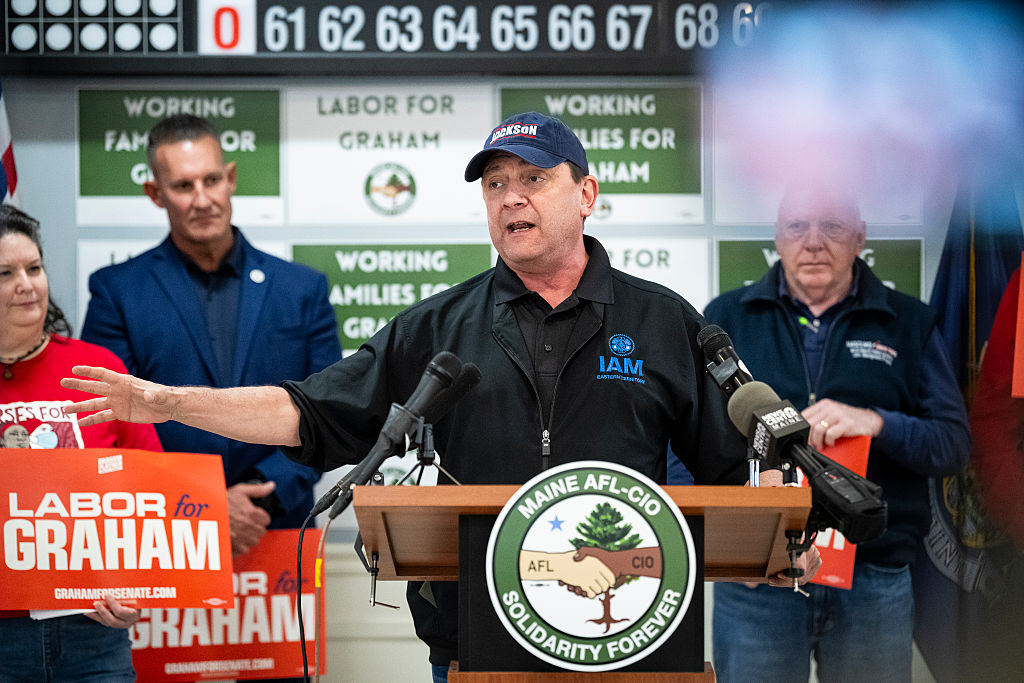
Troy Jackson, a logger from Trump Country, is running to be Maine’s next governor. His progressive, economic populist campaign holds out the hope of winning over rural working-class voters who liberals and the Left have too often neglected. (Graeme Sloan / Getty Images)
“As Maine goes, so goes the nation” is an old adage that describes the nearly one-hundred-year streak of Maine politics as the bellwether of presidential elections. Between 1820 and 1958, elections were held in September so farmers from one of the most rural states in the country could participate between summer crop and fall potato harvest seasons. These elections predicted whether Democrats or Republicans would win the November presidential election for 75 percent of elections held between 1820 and 1932.
These days, the phrase is repeated as a hopeful mantra for a new kind of politics. Mainers are embracing the progressive-populist oyster farmer–veteran Graham Platner in his bid to unseat five-term Republican Senator Susan Collins, organizing to keep Immigration and Customs Enforcement out of our communities, and blocking entertainment giant Live Nation from corporatizing our downtown music scene. Mainers now have an opening to be a political beacon for a Left that has largely forgotten the power and importance of the rural working class.
When leftist streamer and political commentator Hasan Piker said, “Let a thousand Zohrans bloom all around the country,” you’d be forgiven for not thinking that might include a fifty-seven-year-old logger from Maine running for governor — much less one from Allagash, a town of 237 up on the Canadian border in a county that voted three times for Donald Trump by double-digit margins.
Troy Jackson, a fifth-generation logger and labor leader, is the first to say he’s not from the Left or the Right — he’s from the bottom. Troy worked eighty-hour weeks in the woods for big timber corporations as an “independent contractor” forced to accept the prices they set and leave his family for six days a week. In 1998, Troy led the fight to shut down the US-Canadian border to protest the illegal hiring of Canadian loggers, whose national health care system and exchange rate allowed them to work for less.
Jackson initially made his bid for the Maine State Legislature in 2000 as a Republican (and later became an independent), reflecting the political sentiments of many of the people he grew up with and worked alongside. His voting history details votes against marriage equality and legalized abortion. However, Troy is an elected official that actually talks to his constituents. Following his 2009 vote against marriage equality, which he calls “the worst vote he ever took,” he met with a group of pissed-off gay people from Aroostook County. In 2004, Jackson made the switch to the Democratic Party and now is a firm supporter of trans rights, women’s bodily autonomy, and progressive tax reform to make millionaires pay their fair share. For socialists and leftists of all creeds, Troy’s evolution is a vital reminder that political purity is a false god.
Jackson’s tenure in the legislature brought universal school lunches to children, a suite of laws that protected and expanded abortion access following the fall of Roe v. Wade, provided for paid family and medical leave, and reined in wage theft. But many of his progressive bills that have passed a divided legislature were vetoed — first by proto-Trumpian Republican Governor Paul LePage and then by current corporate Democratic Governor Janet Mills.
Mills, the establishment Democrat choice to challenge Collins in the US Senate race who recently dropped out of her primary with Platner (following her veto of what would have been the nation’s first data center moratorium), vetoed labor bills to expand whistleblower rights, establish binding arbitration for public workers, and require harmony agreements that prohibit employer anti-union campaigns in exchange for workers forgoing their right to strike on new clean energy projects. She also vetoed Troy’s health care bills to restrict prescription drug-price-gouging and environmental bills to restrict aerial glyphosate spraying across the Maine North Woods.
These vetoes disproportionately threaten the health of poor, rural Mainers and workers in the public sector. And for over ten months, the Mills administration has refused good faith negotiations with Maine Service Employees Association–Service Employees International Union (MSEA-SEIU) Local 1989 state workers, and without binding arbitration, public sector unions in Maine are left with few options when the boss (i.e., Mills) stalls.
In his campaign for governor, Jackson is the only candidate to reject dark money and has openly challenged other candidates to take the People’s Pledge. The pledge checks outside spending by requiring campaigns to pay a penalty for any external expenditures that benefit the candidate. None of the other candidates (Secretary of State Shenna Bellows; former Speaker of the House and daughter to Congresswoman Chellie Pingree, Hannah Pingree; son of Senator Angus King, Angus King III, and former Maine Centers for Disease Control Director Nirav Shah) have taken him up on that challenge. The other candidates say the pledge won’t work, yet it reduced super PAC involvement in the 2012 Massachusetts US Senate race by 93 percent. With no dark money and the smallest average dollar donations of any candidate, Troy is making himself accountable to organized people over organized money.
Hicks, Hillbillies, and Hayseeds
A lingering issue facing Jackson’s campaign is that he is less known in southern Maine, despite his tenure as Maine State Senate president from 2018 to 2024. South of Augusta, the other gubernatorial candidates have benefited from living and working in the more urban, liberal bastions of coastal southern Maine. All have either held more visible public offices or ridden the coattails of their parents. In many ways, they present as the polished, educated, and dutiful administrative types one might expect from the Democratic establishment.
Contrasted with the archetypal establishment choice, Jackson is a logger from a small town five hours north of Augusta that looks more like an outpost than a village. He is the sort of rural, blue-collar union worker so often dismissed by Republicans and Democrats as uneducated, unsophisticated, and unmotivated.
Yet we know rural people have long been at the forefront of progressive politics and transformational change in the United States. The elitist attitude of the nominal left and its liberal conspirators has in the past one hundred years betrayed this history and rendered our unions, civil society organizations, and alternative parties incapable of organizing a society by and for the entire working class.
It’s common enough to overhear liberals and leftists alike speak condescendingly of rural states or counties — that rural people deserve whatever regressive legislation has been imposed on them and the like. Such attitudes condemn entire regions for an agenda advanced only by a reactionary section of the population. Consequently, actual rural progressives are dismissed and discarded as if the same as those with a reactionary agenda. That condemnation also kills any possibility of recruiting conservatives who rarely or never encounter a progressive politics that pays attention, in any serious way, to their material concerns. To continue Democrats’ error of abandoning rural people as hopeless, or unworthy of a politics that serves their material needs, is to be unserious about a transformative political project for the United States.
So when our gubernatorial candidates share the debate stage, we progressives and socialists in Maine have to fiercely reject the classist “hick” caricature of people like Jackson that we’ve been sold. Who needs a bachelor’s degree when you have a record like Troy’s? A record of consistently challenging pharmaceutical companies, providing lunches to schoolchildren, and protecting reproductive and workers’ rights? His legislative record demonstrates the personal growth and accountability that’s possible when you come from a background of collective action and democratic consultation — not to mention the harms of an establishment governor who poses as a progressive yet can never seem to sign off on the most popular of bills because the whispers of monied lobbyists are just too loud.
We don’t need more respectability politics. We want our taxes to fund the basic necessities of life.
The Rural Opportunity
Right now, Mainers have a massive opening to win a working-class agenda if we can win Platner his Senate seat, Jackson the governorship, and continue building power in our movements. In keeping with the state’s history as a political beacon, Maine is in a unique position to test a rural, working-class agenda for the entire country. So, what do we stand to win?
Electing Troy would mean electing a governor who is much more likely to be accountable to the movement who backed him and the people who voted for him. Voters trust union candidates. Jackson has been endorsed by over forty unions and walked countless picket lines. Building these relationships is a two-way street: not only is organized labor knocking on hundreds of doors a week for Troy, but when the lobbyists are inevitably stalking the halls of the state house, we know where to find him.
A Jackson governorship also means moving beyond an identity politics that keep us divided. Troy’s campaign is about the material interests that all working people have in common. This doesn’t mean he won’t fight the out-of-state, billionaire-led referendum to bar transgender athletes from sports, the federal assault on our immigrant community, and the consequences of centuries of state transgression toward Maine’s indigenous Wabanaki peoples. To the contrary, Jackson has shown he understands that failing to recognize Wabanaki sovereignty, and that shying away from protections and dignity for our trans and immigrant neighbors does nothing to challenge the exploitation we all suffer as wage laborers. Fighting for our neighbors doesn’t hurt us as rural workers — but it does challenge Maine’s big corporate landowners and a federal legal system that victimizes us all.
The election is also an opportunity to unite fractured progressive movements. The existential crises of our time — ecological and economic — demand that we organize ourselves against the machinations of capital. We have the opportunity to bridge divides between social, environmental, and economic justice because they are interrelated and the movement behind Troy Jackson practices democracy every day in its unions and communities. This campaign is a vehicle for resolving the false dichotomy sold to us that economic prosperity mandates ecological ruin.
And ultimately, we get a winning ticket — that is, Troy is the most electable candidate with the best chance to beat the Republicans in November. Aroostook County voted for Trump by double-digit margins three times in a row at the same time it kept reelecting Jackson for state senate as a Democrat. Troy is supported by people across the political spectrum because his platform is a common ground, not a middle ground. It does what establishment Democrats have lacked the will to do for workers, whether in Aroostook County or Western Pennsylvania, where the ruling parties’ abandonment has engendered a political malaise that seems insurmountable. But the sacrifice of rural America is neither inevitable nor eternal.
Maine’s urban-rural and coastal-interior divides run deep, as in the rapid gentrification of cities like Portland, wrapped in the sag and decay of the inland rural periphery. Access to good jobs, education, and health care all fall along the same lines. The numbing electoral maps — blue dots in seas of red — roughly match these geographies too.
Except where they don’t. When candidates like Troy Jackson walk out of the woods and union halls and into the halls of state power, we can get the politics of class solidarity that remap what’s possible in rural America. We can get the kind of politics that only comes with actually being from the bottom, where fighting for each other and for a better future is the only option. We get the politics that creates new leaders and organizers who understand the power of collective action.
To many, Zohran Mamdani and Troy Jackson couldn’t look more different. But both are part of the same political project to uplift “the working class [as] the only real majority in this country . . . a politics that can flourish anywhere,” as Mamdani himself put it. This renewal of class politics has caught fire in cities across America, and now it’s time to set rural America ablaze.