Liberian Rubber Workers Triumphed Against Union Busting
The Firestone rubber plantation in Liberia is the largest contiguous rubber plantation in the world. In a model for labor struggles around the globe, thousands of workers there have overcome Firestone’s efforts at union busting via subcontracting.
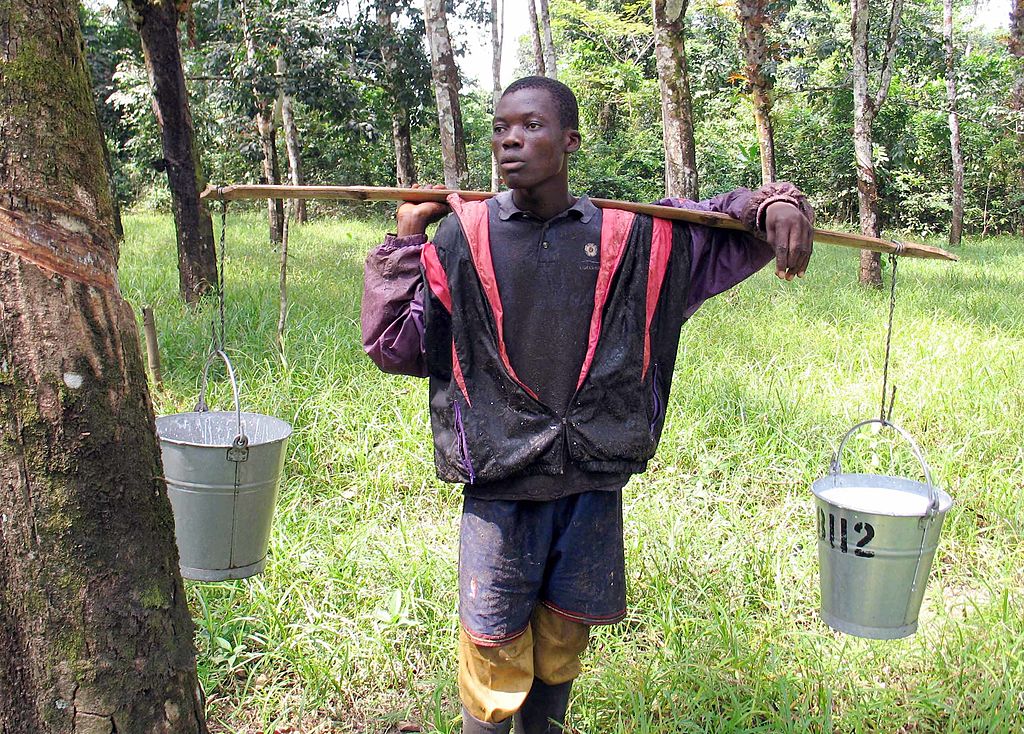
After 8,000 workers unionized the massive Firestone rubber plantation in Liberia, the company fired half the workforce and rehired them as nonunion subcontractors. The union successfully fought to bring those workers back in. (Shashank Bengali / MCT / Tribune News Service via Getty Images)
Stepping onto the Firestone rubber plantation in Liberia, the largest contiguous rubber plantation in the world at 185 square miles, is a step into the past — though which past or which historical moment is debatable. The “plantation,” as it’s officially referred to by Firestone, is at once reminiscent of American chattel slavery, nineteenth-century company towns, and the old Western colonies of Africa.
Most of the eight thousand workers and their families live on the plantation in Firestone-provided housing evocative of dilapidated public housing in poor inner-city US neighborhoods. Their children are born in Firestone hospitals and attend Firestone schools on the plantation. The workers are all Liberian while upper management is primarily white Americans. No Firestone tires are produced in the country; Firestone uses the Liberian workers to extract the latex, package it up, and send it off to other countries for production. Traversing the nearly undrivable dirt roads of the plantation, one sees scores of workers cutting tall grass with rusty machetes, workers forced to relieve themselves in open fields due to the lack of public toilets, and rusty facilities so dilapidated they look as though they might have been abandoned and untouched for decades.
Yet this plantation was recently the scene of a momentous union victory. Facing rampant subcontracting — an increasingly favored weapon of employers worldwide seeking to avoid unions — the Firestone Agricultural Workers Union of Liberia (FAWUL) confronted the practice head-on and won a union election among the plantation’s four thousand subcontracted workers; this past December, they secured their first collective bargaining agreement. As workers and unions around the world increasingly struggle with how to deal with subcontracting and short-term contracts, Firestone workers in Liberia overcame huge political, legal, and economic obstacles to provide an example of how unions might tackle the problem.
Firestone Workers vs. Subcontracting
Firestone workers in Liberia organized their union, FAWUL, in 2007 in response to abhorrent living and working conditions and as part of a broader national wave of organizing. Firestone and government authorities fought the union bitterly — police shot and killed one worker during a twenty-day recognition strike — but the workers ultimately prevailed.
In 2017, Firestone, which is owned by the Japanese tire company Bridgestone Corporation, began subcontracting half of its workforce in an attempt to break the union. Apparently finding the union’s incremental improvements to plantation conditions intolerable, Firestone management terminated four thousand workers and immediately rehired most of them as short-term contract workers, now technically employed by one of several “contractor heads” instead of Firestone.
The newly subcontracted workers’ work remained the same, but their wages and benefits fell drastically. Wages were cut in half, with most subcontracted workers earning roughly $3.50 per day; subcontracted workers went from one family per plantation dormitory room to several families per room; their families lost access to company hospitals and schools; the price for company-supplied rice went from $40 to $80 per month. Perhaps most significantly for both the workers and the company, they were no longer members of the union — membership plummeted from eight thousand to four thousand overnight.

Companies seeking to lower wages, disempower workers, and avoid unions increasingly utilize subcontracting, and Firestone executed the strategy in textbook fashion. Typically, employers like Firestone contract a middleman to posture as their workers’ new “employer.” Workers continue to provide the same labor for the company but with worse wages, benefits, and general working conditions. The coup de grâce comes when the employer then denies any responsibility for the workers’ newfound suffering. Firestone directed workers unhappy with their new working and living conditions to talk with the contracted middlemen, claiming there was nothing they could do as the workers were technically no longer Firestone employees.
The union faced an existential crossroads — grapple with the subcontracting or face a slow death of the union and erosion of everything it had won. With the union’s collective bargaining agreement (CBA) expiring in December of 2024, and with Firestone gradually subcontracting even more of the workforce, FAWUL decided to make organizing and winning union recognition for the subcontracted workers their central demand in CBA renegotiations. Subcontracted workers are notoriously difficult to organize due to their tenuous status and unclear employer, but FAWUL decided it had to undertake the challenge if the union was to survive long-term.
The Campaign
The union hired nineteen external organizers in January 2024 with the sole focus of organizing the four thousand subcontracted workers. Unions from the United States, particularly the United Steelworkers, provided solidarity and support for the organizing effort, including funds, organizing trainings, corporate research, and solidarity videos from US workers.
Facing brutal conditions on the plantation and having already seen the power of the union, the subcontracted workers organized relatively quickly. Workers live in “camps” of run-down, bare-bones housing projects across the plantation, and organizers went camp by camp, summoning all subcontracted workers. For months, organizers trudged across the muddy dirt roads every day to all corners of the eight-mile plantation, talking to subcontracted workers. Within six months, organizers had built an underground organizing committee across the subcontracted portions of the plantation and collected a majority of subcontracted workers’ signatures on a petition demanding union membership. In a race against time to organize the subcontracted workers prior to CBA negotiations scheduled for September 2024, FAWUL submitted a petition to the Liberian Ministry of Labor in August and demanded that Firestone accrete the subcontracted workers into the existing union.

Whereas in many countries the union would know what process to expect upon submitting a union recognition petition, the situation in Liberia was more uncertain. The country’s new president and a new labor minister had just taken office in 2023, and a sweeping new labor law in the form of the Decent Work Act had passed only in 2015. Moreover, due primarily to a brutal history of Western imperialism and exploitation, Liberia is one of the poorest countries in the world, and large corporations often take advantage of the country’s poverty by using money to curry favor with politicians.
On August 16, the Ministry of Labor notified FAWUL that a union election for the subcontracted workers would be held in two weeks, on August 30. On critical election questions, however — such as who would be listed as the employer, the list of eligible voters, specific polling times and locations, and the rules governing the election — the government did not provide specific answers. The union faced the daunting task of preparing the workers for an election without the crucial information it needed, with a nagging worry that perhaps the fix was in for Firestone.
The union’s struggle had become a three-front fight: organizing the workers, pressuring Firestone, and now seeking a fair election from the Liberian government. With increasing urgency, the union made repeated requests to the government for an eligible voter list, polling locations, and election rules, all to no avail. In internal union debates, some workers proposed canceling the election, while others argued that the contract workers were well organized enough to prevail even under extremely unfair election conditions.
Union representatives traveled to the Ministry of Labor office to push for answers just a week prior to the scheduled election but left the meeting in even greater dismay. Most shockingly, the ministry informed the union that a majority of total eligible voters would be needed for the union to win recognition. The union’s expectation, based on prior election experience in Liberia, was that it needed only a majority of those workers who actually voted. Moreover, the ministry stated that it could not provide a list of eligible voters list or poll details yet because the employer had not provided them. Even more than the continued absence of critical information, the implication that the employer would have the right to unilaterally determine the voter list and poll details shocked and outraged the union.
But the union decided to press on. Its attorneys scoured the murky Liberian labor laws, looking for evidence that the proposed election rules did not comply with proper legal protocol. International allies of the union, including labor leaders from the United States, placed calls expressing concern over the undemocratic process. The union held a rally in the middle of the plantation’s central soccer field, bussing in hundreds of workers from across the plantation despite torrential rain. Organizers continued to traverse the plantation camp by camp, motivating the subcontracted workers and informing them that they couldn’t tell them exactly when or where they’d need to vote on August 31, but that they would indeed have to vote.
The Final Days
Four days prior to the election, representatives of FAWUL traveled again to the Ministry of Labor office to seek clarity and object to the unfair election rules. The union bemoaned that the election was four days out and it still had no voter list, no poll location details to inform workers, and faced the unexpected requirement of a majority of the entire workforce rather than a majority of voters. The ministry reversed course on the spot, informing the union that they would only need a majority of total voters to win the election, that the union could submit a list of preferred polling locations that the ministry would utilize in addition to the employer’s requests, and that if the ministry still did not have a voter list from the employer within twenty-four hours then the union could determine the official voter list.
The reversal shocked the union, but it quickly moved to take advantage of the concessions. FAWUL reps demanded the new election rules in writing, out of precaution. They walked out of the Ministry of Labor office with the new election terms, typed up on the spot, complete with the official stamped seal of the Minister of Labor.

The ministry’s change to the election rules raised the union’s morale and made victory seem possible. Still, chaos reigned in the days leading up to the election. FAWUL persistently complained to the ministry that without set voting times and locations well in advance, the union would not be able to get the necessary information to all of the workers. The ministry repeatedly promised to conduct “voter education” in person on the plantation, but two days prior to the election, it still had not done so, and polling times and locations remained completely unclear.
Finally, on the day prior to the election, the Ministry of Labor announced the voting times and polling locations to the union. The promised visit to the plantation never materialized, but FAWUL quickly got on its popular radio station and ran an election notice, with polling times and locations, on loop throughout the day and night. A meeting of the union’s “camp leaders” committee reviewed the election details and dispatched the leaders back to their camps to disseminate the information and organize the next day’s vote as quickly as possible.
Election Day
Election Day itself was even more chaotic than the buildup. With polls scheduled to open at 9 a.m., union leaders slept at their headquarters and eagerly awaited the arrival of the Ministry of Labor staff in the morning to run the election. With twenty-two designated polling locations, some at disparate points on the plantation, the union expected the ministry staff to arrive early for dispatch in order to reach all polling locations in time. But by 8:30 am, ministry staff had still not yet arrived.
Concerned that polls would not open on time, a pickup truck of union leaders drove to the ministry staff’s hotel. At 8:45 am, fifteen minutes prior to the scheduled election, they found ten ministry staff members casually discussing their plan for the day. In addition to the late hour and the growing impossibility of reaching all polling locations in time, facilitating twenty-two polling locations with only ten staff presented an obvious challenge. Animated conversation ensued as union leaders railed that workers expected the polls to open at 9 a.m. and implored the ministry staff to get out of the hotel and to the polling locations.
The ministry staff compounded the union’s dismay by insisting that they work in pairs, halving the already limited number of polling locations they could potentially staff. In disbelief but with little alternative, union leaders rallied the ministry staff out the door, into the single ministry vehicle, and out to whatever central polling locations the ministry deemed it could facilitate.
Throughout the morning, hundreds of subcontracted workers across the plantation lined up and waited for hours at polls not yet opened. Despite intense heat and intermittent rain, workers waited in order to vote for their union. Ministry staff began at just four central polling locations and moved to other locations only when no workers remained in line to vote at the initial polls. Confused camp leaders phoned the union leadership furiously throughout the day reporting the situation at their respective camps — typically hundreds of workers lined up to vote for hours but no ballot box or ministry staff in sight.
Even as the sun set on the plantation, workers waited in line in the dark well into the evening as ministry staff drove from location to location, collecting every ballot and gradually thinning the long voting lines. Despite the chaotic process, the subcontracted workers had turned out to vote in droves across the plantation.

Workers and FAWUL leaders waited as the ministry counted the ballots in a small, dim room on the plantation. At 10 p.m., the ministry summoned the union leadership to announce the vote count. Firestone representatives refused to attend, apparently clinging to the lucrative illusion that the company bore no responsibility for the subcontracted workers.
It was a landslide: 1,660 workers voting for the union and just forty-nine against. FAWUL leaders went back to the union headquarters and announced the results to a crowd of workers and organizers. Rapturous chants of “Union power!” and celebratory dancing ensued in the FAWUL office well into the night.
The Struggle Continues
The subcontracted workers’ election victory was secured only after an arduous fight. There were countless excuses the union could have used to avoid organizing the subcontracted workers: Firestone refused to acknowledge the workers as their employees; FAWUL’s upcoming CBA negotiations required that priority be given to their existing members; the election process afforded by the government was unfathomably chaotic and unfair, and so on.
Yet the union drove forward with organizing the subcontracted workers anyway. FAWUL leadership understood that failure to organize the subcontracted workers would mean the eventual death of the entire union and of any semblance of decent working conditions on the plantation. As employers continue to expand subcontracting globally to drive down wages and evade responsibility for humane working conditions, unions around the world face the same dilemma. As in FAWUL’s situation, it is difficult to imagine a path forward for unions that does not directly confront subcontracting and organize subcontracted workers, despite the many challenges involved.
The ensuing CBA struggle highlighted both the challenges and potential of organizing subcontracted workers. FAWUL settled a contract for the permanent employees that did not cover the subcontracted workers, forcing them to negotiate a lower-tiered contract, and not all subcontracted workers are included in the final bargaining unit. Nonetheless, in late 2025, the subcontracted workers ultimately won a CBA with life-changing improvements including 60 percent raises and access to company hospitals and schools, among others. Nearly all workers on the Firestone plantation are once again unionized.
If, as C. L. R. James wrote, “The rich are only defeated when running for their lives,” FAWUL’s work in organizing the subcontracted workers and winning better conditions on the plantation for all workers is far from finished. The tiered CBAs continued to provide an incentive (albeit diminished) for Firestone to further subcontract and could create grounds for future disunity among the workers. Poverty and exploitation on the plantation are far from vanquished.
Yet Firestone workers’ determination and victory are a beacon of hope for workers across the world who are engaged in similar struggles. Subcontracting as an employer weapon is unlikely to disappear soon, but — as shown by the Liberian rubber workers — neither is the formidable power of the workers united.