Samsung Workers’ Fight Is Just Beginning

Myungkyo Hong

Semiconductor workers at multinational South Korean corporation Samsung won significant contract gains after a credible strike threat this spring. Their struggle is a crucial one for the global labor movement as AI reshapes the world economy.
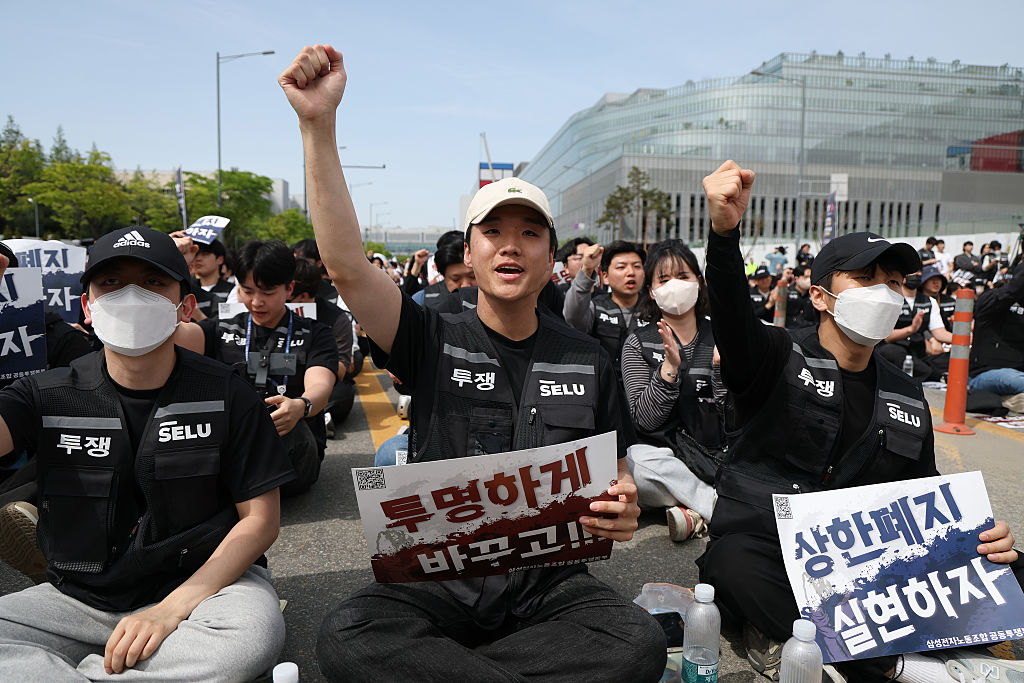
Tens of thousands of unionized Samsung Electronics Co. employees participate in a rally in front of the Samsung Electronics Pyeongtaek Campus on April 23, 2026, in Pyeongtaek, South Korea.

As the artificial intelligence boom drives massive growth in the semiconductor industry, labor fights at electronics giant Samsung are increasingly consequential for workers across East Asia. (Chung Sung-Jun / Getty Images)


Interview by
Gina Ledor

With the artificial intelligence boom reshaping the global economy, workers are racing to defend their rights as the ground shifts beneath them. A narrowly averted strike at Samsung Electronics in Korea this spring was a major test of labor’s ability to fight back.

Weeks before the planned strike, a historic 40,000 Samsung workers rallied outside the company’s semiconductor plant in Pyeongtaek, South Korea, demanding higher bonuses in light of skyrocketing corporate profits and brutal working conditions. In a major concession, Samsung agreed at the last moment to a deal that secures the equivalent of hundreds of thousands of dollars in bonus pay for each worker. The mobilization is also particularly significant in light of Samsung’s eighty-year no-union policy, which only ended in 2014 when subcontracted workers at Samsung Electronics Service (a different subsidiary) won the first collective agreement in company history.

During that initial union drive, Myungkyo Hong was an education and propaganda activist for the Korean Metal Workers Union’s Samsung Electronics Service branch and a policy committee member at Samsung Labor Watch. Hong is also a founding member of Platform C, a social movement organization in South Korea that serves as an educational forum and aims to forge solidarity between various social justice movements including those for labor, Palestine solidarity, feminism, and more. Hong currently serves as the editor of Platform C’s East Asian Social Movement Newsletter. Jacobin spoke to Hong about the history of labor fights at Samsung and what semiconductor workers’ recent contract win means for the company’s workforce more broadly.


Gina Ledor

What’s going on at Samsung right now?

Myungkyo Hong

To first give some crucial context, unions began to form at Samsung Electronics (Samsung Group’s largest subsidiary) in 2017, after federal prosecutors discovered seven thousand pages of internal documents on the company’s union-busting strategy. As several key Samsung executives were arrested in the scandal, the company was forced to recognize multiple, simultaneously established unions.

However, when unions first started forming there, they were initially quite weak. Notably, since there weren’t any labor activists at this factory to begin with, separate unions were formed for the semiconductor division and the Samsung Galaxy parts division.

After that, the Metal Workers’ Union (KMWU), affiliated with the Korean Confederation of Trade Unions (KCTU), adopted a strategy to organize Samsung Electronics. With this strategy, they assigned a representative around 2020 and maintained secret contact. Among the various attempts to establish a union there, they reached out to the group that was the most open, democratic, and independent — one that maintained a stance of independence from the company — and built a solid relationship with them, which lasted for about five years.

So last year, in 2025, we signed our first collective bargaining agreement, and after it was concluded, the National Samsung Electronics Labor Union (Jeonsamno) — which had roughly 45,000 to 50,000 members and was therefore the representative union during bargaining — planned to affiliate with the Metal Workers’ Union. (Under South Korean labor law, a single union must be designated to hold bargaining rights when there are multiple unions at a company.)

However, right at the last minute, last summer, a conflict arose among the internal leaders, intensifying until leadership completely collapsed. Various far-right, pro-business media outlets in Korea — like the Chosun Ilbo — launched attacks. We were greatly affected by this, so we decided to put the unionization on hold indefinitely, and the union’s power weakened significantly.

Amid that situation, the “intercompany union” — essentially a union for the broader Samsung group — began to grow. A significant number of former Jeonsamno officials transferred to the Samsung Electronics branch of the union starting last fall. As a result, it suddenly grew to over 70,000 members by this spring, becoming the representative bargaining unit.

Coincidentally, amid the global AI boom, semiconductor companies experienced massive growth. When Samsung Electronics workers learned that workers at competitor SK Hynix were receiving substantial performance bonuses, their frustration grew immensely — compounded by the company’s already oppressive, extremely competitive and repressive atmosphere. When this frustration finally erupted, a sense of “We need to make strong demands” and “We need to fight” emerged.

Gina Ledor

Ahead of the potential strike, Samsung Electronics workers were the target of criticism in domestic and international media coverage for their demands. Can you explain where these criticisms are coming from and how workers received them?

Myungkyo Hong

Most Samsung Electronics workers view this as unfair criticism. The fact is that Samsung Electronics is one of the highest-paying employers in South Korea, which people envy. Nevertheless, workers’ grievances stem from the company’s work culture and labor environment having long been highly hierarchical and oppressive. It’s important to fight to transform that corporate organizational culture from within.

However, Samsung Electronics’ unions are all grassroots unions. In Korea, most labor unions are organized through the conscious efforts of labor activists — trained and educated based on specific strategies — which historically fostered a certain level of understanding about how the labor movement should operate. Labor unions at other major corporations were established in the 1980s and ’90s, but Samsung Electronics’ union has only just formed. As a result, their imagination regarding what the union can actually do is quite limited. There’s a tendency to focus on immediately tangible demands, like performance-based pay and bonuses.

During this recent struggle, there were criticisms that Samsung Electronics workers were too selfish or demanding too much — not just from conservative media but even many “progressive” outlets and intellectuals. I think this reflects a misunderstanding of the labor movement.

Forming a union doesn’t suddenly transform you into a different person. It’s through continuously fighting, struggling, receiving education, and gaining experience that workers develop a broader vision. But it’s very difficult for people who have just joined a union to, say, start raising demands on behalf of subcontracted workers.

Moreover, because the Samsung Electronics branch of the IT Workers’ Union’s ties to the broader Korean labor movement were severed, this strike took place in isolation. So it’s not a question of selfishness; that connection is simply missing.

Gina Ledor

In that vein, the Yellow Envelope Act, which went into effect this year and allows subcontracted and gig workers to unionize, may be ushering in a new era for nontraditional worker organizing. Now that Samsung workers have won their bonus deal, do you think broader solidarity with subcontracted workers is next?

Myungkyo Hong

The Yellow Envelope Act was enacted as a result of more than twenty years of continuous struggle by subcontracted, nonregular, and special employment workers — many of whom lost their lives in the process. It’s not a perfect solution; most notably, it failed to include institutional mechanisms for special employment workers to take action against their principal contractors.

Still, I consider its enactment significant progress, at least to some extent. Various labor unions are now beginning to utilize this framework to organize more subcontracted workers and engage in collective bargaining.

However, the current Democratic Party government is by no means a pro-labor government — it is offering only lip service. Although the current Minister of Employment and Labor is a former KCTU leader, the government still has a pro-capital character. It’s using enforcement decrees to impose significant restrictions on the law’s details, and companies continue to resist and drag their feet, waiting for court rulings or using similar tactics. So while there isn’t much that can be achieved by this law alone, I believe it can serve as a catalyst.

In the case of Samsung Electronics, we achieved a major victory, but I don’t think the workers themselves can predict whether this will lead to broad-based solidarity. As their ties to Korea’s traditional democratic labor movement are somewhat weak, they don’t have a strong sense of why they need to stand in solidarity with subcontracted workers.

Nevertheless, it’s necessary to propose, persuade, and engage in dialogue to guide the movement in that direction. Ultimately, these semiconductor workers currently occupy a crucial position — their threatened strike would have dealt a severe blow to the company — which is why they were able to win. (Encouragingly, unions are now beginning to form at several Korean subcontracting factories in the semiconductor industry as well.) But Samsung’s management will prepare for this in the future, so to respond to that, we need to organize more subcontracted workers.

Gina Ledor

Is there much history in South Korea of that kind of union consolidation or mergers, and might this be in Samsung’s future?

Myungkyo Hong

Yes, there have been many cases in Korea of divided unions consolidating into a single entity, and that’s necessary at Samsung Electronics as well. But the reason negotiations dragged on this time wasn’t money; it was that the company wanted to maintain its long-standing performance-based bonus system as is, while the union sought to modify it. Samsung argues this system is core to its company culture: low base pay but substantial income if performance bonuses are high. From management’s perspective, it’s also a control mechanism: “Follow orders and we’ll pay you well.” Even the government mediators requested the system be relaxed somewhat, but Samsung held firm to the end.

After the agreement was reached, workers outside the semiconductor division complained they were getting too little. Semiconductor workers, on the other hand, felt that other divisions — like smartphones, when the Galaxy was selling well — had received higher bonuses in the past. So the underlying sentiment was, “You got yours back then; now it’s our turn.” The union leadership had to find middle ground to secure broad member approval, so they made only a modest request to partially relax the performance-based system. The proposal passed with roughly 70 percent approval, with the remaining dissent coming largely from other divisions.

I expect management will keep exploiting these divisions. To overcome this, the union needs to unite — but it won’t be smooth, given how entrenched the performance-based system is.

To organize subcontracted workers, Samsung’s union will ultimately need to join a larger trade union, and right now I think joining the Korean Metal Workers’ Union is the best option. While intellectuals and the media criticized Samsung workers for chasing high bonuses at subcontracted workers’ expense, the reality is that Samsung’s victory has actually sparked growing demand for union formation among subcontracted workers themselves.

The most important thing now is for the Metal Workers’ Union to leverage this momentum and organize subcontracted workers first, then work toward building solidarity with Samsung Electronics. That said, even at Hyundai Motor, where parent company and subcontractor workers are largely organized, solidarity remains weak. We have to tackle these challenges one by one.

Gina Ledor

We’ve talked about solidarity with domestic subcontracted workers, but especially given that Samsung employs industrial workers across the globe, what opportunities do you see for international labor solidarity?

Myungkyo Hong

Joint research on Samsung’s labor-management strategies is also necessary, because Samsung has been very consistently implementing exploitative strategies at its facilities around the world. The most dramatic case I’m aware of is Vietnam, where Samsung holds an absolutely dominant position in the economy.

A few years ago, Vietnam amended its labor law in an attempt to recognize independent unions, which was driven by International Labour Organization compliance requirements, European Union pressure, and the then US-Vietnam negotiations around the Trans-Pacific Partnership, which included a labor clause around freedom of association. As a result, there was a widespread view that Vietnam simply had to recognize independent trade unions.

This created real divisions within the Vietnam General Confederation of Labor (VGCL), with reformists arguing for recognition of unions outside the VGCL, while others insisted on maintaining Communist Party leadership over labor. Samsung’s perspective was that it already had strong ties with Vietnamese Communist Party officials and the VGCL, and the company feared that legally recognized independent unions would allow factory workers — already prone to wildcat strikes — to organize and strike more freely.

I don’t believe Samsung’s strategy for suppressing labor unions has collapsed. I suspect Samsung chose Vietnam precisely because control is easier to maintain there. To counter this, the Korean labor movement has the most significant role to play — building networks wherever Samsung facilities are located, even if it starts with just a small gathering of workers.

Gina Ledor

In the same way that the United States demanded labor protections in South Korea, have Korea or its unions ever made such demands for its overseas partners?

Myungkyo Hong

South Korea has never taken the initiative on these issues; it has never considered itself a developed country, not until now. So it has never approached these areas with the kind of mindset you’d see in Europe.

In most of South Korea’s bilateral trade agreements, the other country made the initial demand. With wealthier nations, the focus was on securing benefits for the manufacturing sector; with countries like Chile, the focus shifted to agriculture. We were never able to think beyond that, and the Korean labor movement itself lacks that vision — the perspective to proactively raise such issues on the international stage.

For the most part, international solidarity efforts by the Korean labor movement have been viewed merely as a necessary measure to address problems faced by workers at global brand factories in Korea, specifically when making demands to parent companies in Germany, the United States, or Sweden. Even now, we still see ourselves as an “intermediate goods” country, but in reality that’s no longer the case. We need to move beyond that and take the initiative, and I believe that is a challenge for the Korean labor movement.

Gina Ledor

I wanted to talk about Platform C, the organization you helped found in 2020. How did your organizing at Samsung and beyond lead you to think such an organization was needed? How do you see its role in struggles like this one?

Myungkyo Hong

As part of Platform C’s East Asia initiatives, I’m currently involved in projects around East Asian movement-building and solidarity. I came to believe these efforts were necessary when I was campaigning to organize Samsung workers in 2013 and discovered, when I was right in front of the factory, that Samsung had already moved many of its production lines to Vietnam. There was no union at Samsung at the time to disperse information, so I didn’t even know that so many workers had been laid off.

That’s when I realized that fighting within Korea alone was too limited. Samsung is already a global company, and many large Korean chaebol conglomerates operate the same way with supply chains now concentrated in East Asia — over 85 percent by my count. International solidarity within East Asia is therefore crucial, and building it within this region is especially strategically important.

The Korean left has always been far more oriented toward the United States and Western Europe, keeping well-informed about the latest developments there, while knowing relatively little about China, Taiwan, the Philippines, Vietnam, or Indonesia. But from the perspective of the South Korean labor movement, building solidarity with other East Asian countries is far more important.

There was also an internal dimension: I have found Marxist organizations to be overly dogmatic. I still consider myself a socialist Marxist, but I don’t think we need to be so rigid. We’re often wrong, and I felt there wasn’t enough openness to admitting that, reflecting, and correcting course. Overcoming that was the second major issue I identified. These two points — international solidarity and organizational openness — and an emphasis on continuous experimentation in the labor movement are what Platform C strives for.