How the Exploitation of Africa Helps Fuel Global Capitalism
The political and economic crises roiling countries like Sudan and Tunisia right now cannot be separated from the global institutions of capital and the cycles of indebtedness that they impose.
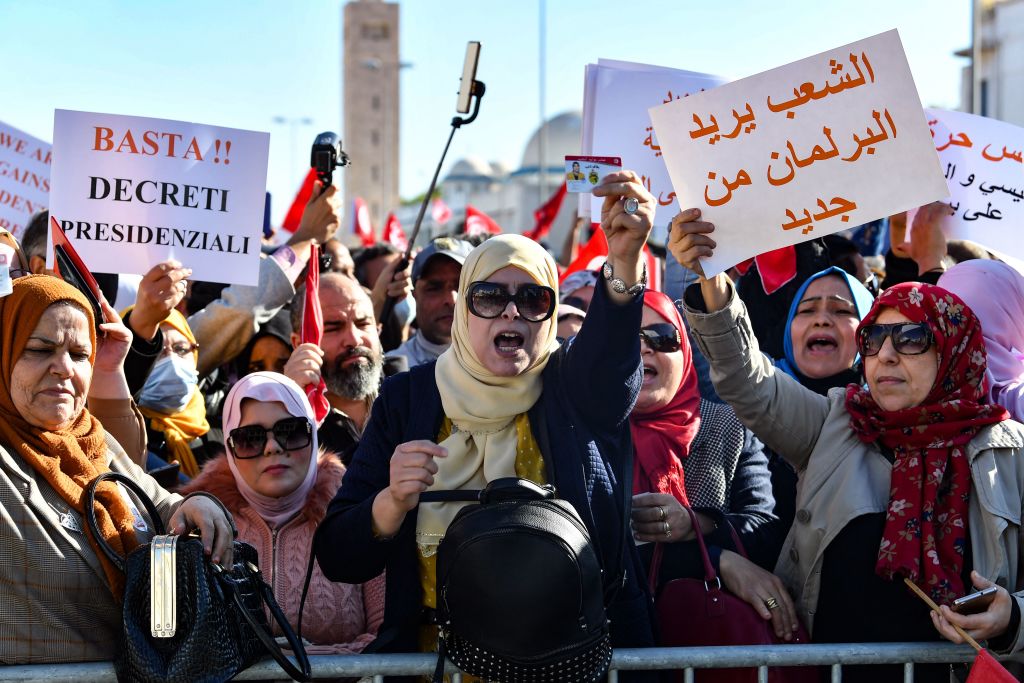
Tunisian demonstrators in front of the parliament in Tunis, protesting against their president Kais Saied’s seizure of governing powers on November 14, 2021. (Fethi Belaid / AFP via Getty Images)
The political and economic crises in Sudan, Tunisia, and Ethiopia have refocused attention on the increasingly volatile North and Horn of Africa. Faltering revolutions, military coups, and the looming threat of balkanization have come to define the region in recent years. Tunisian president Kais Saied has imposed one-man rule, the Sudanese military has dissolved the civilian government, and Ethiopian prime minister Abiy Ahmed’s war on the Tigray Region threatens to tear the country apart.
The international financial press has trotted out the usual boilerplate in its attempt to explain this instability, asserting that African countries cannot manage their own affairs and that Western institutions must swoop in to rescue them. Once again, as the refrain goes, it’s a question of the West’s benevolence in contrast to Africa’s violence and corruption.
The forthcoming Economic and Monetary Sovereignty in 21st Century Africa seeks to challenge these explanations. The collection was born from a 2019 conference in Tunis organized by the Rosa Luxemburg Foundation’s North Africa office. It is edited by a group of young, bold African economists, authors of a fiery open letter challenging the economic orthodoxy that they argue has created the current crises. They hope to not only map the logic of the existing system, but to challenge it.