We Have the Chance to Reel In Israel Right Now

Rahm Emanuel’s speech on Israel reflects an understanding that major changes in the optics of US policy toward Israel are needed if the status quo is to be maintained. This is an opportunity that Israel’s critics should not let go to waste.
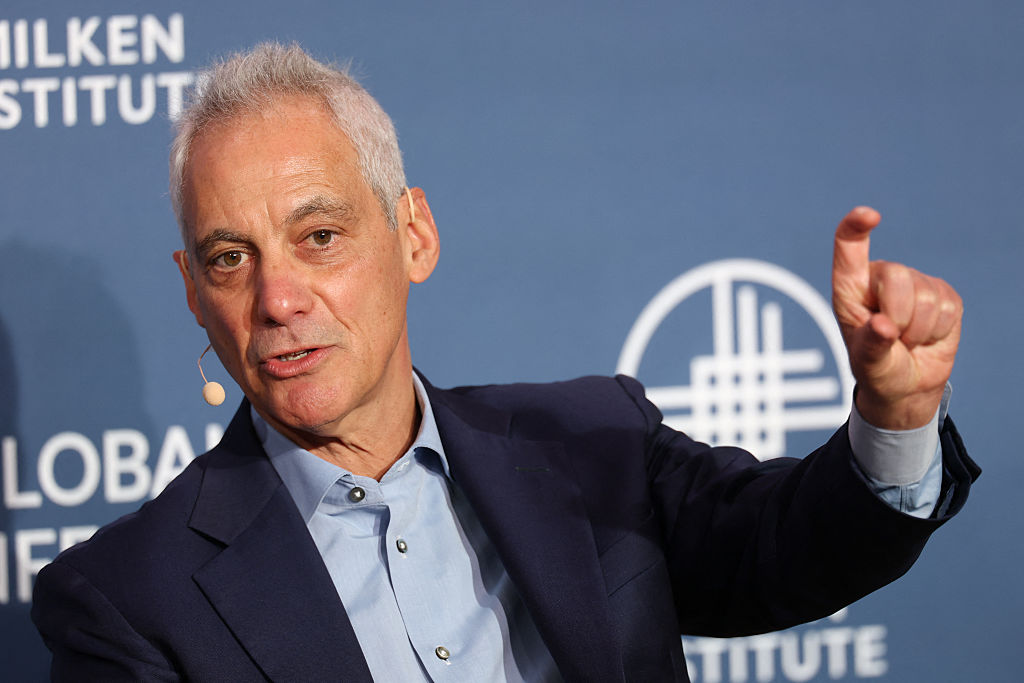
Former mayor of Chicago and White House Chief of Staff Rahm Emanuel speaks during the 29th annual Milken Institute Global Conference at the Beverly Hilton in Beverly Hills, California, on May 5, 2026.

Major critics of Israel’s genocidal violence have floated policy proposals that suffer from two major flaws: they fail to spell out the extent of Israel’s international obligations, and they lack real teeth. Now is a time to change that. (Patrick T. Fallon / AFP via Getty Images)


First, let’s get one thing straight. Rahm Emanuel’s much-heralded speech on US-Israel relations portends no shift at all in Democratic Party policy toward Israel.

In fact, if leaked media accounts are accurate, it doesn’t contain a single proposal that wasn’t already adopted in the waning days of the Biden administration (but quietly rendered toothless by the policy fine print).

What Emanuel’s speech does signal is an understanding that major changes in the optics of US policy will be needed if the status quo is to be maintained.

Thus, Emanuel wants to replace direct financial aid to Israel’s military with hidden subsidies buried in the bowels of the defense procurement budget. Threats of sanctions against “violent settlers” are meant to give political cover to ongoing US acquiescence to the annexation of the West Bank (with the “violence” outsourced to the Israel Defense Forces).

Above all, Emanuel and company are hoping Benjamin Netanyahu’s government will soon be replaced by a coalition that presents a less truculent face to world opinion, even as its policies are unlikely to change very much. Then, it’s hoped, the issue will quietly fade from US politics, and business as usual can resume.

However, Emanuel’s speech does register a bona fide political shift, and that shift represents a genuine opportunity. But right now that opportunity is going to waste, because critics of Israel have failed to advance a policy agenda commensurate with the scale of the problem.

Thus far, advocates of accountability for Israel have floated policy proposals that suffer from two major flaws: they fail to spell out the extent of Israel’s international obligations, and they lack real teeth.

Bills like the Ceasefire Compliance Act, supported by J Street, or Rep. Delia Ramirez’s Block the Bombs Act, at most require (on paper, at least) Israel’s compliance with generic human rights standards or with Donald Trump’s one-sided October 2025 Gaza ceasefire. That amounts, at best, to little more than a restoration of the pre–October 7 status quo.

Meanwhile, the measures that are proposed to force Israeli compliance are far too weak to be credible. Block the Bombs, for example, bars the transfer to Israel of a handful of categories of battlefield munitions, all of which Israel could find substitutes for on the international arms market. That isn’t remotely sufficient to force the necessary changes in Israel’s behavior.

These shortcomings stem from a strange contradiction that plagues discussions of US-Israel relations.

On the one hand, there’s a vastly exaggerated sense of fatalism about the ability of the United States to force fundamental change in Israeli policy. On the other hand — paradoxically — there’s an implicit expectation that any coercive measures must generate quick, painless results.

Both of these assumptions get the problem exactly backward. Israel is a small country that simply cannot withstand concerted international pressure to force its compliance with international law. The notion that a superpower like the US is somehow powerless to stop Israel is absurd.

At the same time, the application of such pressure would represent a profound shock to Israel’s domestic politics, and it would require wrenching changes in both its domestic and foreign policies. That means pressure would take time to produce its intended effect. A decades-old problem won’t be solved in the space of a few months.

Thus, for any 2028 Democratic presidential hopeful to be taken seriously on this issue, they must, as a minimal prerequisite, support two key steps, both of which could be implemented on day one of a new administration.

First, the United Nations Security Council must finally vote to enshrine and enforce the 2024 decision of the International Court of Justice — a court to which Israel is a party by treaty — which ruled, inter alia, that:

  • “The continued presence of Israel in the Occupied Palestinian Territory is illegal”;

  • “This illegality relates to the entirety of the Palestinian territory occupied by Israel in 1967”;

  • “The Gaza Strip is an integral part of the territory that was occupied by Israel in 1967”;

  • “Israeli settlements in the West Bank and East Jerusalem, and the régime associated with them, have been established and are being maintained in violation of international law”;

  • “Consequently, Israel has an obligation to bring an end to its presence in the Occupied Palestinian Territory as rapidly as possible.”

Second, all Israeli settlements must be subject to immediate and comprehensive sanctions.

The settlements are illegal. They undermine US foreign policy objectives. Every president from Lyndon B. Johnson to Joe Biden has warned Israel that the settlements constitute an “obstacle to peace” and thereby threaten core US interests. The charade of Democratic politicians publicly wringing their hands, lamenting that “the window for a two-state solution is closing,” while continuing to wink at the spread of settlements must finally be brought to an end.

What this means in practice is that any company or individual who signs a lease or purchases title to property on occupied land in East Jerusalem or the West Bank (or Gaza) is to be placed on the Treasury Department’s Specially Designated Nationals (SDN) list and barred from access to the US financial system, along with any bank or company that does business with them.

Initially, Israel’s response to such a policy would be one of hysterical defiance. Resolutions would be passed in the Knesset declaring that Israel will never surrender an inch of occupied territory. Leaders across the political spectrum would denounce the US and hurl accusations of antisemitism at the White House. Allusions to Masada would proliferate.

All of this is to be expected and should be accepted with equanimity.

What must not be accepted are attempts by Israel to evade sanctions or vent its fury on the Palestinians by intensifying its campaign of killing and destruction. Escalation of this kind must be met by counterescalation: the extension of sanctions to target the largest Israeli banks, insurers, and energy firms, and ultimately, if necessary, the Israeli central bank. Clear warnings to this effect must be communicated from the outset.

Once the initial burst of fury in Jerusalem subsides, Israeli leaders should be given time and space to finally open the painful and long-delayed national discussion about how the country can begin to extricate itself from the mess it’s gotten itself into.

Politically, any Israeli government would likely have no choice but to indemnify the country’s 750,000 settlers for the economic damage caused by sanctions, including large-scale mortgage defaults, business bankruptcies, and lost property values. The enormous costs to the public treasury this would entail, along with the likely acceleration of high-skilled emigration, would weigh heavily on Israel’s exchange rate, credit rating, and investment climate, and this economic burden would only grow and compound with the passage of time.

Eventually, a much needed sense of realism would begin to dawn in Israeli politics. Ultimately, the country would have little choice but to take the necessary steps to rejoin the international community.

That, of course, won’t happen overnight. But it won’t happen at all unless advocates of change in US Mideast policy get serious about the issue and do so starting today.