The British Establishment Fuels Anti-Migrant Pogroms

The rioting in Belfast fits Britain’s now familiar routine of violent crimes followed by race riots. While the government promises anti-immigration crackdowns, the rioters want to unleash their rage and terrorize minorities.
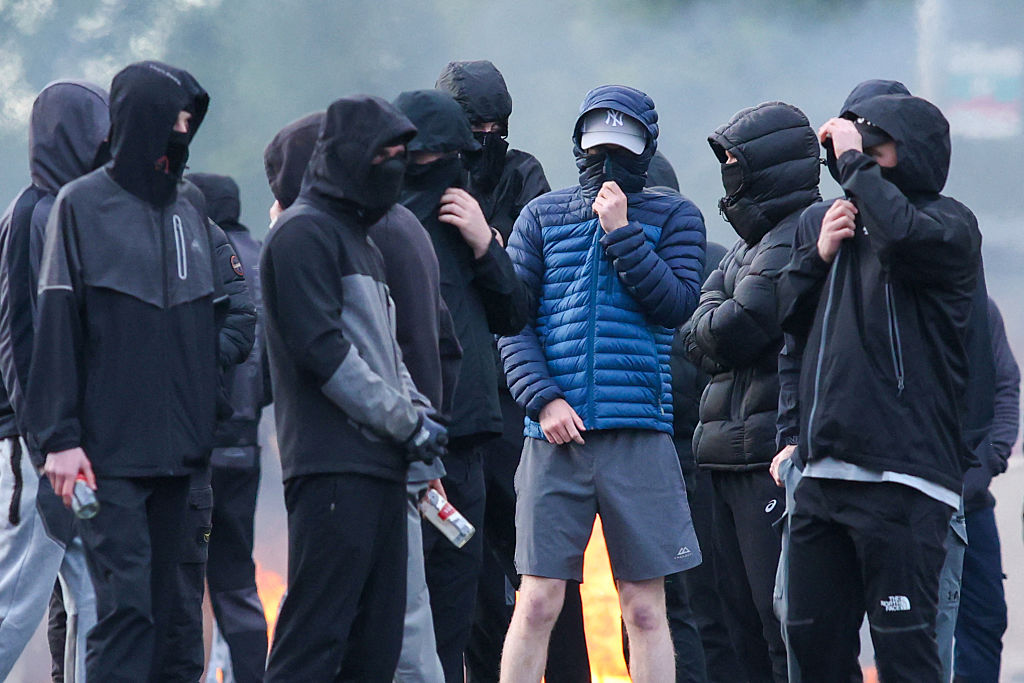
Masked youths block a road with burning debris in Belfast, Northern Ireland, on June 9, 2026.

Masked youths block a road with burning debris in north Belfast, on June 9, 2026. (Paul Faith / AFP via Getty Images)


Nothing much works in Britain these days, but the machinery that churns out armed shitstorms is working perfectly. Why might that be? Consider the dismally familiar pattern of recent events.

Every year since the Knowsley riot in February 2023, which targeted asylum accommodation after footage circulated of an asylum seeker chatting up a fifteen-year-old girl, there has been a new outburst of popular violence against migrants. In summer 2024, after a mass stabbing incident falsely blamed on an asylum seeker said to be on an “MI6 watch list,” riots and pogroms broke out in Hull, Sunderland, Rotherham, Liverpool, Aldershot, Leeds, Middlesborough, Tamworth, Belfast, Bolton, Stoke-on-Trent, Doncaster, and Manchester. Last summer, as racist protests descended on asylum hotels nationally, loyalists (the term for right-wing Protestants loyal to the British crown) in Ballymena reacted to the prosecution of a pair of adolescents for attempted rape by descending on Clonavon Terrace, where many refugees were housed, and setting fire to homes. Two-thirds of the Roma community were forced to leave the town.

And now, again in the summer months, Belfast has gone up in flames. The occasion for the violence was a grim stabbing attack on Stephen Ogilvie, reportedly by a Sudanese refugee who had leave to remain. The attack happened on Kinnaird Avenue in north Belfast, a Catholic street not far from the Crumlin Road. Once again, Ulster’s peace-loving bampots determined that such violence could only have been brought to Northern Ireland by brown-skinned interlopers. Never mind that the province has its own gory history of knife violence. Never mind that Ogilvie himself had previously been tortured by a gang linked to the Ulster Volunteer Force, the loyalist paramilitaries that murdered Catholics with the collusion of the British state during the “Troubles.” Although the stabbing happened on a Catholic street, the pogrom that ensued was largely carried out by loyalists and young men from loyalist parts of north and east Belfast.

In broad daylight, gangs of masked men marched down the streets, targeting homes they knew housed migrants, and began kicking doors in and breaking windows. On the Crumlin and Newtownards roads, which cut across the north of the city, migrants were burned out of their homes. Since the police were notably lax in their response, despite having been warned for months about a far-right hit list targeting the addresses that were burned, and despite the fact that the pogrom was so telegraphed that businesses shut down in preparation, it often fell to migrants to organize their own safety.

To an extent, as Séamas O’Reilly argues in the New Statesman, this is a new expression of old violence: loyalists in Northern Ireland have decades of experience in burning people out of their homes and violently policing community purity. And they have proven links to the mainland British far right. Just because loyalists did the damage, however, doesn’t mean many Catholics didn’t agree. Among all demographics in Northern Ireland, Catholic or Protestant, young or old, anti-immigrant racism is pervasive. Among those interviewed in Aris Roussinos’s report from Belfast was an older Catholic man who said of the rioters: “We’re keeping our distance there at the minute, but by right we should all be coming together here.”

There was also a wider national context to this pogrom. The name of Henry Nowak was mentioned by rioters and specifically linked to Ogilvie’s stabbing by far-right agitators. Nowak was stabbed to death by Vickrum Digwa, from Southport, last December. Police were called to the scene by Digwa who claimed that Nowak had assaulted and racially abused him, and that he was laid out drunk rather than dying of stab wounds. Police dragged Nowak across the gravelly ground and tried to arrest him before even checking for injuries, so Nowak died being treated like a criminal. This did not, however, become a national issue until the trial revealed police mishandling, and police body camera footage was released, showing a dying Nowak being handcuffed. The Right, riveted by the image of white victimhood, blamed it on woke policing. Tory leader Kemi Badenoch claimed that the degrading police treatment of Nowak happened because of “nonsense that came in after the Black Lives Matter movement.” According to Nigel Farage, drawing on a now-familiar slogan, it revealed a “two tier culture where the rights and privileges of white people matter less than those of ethnic minorities.” J. D. Vance blamed European “self-hatred” for inviting a “mass invasion” of migrants.

Far from “two tier policing” disadvantaging whites, the evidence is that the same Hampshire constabulary that mistreated Henry Nowak has a very recent history of institutional racism. Recent inquiries have found racism at every step in the criminal justice system from the use of stop and search, handcuffing, and the use of batons and tasers, to sentencing and imprisonment. But the Right is uninterested in such realities, few in the media bother discussing them, and Keir Starmer’s government certainly doesn’t bring them up. Besides, all such talk is subordinate to the core argument of white ethnonationalism today, which is that whites have become “second-class citizens” — in, it is implied, their “own country.” Their “rights and privileges” matter less, it is claimed, than those of dangerous minorities and migrants. “Woke” elites have produced a perilously inverted moral hierarchy. As Zia Yusuf of Farage’s Reform UK party put it just as Belfast was going up in flames: “Some cultures are MUCH better than others.” And yet we, who are much better than them, are treated as worse. That is why the murder and dehumanizing treatment of Nowak was already on its way to becoming a “trigger event” for pogroms before the stabbing of Ogilvie in Belfast.

To come back to the question: Why are outbursts of murderous nationalism now so routine? Inevitably, we will hear of “legitimate concerns.” Former Labour MP turned Reform supporter Kate Hoey writes of the “legitimate fear” and “anger behind” the riots. Fear and anger over what? The “growing litany of atrocities committed by migrants or the descendants of migrants.” Only those atrocities are attributable, without further thought, to what hard-right Unionist MP Jim Allister calls “alien cultures.” Only they are worthy of the sort of anger that could provoke a pogrom. Presumably, Hoey and her ideological confederates would claim that migrants are particularly disposed to “atrocities,” but the evidence suggests otherwise. Moreover, her problem is not just with migration. The “descendants of migrations” are British citizens, though often with black or brown skin. This was always the innate logic of anti-immigrant hysteria. As Roy Hattersley put it decades ago, if “they” are a problem now, then it follows that “they” were also a problem back then. Perhaps “they” ought never have been admitted. The logic starts with border controls, proceeds to mass deportations, and finds its fulfillment on the far right in demands for ethnic cleansing (euphemized as “remigration”).

So, then, can we blame the pogroms on outside agitators whipping up “division”? Metropolitan Police Commissioner Mark Rowley improbably implied, with no evidence, that Iran or Russia might have a hand in events. Similar dead-end explanations, never evidenced, were offered for the pogroms in summer 2024. More plausibly, the Center for Countering Digital Hate identified Elon Musk’s agitation over Ogilvie’s stabbing on his X platform as “instrumental” to the racist violence that ensued. The Guardian identifies a transnational network of far-right stirrers, including Musk and British fascist Tommy Robinson, as well as a neo-Nazi network of “Active Clubs” based in the United States.

Of course, these constellations matter. Such pogroms are neither wholly coordinated nor entirely spontaneous. They are a form of distributed violence, with elements of top-down control and spontaneous social contagion. The pattern is that of the armed shitstorm, wherein the frenzies and loose associations of online contagions are transported into meatspace. In distributed violence, the responsibility for incitement, organization, arson, assault and murder, and after-the-fact apologetics, is smeared out over a wide network of people. However, they can only act on, and give permission to, furies that are already there.

More interesting by far are the attempts at a symptomatic reading of racist riots as a synecdoche for state failure. John Merrick, for example, writes in the New Statesman of Britain’s dismal record of stagnant wages and productivity, rising rent and energy bills, decaying high streets, potholes, and fly tipping [illegal dumping]. If the government can’t stop thousands of small boat entries of refugees each year, how can it get to grips with the country’s wider ills? This, “rather than some sudden mass outbreak of social sadism or racism, lies behind the YouGov polling last year that found nearly 60 percent of people favored a military solution to the small boats issue.”

Although there is nothing “sudden” about the rise of racism and social sadism in Britain, there is some evidence for this reparative argument. Social attitudes on race have been liberalizing for decades, and most British people, whatever their aversive hostility to migrant scapegoats, are pretty comfortable living in a multiracial society. And certainly, dysfunction and deprivation has some part to play in stimulating hostility. For example, the racist riots in the summer of 2024 erupted in some of Britain’s most deprived areas. A study from the UCL Policy Lab, authored with the centrist More in Common think tank, linked the riots to “social dislocation” in postindustrial areas. In general, income inequality, regional neglect, and personal trajectories of decline are strongly linked to support for ethnic nationalism. If one wants to find “material conditions” conducive to aimless frustration and resentment, waiting to be orchestrated into violent cleansings, they are there.

Yet there is an argument missing here. If the cause is deprivation and state failure, why are we not witnessing violent riots against austerity, stagnant wages, rising bills, and failed governments? Why are all of these riots precipitated by violent crime, and only violent crime committed by someone with brown skin? Why is the preoccupation with moral threat and why, when asked what they want, do rioters invariably say things like “immigrants out” rather than “wages and housing”? Why is ethnic purification the answer to social malaise? Why support an ethnonationalist project that is a conservative obstacle to the improvement of those material conditions? And if migration has become a cipher for social decay and disorder, how did that happen? On the other hand, why have millions of people whose lives were wrecked by capitalism, never joined or justified a pogrom? Why are those at the bottom often the least susceptible to ethnonationalist ideology?

Material conditions must, after all, be lived. Before such conditions give rise to a political expression, they must be experienced and given significance. Often the true causes of our distress are remote, systemic, and, in the fragmented and distorted reporting of “the facts” in the news, utterly opaque. We have to improvise our own explanations based on ready-to-hand wisdom — shit happens, politicians are all the same, life is a lottery — or on whatever mishmash of explanations are offered by Westminster and the media. What the latter have offered, for some time, is moral panic about migration.

In response to the summer pogroms of 2024, Gracie Mae Bradley pointed to the long-established policy, starting with New Labour and continuing through Theresa May’s crackdown as home secretary, the Brexit furors, and “small boats” panic, of creating a “hostile environment” for migrants. Nor did this cease under Labour Prime Minister Starmer, who had in opposition condemned the Tories in opposition for being “too liberal” on migration. His response to the 2024 pogroms was a speech warning that multicultural Britain was becoming an “island of strangers,” and his government announced that among its vicious measures against refugees under the rubric of the “Danish model,” it will be relieving them of their jewelry and selling it off. This racism, though justified as a response to “legitimate concerns” rising from the grassroots, is organized top down as part of a suite of authoritarian measures through which bourgeois politics manages the collapse of its legitimacy.

A particularly lethal aspect of the political kabuki around immigration is what Daniel Trilling identifies in If You Tolerate This. Governments doing a hatchet job on public-sector capacity have simultaneously incited public hostility to migrants, promising an impossible “net migration” target that they have no intention of reaching, while directing spectacular sadism toward the most vulnerable new arrivals, refugees. The result is that the racist right’s “concerns” are validated, while they can continually claim betrayal.

Not that actually reducing migration would make much difference. The results on that are in. Both net migration and small boat arrivals have dropped sharply in the last couple of years: yet still Belfast goes up in flames. While governments bend over backward to patronize and accommodate the racists, it encourages them to demand more. Suddenly it is no longer about numbers, but about “Islamists” running the country, or about a supposed “two tier state” said to be “against white people.” Increasingly, right-wing propagandists like Matthew Goodwin, a political scientist turned far-right grifter and Reform candidate, openly declare that Britain’s non-white communities, being descended from immigrants, cannot be “ethnically” — and thus, it is implied, properly — British. Such is the logical outcome of a sharp move to the right in the state itself, a concerted shift toward austerity, authoritarianism, and racism; and now toward militarization financed by further austerity. Even the way in which the state revises the meaning of racism, to include opposition to genocide, but not anti-migrant bigotry, clears a path for neonate fascism. Dystopia breeds dystopia.

By itself, though, racist resentment, however assiduously molded by bourgeois politicians and the press, and cultivated by the far right, need not produce riots and pogroms. There is something else. For perpetrators, these pogroms are recreational. They offer an exciting, if transient, experience of being part of something bigger than oneself, and of political efficacy. This can never be real agency. The “sad passions,” as Baruch Spinoza described the resentful and hateful emotions in play here, only ever reduce our capacity to act. Even if we act on them, we are only lashing out without understanding. To have true agency, we have to understand our situation. Nonetheless, there is an exciting illusion of “doing something about it” even if we don’t fully grasp what “it” is. Suddenly, there appears to be a community, with a coherent political will. And this points beyond the failure of state capacity to a crisis of public capacity.

It is precisely for want of an organized ability to do anything about the overwhelming crises of the age, in the absence of a viable, mature political vehicle for social transformation, equal to the scale of the crisis and able to sublimate resentment into militancy, that people oscillate between an extreme fatalism and an extreme voluntarism: between sullen withdrawal and abrupt acting out. This is why pogromism is dangerously addictive for those it attracts: it offers short bursts of adventure and felt achievement, but it can’t satisfy. It could no more be placated with more racist violence or state sadism than a phobia about spiders could be soothed by the killing of more spiders. To keep going, it must escalate.

The Left, still recovering from decades of defeat and political recession, has some responsibilities here. I don’t just mean mobilizing anti-racists or, where possible, supporting rapid response to racist attacks. We have an obligation to break out of the doom loop of bourgeois decline and incipient fascism. We have a duty to counter the pseudo-agency of racist violence with real collective empowerment. To counter intoxicating racist myth with sober class hate, rather than trying to bargain with it. To give those who aren’t racist reasons to feel excited and confident and pull some of those who are racist away from its fake glamor.

The growth of pogromism in Britain began during a period in which the Left was organizationally moribund following the defeat of the Jeremy Corbyn project. While it could organize massive meetings over the cost-of-living crisis, they ultimately went nowhere. While it could draw hundreds of thousands to the streets in a flash movement against the genocide in Gaza, this did not result in organizing with social breadth and depth. Launched just last year, Your Party has been a crash course in all the ways the Left defeats itself. The Greens are currently the home for those who want to organize, and to their credit they haven’t blown it, or compromised with racism, or, for the most part, buckled under establishment pressure.

To paraphrase Clara Zetkin, fascism is punishment of the Left for its failures. The pogrom is the programmatic essence of incipient fascism in a nutshell. If we keep failing, it is also our future.