The Democratic Socialists of America Want to Expand Democracy

Right-wing and centrist pundits, and even House Speaker Mike Johnson, have rushed to denounce the Democratic Socialists of America’s new “Workers Deserve More” platform. But the platform’s central insights are hard to dispute.
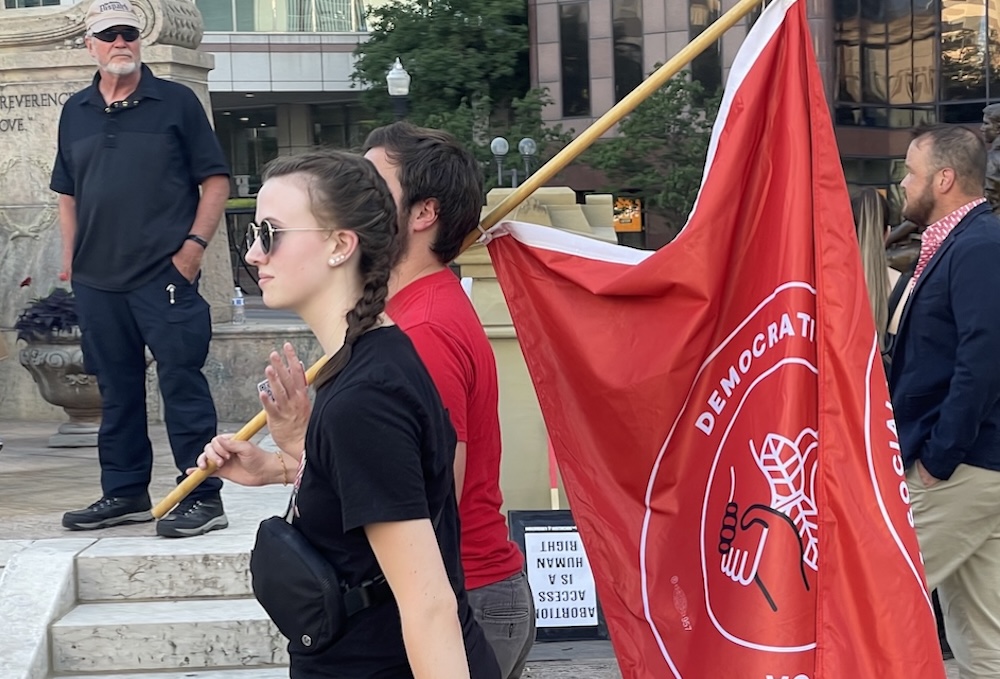
DSA activists protest the Supreme Court's Dobbs decision in Columbus, Ohio.

DSA’s “Workers Deserve More” platform has inspired a wave of panicked commentary. Yet at its core are demands for a fairer, more humane economy and a more democratic political system. (InvadingInvader/ CC BY-SA 4.0 [cropped])


The Democratic Socialists of America (DSA) recently adopted a new platform entitled “Workers Deserve More.” Normally, the only people who notice the platforms adopted by socialist organizations are their own members and members of rival socialist organizations. But not this time.

The Speaker of the House, Mike Johnson, has repeatedly denounced the “Workers Deserve More” platform, expressing amazement that DSA “put this on paper.” Johnson describes the struggle to stop democratic socialists from enacting their agenda as a “philosophical war” to prevent “the greatest nation in the history of the world” from going down a “dark road of death” leading to “communism.”

Writing at the Washington Examiner, Chris Talgo calls the platform “patently unconstitutional” and “anti-American” and says it would spell doom for the very working class it claims to uplift. Talgo goes on to describe DSA itself as “more than dangerous” and a “dire threat to the future of the U.S. as a constitutional republic.” Former Clinton administration staffer Jamie Metzl described the contents of the platform to ABC News 4 as “absolutely unacceptable, disgraceful, anti-American views we should all condemn.” The Denver Gazette’s Vince Bzdek claims the “Workers Deserve More” platform “essentially calls for an end to the American experiment as we know it.

It says something about how profoundly American political discourse has shifted in the decade since Bernie Sanders’s first campaign for president, and especially since a string of socialist victories starting with Zohran Mamdani’s election as mayor of New York City and continuing in congressional primaries this summer, that any of these people even noticed that the platform existed. But anyone listening to Johnson and the parade of pundits would do well to check these denunciations against the actual content of the platform.

The “Workers Deserve More” document is excellent in many ways, while falling short in others. But nothing in it bears the slightest resemblance to Johnson’s “dark road of death.”

What “Workers Deserve More” Actually Says

In the United States today, about three-quarters of the workforce is employed “at will,” meaning that they have no protection against being arbitrarily fired. It’s the only country in the developed world (and one of the only countries in the world, period) that doesn’t legally mandate that employers provide any paid time off. Medical emergencies routinely plunge even Americans who have health insurance into debt. Going to college often means racking up student loan debt, and a changing job market often means that those who rack it up have trouble securing the kind of middle-class jobs that would make it easier to pay off. Many couples refrain from having children (or more children) because of the prohibitive cost of childcare. And for the large and increasing portion of Americans who don’t own their own homes, rent continues to go up.

Several measures in “Workers Deserve More” would directly address these problems. The workweek, set at forty hours by the Fair Labor Standards Act in 1938 and never reduced by so much as a minute since — even as productivity has exploded — would finally be reduced to thirty-two hours. All workers would get paid family leave. Public housing would be massively expanded, and tenants in all housing, public or private, would be protected from arbitrary eviction. Public education would be free from pre-K to college. It would be easier for workers to organize unions and go on strike without fear of losing their livelihood. And the core demand for Medicare for All would be a game changer for workers throughout the economy who would no longer have to worry about their savings being wiped out by unexpected medical expenses, and would no longer stay in bad jobs (or in some cases even bad marriages) for fear of losing their insurance.

Ambitiously, the platform also targets several aspects of America’s political system that have made it so hard to achieve such pro-worker reforms. When Speaker Johnson expressed amazement that DSA committed such dangerously radical notions to paper, several of the items he rattled off were constitutional reforms (or, in some cases, reforms to election laws that wouldn’t require constitutional amendments) like expanding the House of Representatives, abolishing the Senate, abolishing the Electoral College so presidents would be elected by a national popular vote, and scrapping the two-party system by instituting ranked-choice voting for all elections.

The document probably would have been better served by picking a few such reforms to emphasize rather than throwing in everything the authors could think of, sometimes even including multiple demands that don’t quite logically cohere with each other. At one point, for example, “Workers Deserve More” calls for the outright abolition of the presidency in favor of something more like a parliamentary system, which makes the call to abolish the Electoral College for presidential elections redundant. But what can’t be denied is that, in each case, the reforms called for are ones that would make the US government more democratic rather than less.

Speaker Johnson expects his listeners to be scandalized by talk of “abolishing the two-party system,” for example, but why? If voters could rank the choices on their ballots rather than having to pick one, nothing would stop Republicans or Democrats from winning anyway if enough voters ranked Republican or Democratic candidates highly enough. They would simply have more choices, and they would be safe from the concern that, when voters are split on their first choice, the split would deliver the victory to the majority’s last choice.

The platform is obviously a compromise document, representing wrangling between rival factions within DSA, and there are points where it spills over to unhelpful and implausible maximalism. For example, even in an advanced socialist society where poverty was something people read about in history books, it’s not plausible that all interpersonal violence would wither away. We’d need to deal with it somehow, and some sort of professionalized law enforcement body accountable to a democratic government and some sorts of institutions of involuntary confinement would be preferable to vigilantism.

So while the platform’s calls to demilitarize policing, treat drug addiction and mental illness as public health issues, and “empower civilian oversight bodies with real authority over the police” are all laudable, it’s a serious mistake to frame these proposals as “as steps towards fully abolishing the police and prison system which protects the rich and jails the poor.” At best, this means that we’d have a radically different form of policing and imprisonment that would no longer serve the interests of the rich at the expense of the poor. But if so, the expression of this idea in monumentally unpopular “abolish” language is pointlessly alienating to the working-class majority that socialists badly need to win. DSA would be better off taking a cue from the thoughtful message on public safety Zohran Mamdani crafted last year during his mayoral campaign.

These moments of implausible maximalism, though, are the exception rather than the rule in “Workers Deserve More.” The overwhelming majority of the document is devoted to ideas that range from interesting and defensible to manifestly morally urgent. If anything, the place where I found myself dissatisfied with the platform was where it wasn’t nearly maximalist enough — the question of socialism itself.

Socialists Should Talk More About Socialism

Socialists have traditionally had both “minimum” and “maximum” programs. The minimum program is a series of reforms that can be implemented in the here and now. The maximum program is the end goal of socialism itself.

One way of thinking about this is that the minimum program involves bits and pieces of “socialism within capitalism,” socialist policies like Medicare for All or a massive expansion of public housing that could be implemented even within the framework of a fundamentally capitalist economy. The maximum program would be “socialism after capitalism,” a new economic system based on collective ownership and workplace democracy.

Clarity could have been added to the “Workers Deserve More” document by making this distinction. Once or twice, the document seems to gesture in the direction of a socialism beyond capitalism, most obviously in a line about “public ownership of the largest corporations and essential industries.” Surely, though, socialists don’t just want to socialize the largest companies. Only about half the American workforce works for large firms (defined as those with five hundred or more employees), never mind the largest corporations that might have tens or hundreds of thousands of workers. A world where the largest corporations and whatever industries are deemed the most “essential” were under some form of social ownership would be a great improvement on the one we live in, but it would hardly be a postcapitalist society.

Interestingly, while “Workers Deserve More” includes a couple references to “capitalism” as a system that deserves to be ended, it never names, much less describes, what could come next. The word “socialist” appears many times, but the word “socialism” never does.

The criticism shouldn’t be exaggerated. The platform is full of bold proposals that would make our society far more decent, humane, and democratic and bring us closer to socialism. And there are certainly several indications that its authors understand the capitalist system itself as the core obstacle that needs to be overcome as we fight for a better world. But the failure to say much about what could come next is revealing about the general state of the Left in the decades since the collapse of the twentieth century’s deeply flawed experiments in state socialism.

The Communists who often played heroic roles in the labor movement, the civil rights movement, and other struggles for social progress believed that a viable and desirable “socialism after capitalism” was actually being built in societies like the Soviet Union. Even democratic socialists who were always critical of Soviet authoritarianism, and may also have had some idea of the deep dysfunctionality of that economic model, found it easier to imagine a fully postcapitalist world as long as the Cold War struggle over economic systems defined so much of global politics. But the triumph of capitalism has often seemed so total in the decades since then that even those of us who most badly want to end capitalism often have a hard time vividly imagining what could replace it.

Shameless plug: Bhaskar Sunkara, Mike Beggs, and I wrote a book coming out this fall, The Blueprint: How Socialism Could Work in the Real World, where we attempt to think through the mechanics of an economically viable and politically desirable postcapitalist future. In our model, which Beggs previewed here in Jacobin, the “commanding heights” of the economy would be under full public ownership. Investment, crucially, would be socialized through the nationalization of the banking sector. Where we grant that market signals still have a role to play in coordinating production with consumer needs, allocating capital goods, and so on, we think that capitalist exploitation of the working class can be ended in all firms, large and small, by having the remaining market sector be composed of worker-owned and internally democratic firms operating in partnership with public banks.

Perhaps you think that this vision is too extreme, and that a more-or-less socialist society should allow more small-scale capitalist entrepreneurship around the edges of the socialized economy than Sunkara, Beggs, and I envision. Conversely, perhaps you think we don’t go nearly far enough, and that a democratic form of planning could make all markets unnecessary. These are worthwhile debates, and it would be foolish to think that a future socialist society will replicate any particular proposal from 2026 point by point rather than shaping its institutions according to all sorts of historical contingencies that could never be fully predicted in advance.

But the reason it’s worth spelling out how socialism could work is that we badly need to restore the Left’s confidence that socialism — not just social democracy, not just Medicare for All and a thirty-two-hour week, as valuable as these near-term accomplishments would be, but socialism — is still possible. Without a dedicated core of militant workers and organizers animated by that confidence, we’re unlikely to mobilize the kind of socialist movement we’d need to accomplish even a socialist minimum program. And as long as capitalists hold onto their economic power, whatever reformist gains we do manage to achieve will be vulnerable to being rolled back in the future.

Workers do indeed deserve more than they have in America in 2026. Putting aside a quibble here or there, they deserve everything the “Workers Deserve More” platform envisions. But they don’t just deserve a better deal within an economy whose levers they don’t control. They deserve the whole thing.