Contemporary Capitalism Is Brutally Competitive

Advocates of the “political capitalism” and “monopoly capital” theories argue that capitalism is stagnating, increasingly unproductive, and dominated by rent-seeking. These are flawed diagnoses that put socialist strategy on the wrong track.
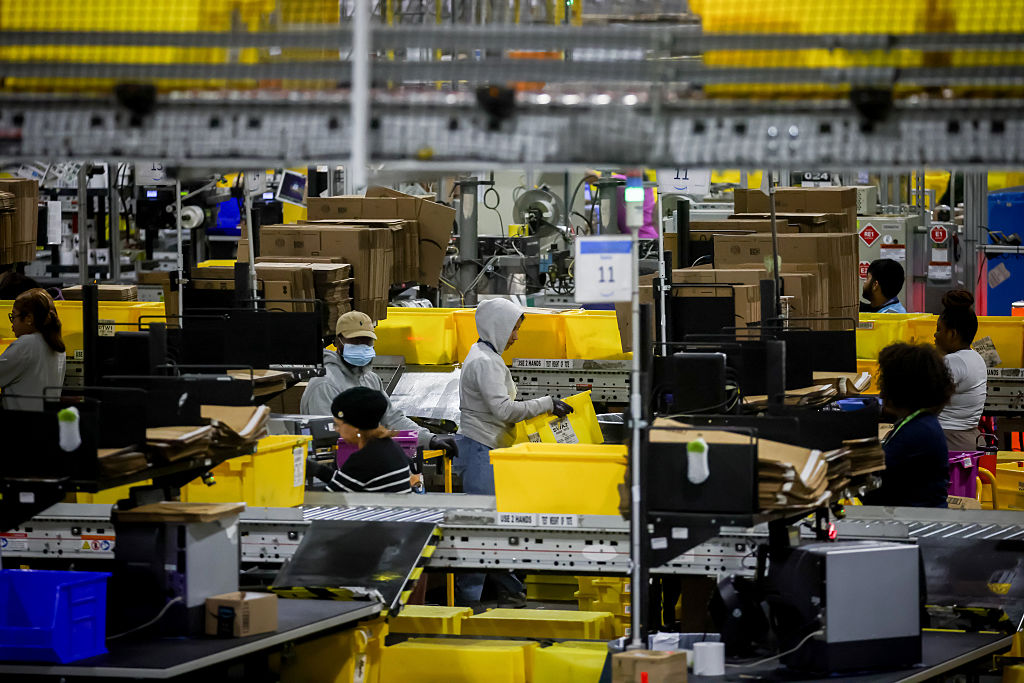
Workers prepare packages for shipping at an Amazon Fulfillment center on Cyber Monday in Robbinsville, New Jersey, on Monday, December 1, 2025.

Workers prepare packages for shipping at an Amazon fulfillment center on Cyber Monday in Robbinsville, New Jersey, on Monday, December 1, 2025. (Michael Nagle / Bloomberg via Getty Images)


We are now living under the most aggressive form of capitalism in history. The global circulation of capital compels states and the workers living within them to compete for investment and jobs — leading to exploding inequality and eroding protections for labor and the environment. Meanwhile, investment is booming, R&D spending is growing, technological development is proceeding rapidly, and profits have reached historic highs. This confounds long-standing arguments that the rise of finance was “hollowing out” production, undermining competitiveness, and leading to economic decline. It also sharply contradicts theories of “political capitalism,” “monopoly capitalism,” and other forms of rentierism, which depict capitalism as stagnating, increasingly unproductive, or in a decadent “late” stage.

In a series of recent articles, we challenged such accounts, arguing that the concentration of capital, financialization, and the growing role of the state have served to intensify what Anwar Shaikh calls “real competition.” These arguments elicited responses from Dylan Riley — who, with Robert Brenner, developed the theory of “political capitalism” — and John Bellamy Foster and Brett Clark, editors of Monthly Review and foremost representatives of monopoly capital theory. Riley argues that productive investment is being displaced by rentier accumulation secured through privileged access to the state, while Foster and Clark claim that ongoing corporate concentration has further entrenched monopoly capitalism.

Both arguments miss the mark. Riley detaches rent from the competitive dynamics of production and distribution, and he conflates corruption with the emergence of a new regime of accumulation. Foster and Clark, meanwhile, treat the absence of expected indicators of monopoly as beside the point, stretching the concept of monopoly until it becomes effectively unfalsifiable. Despite their differences, both struggle to reconcile theories of stagnation with the reality of highly profitable and intensely competitive accumulation — which, we argue, is the chief cause of the social, ecological, and political crises unfolding around us.

Political Capitalism

In a recent article in Sidecar, Dylan Riley reiterated his argument that we are witnessing the rise of what he and Robert Brenner have called “political capitalism.” In this regime, they claim, the extraction of rent through control over the state is overtaking productive investment as the primary means by which the ruling class accumulates wealth.

Capitalists, Riley wrote, “would prefer to make profits through rent-seeking and political extraction without risking their wealth on uncertain investments.” Moreover, this has gone so far that “the most obvious threat to capitalism today comes not from the working class, but paradoxically from capitalists who with increasing success have figured out how to profit by plunder rather than productive investment.” These remarks echo the sweeping claims Brenner and Riley have made elsewhere: that “under political capitalism, raw political power, rather than productive investment, is the key determinant of the rate of return.”

Riley began his Sidecar article by rightly insisting that analysis must focus on the system’s “laws of motion.” But as we argued in a critique in Jacobin, his own analysis seems unmoored from any such grounding. The rent capitalists are supposedly extracting has to come from somewhere. Like profit and interest, rent is a claim on a finite pool of surplus value. It is derived from control over some condition of production or circulation that gives certain capitalists the power to appropriate wealth produced elsewhere — an advantage that cannot be competed away. If access to that condition was generally available to all capitalists, the rent would disappear, since it would no longer confer an exclusive advantage.

Because it is a claim on finite surplus value, rent cannot expand without limit. To the extent that it is deducted from profit, it cannot grow to the point of removing the incentive for productive investment — which would undermine the source of rent itself as well as the reproduction of the entire system. “Extraction” may enrich particular capitalists, but it simply cannot displace productive investment as the general basis of accumulation. As a result, we argued, “Riley’s analysis effectively suggests that capitalism is being replaced by some form of ‘neo-feudalism’ as the accumulation of wealth through ‘plunder’ undermines competition and leads to the suspension of capitalism’s ‘laws of motion.’”

In a somewhat puzzling discussion of rent in response to our criticisms, Riley tries to get around this limit on extraction by separating the capture of rent from the dynamics of accumulation — arguing that “there are many forms of rent that have nothing to do with markets and therefore do not depend on monopolies.” But it is hard to see how this could be the case. The example he offers, government contracts awarded to Trump’s political allies, hardly clarifies matters. If preferential access to state power affords certain capitalists advantages not available to others that enable them to extract wealth from the productive economy, as Riley claims, this would seem to fit the definition of monopoly quite closely.

Moreover, state contracts have been crucial for the competitiveness and profitability of US multinational corporations since World War II. Is all of this to be understood simply as “rent”? Indeed, state spending has long figured centrally in monopoly capital theory. As we argued, if we abandon Karl Marx’s link between rent and monopoly, as Riley attempts to do, the concept of rent becomes so broad that “profit as a distinct category tends to disappear into rent altogether.” As if to prove our point, Riley ends up with a definition that could encompass almost any state fiscal or monetary policy.

Riley’s argument obscures the fact that the state does not constitute an autonomous source of value but redistributes wealth produced elsewhere. He thus cannot evade the limits on the expansion of rent we identified. If rent, plunder, and politically inflated asset values are not claims on surplus value, then what are they claims on? If these are seen as sources of wealth independent of production, then the argument has left Marx’s theory of value behind and moved onto a terrain closer to that of neoclassical marginalism. If, however, they are claims on surplus value, then the questions remain exactly those we posed: how surplus is produced, how it is distributed, and why these forms of appropriation could be understood as a new regime of accumulation.

In his response, Riley jumps from vivid examples of political corruption and self-enrichment by the Trump family to a much larger claim about “political capitalism” in which the entire economy is dominated by an elusive and unnamed “extractive sector.” As in the original Sidecar article, he neither identifies what this “unproductive predatory and extractive sector” consists of, nor provides any evidence of its overall economic significance. Pointing to cases of flagrant corruption is of course very different from demonstrating that state extraction constitutes an entirely new regime or logic of accumulation. At most, then, Riley has identified a particular set of firms profiting through corrupt political connections of the kind reported daily in news stories like those he cites.

Riley’s framework tends to depict the state as the direct instrument of a narrow ruling oligarchy. Yet organizing the power of a ruling class whose members compete with one another and are concerned primarily with their own bottom lines rather than broad systemic stability, requires that the state stand at some distance from particular capitalists — what Marxist state theorists call “relative autonomy.” It does capitalist things not because capitalists tell it to but as a result of structural imperatives. We need a more sophisticated theory that treats the state not merely as corrupt or captured by private interests but as a capitalist state with systemic roles in supporting accumulation, securing legitimacy, and exercising coercion.

Such a theory clarifies both the possibilities and limits of reform. It also helps us understand how the state came to express a right-wing backlash that fused anger at the costs for workers of (very profitable) globalization with anxieties about immigration and the erosion of patriarchy. If capital had its way, Kamala Harris, and not Trump, would be president. The political crisis that gave rise to Trump, and which his chaotic actions in office have only exacerbated, arises partly from the fact that capital does not directly control the state.

There are other fundamental problems with the notion of political capitalism. The framework is built on the claim that stagnation has foreclosed opportunities for productive investment. For Brenner and Riley, the crisis of the 1970s was never resolved, forcing them to explain away the 1990s boom and the post-2008 recovery, as well as current record profits, high R&D spending, and large-scale investment. Yet Riley concedes that Big Tech — typically the central target of “technofeudal” and rentier-capitalist accounts — is competitive, investing heavily, technologically dynamic, and not earning monopoly rents. If this is the case, then it would seem that not much remains of the claim that “zero-sum conditions” mean accumulation can occur only through extraction.

Riley retorts that we must consider growth rates outside of the tech sector. But what does it say if the theory can survive only by leaving aside the most dynamic sector of the economy? Are we also to ignore large investments in military, energy, and logistics? Even if there is some overinvestment, leading to devaluation and market concentration — even potential crisis — this reflects the normal dynamics of technological development in capitalism. It certainly does not indicate a system that is exhausted and stagnant.

Monopoly Capitalism

John Bellamy Foster and Brett Clark, writing in the new issue of Monthly Review, responded to critiques we leveled at monopoly capital theory by pushing in the opposite direction. Where Riley attempts to sever rent from monopoly and ends up with an impossibly broad definition of rent, Foster and Clark push an expansive definition of monopoly that effectively cannot be falsified. In doing so, they demonstrate our central point: faced with a reality that does not fit the theory, monopoly capital theorists have stretched the definition of monopoly to fit the facts. We demonstrate that Shaikh’s notion of real competition captures the dynamics of contemporary corporate capitalism far better than “monopoly capital.”

As we show, monopoly capital theory is closely related to mainstream theories of “imperfect competition,” in which actual markets are measured against the ideal of “perfect competition” imagined within neoclassical economics textbooks. At the core of these theories lies the “quantity theory of competition,” according to which the intensity of competition is seen as a direct outcome of the number of firms in a market. Competition exists on a spectrum, with perfect competition, characterized by innumerable small firms, at one pole, and perfect monopoly, characterized by a single seller, at the other. As markets come to be dominated by a smaller number of larger firms through concentration and centralization, the story goes, capitalism leaves its “competitive stage” and enters a “monopoly stage.” Absent competitive discipline, the result is low investment, stagnation, high prices, and superprofits.

In our Review of Radical Political Economics (RRPE) paper, we looked at the case of Amazon, which is often cited as a key example of a monopoly firm. Theorists of “technofeudalism,” for instance, hold that Amazon and other tech firms are extracting substantial monopoly rents by virtue of their control over intellectual property, platforms, and personal data. As in the case of “political capitalism,” the ability of tech companies to extract rent would depend on their possession of monopoly power: control over something that confers a market advantage that cannot be competed away. Otherwise, above-average profits would attract investment by other capitalists, intensifying competition and pushing profits back toward the social average.

This process whereby the profit rate is competitively equalized is central to the theory of real competition. In this view, competition is not a function of the number of firms in a sector or their size but the mobility of capital. Large corporations, supplied as needed with the requisite firepower by Big Finance, are better equipped to tear aside barriers protecting any markets generating above-average returns. From this perspective, competition is not necessarily weakened as firms get larger — on the contrary, concentration and centralization amplify the force of competition as the “war among firms” takes place on a larger scale.

As we demonstrate, Amazon must compete to attract sellers by reducing turnover time and offering expanded access to markets, as well as to attract customers by offering low prices and lightning-fast delivery. As a result, it is compelled to maximize efficiency, intensify work, exploit labor, and accelerate the circulation of commodities. Crucially, we also show that Amazon has not persistently earned above-average profits. In our recent Socialist Register essay, we demonstrate that the same is true of the other leading tech firms. There is, in short, no evidence that barriers to capital mobility have suspended the competitive equalization of profit rates, as theories of technofeudalism or monopoly capital require.

Foster and Clark do not address this evidence, our broader account of Amazon’s development, or the specific claims made by the monopoly theorists we criticize. Instead, they repeatedly move from the existence of giant corporations to the conclusion that they possess monopoly power. Foster and Clark shift from profit rates to general statements about corporate size, concentration, platform centrality, and strategic planning, citing data on corporate concentration Foster, Robert W. McChesney, and R. Jamil Jonna compiled in 2011. But this assumes precisely what must be demonstrated. The existence of large firms is of course not in doubt; what we are challenging is the assertion that concentration inherently equates to monopoly.

To support this argument, Foster and Clark turn from the evidence to interpreting what Marx really thought, claiming that he endorsed the quantity theory of competition. Yet the single passage from Volume I of Capital they cite is taken out of context. Marx’s theory of competition is developed across all three volumes of Capital, and it is not until Volume III that he fully examines its operation across the system as a whole. Even the passage Foster and Clark quote concerns a specific situation in the process of capitalist development, in which small capitals unable to meet the rising minimum scale of investment are excluded from sectors transformed by modern industry and crowd into spheres it has penetrated only partially. “Here,” Marx writes, “competition rages in direct proportion to the number, and in inverse proportion to the magnitude of the rival capitals.”

The word here matters. As Howard Botwinick notes, Marx is describing the desperate rivalry among numerous small capitals confined to an increasingly limited economic sphere, not stating a general law. With the establishment of modern industry, however, competition increasingly operates through scale, technological development, productivity growth, and the capacity to enter new markets, all facilitated by access to credit. Only a few sentences later, Marx identifies the broader tendency: “Commensurately with the development of capitalist production and accumulation there also takes place a development of the two most powerful levers of centralization — competition and credit.” In other words, competition and credit develop alongside accumulation, even as they propel concentration and centralization.

Foster and Clark criticize us for failing to recognize that rivalry persists within monopoly capitalism — a feature of what they call “real monopoly.” But this is precisely the issue our RRPE paper addresses. As we point out, these theories acknowledge oligopolistic rivalry within a system of collusion, price fixing, stagnation, and surplus profits. Yet this does not correspond with the reality of modern capitalism. It is in response to this reality that a new generation of monopoly theorists, from Lina Khan to proponents of technofeudalism, have expanded the concept of monopoly to encompass competition itself. Thus Khan famously presents Amazon as a “paradox”: on the one hand, it is a giant firm operating in a concentrated market, but on the other hand it engages in apparently competitive behavior. Her solution is to make the quantity theory true by definition: large firms count as monopolies whether they raise or lower prices, expand or stagnate, invest or not. If we abandon the quantity theory, however, the paradox also disappears: the simpler explanation is that these firms are competing, exactly as the theory of real competition would expect.

Foster and Clarke’s reply largely confirms this tendency, even crediting Khan as a theorist of “real monopoly.” They acknowledge that monopoly firms compete to reduce costs and expand sales and may even invest on an enormous scale. But it is hard to see how such “monopoly” behavior can be distinguished from competition. As they argue, high profits count as evidence of monopoly rents, while low profits are attributed to long-term monopoly strategy; underinvestment confirms monopoly stagnation; high investment confirms monopoly consolidation. Every outcome supports the theory. The decisive distinction Foster and Clark draw between real competition and “real monopoly” is that monopoly firms avoid price cutting. But they do not address the evidence we present that price competition is in fact occurring. Nor do they confront the implications of their own claim: if firms are charging monopoly prices, they should earn above-average profits — but as we show, they do not.

The sole indicator Foster and Clark offer in support of monopoly capitalism is inflation. But inflation is neither a measure of monopoly nor a direct index of market structure. Prices may rise because of demand and credit creation, wages and class struggle, supply disruptions and exchange-rate shocks, fiscal and monetary policy, and numerous other factors. Market power might allow firms to sustain higher markups and therefore a higher price level, but it cannot explain continuing inflation unless these markups themselves keep rising. The persistence of inflation therefore does not demonstrate the disappearance of price competition. Foster and Clark’s argument fails at the most basic level: inflation alone cannot tell us whether firms possess monopoly power, coordinate prices, or remain subject to competition.

Foster and Clark close with a lengthy quotation from a 1981 essay by Paul Sweezy that they claim “spells out a theory of real monopoly.” But that passage sets out much more definite expectations than Foster and Clark’s elastic concept suggests. Monopoly capital theory, Sweezy writes, confronts the “realities” of mature capitalism: “overaccumulation and stagnation, idle productive capacity and underinvestment, surplus profits and underconsumption”. It is hard to see how this could be squared with Foster and Clark’s recognition that the tech firms exhibit massive investment, rapid technological development, expanding capacity, labor-process restructuring, and no consistent monopoly superprofits.

The evidence therefore contradicts the tendencies Sweezy identifies far more directly than Foster and Clark acknowledge. Rather than a mature monopoly capitalism escaping competitive discipline, as Sweezy and Paul Baran would have expected, Amazon displays the intensified competition predicted by Marx and Shaikh.

Competition and Profits

The great political value of the theory of real competition lies in the clarity it provides about the struggle for a more sustainable and democratic alternative to capitalism. Reading Foster and Clark’s reply, one wonders why it is so important to twist ourselves in knots to base our analysis in “monopoly capital.” We have argued that treating the malfunctioning of capitalism, rather than its routine operation, as the central problem can “gesture toward” a narrow politics of revitalizing capitalism rather than building the capacities necessary to transcend it. This does not mean that every theorist or actor who has invoked monopoly — from Che Guevara and Vladimir Lenin to Sweezy and Foster — is a reformist. The problem is that by obscuring the central role of competition in driving capital accumulation, the exploitation of labor, and environmental destruction, the monopoly capital framework can also obscure the central importance for socialist strategy of breaking with competition.

Foster and Clark’s own reply reflects this ambiguity. On the one hand, they insist that monopoly is inseparable from capitalism itself, and that anti-capitalist and anti-monopoly politics are integrally linked. On the other hand, they present antitrust measures that would intensify competition as potentially beneficial to workers. But Amazon is already fiercely competitive. Its low prices and rapid delivery are achieved through relentless pressure to cut costs, accelerate circulation, discipline suppliers, and intensify work. Amazon is bad for workers not because it is a monopoly but because it is a ruthlessly competitive capitalist firm. Automation, surveillance, and work discipline are better understood as weapons in the warlike struggle among capitalists for profits than as consequences of monopoly power. And as Foster’s sometime coauthor Paul Burkett powerfully demonstrated, these same competitive imperatives drive environmental destruction.

This underscores the need for a systemic transformation. The question in this respect is not whether to pursue reforms but what kind of reforms should be prioritized and why. For socialists, the answer to these questions hinges on their ability to form a link in a broader struggle to shift power toward workers, build democratic capacities, and open a path beyond capitalist market discipline. As Leo Panitch and Sam Gindin wrote, we must “liberate ourselves from the notion that it is only through competitiveness that we can confront the development of our productive capacities.” Indeed, “to accept competition as the goal . . . is to give up on the socialist project before you begin.” This means revitalizing and transforming the labor movement as the linchpin of a broader class politics and, no less important, imagining and constructing institutions capable of expanding democratic control over investment. As the climate crisis accelerates, the failure of investors and capitalist states to undertake a green transition makes clearer than ever the need to allocate resources according to social and ecological needs rather than competitive market imperatives.

Share this article

Contributors

Stephen Maher is assistant professor of economics at SUNY Cortland and coeditor of the Socialist Register. He is the coauthor of The Fall and Rise of American Finance: From J. P. Morgan to BlackRock with Scott Aquanno and author of Corporate Capitalism and the Integral State: General Electric and a Century of American Power.

Scott Aquanno is assistant professor of political science at Ontario Tech University. He is the coauthor of The Fall and Rise of American Finance: From J. P. Morgan to BlackRock with Stephen Maher and author of Crisis of Risk: Subprime Debt and US Financial Power from 1944 to Present.

Filed Under