Alan Greenspan Was a Faithful Servant of the Ruling Class
Longtime Federal Reserve Chairman Alan Greenspan is often thought of as a free-market dogmatist. In reality, he was something far worse: an ideologically flexible but devoted servant of the powerful and a leading organizer of the war on US workers.
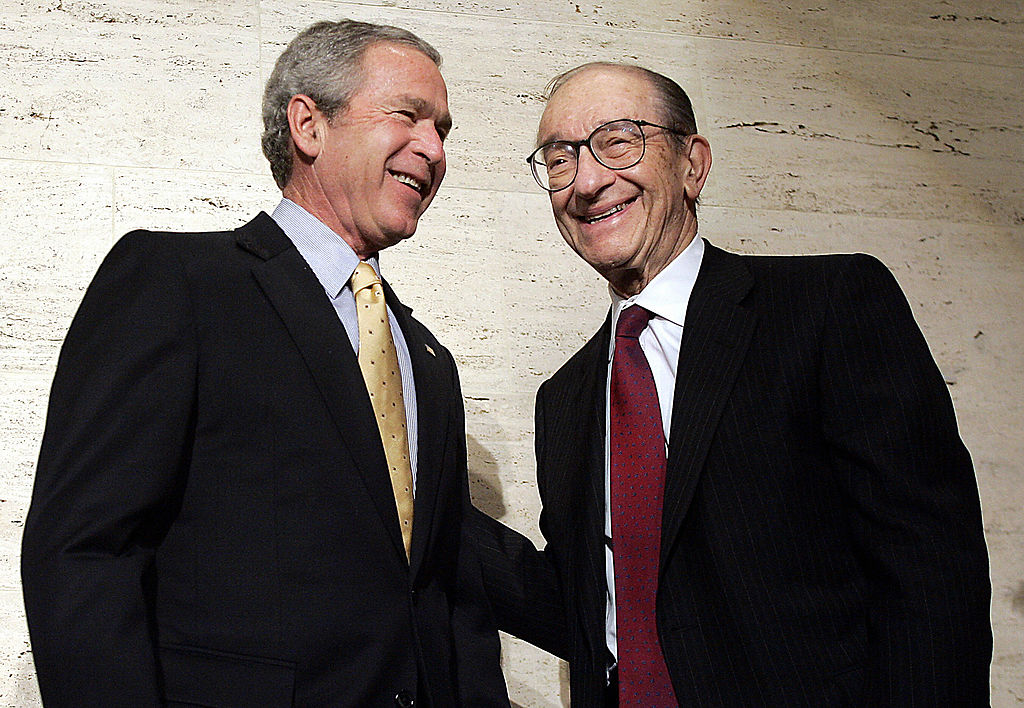
Alan Greenspan’s entire career was dedicated to unshackling the American elites from any fetters on their ability to gain more wealth and power. (Jim Watson / AFP via Getty Images)
During his 2008 presidential campaign, John McCain joked that he would put Alan Greenspan in charge of tax policy even if the recently retired central banker were deceased. “If he’s alive or dead it doesn’t matter. If he’s dead, just prop him up and put some dark glasses on him, like Weekend at Bernie’s.”
McCain’s timing, as always, was terrible. The quip about Greenspan was made in October of 2007, as the housing market collapse that would trigger the Great Recession was accelerating. This collapse would drastically reshape Greenspan’s reputation. For the previous two decades, when he served as chair of the Federal Reserve, Greenspan’s piloting of the American economy won him endless encomia. In the aftermath of the crisis, however, Greenspan would be forced to confess that he found a “flaw” in the model of free-market economics through which he had made policy.
With Greenspan’s death at age one hundred on June 22, attention has returned to Greenspan’s role in shaping modern capitalism. His acknowledgment of a flaw in his ideology, made in testimony before Congress in October of 2008, serves as a handy tentpole for retrospectives on his career, contrasting his dogmatic faith in free markets with the messier economic reality.
But Greenspan’s career has a great deal more to tell us than a mere repetition of Johann Wolfgang von Goethe’s warning that “theory is grey, but the tree of life is ever green.” Indeed, as some of his more perceptive critics have observed, Greenspan hardly ever let himself be constrained by ideological consistency, blithely changing his tune as the occasion demanded. As an economist, he was (to his credit) far more of an empiricist than has often been appreciated.
Greenspan was no abstruse theoretician. What he was instead was far worse. Throughout his career, he maintained a steadfast commitment to serving the powerful and plundering the powerless. He was a leading organizer of the war on the American working class over the last fifty years. It is this devotion to the interests of the ownership class that forms the true through line of Greenspan’s career.
At the Feet of the Master
Greenspan began his economics career at New York University in the 1940s. As a student, he had a reputation as a prickly individualist, but not a particularly ideological one. After receiving a BA in economics, he went to work as a researcher for the Conference Board, one of corporate America’s premier think tanks. Founded in 1916, the group emerged after World War II as one the leading policy planning organizations for the new corporate elite. Greenspan distinguished himself with his research at the group and soon became an in-demand corporate consultant.
At the same time, Greenspan was introduced by his first wife to Ayn Rand. Rand had built up a circle of acolytes around Washington Square in these years and hosted a kind of philosophical salon–cum–cult of personality out of her apartment. Greenspan was invigorated by Rand’s philosophical self-confidence and soon emerged as a devotee of her idiosyncratic brand of libertarianism. His first piece of political writing was a letter to the New York Times defending Rand’s novel Atlas Shrugged from a hostile reviewer.
In 1966, Greenspan contributed an essay to Rand’s newsletter that explicated principles to which he would hold for the rest of his career. Entitled “Gold and Economic Freedom,” the essay is a schmaltzy brief for the indispensability of the gold standard to the free market. The connection comes through the gold standard’s foreclosure of the possibility of a welfare state. As Greenspan explains it, “The welfare state is nothing more than a mechanism by which governments confiscate the wealth of the productive members of a society to support a wide variety of welfare schemes.” Gold, however, “stands in the way of this insidious process. It stands as a protector of property rights.”
Though Greenspan would, in short order, abandon his support for the gold standard, he would increasingly substitute himself in the role of protector of property against the covetous masses.
As Greenspan gained stature as an economist and defender of the free market, he inevitably got more involved in politics. In 1964, he, along with the rest of the Randians, had endorsed Barry Goldwater’s far-right campaign for the presidency. In 1967, he was approached by some of Richard Nixon’s inner circle and quickly became an important adviser to the candidate. It was Greenspan who helped formulate Nixon’s program of “black capitalism,” which Nixon used, with some success, to try and win Black Power supporters to his camp.
Greenspan’s association with Nixon also revealed the labile nature of his principles. In 1972, as Nixon was running for reelection, he began a concerted campaign of pressure against the chair of the Federal Reserve, Arthur Burns. Nixon wanted Burns to cut interest rates to boost the economy before the election and to declare publicly that the economy was in fine shape (with the implication that the president deserved the credit). Burns was reluctant to do so, and so Nixon leaned hard on him. His henchmen planted a false story in the press that even as Burns was advocating wage restraint to tame inflation, he was privately demanding a 50 percent pay raise for himself.
Greenspan was the go-between chosen to let Burns know that the right words about the economy could make such scurrilous stories disappear. (Burns had been Greenspan’s adviser when the latter began an economics PhD at Columbia, and the two had been friends for over a decade.) Greenspan told Burns that he was hurting the administration with his comments about the economy, and soon thereafter Burns changed his tune. Though Greenspan would later deny carrying water for Nixon in this regard, his biographer Sebastian Mallaby points out that handwritten notes by Nixon’s thugs confirm his participation in the scheme. A few years later, Nixon appointed Greenspan head of the president’s Council of Economic Advisors (CEA), where he would serve until the Carter administration.
Traumatized Workers
After his time on the CEA, Greenspan returned to consulting. Though he was brought back into government for a stint on Ronald Reagan’s Social Security reform committee, he ultimately played little role in the compromise that emerged as Social Security Amendments of 1983. In the meantime, he sold advice and expertise to corporate boardrooms, including an ignominious episode vouching for a particularly badly run Savings and Loan that ultimately needed to be bailed out to the tune of about $3 billion.
In 1987, Ronald Reagan nominated Greenspan for chair of the Federal Reserve. The institution was in a very different place from when Greenspan had played his part in bullying Arthur Burns over a decade earlier. In 1979, Jimmy Carter had appointed Paul Volcker to chair the board, hoping to tame the economic turbulence that had rocked the country since the late 1960s. Volcker, who had a background in corporate policy planning organizations like the Trilateral Commission and the Council on Foreign Relations, shared the opinion that had coalesced in corporate boardrooms in the second half of the 1970s: inflation was caused by labor having too much power, and the solution was to crush labor. As one member of the Fed’s open markets committee lamented in 1977, “Businesses did not appear to be pressing as actively as they might to hold labor costs down.”
What pusillanimous boardrooms failed to do for themselves, the Fed under Volcker would do for them. By shifting to targeting the quantity of bank reserves and letting interest rates float, Volcker pushed rates into the stratosphere.
Throughout the 1980s, transcripts of the meetings at Volcker’s Fed reveal an institution obsessed with union contract negotiations. In 1981, in the depths of Volcker’s recession, one Fed governor explained the fruits of the economic bloodletting:
When the Teamsters open the master contract because they see some of their truckers going under, when the UAW talks about job security instead of wage increases, and when Pan Am workers are willing to take 10 percent wage cuts because the airlines are in trouble, I think those are signs that we’re at the point where something can really start to happen.
Volcker himself saw Reagan’s crushing of the 1981 Professional Air Traffic Controllers Organization (PATCO) strike as decisive, demonstrating to the unions that they had no allies.
Whatever the mechanism, by the mid-1980s, unions were asking for a lot less and indeed represented a rapidly shrinking part of the American labor force. This was the context in which Greenspan took over the Fed.
Greenspan’s “Miracle Economy”
If Volcker’s tenure was marked by persistent anxiety over the supposedly extravagant wage demands of American workers, Greenspan’s was instead characterized by satisfaction over the carnage wrought by Volcker’s policies. This would ultimately form the core of the Greenspan legend: the “miracle economy” of the late 1990s.
To understand why Greenspan reaped such a reputational bonanza from his leadership of the Fed, it is worth stepping back to understand the general framework within which he was operating. For decades, the conventional wisdom at the Federal Reserve was that there was a trade-off between inflation and unemployment. If unemployment was too low, workers would demand higher wages, companies would pass these on to customers in the form of price increases, and inflation would result. If unemployment was too high, demand would be depressed, and inflation would be low or even negative (resulting in deflation). The job of the Fed was to balance these at what economists came to call the Non-Accelerating Inflation Rate of Unemployment. For most of the 1970s and ’80s, economists at the Fed and elsewhere judged that this balanced rate of unemployment was between 5 and 6 percent.
In the aftermath of Volcker’s recession, unemployment took its time coming down, and for the first few years of Greenspan’s term, it remained relatively distant from the Fed’s goal. The recession of the early ’90s pushed unemployment up again, but by the middle of the decade, it was beginning to dip below what Greenspan and almost everyone else had agreed was the balanced rate. Despite this, Greenspan declined to raise rates. The result was, in the second half of the ’90s, an economy that combined low inflation and low unemployment in a way that few in Greenspan’s circles had thought possible for most of the past two decades. Greenspan received the lion’s share of the credit for this.
But it’s worth looking more closely at why Greenspan felt able to refrain from raising interest rates when his general framework suggested that he should. The answer is clear in the transcripts of Federal Reserve committee meetings. While these discussions show a continued focus on the bargaining power of workers, they also display a shift in the valence of that focus. Where the Volcker-era Fed was concerned that union contracts might bring back inflation, the Greenspan Fed, by the mid-1990s, was trying to explain why, even as unemployment dipped ever lower, wages stubbornly refused to rise.
At first, Greenspan’s answer was that American workers were still, in the wake of the Volcker Shock, too scared of unemployment to press for higher wages. This became widely known as the “traumatized worker” thesis after it was reported on in Bob Woodward’s 2000 hagiography of Greenspan, Maestro.
Greenspan gave voice to this thesis at various points throughout the ’90s. In 1994, he reported that labor leaders had told him that workers were reluctant to quit their jobs for fear of losing their health insurance, and that this was “a major factor in holding wage increases to a very sluggish pace.” In 1997, in testimony to Congress, Greenspan attributed the “exceptional” performance of the economy to a “heightened sense of job insecurity and, as a consequence, subdued wage gains.” When workers did occasionally fight back, Greenspan looked on with trepidation. After the successful 1997 UPS strike, he fretted that it could undo everything that had been accomplished since the PATCO strike.
By the late 1990s, however, as unemployment was heading toward 4 percent, Greenspan had to revise this hypothesis. In a Fed meeting in 1999, he confessed that “an increase in uncertainty and the fear of job loss amongst workers cannot account for this extraordinary combination of low unemployment and no acceleration in hourly compensation.” Instead, he suggested that workers were pressing for higher wages, but that employers were subject to increasing price competition, which made it impossible to grant the demands. Yet such a situation could not persist indefinitely, for “unless the laws of supply and demand have been repealed, there has to be some level of labor market tightness at which nominal wages begin to accelerate.”
Though Greenspan and his colleagues at the Fed tracked union contract negotiations closely, vigilant for any sign of out-of-control wage demands, they were strangely insensitive to the overall trajectory of American unions in these years. At the beginning of Paul Volcker’s reign, private sector union density was over 20 percent. By the late 1990s, it was dipping below 10 percent. Though Greenspan was, like his predecessor, obsessed with ensuring that the bargaining power of American workers remained low, he seemed curiously oblivious of by far the most important source of the reduction of that bargaining power during his time at the Fed.
Handouts to the Rich
Though Greenspan’s interest rate policy at the Fed was where he left his mark most strongly, he shaped American economic policy in other ways as well. These also worked to protect the wealth of those he had referred to as “the productive members of society.”
After George W. Bush’s election in 2000, the administration was eager to enlist Greenspan’s support for its signature domestic policy, a massive tax cut whose benefits flowed overwhelmingly to the richest Americans. There was some doubt as to whether Greenspan would give the policy his blessing, as for Bill Clinton’s entire administration, he had been a deficit hawk, harping on the need to pay down the government debt with the budget surplus that had developed in Clinton’s second term.
But Greenspan was supportive when the Bush administration approached him. Shortly thereafter, he defended the tax cuts in Senate testimony, arguing that if the federal government paid down the debt and persisted in maintaining a budget surplus, it would be forced to use its growing cash pile to invest in the stock market, effectively creating a sovereign wealth fund. Quelle horreur! The notion of instead increasing spending on the welfare state, and thereby aiding the “unproductive” members of society, apparently did not occur to him.
The Bush tax cuts passed in 2001, blowing a massive hole in the budget and making federal taxes much less progressive. They also phased out the estate tax, encouraging the rise of dynastic fortunes. A few years later, Greenspan testified before Congress that the tax cuts, which were set to expire in 2010, should in fact be made permanent. The deficit, such a pressing concern in the 1990s, seemed to be much less of an issue under a Republican president. Though he would later, after the Great Recession, call for repealing the Bush tax cuts and would express regret for supporting them, at the time he was happy to leverage his considerable reputation in support of their passage.
Greenspan also played an important role in fending off regulation of new financial instruments in the late 1990s and early 2000s. The rise of more exotic financial products like collateralized debt obligations and credit default swaps in the ’90s stemmed from banks’ desire to offer higher-margin financial products to customers. While products like money market accounts were fairly generic and low margin, complex derivatives could be sold that were tailor-made for individual customers and hence far more lucrative for the banks.
But the bespoke nature of the products also hindered transparency. As financial institutions loaded up with custom-made derivatives, it became difficult for anyone, regulators or the banks’ own managers, to get an accurate estimate of the institution’s potential liabilities. As these instruments proliferated in the 1990s and were involved in several minor financial meltdowns, calls for their regulation began to sound.
In the face of these calls, Greenspan argued that any attempt at regulation of the new derivatives would be pointless and destructive. When Brooksley Born, head of the Commodities Futures Trading Commission, which was nominally in charge of derivatives regulation, began pushing for regulation, Greenspan invited her to lunch at the Fed and explained that “if a floor broker was committing fraud, the customer would figure it out and stop doing business with him.” As such, no regulation was necessary. When Born pushed ahead anyway with her attempt to rein in derivatives, Greenspan helped marshal public opposition to her from within the Clinton administration. When Congress passed a law making it impossible to regulate derivatives, the administration happily signed it.
Greenspan had succeeded in protecting the profits of investment bankers. But the derivatives that he saved from regulation would play a central role in the financial crisis of 2008, which itself would prove so destructive to Greenspan’s legacy. His advocacy on behalf of the powerful was not without a price.
Recently, as Donald Trump has embarked on a thuggish campaign of intimidation against the Federal Reserve, Greenspan’s reputation has received some rehabilitation. His occasional criticisms of Trump have bolstered his standing as the kind of institutionalist needed to contain a would-be autocrat. Yet Greenspan’s entire career was dedicated to unshackling the American economic elite, the very process that brought Donald Trump to power in the first place. A young Greenspan imagined gold as the ultimate protector of the wealthy; the policies he enacted delivered us a gilded tyrant.