Lula Might Just Keep Bolsonaro’s Son Out of Power
For much of the year, Flávio Bolsonaro, son of Brazil’s former president, seemed to be gaining on Lula ahead of the upcoming general election. But a mix of redistributive policies and right-wing incompetence has put the incumbent back in the lead.
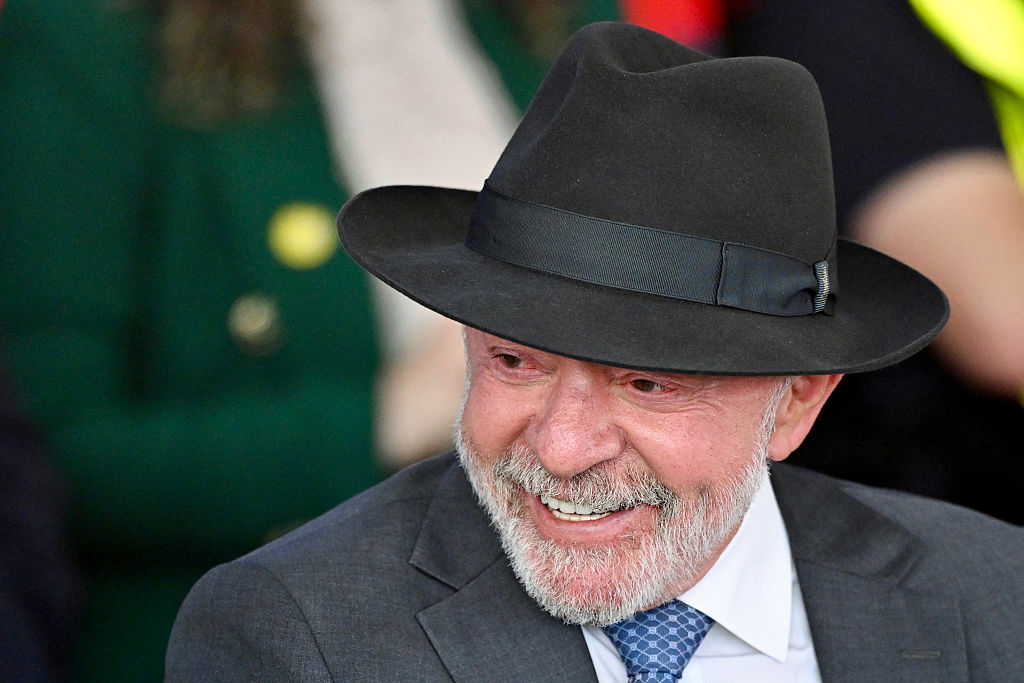
By meddling in Brazil’s politics and questions of internal security, Washington has handed Lula the grounds to reprise a powerful sovereignty-based campaign. (Evaristo Sa / AFP via Getty Images)
On Sunday, June 21, tough-on-crime far-right outsider Abelardo de la Espriella claimed a narrow victory in Colombia’s election, winning 49.7 percent of the vote against the left-wing Iván Cepeda’s 48.7 percent. The nation appears ready to turn its back on the only leftist administration it has arguably ever elected. This marks the latest lurch rightward in a wave sweeping across Latin America, boosting Nayib Bukele in El Salvador, Javier Milei in Argentina, José Antonio Kast in Chile, Daniel Noboa in Ecuador, Rodrigo Paz in Bolivia, and, this month, the apparent victor in Peru, Keiko Fujimori — daughter of the dictator Alberto Fujimori.
For months it has looked as though the same wave would break over Brazil too, which chooses its leader in October. Running against Flávio Bolsonaro, the son and political heir of the imprisoned former president, Jair Bolsonaro, eighty-year-old Workers’ Party incumbent Luiz Inácio Lula da Silva has watched a once-commanding lead drain away: from double digits late in 2025 to 7 points, then 5, then a dead heat by March. In April, a DataFolha survey put Flávio narrowly ahead for the first time.
But over the past month, Lula’s fortunes have turned, in no small part because of a cluster of clumsy interventions from Washington, which has sought to exercise greater influence in Latin America. On May 28, two days after the Bolsonaro brothers were received at the White House, the State Department moved to brand Brazil’s two largest criminal organizations, the Primeiro Comando da Capital and the Comando Vermelho, as “foreign terrorist organizations,” the same designation used to justify dozens of extrajudicial strikes on alleged Venezuelan and Colombian drug traffickers in the Caribbean. By overriding the Brazilian state on a matter of its own internal security, and doing so at the express request of the incumbent’s chief electoral rival, Washington handed Lula the grounds to reprise a powerful sovereignty-based campaign.
It is a familiar rhetorical strategy, and a reliably profitable one for Lula. Last summer, when Donald Trump tried to derail the prosecution of Jair Bolsonaro by slapping 50 percent tariffs on Brazilian goods, Lula’s approval soared, overtaking his disapproval for the first time since late 2024 as he rallied voters against what many Brazilians see as modern American imperialism.
The narrative that the Bolsonaros are doing Washington’s bidding only got easier to make last week, when the Supreme Court sentenced US-based Eduardo Bolsonaro, in absentia, to four years and two months in prison for lobbying the United States to sanction his own country’s judges over the case against his father. Lula’s case was strengthened even more dramatically, however, when, four days later, the US Trade Administration singled out Brazil’s state-run instant-payment system, Pix, as an unfair practice disadvantageous to American credit card companies, floating 25 percent tariffs in response.
The move could not have been more compromising for Flávio. Pix, introduced under his father, Jair, is a beloved piece of national infrastructure, which is free, instantaneous, and used by tens of millions daily. So popular is the software that in early 2025, a wave of far-right misinformation claiming Lula’s government meant to tax it sent his approval to its lowest point during his tenure.
Washington’s attempts to pressure Brasília have not only handed Lula a nationalist cudgel against his opponents, it has given Brazil’s powerful, conservative agribusiness sector one more reason to embrace China. Barely a day after the United States unveiled its newest tariff threat, China’s customs agency recognized the entirety of Brazil as free of cattle-borne disease, lifting bans that had stood since the early 2000s. The prize is considerable, since Brazil is the world’s top beef exporter, and China already buys roughly half of what it ships. Just as Washington reached for the stick, Beijing — at that very moment hosting Foreign Minister Mauro Vieira for “strategic dialogue” — reached for the carrot.
It would be a mistake, though, to credit Washington’s blunders alone for Lula’s recovery. His best month in office also owes much to a fresh scandal engulfing his chief rival. In mid-May, the Intercept published leaked messages indicating that Flávio had solicited some $24 million from Daniel Vorcaro, the now-imprisoned banker behind the collapsed Banco Master, to bankroll a flattering film about his father.
The most durable sources of approval, however, may be entirely domestic. The income tax overhaul Lula signed in November and brought into force in January, spares some fifteen million Brazilians part or all of their income tax while raising the bill for only about 141,000 of the highest earners. This is just one of many popular concrete policy changes introduced on his watch.
The most recent polls now appear to put Lula at a comfortable lead for the first time in what has been a tight race. Still, four months remain, and this is a contest that has swung before. What can be said, for now, is that Washington’s attempts to bully Brazil and boost its preferred candidate have, so far, backfired — that is, if they were ever deliberate in the first place. Asked recently whether he was a fan of the Brazilian president, Trump replied: “I don’t think about him, to be honest with you. I don’t really think about him. I couldn’t care less.”