Things Keep Getting Worse for Brazil’s Bolsonaro Dynasty

After the conviction of Jair Bolsonaro for trying to overthrow Brazilian democracy, his far-right movement had to find a new presidential candidate. His son Flávio has picked up the baton, but his campaign is already plagued by scandals.
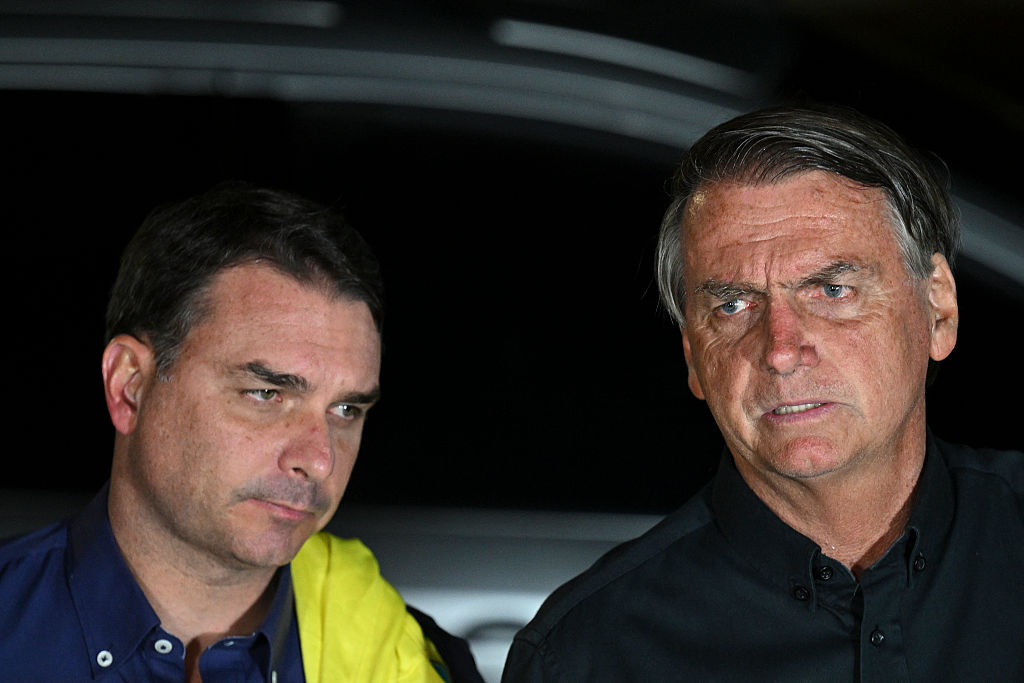
Jair Bolsonaro speaks next to his son Flávio in Brasilia, on October 2, 2022.

An upcoming film featuring Passion of the Christ star Jim Caviezel will depict Brazil’s ex-President Jair Bolsonaro as the ultimate martyr. But his personality cult does not seem to be helping his son Flavio in his scandal-ridden bid for the presidency. (Evaristo Sa / AFP via Getty Images)


As Brazilian President Luiz Inácio Lula da Silva campaigns for a fourth term in office ahead of this October’s general election, the Brazilian right is struggling to keep up with the country’s popular left-wing leader. The right-wing political vacuum created by the conviction of former President Jair Bolsonaro left many questioning who would take on the Bolsonarist cause — still the overwhelming force among Brazilian conservatives.

In the end, Flávio Bolsonaro, the former president’s eldest son, and himself a veteran politician, took on the mantle and is currently Lula’s main opponent for the leadership of Brazil. However, a series of financial and personal scandals that have developed over the last few months, ranging from alleged movie bribes to quarrels with his influential stepmother, have rocked the younger Bolsonaro’s candidacy, with some arguing his bid is now in free fall.

Dynastic Politics

In 2025, as the likelihood grew that Jair Bolsonaro would be convicted on charges of conspiracy against Brazilian democracy, the question of who would replace him began to emerge. Much like Lula on the opposite side of the spectrum, Bolsonaro had come to dominate Brazil’s right-wing camp.

The Liberal Party (PL), adopted by Bolsonaro during his presidency and soon molded into his populist quasi-fascistic image, became the mainstream right-wing party of Brazil. It eclipsed the neoliberal (and confusingly named) Social Democratic Party, shifting Brazilian politics away from the center and toward the far right.

Today the Liberal Party is among the largest in Brazil, with the most senators and the second-highest number of deputies, not to mention thousands of mayors and local representatives. Its candidates preach an evangelical, authoritarian, and reactionary program that blurs the line between state and religion as well as between private and public interests. In these circles, Bolsonaro is seen more as a father figure than a conventional political leader.

Yet for many months, the favorite to replace Bolsonaro was not a member of the Liberal Party. Instead, the expected choice was the Governor of São Paulo, Tarcísio de Freitas, a figure who managed to position himself as the more moderate and palatable option. This not due to any actual moderation on his part — Freitas is a noted right-wing populist, with his own fair share of controversies — but simply by dint of being unconnected to the countless scandals that plagued Bolsonaro and his main political supporters.

By painting himself as a less scandalous and more pragmatic kind of right-winger, Tarcísio recalled the abortive US presidential campaign of Ron DeSantis, the Florida politician who tried to present himself as the more reasonable Republican alternative to Donald Trump.

His Father’s Son

In the end, and to the surprise of many — Tarcísio included — Flávio Bolsonaro, Jair’s oldest son and a senator in his own right, announced his candidacy under the Liberal Party banner after reportedly consulting with his imprisoned father. The announcement placed Flávio in the position of successor, or more accurately, replacement (as his father’s influence is certain to loom large over his hypothetical administration). It also immediately deflated the hopes of Tarcísio, who promptly announced his reelection campaign for the São Paulo governorship instead.

More than a party decision, Bolsonaro’s choice in favor of his own son demonstrates that the former president wishes above all to keep the leadership of the Brazilian right in his grasp. Nevertheless, Flávio Bolsonaro is not a carbon copy of his father.

While his father has a long track record of brutishness and throwing insults that made him loved by some and hated by many, Flávio has a reputation for politeness and pragmatism. He has been known to work well even with rivals from Lula’s Workers’ Party (PT) if it meant passing legislation.

He is no less right wing than his father and defends many of the reactionary claims about the historic military dictatorship and the 2022 election, which Bolsonaro supporters falsely maintain was stolen by Lula. Yet despite being an ardent defender of his father’s legacy, Flávio is known as the more “respectable” of the three Bolsonaro brothers, and seems intent on presenting his own persona.

His campaign had already suffered from Lula’s bump in popularity earlier this year. Now it has faced some massive setbacks, all connected to his own family.

Embarrassing Relatives

Flávio’s well-groomed, calculated persona starkly contrasts with that of his younger brother, Eduardo. Currently residing in the United States, Eduardo takes much more after his father in demeanor, being known for his online rants and slur-filled tirades against those who oppose the family.

The former president’s chief spokesperson and speechwriter, Eduardo is a gifted propagandist who has spent the last few years on the conservative lecture circuit preaching about the supposed persecution of his family, the dictatorial tendencies of the Brazilian judiciary, and the dangers of cultural Marxism. A figure with close ties to US right-wing media, Eduardo Bolsonaro took leave of his position as federal deputy to live in the United States in early 2025.

He has led the anti-Brazilian lobby in US politics from this vantage point ever since, working hard to sabotage the Brazilian government through any means. In July 2025, he took partial credit for Trump’s decision to impose tariffs on Brazil, a move justified with reference to the treatment of Jair Bolsonaro.

However, Eduardo’s lobbying generated a tremendous backlash inside Brazil. Not only did it create a “rally-around-the-flag” effect, bolstering Lula’s polling at a time where the president was facing his lowest ebb in terms of popularity, it brought wide condemnation upon the Bolsonaro family from across the Brazilian political spectrum.

Eduardo has since had his mandate as a federal deputy revoked for his lengthy absence. In June this year, he was convicted of attempting to obstruct justice and the trial of his father with his lobbying. Eduardo was quick to brand the Brazilian authorities a “Gestapo” and ask the US government for political asylum. This was quickly granted, in contrast with the way the Trump administration treats genuine refugees, and he now possesses a green card.

Eduardo’s antics have done much to hurt his brother’s standing as a presidential candidate. His involvement in the tariffs imposed upon Brazil have significantly tarnished the Bolsonaro name, and with the United States announcing an additional 25 percent tariff on all Brazilian goods in July, the issue remains fresh in the minds of all Brazilians.

Making Movies

Meanwhile, Flávio Bolsonaro has also been caught up in a bizarre banking scandal. Leaked messages between Flávio and Brazilian banker Daniel Vorcaro showed him asking for almost $25 million to help fund his movie project Dark Horse.

The film is a Brazilian-American production, starring American actor Jim Caviezel — previously best known for playing Jesus in The Passion of the Christ — as Jair Bolsonaro. It has not yet been released, but there has already been much talk among the Brazilian public about its casting choices and presumed propagandistic quality.

Vorcaro, head of the Master Bank, is currently under investigation for a large and extremely public banking fraud scandal. The origins of the money transferred for the funding of the film — a transfer initially denied by all parties — have been put under heavy scrutiny, not to mention the propriety of a serving senator receiving such money.

The leaked messages have revealed deep ties between Flávio and Vorcaro, with the two having a long history of communication. As the investigation into the latter continues, there may be further revelations.

The Master Bank is a very popular institution, particularly among working-class people in Brazil, and the case has attracted great public attention, with Vorcaro quickly becoming a vilified figure. Bolsonaro’s messages, asking Vorcaro to cover expenses and addressing him as “brother,” have not helped his image with the public.

The family has made a habit of campaigning on anti-corruption platforms, despite its own proliferation of corruption scandals, and Flávio’s presidential campaign is no different, throwing accusations of gross corruption at Lula and the PT. The Master Bank scandal has made it impossible for the younger Bolsonaro to properly campaign on such a platform without inviting charges of hypocrisy.

However, that hasn’t stopped him from trying. In a recent rally, Flávio appeared with a shirt displaying the phrase “Pix is from Bolsonaro, Master is from Lula,” attempting to take credit for a very popular direct cashless payment system used in Brazil while placing the blame for the Master scandal with Lula. It seems unlikely that such rhetoric will have any effect, but there is little else Flávio can do to distance himself from this ongoing scandal.

Family Quarrel

On top of all this, Flávio has recently had a very public falling out with his stepmother, Michelle Bolsonaro, in a family quarrel that threatens to divide the Bolsonarist electoral base. Michelle rose to prominence during her time as First Lady. She is an influential conservative voice among Brazilian women and serves as president of the Liberal Party’s women’s wing, coordinating the campaign of many conservative female candidates.

Michelle has long been known to harbor greater political aspirations. She is not only popular with the female electorate, whom she targets specifically in campaigns, but also has strong ties to the powerful evangelical movement in Brazil. Following Jair Bolsonaro’s arrest and conviction, she was also seen as a possible candidate to replace him before the more experienced Flávio was chosen.

There have been many reports over the past few years of conflict between Michelle and her stepsons, with the latter claiming she was inexperienced and meddling with fields outside of her scope. Recently this fight has intensified over a possible political alliance which Michelle criticized as being “inconsistent with the interests of the Brazilian Right.”

Previously these fights unfolded behind closed doors, but Michelle has recently brought them to the forefront by releasing a twenty-seven-minute-long video on June 25 where she gives her account of the disagreements with Flávio Bolsonaro and the reasons for her clash with the brothers. In the course of the video, she directed many passive-aggressive attacks at the candidate of her party.

Presenting the video as being for all the “good women” of Brazil, Michelle positioned herself as a defender of conservative women nationally, praising their “delicate strength.” The language she used stressed her loyalty to the leader (Bolsonaro), with Michelle arguing that she always operated under the direct instructions and with the full endorsement of her husband.

She claimed that it was Flávio and other members of the Liberal Party who were going against the interests of the Brazilian right, and urged Flávio to stop talking about her, suggesting that the online gossip was affecting the well-being of her daughter.

With the highly publicized and analyzed video, Michelle has created a very public rift between herself (and by extension her own following) and Flávio Bolsonaro. Michelle´s influence among evangelical circles, evident rhetoric skills, direct connection to Bolsonaro, and (so far) clean record make her attacks on Flávio a devastating blow to his campaign.

This could be evidence of her own desire to eventually head the Bolsonarist movement herself, as well as to distance herself from what might very well become an electoral sinking ship.

Hanging by a Thread

Despite being surrounded by scandals, Flávio Bolsonaro continues to head the Liberal Party´s bid for the presidency. There are no other candidates that come even close to his or Lula’s polling figures (all other candidates are below 10 percent, while Flávio and Lula float around the 40 percent mark). This means that the Brazilian right’s only hope of recovering the presidency lies with Flávio’s flailing campaign.

Following Brazilian electoral law, national conventions are taking place over the last week of July and the first week of August. It is in these conventions, held separately by the branches of a party from each Brazilian state, where the pre-candidates are usually confirmed by their party delegates. It is noteworthy that Flávio has arrived at such a moment without already having a running mate already selected, something that nearly every other major candidate has taken care of. This may be a sign that noteworthy figures of the Brazilian right and center are attempting to distance themselves from his campaign.

Nothing will be official until the conclusion of these separate conventions in early August, but Bolsonaro’s presidential hopes are hanging by a thread. While it would be unprecedented to remove him from the ticket, far crazier things have happened in Brazilian politics. With the Master Bank investigation set to run and run, he may yet become the third member of the Bolsonaro family to face the legal consequences of their actions.