Brazil's Turn to the Left Continues
Jair Bolsonaro’s far-right rule was a dark time for social movements in Brazil. Since Lula’s return to power, housing activists have had a renewed role not just in the streets but in setting government policy.
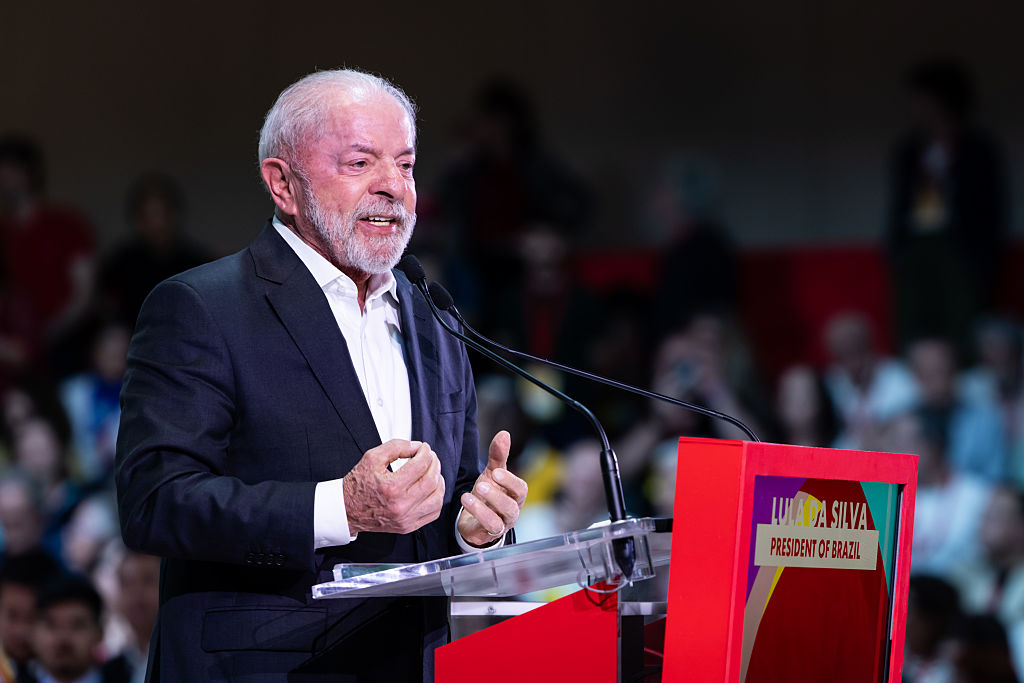
This October’s Brazilian election will see President Lula face off against far-right Jair Bolsonaro’s son Flávio. It’ll be a key test of whether the legacy of Brazil’s left-wing government can endure. (Aldara Zarraoa / Getty Images)
- Interview by
- Pablo Castaño
Now serving as Brazil's Secretary of Youth in Luiz Inácio Lula da Silva’s government, Vitória Genuino cut her teeth as a grassroots activist in the Movimento dos Trabalhadores Sem-Teto (MTST, Homeless Workers’ Movement), the spearhead of the fight for dignified housing and social justice.
Last weekend, she was in Barcelona to take part in the Global Progressive Mobilization meeting, bringing together left-wing and center-left heads of government such as Lula, Colombia’s Gustavo Petro, Mexico’s Claudia Sheinbaum, and Spain’s own Prime Minister Pedro Sánchez. She told the conference about mobilizing youth and her work in Brazil.
In an interview with Pablo Castaño for Jacobin, Genuino spoke about the opportunities and contradictions of moving from social movements to institutional politics. She also takes stock of Lula’s government just a few months before October’s general election, in which the veteran leader of the Partido dos Trabalhadores (PT, Workers’ Party) will face Flávio Bolsonaro, the son of former far-right President Jair Bolsonaro.
Pablo Castaño
Before joining the Brazilian government as youth secretary, you had a long record of activism in the Movimento dos Trabalhadores Sem-Teto. At this moment, how do you see the struggle for decent housing in Brazil?
Vitória Genuino
With President Lula’s return to power [at the start of 2023], the movements now have a greater possibility of dialogue with the government. The spaces for social participation that the government promotes help in this process of reorganization of the movements, which during the last period, under Jair Bolsonaro's government, suffered a very violent criminalization. So I value this as a moment of reorganization and strengthening of the struggles for rebuilding housing policy in Brazil.
President Lula’s refounding of the Ministry of Cities offers the possibility for the movements to go beyond frontal confrontation with the government, and to themselves be part of reconstructing policy. I believe that this is a good moment for rearticulating problems, reorganizing, and making concrete proposals for the improvement of housing conditions.
Pablo Castaño
More personally, how have you experienced this change from movement politics to institutional politics?
Vitória Genuino
It's a recent change, from December to now. It's very different to be in the government, but it’s an important experience. As much as I am today fulfilling an official function and representing the Brazilian government, I do it as a militant for the right to housing and for youth rights.
I believe that the government can be a tool of social transformation. It is a space where I, as a militant, can conceive and build public policy based on this militant vision, understanding that now I answer “from the other side of the balcony,” as we usually say in Brazil. I know the difficulties, and I can have a different view of the demands that come up. Not only because I am a militant but also because of where I come from: I grew up on the outskirts of the city of Olinda, in the Brazilian northeast. This different perspective means I can understand that, while this moment in government is surely a temporary one, it is also a real tool for social transformation.
Pablo Castaño
Is your background exceptional within the current Brazilian government, or are there other figures who come directly from social movements?
Vitória Genuino
Several people who are in the government today have a history of social movement activism, but I can speak more directly about the ministry [of the Presidency] that my secretariat is part of. Minister Guilherme Boulos [belonging to the left-wing party Socialismo e Liberdade, PSOL], who for the first time is also part of the government, has a long history in the housing movement, but he was not the first. The Lula government created, for the first time, the National Secretariat for the Outskirts of Cities. This had historically been a demand of social movements, which understood the need, within the Ministry of Cities, to create a space that concretely discussed the problems of peripheral areas. There is also Izadora Gama Brito, who is the Secretary of Social Participation, and came from the MTST’s struggles.
Pablo Castaño
In the run-up to the 2022 general election, Lula reached an agreement with traditional parties, which included the presence of a former rival, Geraldo Alckmin, as his vice president. What impact has this agreement had on the government’s policies, compared with Lula’s earlier stints in power?
Vitória Genuino
There is a constant dispute to move the government to the right, or more to the center, or to the left. Each actor in government has their role in this. The partnership that President Lula made with Vice President Geraldo Alckmin was important for us to be able to return to power, in our struggle with the right wing represented by Bolsonaro, but this also has its consequences. We play our role of giving a push to the left.
Last week, President Lula took up the struggle against 6x1 [the six-day working week], in a direct dialogue with the app-based platforms, as part of a broader discussion about dignified work. This [initiative] largely comes from Minister Boulos — this is his historic agenda. Our role is to promote the urgent agendas of the working class [within the government’s work], and President Lula has directly taken up these issues.
Pablo Castaño
What policies would you highlight in this government’s record?
Vitória Genuino
When we specifically speak about this Lula government [2023–present], it is important to highlight that it is a government of reconstruction. This means the return of the Ministry of Cities and giving resources to strategic ministries. . .
Today, we have a reduced unemployment rate among Brazil’s youth. And the Ministry of Education, for example, has launched the “popular courses,” a very important policy aimed at students from the peripheral territories and favelas of Brazil. Then there’s the Pé-de-Meia, a policy where the government provides resources for students in public school. So, in terms of the policies around education and especially for youth — which is the agenda that I am building today within government — we managed a series of advances.
Pablo Castaño
The polls show a tie between Lula and Bolsonaro’s son, Flávio, ahead of this October’s general election. Why do you think that the far right is so strong in Brazil, even after Bolsonaro’s coup attempt and imprisonment?
Vitória Genuino
The wealthiest class, the center that controls the world's wealth, also has its extensions in Brazil. The Bolsonaro government did have an influence on society. Today, for example, we have a clear increase in cases of violence against women. This is a result of what the Right left behind after its stint in government.
I think that this ruling class has a symbolic influence on society, and the free-market discourse can be appealing for many. But we believe that the Brazilian people are in favor of this reconstruction of the country. Today we have a much better situation for our people. We believe that through the real construction of public policy, we will be able to advance and continue this work.
Pablo Castaño
One of the challenges that Latin American progressive presidents (Lula, Petro, Sheinbaum) face is their relationship with Donald Trump, given the continuous threats, attacks, and tariffs. How has Lula dealt with Trump?
Vitória Genuino
Brazil has a very important role in building dialogue in international politics. President Lula and our government are strengthening our sovereignty and our independence, and we defend a very concrete position in relation to the Trump government’s policies, mainly affecting Brazilians who today reside in the United States. We fight very strongly. Our role is to pursue dialogue, so that we can avoid new conflicts.
Pablo Castaño
During the first Lula governments [2002–2010], Latin America was more united as a geopolitical actor, with the creation of Mercosur and other regional integration schemes, than it is today. Do you think that having to confront Trump can help to rebuild some kind of Latin American unity today?
Vitória Genuino
It is becoming an important engine for mobilizing. The Global Progressive Mobilization represents this reorganization of Latin American countries, understanding the historical period that we are living through, given the right-wing advance in these countries. But I think that President Lula, Sheinbaum, and these other actors who will meet here in defense of democracy are demonstrating our commitment to this agenda. Brazil has this important role to dialogue with both sides, at the same time, to strengthen the sovereignty of our territory.
Pablo Castaño
What do you expect from this meeting in Barcelona?
Vitória Genuino
The main legacy that we want to leave is the fight against extremism and the defense of democracy. Our participation here has the purpose of strengthening the sovereignty of peoples and territories, through democracy. I think this is the main message.
Pablo Castaño
In Europe, we often hear that young people are wavering between apathy and conservative positions, and polls show a certain right-wing turn among young men. What is your experience in Brazil?
Vitória Genuino
Certain polls suggest a drop in popularity of Lula’s government among young people from ages sixteen to twenty-four. We need to better understand how to communicate the advances and policies that we have built around youth. Although there is a smaller mobilization in the streets [than in previous periods], there is also some resistance. We have the National Union of Students, the Brazilian Union of Secondary Students . . . historical movements in schools and universities that are still strong today.
But there are also very strong cultural and religious youth movements that are not organized in these traditional models of parties and student movements. We need to learn about these new experiences. Sometimes, when we talk about mobilization, we think about that traditional model. But we have a new generation. Social networks may have a bad side; we need to speak about the mental health of the young. But, at the same time, we need to understand how we can talk to youth about all these rights and advances that we have been developing.