Public Bailouts Are What Keeps Our Economic System Afloat
Every time our economic system generates another crash, the state is on hand with public money to bail out private losses. It’s time we stopped seeing bailouts as individual episodes and recognized them as a core feature of contemporary capitalism.
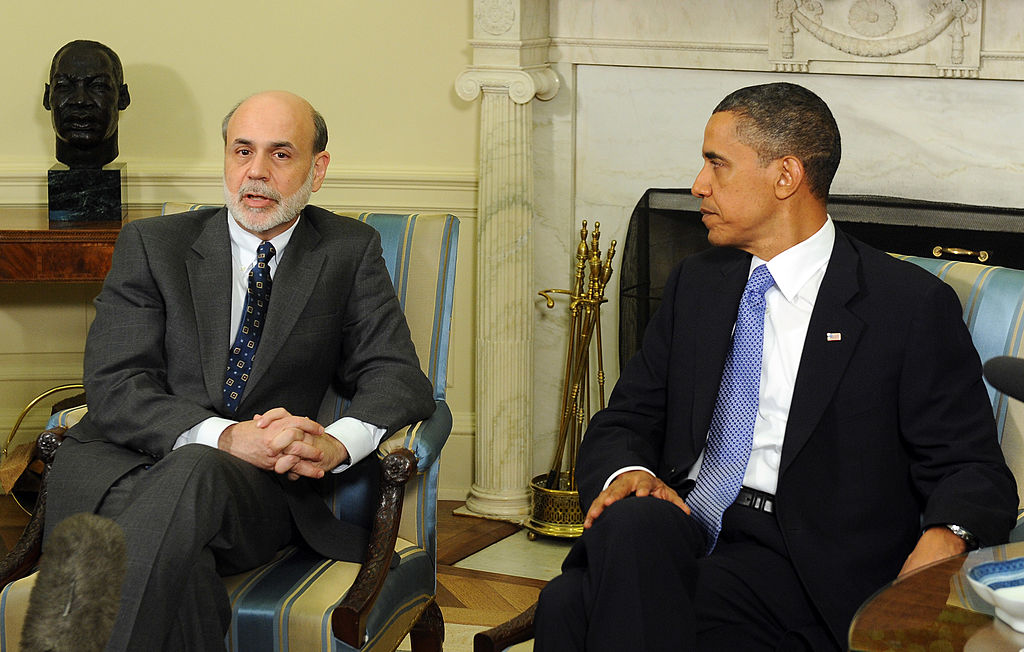
We shouldn’t let the anti-state rhetoric of neoliberalism mislead us: instead of shrinking the state, its effect has been to create a ruinously expensive public safety net for asset ownership, a “wealthfare” state instead of a welfare state. (Roger L. Wollenberg / Pool via Getty Images)
- Interview by
- Mona Khneisser
In his book The Bailout State: Why Governments Rescue Banks, Not People, political economist Martijn Konings argues that the contemporary state has become a standing source of guarantees, subsidies, and backstops for capital. Government is no longer capitalist in the sense that it protects property rights or is easily infiltrated by moneyed interests (two logics long recognized by Marxists and other critics of capitalism). Instead, public financial management itself has become deeply interwoven with the accumulation of private wealth.
Tracing the origins of the bailout state back to the era of welfare capitalism, Konings depicts the neoliberal period not primarily as a decisive break with Keynesianism, but as a moment in the longer-term evolution of institutions that subsidize asset ownership and manage the resulting inflationary pressure with austerity measures.
Mona Khneisser
Your book develops a new analytical history of American capitalism since the New Deal. To start, could you take us through the main elements of that narrative, including the distinctive periodization and turning points it suggests?
Martijn Konings
When it came to money and finance, the mid-twentieth century Keynesian revolution was incomplete: it did not establish public control over credit creation or disable the deflationary policy levers of central banks. That greatly complicated attempts to use public spending to promote growth and employment, which was supposedly the centerpiece of the Keynesian program.
From early on in the postwar period, therefore, Keynesians turned to supply-side policies, using public guarantees and tax breaks to influence private investment. Such programs gradually shifted the financial structure of the state from welfare toward “wealthfare,” but they were never effective in delivering inflation-free growth.
That, of course, became the rationale for the policy shifts of the late 1970s and early ’80s. The tendency of left-wing critics to take the anti-state rhetoric of neoliberalism at face value has often made it difficult to recognize what those policy shifts really brought about: they dramatically expanded the public safety net for asset ownership.
The notion of neoliberal backlash has also made it hard to see that one kind of middle-class politics gave way to another (in spite of or, perhaps more accurately, facilitated by growing inequality). The tide of capital gains that washed over the US economy enabled an asset-centered politics that experienced its heyday in the 1990s and gave credence to the Clinton administration’s claims about the efficacy of its progressive supply-side program.
Since then, progressives in office have tried (and failed) to recapture the magic of the Bill Clinton years. Following the bank bailouts during the global financial crisis, the Obama administration turned to budgetary austerity, mistakenly believing that it held the key to a repeat of the roaring ’90s. The Federal Reserve kept the American and global economies afloat by constructing a permanent edifice of financial backstops. Another asset boom ensued, but it could no longer drive generalized growth as property ownership had already become too concentrated.
Recognizing how austerity policies had contributed to economic stagnation, the Biden administration briefly experimented with a pre-neoliberal version of Keynesianism. However, when that predictably gave rise to conflicts over institutional arrangements, it was unable to break out of the technocratic mold. The Trump administration is not constrained by considerations of financial probity or personal integrity, so it is currently putting the bailout state to the political uses that it so obviously invites.
Democrats, meanwhile, are trying to restore the ideological facade of that state by campaigning for central bank independence (from direct political interference, not from financial institutions) and supporting the backstopping of investment in growth technologies like AI. What they are studiously ignoring is something that MAGA has had much less difficulty in grasping, at least on an intuitive level: financial sovereignty (whether authoritarian or democratic) requires control over the monetary architecture of contemporary capitalism.
Mona Khneisser
A central argument of the book is that the bailout state is not a break from Keynesianism but in important ways grows out of postwar Keynesian governance itself. What do you most want skeptical readers to understand about that claim, especially those on the left who still treat Keynesianism and neoliberalism as if they were neat opposites?
Martijn Konings
The debate about neoliberalism has gone through a few phases. Two decades ago, it was a concept to refer to a historical era shaped by free-market politics. Then there was a somewhat pedantic backlash, with scholars arguing that the world is too complex to be captured by such neat labels. In my own previous work, I have criticized such dismissals of the neoliberalism concept: if we rule out the idea that there is more at play than path-dependent complexity, that makes it impossible to put one’s finger on the deeper transformation at work.
But there has also been a stronger response that has bent the stick too far in the other direction. It has had a strong focus on the anti-Keynesian convictions of leading thinkers, the reactionary organizations that incubate them, and the stealthy way these ideas and actors have captured public institutions. It has also set up an overly stylized contrast between the oppressions of the neoliberal era and the relative democratic harmony of the early postwar period.
To my mind, an equally important transformation has to do with how mainstream actors have adjusted their thinking and operations, often in the full light of day. If you take just some of the most obvious challenges to any literal understanding of neoliberalism — the state is no smaller than it was, and principles of tight money and austere budgeting are applied in highly selective way — you can understand much of that by tracing the evolution of practices and conceptions of macroeconomic management. The key actors here are not necessarily neoliberals with a developed understanding of their political mission, but pragmatists and centrists who were managing problems like inflation in real time.
How Keynesianism remade itself in the face of the neoliberal challenge has in many ways been more consequential than any belief in free markets or the influence of neoliberals in government. That shift can be characterized in broad terms as the transition from neo-Keynesianism (the postwar synthesis of John Maynard Keynes and neoclassical economics) to New Keynesianism, which is packaged in sophisticated economic models but at its core involves a belief in finance and tech as the drivers of growth and the need to configure government policy around them.
Some would reject the idea that New Keynesianism is still Keynesianism. But the red thread here is the recognition of the stabilization imperative — in other words, the commitment to using fiscal, monetary, and regulatory instruments to keep growth going and to prevent the economy from entering into the kind of deflationary spiral that caused the Great Depression.
In The Bailout State, I try to show how that logic of macroeconomic governance meant different things at different points. The defeat of attempts to legally bind the economic role of the state to social objectives (e.g., through a full-employment guarantee) meant that stabilization policies came to revolve around subsidizing property and deflating wages. That tends to reproduce the artificial scarcity of capital that Keynes attacked, and over time the welfare state morphed into a wealthfare state.
To the extent that the repurposing of public resources has been overseen by a bipartisan coalition, the problem is deeper than might be suggested by perspectives that focus on neoliberalism as a right-wing impulse. That is why Larry Summers plays an important role in the book: a politically middle-of-the-road character who has endless mainstream credentials, he has been one of the main architects of a regime of public generosity toward capital and austerity for the rest of the population.
Mona Khneisser
Several reviewers suggest that one of the book’s strongest insights is also one of its most controversial ones: the concept of “bailout” may be doing a lot of work in relation to very different mechanisms — backstops, guarantees, subsidies, tax breaks, lender-of-last-resort actions, and so on. How do you define a bailout analytically, and why is it useful to group these different practices together rather than distinguish them more sharply?
Martijn Konings
In the book I use term “bailout” metonymically, as a way to refer to the broader configuration of guarantees, subsidies, and backstops that governments offer business and asset owners. All of those mechanisms work in different ways, and I could certainly see the value in an analysis that carefully distinguishes among them.
The reason I nevertheless group them together is that we often find it difficult to understand regressive risk-shifting as a core government activity. Instead, we tend to see discrete policy instruments and we assess their effects. That makes it easy to miss the bigger picture: these different instruments and techniques are part of a pattern in which the state reduces the risk exposure of some individuals and organizations and shifts it to others.
This is what Hyman Minsky’s model of capitalism allows us to understand with some degree of clarity: capitalism is not primarily a system of commodity exchange but a network of debt connections that allows property to lead an abstract financial life while continuing to enjoy extensive political protections. I define “bailout” as the institutional immunization of property: allowing asset owners to enjoy the upside of risk exposure while shielding them from downside risk, essentially guaranteeing a minimum market value and return.
Mona Khneisser
Your reading of Minsky seems to be doing major theoretical work in the book, particularly against both standard economics and parts of the post-Keynesian/Modern Monetary Theory (MMT) camp. What does Minsky let us see about bank money, state power, and capitalist stabilization that other frameworks miss?
Martijn Konings
During the global financial crisis, mainstream commentators started referring to the “Minsky moment” as the point at which an over-leveraged pyramid of speculative debt comes apart. It aligns with the post-Keynesian perspective on Minsky’s contribution. Emphasizing the instability created by overindebtedness works fine as an argument against fantasies of perfect equilibrium, but otherwise it’s a somewhat limited idea.
When I started reading Minsky himself (initially for my 2018 book Capital and Time), I realized that his key insights related not just to the buildup of market risk, but more importantly to how such risk is managed and socialized. Of course, such policies become themselves factors in encouraging market actors to pursue destabilizing strategies (“moral hazard”), which then require further stabilization.
But that is not just a question of objectionable policies — it is a question of how the system works and evolves at its most basic level. Minsky understood this so well because he did not think of finance in normative terms, which is to say he did not analyze the actual workings of the system by comparing it to a model of how it is “supposed” to work.
Modern Money Theory has gone beyond the somewhat mournful tone of the post-Keynesian critique of speculation and debt. It discerns clearly that economic policy can and does violate its austerity tenets when too-big-to-fail interests are at stake. It sees this as evidence that there are no technical reasons why governments cannot finance projects based on their social and democratic, rather than economic, value.
Minsky was very sympathetic to the MMT version of Keynes (“anything we can actually do, we can afford”). But he also understood that making value creation a public matter requires a broader transformation, not a simple policy fix.
Minsky considered the idea of chartalism, which sees “money as a creature of the state,” in Abba Lerner’s words, to be oddly analogous to orthodox conceptions of money. As much as the former defines itself in opposition to the latter, both subscribe to the notion that a monetary standard can be defined from outside the system of economic interaction.
In the book, I argue that Keynes’s earlier affinity with chartalism made him receptive to more orthodox conceptions of money (leading to neo-Keynesianism). Both perspectives struggle to understand money as arising out of the interaction of balance sheet units and the way banks intermediate that dynamic.
Instability will inevitably arise in a system where private property and finance are allowed to mix freely, and beyond a certain point, that instability will need to be managed by public risk socialization. The liquidity-producing role of banks (often performed by institutions that we don’t think of as “banks”) is crucial here. Without their extremely leveraged balance sheets and ability to create money ex nihilo, volatility could not be so pronounced.
If we don’t take aim at that system, we are bound to get caught up in the pernicious dialectic of bailout and austerity. Minsky already saw it at work during the 1950s, and the neoliberal era is not comprehensible unless we see it through that lens: a dramatic expansion of the bailout state, with the inflationary pressure that this inevitably creates managed with monetary and fiscal austerity.
In the current moment, heterodox economists seem to be losing sight of that logic. The claim that inflation is driven by specific supply-side shocks that we need to analyze empirically has become very prominent in short order. While that is of course a legitimate argument to use against the orthodox insistence on wholesale deflation, it risks losing sight of the systemic dimension. Deflationary policies never target what caused the problem in the first place, but that’s the whole point: they serve to shift the burden of adjustment onto constituencies that have neither caused nor benefited from inflationary pressure.
Mona Khneisser
One of the most provocative aspects of the book is the idea that the bailout state is sustained not only by elite interests but also by a broader middle-class investment in the status quo through housing, pensions, and asset ownership. How should we think about that politically? Does it make opposition to the bailout state more difficult than a simple “Wall-Street-vs.-Main-Street” story would suggest?
Martijn Konings
I appreciate the term “provocative,” because I occasionally have to defend myself against allegations of credulity: as billionaires are rampaging through the government with impunity and the administrative state is being demolished before our eyes, how much sense does it make to say there is a middle-class politics to any of this?
At a time when mainstream liberal-democratic institutions are under pressure, it is understandably tempting to overlook their flaws and limitations and to focus on defending them against the fascist far right. But such unthinking defense of institutions that are responsible for escalating inequality is of course what has allowed MAGA to flourish in the first place.
It seems likely that, before MAGA is in a position to truly deactivate democratic institutions in the United States, the Democratic Party will get a few more chances to turn the ship around. But the party mainstream seems only interested in rehabilitating a middle-class supply-side politics that acquired some plausibility during the ’90s but has since consistently failed to deliver.
Although we can now see fairly clearly what happened during the 2010s — the Federal Reserve’s attempts to prevent a second Great Depression was responsible for the growth of the billionaire class — that understanding does not by itself point to a clear political strategy. The more the bailout state fails to deliver broad-based prosperity and the more its circle of beneficiaries contracts, the more anxiously middle-class politics clings to what few benefits remain on offer.
Here, too, I think that the literature on neoliberalism has become too focused on identifying the people who did this to us, decoding their plans, and exposing how they benefited. That diverts attention from the more important question of what kind of political fantasies and investments have allowed this to happen.
The fact that the Right has now fully turned on the institutions of liberal democracy might seem to vindicate an approach that neatly separates elite machinations from the public interest. But I think that would be the wrong lesson to draw. Instead, we need to think about the contradictions of democracy in a critical and non-reactionary way.
When you look at capitalism as a global system (as we should), the Western propertied class appears as a key part of the rentier class. Many people merely looking for a modest retirement are driving a capitalist system that has always been savage outside the West but is increasingly predatory there as well.
How do we approach that element of structural implication? What can you do inside a tightening net of complicity that is not just anxiously self-protective? Probably the greatest victory of neoliberalism as a system of thought is that we have almost no vocabulary anymore to think about these issues.
Mona Khneisser
The book points toward the “democratization of banking” as both the horizon of the project and an unresolved question. What would democratization mean in institutional terms? And where do you see the real political openings for such a project today?
Martijn Konings
I think we’re seeing an interest in “real utopias” and “feasible socialisms” coming back, and there are many plans circulating to make the financial system more transparent, egalitarian, or democratic. The important contribution of MMT has been to point out what needs socializing: not just “private property” or “investment,” but specifically public capacities for influencing credit creation and selectively stabilizing leveraged balance sheets. The problem is that it trivializes the politics arising from that insight and ends up looking for technical fixes, which reproduces a very common problem in left-wing thinking about alternatives.
Many progressive proposals can only be acted upon if we get past some deeper blockages. In terms of political strategy, the difficulty with relying on artificial scarcity as a way to maintain a middle class is that it erodes rather than builds solidarity. Problems are solved constantly by tightening the in-group. Over time, that inevitably leads to some variety of authoritarianism or fascism.
Those problems are visible in an almost farcical way in discussion of the affordability crisis. While its distinctive character is widely acknowledged (budget pressures are not limited to households without assets or income, but go to the heart of the middle-class experience), mainstream proposals continue to center on the possibility of propping up the very kind of supply-side politics that has stopped working.
The spectacle of Democrats rallying around the “abundance” agenda is probably the most prominent example of that. It’s a jargon that serves to preemptively rule out any measures that could make more than a superficial difference. According to its logic, nothing can be done unless it is actively endorsed and financed by those constituencies whose interests are most tightly bound up with perpetuating the existing state of affairs.
The way I read Minsky, he was in favor of the idea of a full-employment guarantee not because it was a policy that would fix the system, but precisely because the system could not accommodate it. It would strain the existing framework, bring to light how key institutional parameters constrain our options, and so empower the public to make new choices.
Zohran Mamdani’s agenda in New York is exciting for similar reasons. His administration is implementing measures against which the mainstream has a thousand perfectly valid counterarguments. At some point, the tensions generated by Mamdani’s policies will reach a crisis point where he will either need to retreat or advance toward a broader transformation. What his administration seems to be banking on is that, by the time it reaches that point, his policies will have broadened support for a progressive program and built the kind of solidarity that is needed to win battles over key institutions.