The War on Iran Has Made the Rich Even Richer
Over 50% of the profits from recent oil supply shocks went to the top 1% of Americans. The bottom half received just 1%. The Iran war likely triggered another massive transfer to the very richest.
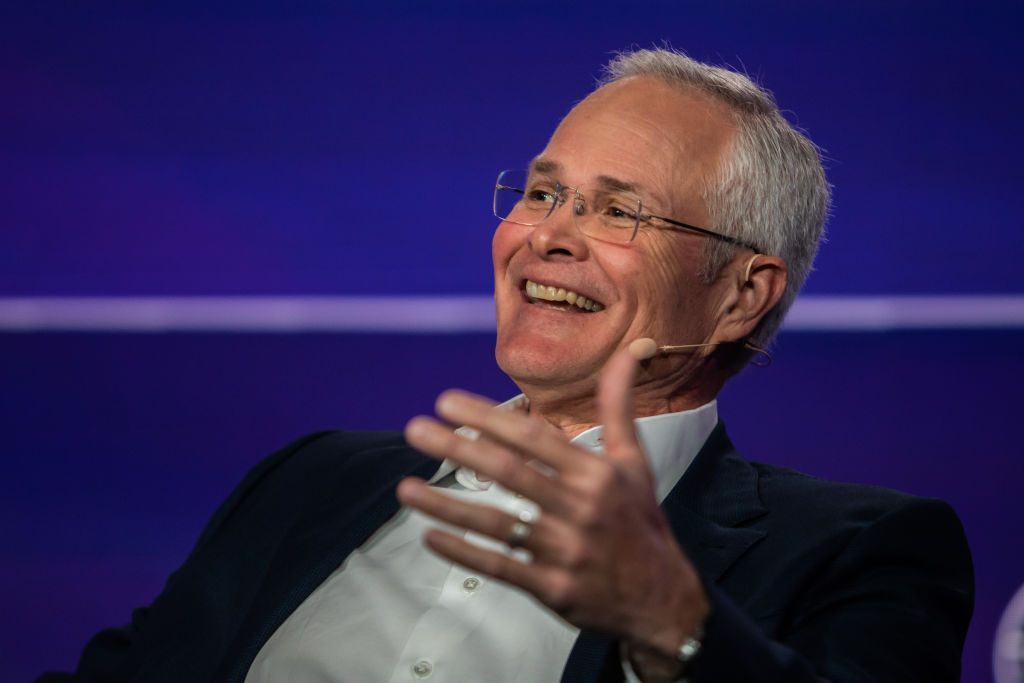
ExxonMobil CEO Darren Woods speaks at the Milken Institute's Global Conference in Beverly Hills, California, on May 6, 2024. The conference explored various topics, from the rise of generative AI to electric vehicle trends and featured participants Elon Musk, retired soccer star David Beckham and actor Ashton Kutcher. (Apu Gomes / Getty Images)
The recent war in Iran has triggered a massive global oil shock. Virtually everyone on the planet relies on oil, or on products that require it, which means virtually everyone is now paying more for the basics of daily life. It feels like the rare crisis that hurts everyone equally.
It doesn’t. New research from economists Gregor Semieniuk, Isabella Weber, and colleagues uses financial forensics to show exactly how supply shocks funnel money upward: over 50% of the profits from the COVID and Ukraine-related supply shocks of 2021 and 2022 went to the top 1% of the US wealth distribution. The bottom 50% received just 1%. There is every reason to believe the same pattern is playing out right now.
The mechanism is straightforward. Suppose a war destroys some company’s oil supplies — but not yours. The global price of oil rises because total supply has fallen, even though your company has lost nothing. You now sell the same amount of oil as before at dramatically higher prices, having done nothing to improve your product or your efficiency. It is a pure windfall.
When this happened during the 2021 and 2022 shocks, companies like ExxonMobil and Chevron posted record profits. There were, understandably, calls to tax those profits and return something to the public bearing the cost of higher prices at the pump.
As Darren Woods, CEO of ExxonMobil, remarked: “There has been discussion in the US about our industry returning some of our profits directly to the American people. In fact, that’s exactly what we’re doing — in the form of our quarterly dividend.”
Needless to say, chances are, you are not the one receiving that dividend.
Who Gets the Money?
To track where fossil fuel profits actually end up, the researchers followed the ownership chain from oil companies all the way down to individual shareholders — including people who own oil stocks indirectly through hedge funds, investment funds, or other companies. The finding is stark.
The top 1% of the wealth distribution captured more than half of all fossil fuel profits during the 2021–22 supply shocks. The bottom half of Americans received just 1%. This fundamentally changes how we understand supply shock–driven inflation. If you only look at rising consumer prices, this inflation hits everyone roughly equally — about 6.5% in 2022 across income groups. But once you factor in the profits flowing back to shareholders, a very different picture emerges.
For the top 1%, effective inflation in 2022 was around 3% — because their dividend and stock income offset much of the price increases. For the bottom 50%, there was no such offset. They were forced to absorb the full hit.
What’s Happening Now
Individual companies have already reported the results. Shell and BP have announced huge profit surges. US crack spreads — the standard measure of refinery profit margins — show that much of the increase in fuel costs reflects higher profit margins, not higher input costs. And because the major oil companies are vertically integrated, they profit at both ends: from the increased prices they sell their excess crude at, and from the rise in their own refinery margins.
Markets, it seems, were ahead of the public. Fossil fuel stocks began rising in January and February of this year, when tensions with Iran first escalated and the US invasion of Venezuela raised fears (or, for shareholders, perhaps hopes) of further supply disruption.
Supply shocks do not spontaneously generate inequality, but instead amplify the inequality already existing. The war in Iran did not choose its economic winners and losers; the ownership structure of the global fossil fuel industry did that. When we describe what follows simply as “inflation” or “market dynamics,” we are using neutral language to describe something that is, at its core, a transfer of resources from people who are suffering to people who are not.