“Medics for the People” Turns Health Care Into Organizing
The Medics for the People initiative promoted by the Workers’ Party of Belgium provides free primary care. It offers direct aid to the population, not out of charity but as a basis for organizing working-class communities.
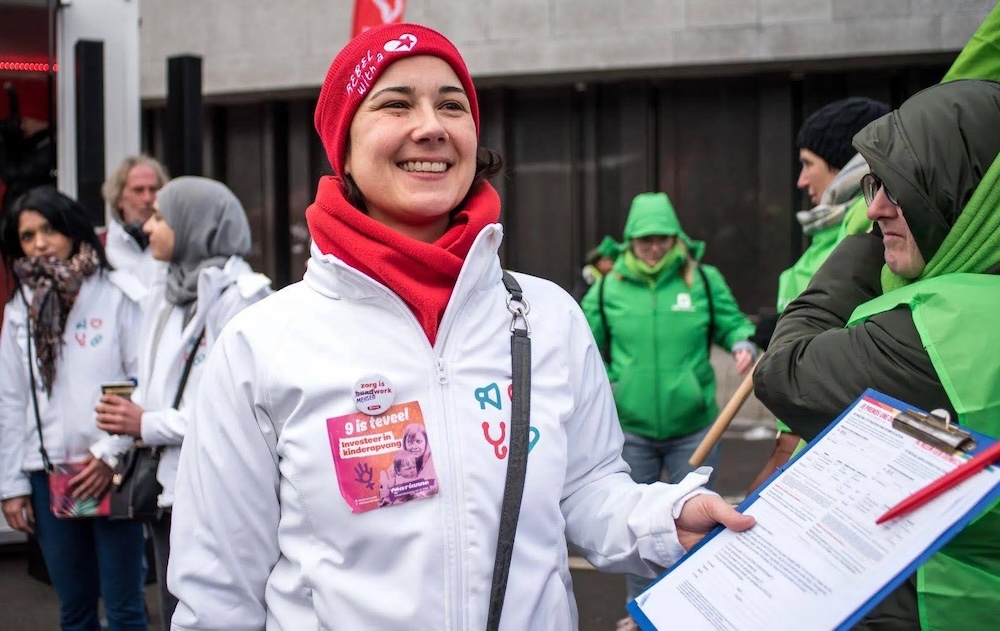
In Belgium, the Medics for the People initiative helps working-class people with basic health care problems. But it also uses this connection to organize around the workplace and neighborhood issues that are making us ill to begin with. (Medics for the People)
Dr Hanne Bosselaers had already seen half a dozen patients by the time the young man came in. The patient worked both as a driver and a building worker to support his family. He’d broken his wrist on his construction job. After examining him, Bosselaers told him he would never regain full mobility and that resuming his main driving job would be impossible.
The man felt guilty. But Bosselaers reassured him that he shouldn’t. As a doctor at Medics for the People (MPLP) in Molenbeek, one of Brussels’s most working-class neighborhoods, her approach is different than a normal doctor’s.
“It’s my role as a health worker to explain that it’s not his fault,” she said. “He is in a system that has big risks and that doesn’t protect him as a worker properly. These kinds of situations, where people don’t earn enough with one salary, have enormous consequences.”
The patient began to understand his accident was a structural failure rather than a personal one. “They are always after us as working people, and they leave these rich people untouched,” he said. He saw the posters for local campaigns on the way into the clinic. Bosselaers told him about a trade union demonstration about the retirement age and energy prices. He said he’d join.
He came in as a patient and left as a political actor. That is why Medics for the People exists: to politicize and socialize health issues ordinarily seen as individual problems. It’s attempting to solve a problem that social movements have wrestled with throughout history: how to provide direct services that both meet people’s day-to-day needs and feed into drives for collective political transformation.
It’s a difficult tightrope to walk. Many service-based initiatives lapse into paternalistic charity or, at best, become forms of mutual aid disconnected from a wider political project. Medics for the People is not perfect. But through decades of work pairing health care with organizing vision, it’s built an important model that movements internationally can learn from.
From Pickets to Clinics
Coming down from the revolutionary highs of 1968, a group of Maoist students in Antwerp started building what would become the Workers’ Party of Belgium (PTB). One of their first moves was to show solidarity with striking workers at a local factory, joining them on the picket lines.
Two weeks into the strike, one of the workers told a student that his child was sick and he couldn’t afford a doctor, and he had no pay because of the strike. The student happened to be studying medicine and said maybe he could help.
“It was not an idea that was developed by us,” says Dr Tim Joye, now the president of Medics for the People and a practicing doctor at that original Antwerp center. “It came directly from people’s needs.”
From that exchange emerged a makeshift clinic. Over the last fifty years, that clinic has grown into eleven medical centers across Flanders, Brussels, and Wallonia — an organization with 220 staff members, hundreds of volunteers, and around twenty-nine thousand patients each year. The PTB, meanwhile, went from a tiny cadre party to the largest party to the left of the mainstream social democrats. It is now in parliament and has even topped polls in one region.
To grasp how Medics for the People works, you first need to understand the Belgian health care system. It has neither a US-style private model nor a nationalized service like Britain, where the state directly employs doctors and provides health care free at the point of use. Instead, it uses the so-called Bismarck model, akin to France, Germany, and the Netherlands. Social insurance covers most health care costs, but doctors operate as private practitioners and patients typically make up-front payments — even if some of the cost is later reimbursed by the state. This leaves working-class people facing real access barriers, both financial and cultural. Doctors operate as self-employed professionals who are often hostile to social medicine and occupational health as frameworks for thinking about illness.
Having begun as a free service where doctors volunteered their time, Medics for the People now operates under Belgium’s “capitation” system, which provides a per-patient monthly payment from the government rather than a fee per consultation. This means that no patients are required to pay when they come through the door.
“We are not motivated by every transaction,” says Stijn De Vos, who coordinates the Hoboken center in Antwerp and handles national budgeting. “We can change how we work, and we know we have our funding, and we can do what needs to be done.” During COVID-19, when other practices hemorrhaged income because patients could not attend in person, Medics for the People could switch to phone consultations and maintained its funding.
The capitation model also eliminates the financial relationship between doctor and patient that pushes so much health care toward overtreatment, under-prevention, and pathologizing individual behavior. When you aren’t paid per visit, you have less incentive to see problems as requiring your direct intervention, and more space to look for collective solutions.
“The main goal is to contribute to another society,” says Joye. “But day to day, we are a health care center. Patients come in; I just did consultations this morning. But we try to combine it and take concrete problems and turn them into a political struggle.”
The Social Stethoscope
Every doctor has a stethoscope; Medics for the People talk about having two.
In every consultation, doctors ask where the patient works, where they live and what their conditions are like. This is the “social stethoscope,” diagnosing individual complaints as part of structural conditions and regarding the structural conditions as clinically significant.
Back pain, anxiety, tendinitis, and insomnia are often not only medical problems but symptoms of bad working and living conditions. The system that produced them is as relevant to the treatment as the body that presents these symptoms.
Across multiple centers, doctors kept seeing women who worked as cleaners in private homes presenting with identical shoulder and elbow injuries: tendinitis from scrubbing floors, wringing cloths, and repeating the same actions for hours every day. Belgium has a compensation system where you get reimbursement and extra income from work-related injuries, but every file Medics for the People submitted was rejected, with the government claiming that the injuries could have been the result of cleaning at home.
In response, they gathered hundreds of files and sent them in all at once, with a joint demand. Medics for the People also organized a delegation to Brussels, along with supportive unions, and the patients held a demonstration. Patients who had arrived with individual problems became participants in a collective struggle and the files forced the government to review its scientific guidelines. “Filling in those papers with all those patients together and then hearing the message about how this wasn’t their individual problem, that every person in the community had the same problem” — says Joye — made them “want to act.”
Joye mentioned another patient from a migrant background. The patient hadn’t “said ‘I’m a victim of racism.’ He said, ‘I don’t sleep well. I have anxiety issues. I have trouble going to work.’” Only when Joye took the time to ask did a fuller story emerge: the patient had suffered bigoted and racist insults from his colleagues and internalized this as a personal failing. Joye could point to potential legal remedies to address the discrimination. In other instances, Medics for the People has organized information evenings for patients who have experienced racism at work.
Hanne Bosselaers describes a similar process with her patients in Molenbeek, many of whom are Moroccan and Arab and have watched the genocide in Gaza with strong personal anguish. One patient, a woman in her seventies, had severe arthritis in both knees. She could barely walk. She had been watching videos from Gaza on her phone, alone and at home, getting more and more depressed.
After seeing Dr Bosselaers for an appointment, she asked what she could do. “There’s a protest next week,” Bosselaers said. “Just come and sit on the side and watch the people walk by.” Bosselaers did not actually believe she would come, but they agreed on a meeting spot nonetheless, and on the day she was there — at a march of ninety thousand people, many of them young, many of them from organizations and trade unions she had no idea cared about Palestine. The woman burst into tears. “I didn’t know that they all work for Palestine,” she told Bosselaers. “I had no idea that so many people cared.”
While no single protest can cure depression, at the next consultation she reported at least feeling less alone.
The Difficulties of Political Medicine
“Some days it can just be all flu, flu, flu” says Joye. “As [Medics for the People’s] president, sometimes I wonder, is this worth the time? I could instead write an article for the newspaper or organize a protest.” Many health issues have little social or political context that can be organized around. Doctors can be trained in the social stethoscope — asking where someone works, looking for structural explanations — but often people are just sick and need treatment.
While the fusion of medicine and organizing is possible, it is not necessarily easy to do well. Young doctors arrive with what Bosselaers calls an “empathic but paternalistic response.” They are overwhelmed by patient need, they feel individually responsible for fixing it all, and they quickly realize they cannot. This “doctor-as-hero” mentality, Bosselaers comments, can lead to doctors “going down” with their patients, which leaves them feeling “fatalistic and passive.”
“I would not be able to work alone, just seeing people being sick of the system all day,” says Bosselaers. Political medicine is one of the things that makes the job doable.
There is a long history of paternalistic tendencies in left-wing service provision. Projects started by movement organizations often begin with radical intentions but then slide into charity that helps individuals without building collective power, covering for a state that is often happy to withdraw services. “You can be like a really paternalistic Marxist,” says De Vos.
“You are educated and formatted to be paternalistic as a health care worker,” Bosselaers adds. Overcoming that “requires really active work . . . questioning yourself, your own practice, always being very self-critical about it.”
Some left-wing doctors such as Georges Bauherz, who works at a clinic in Brussels not associated with Medics for the People, raise more fundamental questions about its model, claiming that it maintains the usual relationship between doctor and patient, relying on the authority of the doctor to impose a social diagnosis rather than an individual one.
Combine this with work pressure, Belgium’s national shortage of doctors and nurses, and a left-wing medical center’s ever-precarious reliance on government funding, and it’s easy to see how campaign work and collective action can get squeezed.
Part of the answer, Bosselaers says, is knowing when to stop. Social workers with Medics for the People started seeing patients with problems that were properly the responsibility of the state. The demand expanded rapidly, and they took the difficult decision to stop providing the service.
“Of course you always want to help the person that is in front of you,” says Bosselaers. “So, you start, and then you just open a big tap. If we are going to absorb all that, it just permits the state to continue to cut down and to not deliver these services.”
The answer is instead to organize, to go to the press, to make the state’s failure to provide basic services visible, and to refuse to fill in the gaps. But making the judgement as to when to do this, and when to resist the more immediate urge to help, illustrates a core tension: meeting short-term needs often clashes with long-term movement building.
Proud Party Link
Although Medics for the People was founded by PTB members, it is now formally autonomous. It has its own elected leadership, its own budget, and makes its own strategic decisions. Still, most people in senior positions are PTB members, and they communicate across organizations. De Vos describes the connection as more like a shared set of principles and a lot of overlapping people, rather than the imposition of party hierarchy. “It’s not like I get a call from Peter Mertens [the leader of the Workers’ Party of Belgium]. That’s not how it works.”
Medics for the People is open about the relationship. In an organizational vision statement it writes, “Politics is medicine on a grand scale . . . So, it is also the task of health professionals to engage in politics. That is why Medics for the People is associated with the Workers’ Party of Belgium, the political party that is fighting for a different system.”
This transparency is unusual. Most left service providers manage political connections carefully, downplaying them to avoid alienating patients or funders. Medics for the People takes the opposite approach. Waiting rooms and the front windows of clinics are full of PTB posters. Dr Bosselaers and others actively recruit for PTB demonstrations. And while not all its doctors are party members, many still are. Even left-wing critics such as Georges Bauherz have questioned this relationship at times, wondering if Medics for the People might be more effective if not roped to a single political organization. Yet Dr Joye estimates that up to 40 percent of Medics for the People’s patients do not vote for PTB candidates, but they still come for health care because it is the center they trust.
The party gains a lot from this, according to Joye — in particular, a reputation for supporting working-class people in a concrete way, rather than just representing them in government. “If you go to the market and ask people ‘What do you think of the Workers’ Party of Belgium?’” says Joye, “you’ll hear people say that they do what they say. And one of the things they reference is Medics for the People. ‘I know they have doctors,’ people will say. ‘They do some good work.’”
During COVID, Medics for the People drew in over a hundred volunteers to help with groceries, running prescriptions, organizing testing and making masks. “They volunteer here, they get to know people, they ask about the [PTB] or we tell them, and they get invited to base groups. They get connected in this organic way,” says Joye.
Dr Bosselaers has patients who arrived with a health problem and left, months or years later, as active party members. Nobody receiving care is asked to sign up to the PTB. Yet the experience of understanding your health problems in a social context, and of going to a march and meeting people who care about the same things, can change your relationship to political organizations.
Patients Against Highways
“Show me your lungs, and I’ll tell you where you live,” says a doctor from Medics for the People’s Antwerp clinic. Practitioners here noticed that six in ten young children locally were using inhalers. This compared to just one in ten in a rural community twenty-five miles away. They looked for an explanation and found it in the scientific literature: children living near motorways have measurably less healthy lungs.
That week, they heard about a proposed new road — the Lange Wapper — that would route the Antwerp ring road directly over the dense residential areas where their patients lived. The doctors ran the calculation and started organizing. Not only did they hold community meetings, but they spread information and scientific briefings, making them easier for neighborhood groups to grasp. They built coalitions with environmental organizations and other social movement allies.
Given that they were up against a powerful construction lobby chasing a lucrative public contract, it is perhaps not surprising that the fight lasted ten years. Along with other groups in the city, they collected over fifty thousand signatures — enough to force a referendum — and the people voted against it. The mayor had to back down and the highway was never built. “Against the power of money and the lobby of contractors,” they wrote later, “we had the power of numbers.”
This is what Medics for the People looks like at full force: a medical center that is a provider of working-class health care, a neighborhood organizing space, and a source of medical advocacy that is hard for politicians to ignore. The doctors’ clinical practice provides a source of knowledge and develops the base of people that makes campaigns possible. Other health care providers see the same environmental health hazards, but only Medics for the People shows up with both the scientific evidence and the patients to organize against these problems.
In another effort that became known as the “Kiwi model campaign” — a decades-long fight for competitive public bidding on drugs based on New Zealand’s system — eventually produced a parliamentary bill and price reductions on vaccines. Similarly, its “No Profit on Pandemic” campaign, at the height of COVID-19, gathered thousands of signatures nationally demanding that pharmaceutical companies stop monopolizing publicly funded vaccine research. In both cases, Medics for the People’s credibility as an organization of health care workers gave the drives a legitimacy that purely political organizations could not match.
“No other doctor, no other health care center in Belgium does that,” says Joye. “That’s only us.”
Medics for the People USA?
Medics for the People has grown in the specific context of an insurance-based health care system where it’s possible to set up political clinics funded by state resources. While the model is unsuitable for a country with a nationalized health care system like Britain, it could possibly gain traction in the United States, where Belgium’s health care payment system bears some resemblance to how Medicaid and Medicare plans function.
If anything, it’s even more needed than in Belgium. The US health care system routinely produces the kind of individual tragedies that Medics for the People treats as political raw material: a broken wrist without insurance, individualized workplace abuses, chronic work-related conditions, or the asthma caused by pollution. They’re all cases ready to be diagnosed with a social stethoscope.
“In America, I would probably link up with the [Democratic Socialists of America]; they could help you with people, with support, with ideology,” says De Vos, emphasizing the importance of a party connection to get a similar initiative going. The harder question is whether left-wing organizations could accept the trade-offs. Setting up a health care provider may seem like a dauntingly massive outlay of resources: the type of investment that only makes sense over decades.
But for those serious about deeper organizing and addressing working-class needs, health care is a promising place to start.
“Come with concrete help . . . and then immediately link it to movement and political power,” Dr Bosselaers advises. “Otherwise you will just be submerged by misery and the effects of social injustice, without the means to act on them.”