The Wealth Tax Is Popular but Faces Serious Obstacles
Billionaire wealth has doubled in five years, and there’s a growing movement to tax it. But there’s a problem: the fate of a national wealth tax may ultimately hinge on a few words buried in an arcane passage in the Constitution.
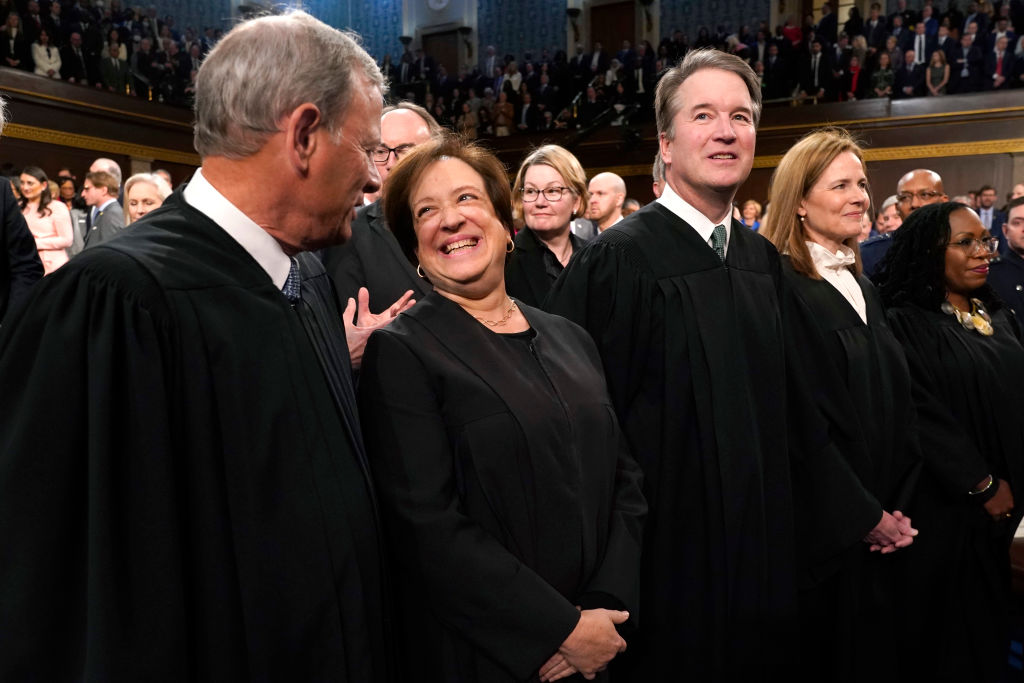
Americans have favored higher taxes on the wealthy for decades, and that preference is starting to harden into an urgent demand. But to win it would require overcoming a conservative Supreme Court and an obscure constitutional provision. (Jacquelyn Martin Pool / Getty Images)
The United States’ descent into oligarchy was first gradual, then swift. While the ultrarich have been steadily accumulating political power for decades, the election of Donald Trump in 2024 rapidly accelerated the process. Since then, the country’s oligarchs have grown increasingly brazen in their takeover of America’s political, economic, and civil institutions — not unlike the billionaire president himself.
A year and a half into Trump’s second term, the billionaire class has never been wealthier or more powerful. Yet this conspicuous takeover of American society has prompted a predictable backlash that appears to be growing in tandem with the rising wealth and power of the billionaires themselves. Just as the first Gilded Age gave rise to the populist and progressive movements, our current age of extreme inequality has driven more people to support proposals that aim to drastically curb the power and wealth of the oligarchs.
Over the last year, no proposal has gained more traction (or attracted more controversy) than the wealth tax, which would directly target the ballooning fortunes of billionaire tax evaders. Though long advocated by progressives and socialists, the billionaire wealth tax was given a major boost last October when the California chapter of the Service Employees International Union–United Healthcare Workers introduced a ballot measure proposing a one-time 5 percent tax on the state’s two-hundred-plus billionaires to help offset federal cuts to health care from last year’s “Big Beautiful Bill.”
Since then, the ballot proposal has not only gained more than 1.5 million signatures on its petition (almost double the number required to appear on the state’s ballot later this year) but has also led many of the state’s billionaires to pour tens of millions into the effort to defeat it. It has also inspired other proposals at the federal level that offer a blueprint for taxing the ultrarich nationwide. The first, introduced last March by Sen. Bernie Sanders and Rep. Ro Khanna, mirrors the California proposal, applying a 5 percent annual wealth tax on the nation’s roughly 950 billionaire households. According to projections, this single tax would raise as much as $4.4 trillion over the next decade, which the bill earmarks for various spending measures.
A few weeks after Sanders and Khanna unveiled their proposal, Sen. Elizabeth Warren, Rep. Pramila Jayapal, and forty-five other members of Congress reintroduced a proposal first put forward in 2019 that would tax the wealth of not only billionaires (albeit at a lower rate) but also those with fortunes over $50 million. The “Ultra-Millionaire Tax Act” would levy an annual 2 percent wealth tax on fortunes valued over $50 million and an additional 1 percent surtax on those valued over $1 billion. If implemented, it would generate around $6 trillion over the next decade and impact the country’s wealthiest 260,000 households.
These projections drive home how much billionaire wealth has exploded in just half a decade. In a 2021 analysis of the Ultra-Millionaire Tax in its current form, economists Emmanuel Saez and Gabriel Zucman projected that it would impact the top one hundred thousand households and raise $3 trillion. The latest numbers reveal that billionaire wealth has doubled since then, while the number of households worth $50 million or more has increased by 160 percent.
As Saez told David Dayen at the American Prospect in March, “The U.S. economy is now so top-heavy that ultra-rich wealth taxes can be very large revenue raisers.” These numbers alone demonstrate the urgent need to tax the rich and explain why popular support for a wealth tax is growing. Americans have favored higher taxes on the wealthy for decades, but as billionaire wealth has soared into the stratosphere, that long-standing preference has hardened into a near demand.
Despite this growing momentum, the odds of enacting a national wealth tax remain slim (unlike the California proposal, which has a real chance of becoming a reality). It is all but certain that as long as Republicans hold power, the chances of passing any tax increase on the rich — let alone a wealth tax — are effectively nil. Even with a future Democratic majority, the odds remain long. While a majority of Americans and nearly eight in ten Democrats back a wealth or billionaire tax, convincing enough Democratic lawmakers to sign off on such a proposal will be an uphill battle even in the most favorable circumstances.
As daunting as these political challenges are, they represent only the first hurdle to enacting a national wealth tax. The far greater obstacle is the legal onslaught that will inevitably follow any attempt to tax wealth. Whatever the political conditions, any serious attempt to tax billionaire fortunes will eventually land before a Supreme Court whose six conservative justices give little reason for optimism.
The Apportionment Problem
The fate of a national wealth tax may ultimately hinge on a few words buried in one of the Constitution’s most controversial passages, right alongside the notorious “three-fifths compromise.” Besides serving as a reminder of the country’s shameful history of slavery, the so-called enumeration clause includes an important provision on taxation that has been disputed since the earliest days of the republic due to its vague requirement that “direct taxes” be “apportioned” according to the population of each state. Today “apportionment” is mostly associated with the distribution of congressional seats based on state population sizes, which is perfectly logical. In contrast, the apportionment requirement for “direct” taxes is perfectly illogical and has been rightly described by one tax scholar as a “constitutional absurdity.”
In her recent book on the history of taxation in America, The Price of Democracy, Vanessa S. Williamson describes the tax apportionment provision as an “ill-considered vestige of the requisition system and the three-fifths compromise” and unpacks the practical implications of the clause. “Under this apportionment system,” Williamson writes, “the federal government would determine a total amount of revenue a tax was supposed to raise, and then assign each state a share of the tax responsibility based not on the amount of the taxable item in each state, but on the state’s population.”
As Williamson goes on to note, none of this makes a lick of sense, and there is “no earthly reason that tax rates should have anything to do with state population.” While constitutional scholars disagree on the actual meaning of “direct taxes” (the founders themselves also disagreed and left it undefined), it was primarily associated with land or property taxes during the country’s first century. Then, in 1895, the Supreme Court decided to dramatically broaden its definition in order to strike down a modest 2 percent income tax that Congress had passed a year earlier. That controversial decision broke with the precedent of the 1860s, when the income taxes passed during the Civil War were tacitly approved by the high court.
The major change in the decades between, notes Williamson, was not precedent but the “ideological tenor” of the court, which by the late Gilded Age had become increasingly conservative and pro-business. The Court’s 1895 decision on the income tax marked the beginning of a forty-year conservative reign, remembered as the Lochner era, when the court regularly struck down labor regulations, minimum wage laws, and other progressive or pro-worker policies. The landmark decision also spurred a popular movement that culminated in the 16th Amendment, which explicitly grants Congress the power to levy taxes on incomes “without apportionment among the several States.”
The Rocky Road to a Wealth Tax
In our own Gilded Age, the ideological orientation of the high court has once again shifted to the right and is now the most conservative it’s been since the Lochner era. This makes it highly likely that a simple national wealth tax would be struck down under the apportionment clause.
While the Constitution “clearly and unambiguously grants Congress the power to legislate an apportioned wealth tax,” University of Missouri tax law scholar David Gamage told Jacobin, a “non-apportioned (uniform) wealth tax” is a “contested question that is more complicated.” Steve Wamhoff, federal policy director at the Institute on Taxation and Economic Policy (ITEP) and former senior tax policy analyst for Sen. Sanders, echoed this sentiment, noting that it’s technically true the Supreme Court “would not say any and all federal taxes on wealth are unconstitutional,” but that they are likely to interpret it as a “direct” tax, in which case it would have to be apportioned by population. This would effectively “rule out the kind of straightforward federal wealth tax proposed by people like Sen. Elizabeth Warren and Sen. Bernie Sanders.”
There may be ways to get around this constitutional roadblock. Scholars like Gamage have designed proposals that specifically attempt to satisfy the apportionment requirement and thus reduce the constitutional risk. These proposals require taxing poorer states at higher rates and adding a mechanism to equalize the fiscal burden later based on wealth, typically through federal block grants and state tax refunds. While these proposals are “a little complicated and a little more difficult for the public (or frankly the typical lawmaker) to absorb,” said Wamhoff, “it could be done.”
Another option that might hold up slightly better under constitutional scrutiny is a tax on unrealized gains or a “mark-to-market” tax. This approach would capture the rapidly expanding wealth of oligarchs like Elon Musk and Jeff Bezos, which currently goes almost entirely untaxed because it is “unrealized” (something the ultrarich are careful to preserve, often taking out low-interest loans in perpetuity to avoid selling shares). An unrealized gains tax can be plausibly claimed to be an income tax, which would eliminate the apportionment requirement. According to Wamhoff, a mark-to-market tax would “logically be more likely to survive a constitutional challenge because arguably unrealized capital gains are a type of income and not wealth.” Yet a tax on unrealized gains would fare only marginally better before the current court, as four justices have already signaled that they view such a levy as a direct tax on wealth rather than income.
In the end, any serious attempt to tax the ultrarich will face significant hurdles regardless of what kind of adjustments are made in a potentially futile effort to accommodate conservative justices. A national wealth tax on the ultrarich commands consistent majority support in polling, which reflects its intuitive appeal and simple premise — neither of which survives the apportionment fix. The case for accommodation rests on the assumption that the Supreme Court can be satisfied. If it can’t, advocates of a wealth tax may be better off pushing for the most ambitious proposal and forcing the court to own the political consequences of striking it down.
As some have pointed out, there can be “unexpected consequences” when the judicial branch oversteps and strikes down laws that are broadly backed by the public. The court’s decision to rule an income tax unconstitutional in 1895 is a case in point. Not only did it undermine the court’s legitimacy with the public, but it also prompted a national campaign to amend the Constitution, which triumphed less than two decades later.
In his acclaimed history of the income tax in the United States, Steven Weisman described the Supreme Court’s ruling as one of the key decisions in the late nineteenth century that “laid the groundwork for the popular revolt against conservatism characterizing American politics” over the next two decades.
For obvious reasons, any wealth tax push should be paired with broader tax reforms and increases that don’t carry the same constitutional risk. This includes hiking the corporate tax and top income tax rates, eliminating loopholes that enable big companies or hedge fund billionaires to pay lower rates, closing the so-called Angel of Death loophole that erases all unrealized gains upon the death of a shareholder, replacing the estate tax with an inheritance tax, and much else. A wealth tax is the logical centerpiece of any program aimed at taxing the rich, but the broader arsenal of tax reforms provides an important bulwark against judicial overreach.