Strikes Are Down, but Workers Are Rediscovering Their Power

A group of researchers tracking every strike in America for the past five years write that after a promising increase in strikes and number of strikers in 2022 and 2023, strike activity dropped off significantly in 2024 and remained low in 2025.
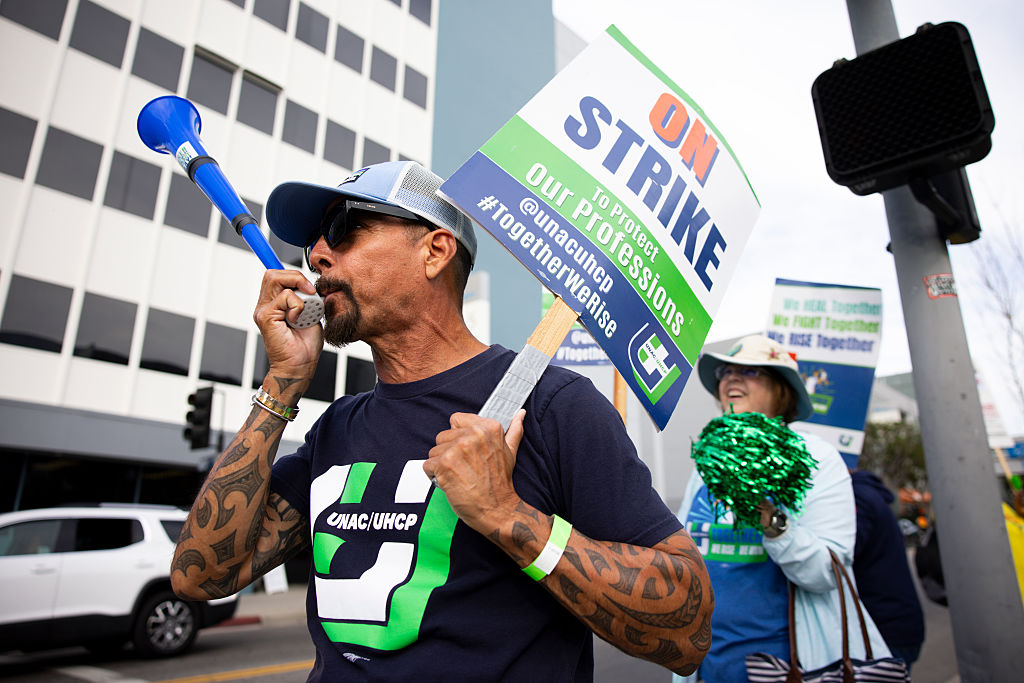
Rolando Escobar, right, a registered nurse, blows a horn during the strike in front of the Kaiser Permanente Los Angeles Medical Center on Monday, February 9, 2026, in Los Angeles, California.

In the context of US strikes that have taken place over the past five years, the most salient strike dynamic in 2026 may be the expansion of basically unquantifiable political strikes. (Kayla Bartkowski / Los Angeles Times)


In the summer of 2020, we decided to count every strike in the United States. The Labor Action Tracker (LAT), currently the only comprehensive strike database in the country, was conceived amid the upsurge of activism during the most intense phase of the Black Lives Matter (BLM) movement. At the time, many businesses shut down, and people walked out of work to protest racism and police violence. Most prominent, the National Basketball Association’s Milwaukee Bucks players refusal to take the court after the police shooting of Jacob Blake inspired a series of strike actions by athletes in various sports. In targeting systems of racism and broader social oppression at the workplace, these activists were reviving the strike as a political tool. But given the inadequacy of official data sources, we had no way of precisely assessing how these strikes fit in with historical trends.

Today is the fifth anniversary of the LAT’s launch, and we now have the data to better analyze the actual dynamics of recent strike activity. When we look back over the past five years, what trends emerge, and what are the lessons for the labor movement and progressive social movements more broadly? At a moment of growing authoritarianism, violent deportations, ever worsening inequality, but also growing resistance, this is a pivotal moment to reassess the power of workers.

Several developments indicate that workers began to reclaim workplace-based organizing and militancy after decades of decline in unionization and strike rates. Organizing victories at Starbucks, Amazon, and other prominent brands in the private sector suggested greater potential for union revitalization. Young, leftist workers who had formative experiences in social movements like BLM would go on to lead several of these campaigns. Many unions no longer view strikes as a last resort against concessionary bargaining by employers but rather as a tool to secure better standards and more control over working conditions. Union reform efforts at the United Auto Workers (UAW) and the Teamsters oriented those unions toward a greater willingness to confront management during contract negotiations, as evident in the Teamsters’ credible strike threat at UPS and the UAW’s “stand-up strike” against the Big Three automakers, both of which secured strong gains for workers. The latter helped contribute to the peak year for strike activity in the United States post-COVID-19, as workers organized 467 strikes involving around 540,000 workers in 2023.

However, the headline numbers are clear enough: after a promising increase in strikes and number of strikers in 2022 and 2023, strike activity dropped off significantly in 2024 and remained low in 2025. Even in the relatively high years of post-pandemic strike activity, our analysis shows that strikes by a few particularly large bargaining units and robust activity in California contributed overwhelmingly to the number of workers on strike.

Workers have won important gains through workplace-based militancy, particularly in unions that have undergone transformation through internal rank-and-file reform efforts. Nonetheless, we are clearly not in a moment of linear growth in workplace-based strikes, nor was the earlier upsurge sufficiently broad-based to precipitate meaningful political reform. While our project has focused on quantifying the scale of strikes, the most salient strike dynamic in 2026 may be the expansion of basically unquantifiable political strikes.

A Few Strikes Equal Most Strikers

Before discussing trends in strikes over the past five years, it’s important to explain how we created and developed the LAT. We drew inspiration from the China Labour Bulletin’s strike map and are part of a broader international community of activists and researchers that have documented labor strikes in various countries. We launched the LAT for two main reasons: to count all strikes regardless of size and whether striking workers belonged to a union, and to amplify the voices of workers on the picket line. The Bureau of Labor Statistics (BLS) kept quite comprehensive data on strikes until funding cuts by Ronald Reagan’s administration in the early 1980s, which led the BLS to only document very large work stoppages involving 1,000 or more workers. Considering the further politicization of the BLS under the second Trump administration, it is imperative to have reliable strike data outside of government statistics.

To understand how we add strikes and nonstrike protests to our database, our methodology is available here.

Most strikers in the United States have been concentrated in a relatively small number of events. We found that the five largest work stoppages in each year constituted a majority of workers on strike nationwide. For example, in 2023, the Screen Actors Guild–American Federation of Television and Radio Artists (SAG-AFTRA)–Alliance of Motion Picture and Television Producers (AMPTP), Service Employees International Union (SEIU)/Office and Professional Employees International Union (OPEIU)/International Federation of Professional and Technical Engineers (IFPTE)–Kaiser Permanente, SEIU/United Teachers Los Angeles (UTLA)–Los Angeles School District, UAW–Big Three, and UNITE HERE — Hotel Association of Los Angeles strikes made up over two-thirds of the 539,000 workers on strike. This suggests that while factors like internal reform efforts at legacy unions, favorable labor market conditions, and pro-labor policies likely contributed to this post-COVID peak, the reality that multiple large bargaining units had contract expirations in the same year largely drove this uptick.

This contingency argument also applies to the number of strikes organized each year. Organizing wins at Starbucks drove a wave of strikes at the company in 2022 and 2023, with 101 and 88 strikes in these years. Nationwide the total number of strikes declined by 102 from 2023 to 2024, but strikes at Starbucks dropped from 88 to just one. Therefore, the primary cause of reduced strikes in 2024 was a decline in the number of actions at Starbucks.

Table 1
Top five largest strikes/year compared with total number of workers on strike/year
YearTop Five StrikesTotal% From Top Five Strikes
202182,100140,00058.64%
2022119,500224,00053.35%
2023370,100539,00068.66%
2024152,300293,00051.98%
2024183,000290,00063.10%

For a project created in a time of increased interest in unconventional labor actions, legacy unions still represent the vast majority of American workers who walk off the job. Wildcat strikes are nearly nonexistent in the United States, except for certain groups of public sector workers that use sick-outs to bypass strike bans. Of the 1,308 strikes by unionized workers from 2021–25 where we could determine authorization status, only 6.4% were unauthorized.

This further demonstrates the importance of internal rank-and-file reform efforts, such as those in the Chicago Teachers Union, the Teamsters, and the UAW, that push unions to fight at the bargaining table, as organizational support remains essential for mobilizing and sustaining strikes. Arguably the biggest surprise of our project is that nonunion workers organized approximately one-third of all strikes from 2021–22, though the percentage of strikes organized by nonunion workers declined to 22% for 2024–25. These strikes also involve far fewer workers than those led by unions.

Our project has also revealed important geographic disparities in strikes. The Western region (the Rocky Mountains and west) has consistently contributed more than 60% of the workers on strike in the last three years, rising to 77.1% of all strikes in 2025. California’s importance is particularly notable, with the state contributing a substantial share of total workers involved in strikes.

As Table 2 shows, California workers represented about two-fifths of all workers on strike from 2021–24, signaling how the state’s large workforce and strong labor movement continue to shape the broader landscape of labor activism. In 2025, California workers comprised nearly two-thirds of all workers on strike across the country, mainly due to large actions such as the short duration American Federation of State, County and Municipal Employees (AFSCME)/Communications Workers of America (CWA) strikes in the University of California system, the SEIU LA County strike over two days involving 55,000 workers, the five-day strike by unions affiliated with the Alliance of Health Care Unions at Kaiser Permanente, and the open-ended Starbucks Workers United strike that began in November 2025 at locations in California and beyond.

Table 2
Workers on strike in California compared with total number of workers on strike nationally
YearCaliforniaTotal% From California
202163,958140,00045.68
202289,691224,00040.04
2023219,918539,00040.80
2024127,312293,00043.45
2025188,896290,00065.13

When we look back over the past half decade, the broader data tell a sobering story. The apparent surge in labor militancy is less a nationwide groundswell than the result of a handful of large, highly visible actions, many of them concentrated in the West. Rather than signaling a sustained national uptick in worker power, the numbers reveal how uneven and fragile today’s labor push really is. That geographic and numerical imbalance underscores the central challenge that without a deeper, more widely distributed wave of organizing and collective action, pressure from below will likely remain too thin to force meaningful political change from above.

Nonetheless, high strike activity is not always equivalent to more political power for the working class. A qualitative shift in labor’s power is equally important. The 1970s saw some of the highest levels of strikes in US history, but these defensive strikes coincided with the demise of labor’s institutional power rather than its rebirth.

Political Strikes

Even if the recent level of strikes is relatively low when considered against historical precedents, there are tentative signs that labor and social movements of the past decade have altered the political terrain. As has been widely reported, Americans’ support for unions has increased dramatically since its low in 2009, with approval hovering around 70% since 2021.

Despite high levels of public support and a very pro-labor National Labor Relations Board (NLRB), the drop in strikes began while Joe Biden was still in office. Nonetheless, with the sharp anti-worker turn of Donald Trump and loosening of the labor market, conditions for striking became markedly worse in 2025. Social movement activity increasingly focused on the fight against fascism and in particular the mass violence of deportations. The No Kings protests in the summer and fall of 2025 brought millions of people into the street.

The Minnesota conflagration in January further intensified this dynamic as liberals and moderates continued to move to the left while embracing more confrontational tactics. Amid the federal government’s xenophobic terror campaign, tens of thousands of people engaged in mutual aid, took to the streets in marches, engaged in civil disobedience, and monitored and disrupted Immigration and Customs Enforcement (ICE) activities, all while enduring violent repression.

In this context, the call for a general strike on January 23 appeared as a commonsense tactical escalation. Calls for a strike were no longer limited to radical social media posts but were embraced by hundreds of community and religious groups, schools, and unions. The Minnesota AFL-CIO supported the strike call, and several unions throughout the state worked around no-strike clauses to support the effort.

The strike and broader mobilization were a major success. According to one survey, 45% of all Minnesota voters and 80% of self-identified liberals supported the action. Soon thereafter, ICE announced it would be drawing down its forces, and Border Patrol commander at large Gregory Bovino was relieved of his duties. The Minnesota fiasco undoubtedly hastened the demise of then Homeland Security Secretary Kristi Noem and, at a minimum, forced ICE to take a less spectacularly violent approach.

In the months since, driven by multiplying domestic crises and widespread disillusionment with Trump’s war of imperialist aggression in Iran, calls for political strikes have gained ground nationally. The March 28 No Kings Day — one of the largest single protests in American history — saw widespread calls for a May Day general strike, including from Indivisible. Hundreds of organizations in the May Day Strong coalition have called for no work, no school, and no shopping on May 1 to oppose authoritarianism, ICE, and the war in Iran and to demand taxes on the rich. Dozens of Solidarity Schools have sprung up around the country to provide training and build capacity for collective action. Looking a bit further into the future, the UAW has been pushing the labor movement to align their contracts and prepare for a nationwide general strike on May Day, 2028.

The questions that remain are whether political strikes can be effectively deployed at the current level of workplace organization and whether they continue to emerge in the absence of militarized occupation of cities, like in Minnesota earlier this year. The relatively low levels of strike activity outside of several large bargaining units and certain hot spots of labor militancy, especially since 2023, suggest challenges for constructing this sustained political capacity.

At a moment when we are witnessing the mainstreaming of multiple left-wing demands and the reemergence of the strike as a political weapon, unions will need to build strong workplace power while also working in coalition with the broader movement to defeat oligarchy and rebuild democracy.

Share this article

Contributors

Johnnie Kallas is an assistant professor at the University of Illinois School of Labor and Employment Relations and the project director of the Labor Action Tracker.

Deepa Kylasam Iyer is a PhD candidate at the Cornell University School of Industrial and Labor Relations and a project coordinator with the Labor Action Tracker.

Luke O’Brien is an undergraduate student at the Cornell University School of Industrial and Labor Relations and a research assistant with the Labor Action Tracker.

Eli Friedman is the author of Insurgency Trap: Labor Politics in Postsocialist China. He teaches at Cornell University.

Filed Under