The Citywide General Strike Has a Rich History in America
In response to the killing of Renee Good and the ICE invasion, the Minneapolis labor movement has issued the nation’s first citywide general strike call in nearly 80 years, set for tomorrow. It is building on a grand American labor tradition.
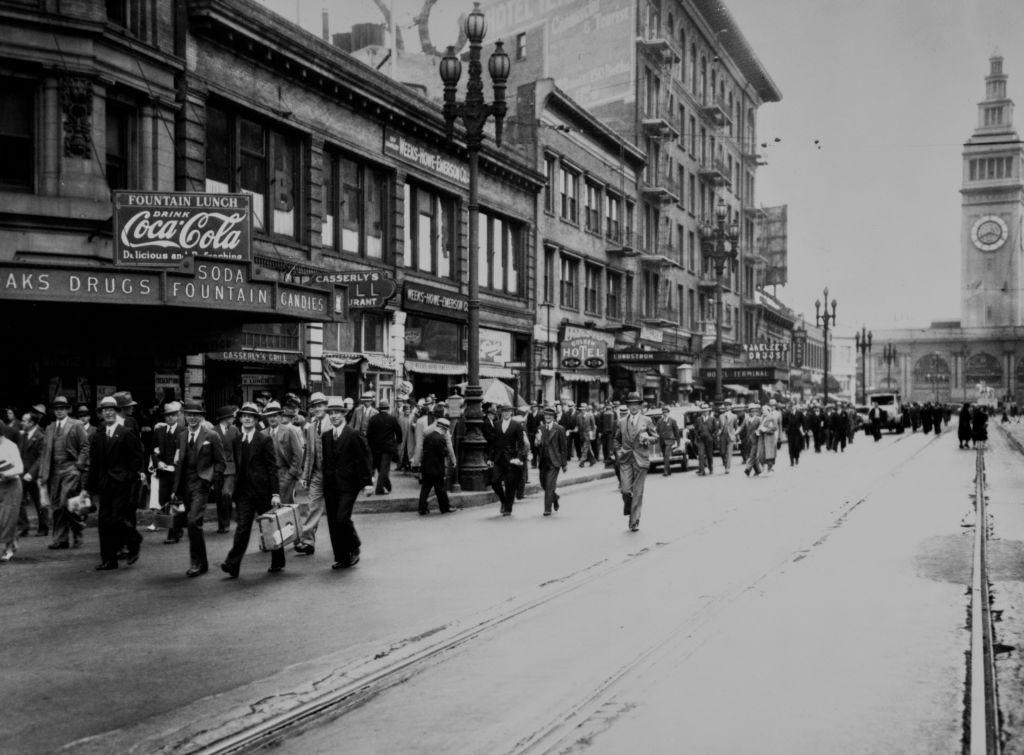
Striking workers march along Market Street in San Francisco during the general strike, July 16, 1934. (UPI / Bettmann Archive / Getty Images)
Unions, community and faith groups, and small businesses are preparing for a day of “No Work, No School, and No Shopping” on Friday in the Twin Cities in protest against the Immigration and Customs Enforcement (ICE) invasion and January 7 murder of Renee Good. Hundreds of businesses have pledged to close; hundreds more plan to remain open but donate the day’s proceeds to victims of the ICE assault and organizations seeking to protect them.
Lending moral backing for the day is the call by faith leaders to honor the memory of Good. Providing the organizational backbone is the somewhat ambiguous but official call for a general strike by the Minneapolis American Federation of Labor and Congress of Industrial Organizations (AFL-CIO) and its sister local federations throughout the state — the first such call in three-quarters of a century.
As events unfold, it may be helpful to remind ourselves of the history of citywide general strikes in America.
General strikes are difficult to pull off and thus relatively rare. They’ve occurred little more than a dozen times and have usually had a major impact on working conditions and public policies. They have often arisen in the context of smaller actions against injustice building toward larger ones. These events are gaining renewed interest today in the search for effective tactics to resist authoritarian rule.
This will not be Minneapolis–St Paul’s first go-around with the tactic. The 1934 general strike — a foundational event for the city and state’s unions — may have moved beyond the reach of individual memory in recent years, but it suffuses the regional labor movement’s collective sense of its own origins. Add that background to the ICE incursion and the brutal and illegal execution of Good, and you have the ingredients behind the reentry of city general strikes onto the American political scene.
1835 — Philadelphia
Supporting a coal heavers’ strike on the docks, the General Trades Union (GTU), an early central labor council, issued a call for a standard ten-hour day, sparking the first citywide general strike in US history. The GTU also pioneered solidarity between skilled and unskilled workers when it admitted the coal heavers into a previously skilled-only organization. The general strike achieved its goal of a ten-hour day for most workers. But the GTU, like most labor organizations of the nineteenth century, could not survive an economic depression, which in this case occurred two years later — at which point the ten-hour day disappeared as well.
1877 — St Louis
In the midst of the first national strike of an entire industry, fought by railroad workers against employers pushing wages down to starvation levels during a severe economic depression, workers in St Louis led by the socialist Workingmen’s Party of the United States walked out in solidarity with the railroad strike and on behalf of demands of their own. A chaotic affair, in which many workplaces were shut down for anywhere from a few hours to several days, the general strike lasted a week in late July before the national rail strike was put down by the federal government and the railroad corporations through a combination of federal troops and hired thugs.
1886 — National
The only national general strike in American history was called by the labor movement for May 1 to support a decades-long campaign for the eight-hour workday. A third of a million workers walked off the job. Chicago saw the largest demonstrations, essentially a citywide general strike that continued for days. But a rally protesting police murders of strikers was interrupted by a bomb, followed by brutal repression. Assaults by the authorities on civil liberties, especially harsh for immigrant workers, included death by hanging of several labor leaders in a transparent miscarriage of justice, an episode now known as the Haymarket affair. This “red scare” set back the eight-hour movement for decades, but also resulted in May 1 being declared International Workers’ Day by the Socialist International to honor the eight-hour martyrs.
1892 — New Orleans
About half the working population of this port city struck on November 8. These workers swelled the ranks of three unions already walking picket lines seeking a union shop, pay for overtime work, and a ten-hour workday. Notable during the general strike were the ugly race-baiting divide-and-conquer tactics of the employer-controlled newspapers and the firm commitment by the Workingmen’s Amalgamated Council in charge of the strike to keeping its black and white membership unified and peaceful on the streets. After five days, the employers’ association agreed to the ten-hour day and overtime pay, but not the union shop.
1919 — Seattle
Backdrop: an upheaval of the international working class in the wake of the 1917 Russian Revolution, and industrial layoffs in a shipbuilding town following the end of World War I. When employers broke their promise to negotiate with the shipyard unions, first those workers shuttered the yards, and then all the unions affiliated with the labor council walked out in solidarity. With a high proportion of single male workers reliant on restaurants to eat among the 65,000 workers on strike, the unions organized meals for thousands at union halls for several days. American Federation of Labor (AFL) and Industrial Workers of the World (IWW) locals, usually split along ideological lines, cooperated to keep the city running and peaceful before employers, city government, and the National Guard crushed the strike. The repression of labor leadership and left organizations following the strike’s end foreshadowed the upcoming national Red Scare and Palmer Raids.
1934 — San Francisco, Toledo, and Minneapolis–St Paul
Not one but three citywide general strikes rocked the country during one of the most militant years of the Great Depression, with a national strike of the textile industry thrown in for good measure.
The San Francisco General Strike emerged out of a West Coast–wide maritime strike, in response to police shootings of strikers. Longshoreman Harry Bridges rose to national prominence for his role leading the general strike, which established the power of the International Longshore and Warehouse Union on West Coast docks.
In Minneapolis–St Paul, a large Teamster local organized drivers across the city and occupational lines. When its demands for union recognition and wage increases were rejected by employers, the local struck, with other unions joining in a general strike. After success in the strike, International Brotherhood of Teamsters Local 574 helped unions in other industries organize the city into one of the most unionized in the country.
In Toledo, a strike of autoworkers for union recognition and wage increases featured enormous picket lines with thousands of participants, demonstrations, and violent confrontations.
In each of these three citywide strikes, the intransigent anti-union behavior of employers and public authorities — who unleashed police and National Guard violence on their behalf, on top of ongoing dire economic circumstances for working-class communities — led to powerful and courageous collective action by the workers. In each city, they were led by radical labor organizers (Communists in San Francisco, Trotskyists in Minneapolis, and Socialists in Toledo). In each city, the unions carefully built alliances with unemployed workers beforehand to reduce the potential pool of strikebreakers. In each city, strikers died at the hands of police, and hundreds were injured. Not coincidentally, the National Labor Relations Act, setting up rules for peaceful conflict resolution between labor and capital, passed in Congress the following year.
1946 — Stamford and Hartford, CT; Camden, NJ; Lancaster, PA; Rochester, NY; Oakland, CA
Doubling the previous record for citywide general strikes in a year, 1946 witnessed six: five in the Eastern United States and one in the West. Each of these city work stoppages featured its own local grievances and demands. But they were also part of the largest wave of strikes in American history, as the wage and price controls from World War II were lifted, prices of basic goods rose, and workers demanded that their wages keep pace. In all, four and a half million workers walked picket lines throughout the year.
A Final Note
As fascism increasingly penetrates and guides the apparatus of the federal government, a movement has been building to oppose it. It is moving faster in Minneapolis in response to the larger, more coordinated, and more deadly forces deployed there by Donald Trump. In recent days, marches, demonstrations, and spontaneous local acts of resistance to ICE abuse have multiplied, building toward Friday’s mass event. Whether it takes the classic form of a general strike as outlined in the above examples remains to be seen. With a smaller labor movement and restrictive laws put in place following the last wave of general strikes in 1946, we are in a different moment of history.
However, over the past few decades some large-scale protests have referred to, and in some respects echoed, elements of citywide general strikes, like the 2006 immigrant rights demonstrations (“A Day Without Immigrants”); the Occupy Oakland port shutdown of November 2011; and the “red state revolt” of public education unions in 2018. Labor historian Jeremy Brecher has dubbed these mass actions “social strikes” in reference to their hybrid combination of workplace and community activities — maybe not involving an entire city at a standstill, but developing significant forms of resistance to the abuses to democracy and human dignity we are suffering. This is probably more like what we will see in Minneapolis. And win, lose, or draw, we will learn from the experience for the next step.