May Day: An Answer to Rampant Individualism 

Countless influencers and quack positive-thinking gurus tell us that success is all a matter of individual effort. International Workers’ Day reminds us that individuals are happiest when we have others standing alongside us. 
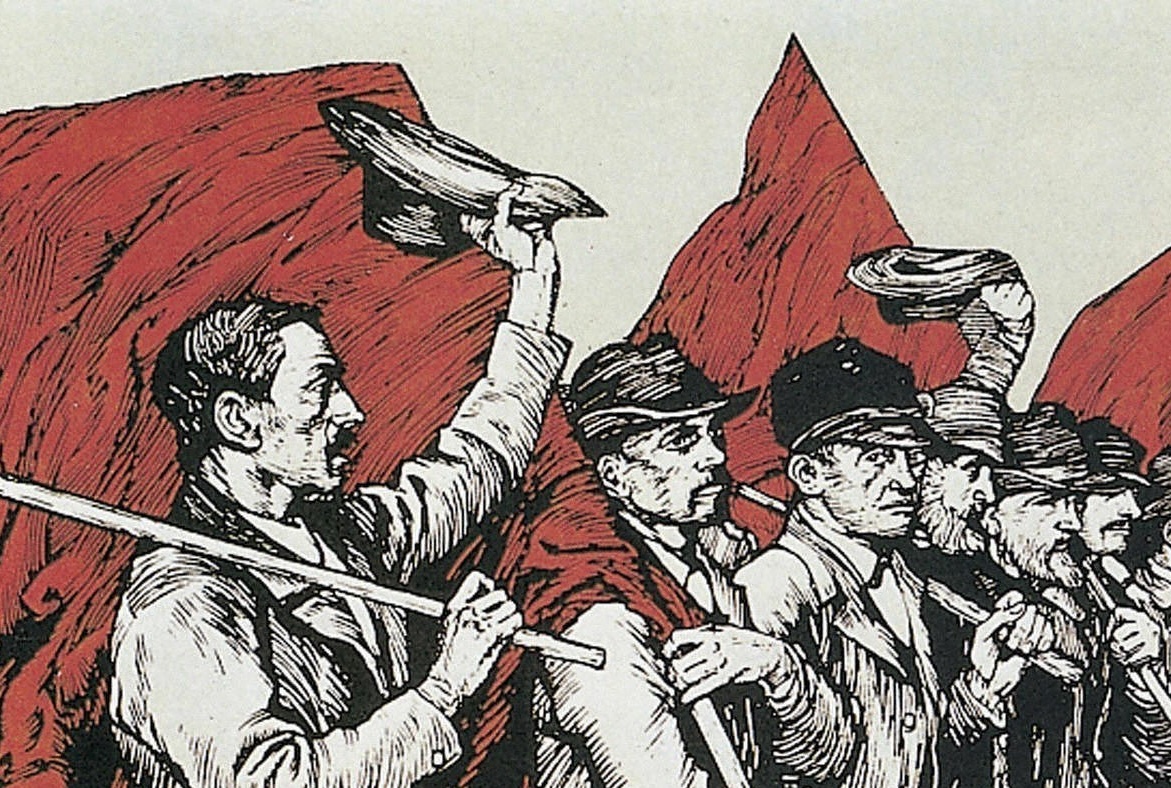
A wood engraving from the Maifestzeitung 1904 of the German Social Democrat Party's organ <cite>Vorwarts</cite>, depicting workers marching with red flags to commemorate May Day.

Trade unions defend not just workers’ conditions but the right to an existence not cramped by the pressures of the job. On May Day, we celebrate workers’ right to work less. (Photo 12 / Universal Images Group via Getty Images)


In its failed attempts to undermine and abolish the May 1 bank holiday, the French government has sought to depict International Workers’ Day as an anachronism. But when we look at the problems facing society today — and the ways in which people are trying to deal with them — it strikes me that a day dedicated to the collective power of working people is needed as much now as ever before.

Everywhere we turn now, we are confronted with the negative impact on people of the politics of isolationism. A world in which every problem you face is your fault and can only be resolved by you alone. It’s not a new phenomenon. British Prime Minister Margaret Thatcher told us in the 1980s that “there is no such thing as society.” But it certainly has been exacerbated by the social conditions of our time.

In his new documentary on the “manosphere,” Louis Theroux shines a light on the online community that tells young men they are struggling financially because they are simply not “alpha” enough. Many are convinced to send what little money they have to influencers who share the supposed path to success. That usually consists of treating women appallingly, abusing drugs to acquire a certain physique, and putting themselves in further financial difficulties to obtain status symbols.

Equally, women can’t look at their phones without being tormented by videos of “tradwives.” Women struggling to juggle work and care responsibilities are told that their stresses will disappear by donning an apron and turning the clock back to simpler time, when women were, allegedly, taken care of economically by their breadwinning husband, on the condition that they provided labor in the domestic sphere. Keep scrolling, and you’ll find someone else sitting crossed-legged on the floor telling you all your problems can be resolved by breathing slowly and thinking positively. That may well have a role to play, but as a new book by sociologist Damien Karbovnik points out, that kind of “positive psychology puts the responsibility on individuals, as if the social or economic context has no influence.” Worse still, any form of collective resistance, dare we say rage, has no place or legitimacy, as that would run counter to a “positive mindset.”

In fact, anyone looking to improve their personal wellbeing would do well to start by accepting that we exist as individuals as part of a society. That we cannot solve every problem we face alone. Sometimes we face common challenges that require common solutions.

The isolated young men on which the likes of Andrew Tate prey are experiencing the same problems as millions of their peers. Problems caused by political and economic decisions taken after the financial crisis to dismantle security and promote precarity. The women targeted by “tradwives” have had their lives made harder by cuts to welfare and public services that have exacerbated already unequal caring responsibilities. The same women are likely to be exposed to a wave of hatred and misogyny, online and offline, of which new shocking variations seem to appear every single day, while support networks are targeted by funding cuts or criminalized. We all, women and men, old and young, are worse off — materially and mentally — because of the decisions taken by neoliberal politicians who then tried to convince us it was all our own fault. That is called gaslighting.

In this context, a day dedicated to the power of collective action could not be more relevant. On May Day, we celebrate the victories we have already achieved by coming together in trade unions, and we demand a better future still. Not only is coming together a practical solution to our problems, but it’s empowering for individuals and liberating to know we have others on our side. May Day demonstrations will be taking place in towns and cities across Europe today, each with different demands to meet their circumstances. What we in the European Trade Union Confederation are trying to do is to create the conditions for workers to come together and win wherever they are.

The key is rebuilding collective bargaining. More than three million workers have lost the benefits of collective bargaining since the turn of the century because of austerity and union busting. The results have been lower living standards and an explosion in insecurity. Not everyone lost out though. CEOs and shareholders have taken a greater share in profits at our expense. This increased economic inequality and weakened social cohesion, leaving people vulnerable to the snake oil salesmen on social media.

Through the European Union’s Minimum Wage Directive, we won a requirement for all member states to take action to restore the share of workers covered by collective bargaining to at least 80 percent. Now we are fighting to ensure that public contracts — worth €2 trillion every year — go to companies that respect workers’ right to collective bargaining. That would give working people not only the power to negotiate better wages but also create a requirement for companies to create apprenticeships for young people and deliver equal pay for women who are paid hundreds of euros less than men for doing work requiring the same levels of skills, education, and physical effort. Through the EU’s new Pay Transparency Directive, “which aims to force companies to reveal and act upon gender disparities,” the collective fight for equal pay will be supported, as every woman worker can count on their trade union reps to face employers that are paying their workers unfairly.

Trade unions have every reason to be proud of what we have achieved together: decent wages, safer workplaces, and stronger rights that benefit all workers, not just our members. Those gains didn’t come easily; they were won through collective strength, solidarity, and a willingness to stand firm when it mattered most. And that hasn’t changed. When workers are threatened, intimidated, or treated unfairly, trade unions don’t back down. To anyone who thinks they can bully workers: we see you, and we will stand up to you.

As the saying goes, united we bargain, divided we beg. That’s as true today as it was 140 years ago when European workers came out to demonstrate on May 1 for an eight-hour working day. We face different challenges now, but the answer to most of them still lies in coming together. May Day reminds us of that essential truth.