May 1: Day of Work or Workers’ Day?

In France, May Day has long been a day for all workers to stop working. A recent proposal for some businesses to remain open forced unions to defend the idea that French workers keep May Day as a day to themselves.
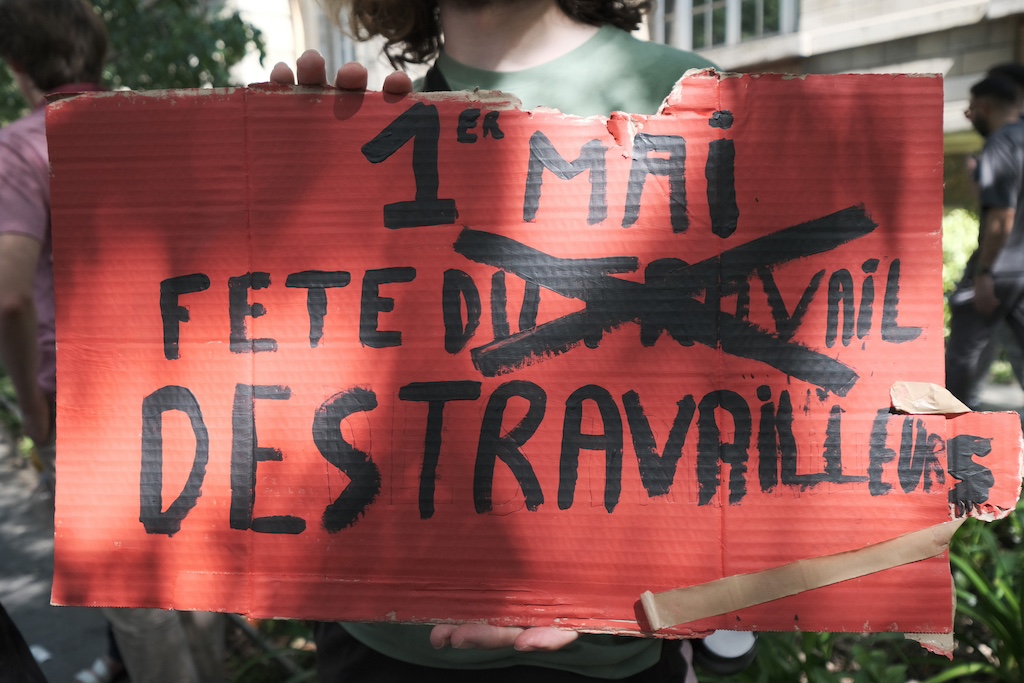
A red sign that reads "1st May fete du travail des traveileures," with an x over du travail.

A sign at the 2025 May 1 demonstration in Paris. (Courtesy of Thomas Le Goff)


For several weeks, the idea of the first of May as a nonworking public holiday for all workers has been contested in France. After well over a century at the center of the international workers’ movement calendar, it took an effort by trade unions to defeat a draft law allowing bakeries, pastry shops, and independent florists to open during the holiday.

Marylise Léon, head of the French Democratic Confederation of Labour (CFDT), objected to the idea “that people should always have to work more, even on the very day that symbolizes the rights won by the working world.” And Sophie Binet, the head of the General Confederation of Labour (CGT), pointed out that if the law were passed, it “would make it possible to have at least 1.4 million more workers working on May 1.” The mobilization proved effective, and Sébastien Lecornu’s government did not end up introducing the bill. But the fact that it was even such a live debate in France tells us something important about the political winds in the country.

The Martyrs

May 1 carries several meanings in social and political history. First and foremost, it is a nonworking day — an occasion to go on strike and participate in the labor movement’s marches and demonstrations — a sometimes-insurrectionary dimension of the day that has led to numerous repressions. In this sense, it serves as a commemoration of Chicago’s Haymarket Massacre in 1886, or five years later in France when multiple labor movement demonstrators were injured or killed in a similar episode.

An engraving of the Fourmies massacre in France, with people in despair, one holding a French flag, with soldiers pointing their guns at them.
An engraving of the aftermath of the Fourmies massacre, published on the front page Le Petit Parisien, May 17, 1891. (E. Glair-Guyot, adapted from a photograph by M. Perron / Musée de l’Histoire vivant)

In the small industrial town of Fourmies in the Nord, a worker protest was met with fierce opposition from local employers, who had announced the day before, via public notice, that “work will proceed on May Day as on any other day; any contrary movement will be severely repressed.” These explicit threats did not deter mobilization. Armed troops, equipped with Lebel rifles, opened fire on the demonstrators. Nine people were killed, including two children, and thirty-five were wounded.

The Mobilizations

Across the capitalist world, newly formed parties of the Second International promoted resolutions to mark May Day as the day of working-class resistance to capital. “The May 1st resolution was the finest our congress has produced. It proves our strength across the world,” wrote Friedrich Engels in April 1890.

A few days later, on April 29, French revolutionary Louise Michel declared:

The earth provides enough for all. Do not beg, on May 1st, for what you have the right to demand. Walk with your heads held high. Remember that you are the force. The May 1st demonstration must take on a revolutionary character, herald the coming of the social Revolution. Our comrades in Chicago died for an idea, for the revolutionary idea. That is the fate I wish upon myself.

The very next day, she was arrested in Paris, at the Gare de Lyon station.

By 1906, France was under a reform-minded government, but one that still attempted to quell mobilization around the eight-hour workday. Paris was placed under a state of siege: more than 36,000 troops were deployed, and working-class militants are hemmed in, charged, and arrested. Over two thousand workers, deemed guilty of leaving their posts on May 1, were dismissed by employers. It is in this context of the fight for reduced working time that May 1 crystallized the organized struggle to gain new rights.

A sepia-colored postcard showing a banner hung on the Labor Exchange Building in France that reads,
A postcard showing a banner hung by militant typographers at the Labor Exchange Building: “Starting on May 1st, 1906 we won’t work more than 8 hours per day.” (Musée de l’Histoire vivant)

The Many May Days

Beyond the moments of remembrance for the martyrs of the workers’ movement, May 1 came to symbolize the powerful mobilizations of emerging labor organizations. In the aftermath of World War I, the day became institutionalized, laying bare the divisions within the workers’ movement. On May 1, 1920, in Soviet Russia, it was recast as the day of the great subbotnik (the “Communist Saturday”), a celebration of “liberated and joyful labor” staged on the square of the Winter Palace.

A poster that has multiple hands holding a flag reading
A CGT poster for May 1st, 1936, celebrating unity and calling for peace and a forty-hour workweek. Later that month, the Popular Front alliance of left-wing parties won the legislative elections. (Apic / Getty Images)

In 1933, May 1 was hijacked by Adolf Hitler and recast as an official celebration of the Nazi regime: first as the festival of “national labor,” then, from 1934 onward, of the “German people.” Inscribed into the official calendar of the Third Reich, May 1 became a central instrument for disciplining the working class. Under the direction of the Ministry of Propaganda and Public Engagement, it was deployed to win over German workers to Nazism, remolding them into militants of the so-called “people’s community.”

In contrast to the Nazi’s hollowed-out May 1, the day took on a new, openly anti-fascist form elsewhere — especially in France, from 1934 onward. On May 1, 1936, the CGT, recently reunified at its Toulouse congress, celebrated not only its restored unity but forcefully advanced its demands: the forty-hour workweek, collective agreements, and peace. The day unfolded as a surge of mobilization between the two rounds of the legislative elections that brought the Popular Front to power.

The social and political dimensions came together in an anti-fascist response born of popular unity, even if workers still had to strike to demonstrate for what was not yet a guaranteed day off. Placards proclaimed: “Railway workers, builders of the Popular Front, for Bread, Peace, and Freedom.” Yet repression persisted. Many trade unionists were fired, and tensions spilled over into the great strikes of spring 1936, first erupting on May 11 in Le Havre, then on May 13 in Toulouse, before spreading to the Paris region, where factory occupations took hold.

A poster of a hand reaching down to pluck a lily of the valley, with a factory in the background, it reads,
A 1942 Vichy-era poster commissioned by Philip Pétain’s government. The Popular Front’s red wild rose flower is pushed into the background, while lily of the valley, long associated with the Virgin Mary, takes center stage. The visual propaganda of the World War II occupation repurposed familiar symbols to emphasize conservative values. (Hugon Roland / Universal History Archive / Universal Images Group via Getty Images)

During World War II, under the Nazi-collaborationist Vichy regime headed by Philippe Pétain, May 1 became a site of revenge against the Popular Front and the workers’ movement. Renamed the “Day of Work,” it erased the subjects of organized social struggle: unionized workers. What remained was a stripped-down celebration of one pillar of the regime’s “National Revolution” trinity: work, family, fatherland. The holiday’s collective character was lost, superseded by the cult of the head of state typical of fascist regimes, in which Pétain became “Saint Philippe.”

In the aftermath of the war, May 1 reclaimed its meaning. On April 26, 1946, the tripartite government of the new Republic granted May 1 the status of a nonworking day, securing what the Popular Front had been unable to achieve. This commitment was deepened and made permanent by a law passed on April 29, 1948, which established May 1 as an official public holiday. The day thus became a consecration of workers’ dignity and sovereignty. Celebrated with family, comrades, and friends, it also took on the character of working-class sociability.

May 1968

By the 1950s in France, May 1 had settled into an unmistakably working-class celebration, marked by the sale of lilies of the valley, which replaced the red wild rose of the 1930s. Yet marches in Paris were frequently banned by the police prefecture; it was not until 1968 that a demonstration was authorized for the first time since 1954, drawing around one hundred thousand participants.

By the late 1960s, workers’ demands and student mobilization were converging in the Paris region and beyond, spilling over into the upheavals of May–June 1968. In the wake of the brutal repression of the Night of the Barricades, the CGT brought together other trade union organizations and called for a general, cross-sector strike on May 13, 1968 — ten years to the day after the beginning of General Charles de Gaulle’s return to power. The strike was a resounding success, particularly in the north of the country, including the Paris region. Most importantly, it opened the door for workers in many workplaces, already mobilized around specific demands, to launch strike movements of their own after May 13.

Across the country, roughly 450 demonstrations brought workers, youth, students, high schoolers, and onlookers to the same marches, giving rise to a collective exchange that became one of the defining features of the May–June 1968 movement. Throughout the upheaval, contact between students and trade unions were maintained, even if relations between the CGT and the National Union of Students (UNEF), suspected of leftist radicalism, remained marked by deep mistrust.

Following the events of 1968, May 1 once again became a day of working-class celebration, featuring demonstrations that were sometimes unified, sometimes not, but consistently aligned with the expectations of workers and their trade union organizations.

A 1988 poster that reads,
A 1988 poster commissioned by the Front National, featuring Joan of Arc in an attempt to fuse May Day with a traditionalist celebration of the national heroine. (Patrick Aventurier / Gamma-Rapho via Getty Images)

“Beware of the Impostors!”

However, in 1988, Jean-Marie Le Pen, leader of the far-right National Front, attempted to wrest control of May 1 away from worker and trade union organizations. He decided to mix it with the celebration of Joan of Arc. These demonstrations drew Pétain nostalgists and other currents of the far right. During one such march in 1995, a young Brahim Bouarram was thrown into the Seine and murdered by three skinheads.

From that point on, May Day, long an expression of workers’ internationalism, became increasingly contested. Annie Ernaux recalls this forcefully and lucidly in a Le Monde column pointedly titled, “May 1st: Beware of the Impostors!” She denounces the maneuvers of the Right, urging, “Let us not allow the Right to appropriate this day of memory and struggle.”

In 2023, amid the mobilization against pension reform, May 1 took on a renewed character. A joint march brought together the eight main French trade unions, giving the day a more combative and united tone once again.

May Day remains, however, a festive moment — a holiday that celebrates workers. The mobilizations of 2026, for instance, will highlight the ninetieth anniversary of the Popular Front, paid leave, collective bargaining agreements, and the election of union delegates within firms. But they will do more than commemorate past victories; they will point toward new horizons, a broader emancipation grounded in equal rights, and an internationalist vision that stands firmly against all forms of imperialism and fascism.