NYC’s Economic Development Corporation Can Build Public Options
The Left needs to show it can deliver bold, ambitious new public services. Zohran Mamdani can transform the Economic Development Corporation into an incubator for public goods that can meet the needs of all New Yorkers.
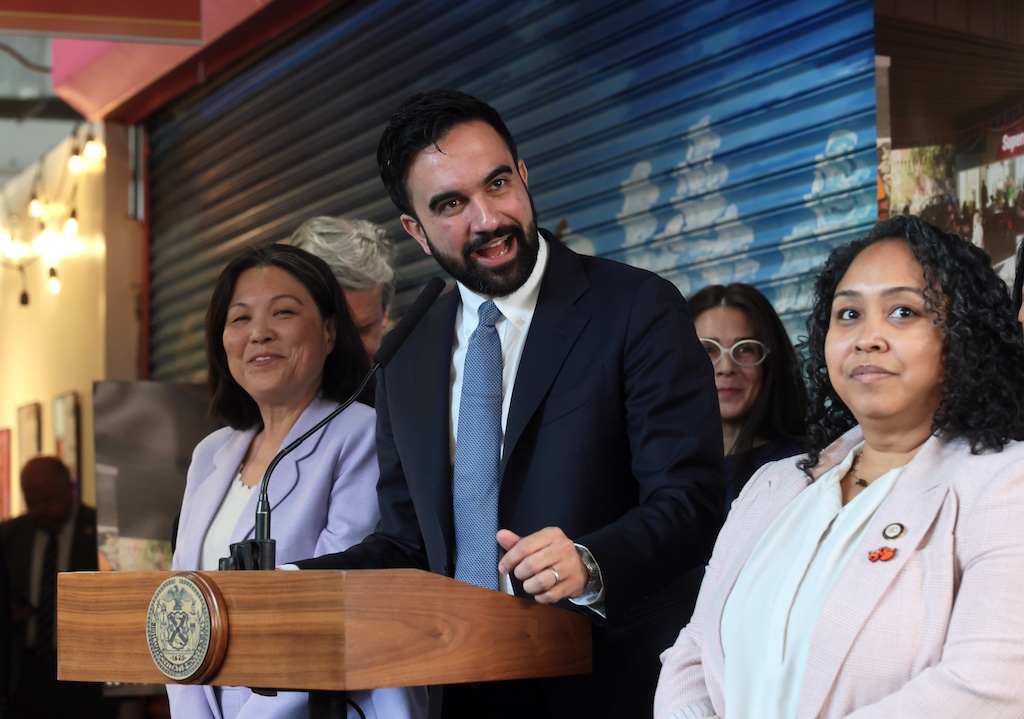
Zohran Mamdani is turning Hunts Point in the Bronx into a publicly owned grocery store next year. (Spencer Platt / Getty Images)
In January 2021, workers at the Hunts Point Produce Market in the Bronx walked off the job for a one-dollar raise. Some pro-labor politicians like Rep. Alexandria Ocasio-Cortez flocked to the picket line. But Mayor Bill de Blasio stayed home. The awkward truth was that Hunts Point sits on land owned by New York City and managed by the city’s Economic Development Corporation (EDC). In 2013, the EDC handed the market’s owners an 11 percent rent reduction when they threatened to move the market to New Jersey. The EDC included no protection for workers in this deal — it simply handed over public land and public money and stood by while unionized workers fought alone.
At the time, Avi Garelick and Andrew Schustek argued in Jacobin that the Left’s response to the EDC should be straightforward: abolish it and subordinate its functions to direct democratic control. Abolition is the path Boston Mayor Michelle Wu took when she reformed her city’s equivalent agency, the Boston Planning and Development Agency.
We propose a different approach. The EDC shouldn’t be abolished — it should be at the heart of an ambitious rethinking of what government can do, how the city can deliver public services to its citizens, and how a democratic socialist can manage the economy.
We need an economy that works for all, where all workers have good jobs that build real products and deliver services that help everyone live lives of dignity. Using the EDC to create a public options incubator can accomplish exactly that.
Three Decades of Managed Decline
To understand what the EDC could be, we have to understand what it is now and why. The agency grew out of a vision of urban economic development that crystallized across America in the 1990s: the city would get out of the business of directly providing goods and services and instead become a broker of public-private partnerships. This is a kind of watered-down Keynesianism that believes that the government can grow the gross domestic product and create jobs through public investment, but only by directing public investment through private actors.
The EDC delivers on this vision and then some by giving private actors property tax breaks, cheap land, and subsidized financing to attract corporate investment. This activity, theoretically, trickles down to working New Yorkers.
This public-private partnership model is mirrored in the organization structure itself. The EDC is not a city agency. It is a state-created nonprofit entity that operates outside the direct constraints of the city’s procurement rules and budget process. It has more flexibility to pilot new programs and hire experts. It can raise capital through the New York City Industrial Development Agency and Build NYC for public purposes such as offshore wind development. The EDC also controls a massive portfolio of city-owned land. It already operates commercial enterprises directly, such as the Hunts Point market, cruise terminals, and the ferry system.
As is often the case in tax break–driven development, there’s insufficient post-grant oversight to ensure that this money is well spent. This lack of accountability isn’t hypothetical: In 2004, Pfizer took $46 million in EDC incentives to “stay” in New York, then it cut over a thousand jobs anyway. Fresh Direct got $128 million in 2012 to move a warehouse from one borough to another, yet the EDC claimed credit for the jobs that already existed.
Years of disappointment in corporate subsidy–led growth resulted in a community uprising in 2019 that blocked the plans for Amazon to build a headquarters in Long Island City. Activists were right to be skeptical of lofty promises of investment and job growth. Having been rejected by New York City, Amazon instead took massive tax breaks to build in Northern Virginia; despite taking billions in state funds, the company created no new jobs in Virginia last year. The project has largely been seen as an expensive boondoggle, on par with famous failures like the Foxconn debacle in Wisconsin.
Moving Forward With Public Options
All of this power has been used by the EDC to systematically benefit private actors at public expense. It doesn’t have to be this way. Instead of doing giveaways to corporations, we could be using the EDC to build public capacity and produce the goods and services New Yorkers need most. And the way we can do that is through creating public options.
A public option is a “good government program with two features: it provides an important service at a reasonable cost, and it coexists, quite peaceably, with one or more private options offering the same service.” The idea first came into broad public awareness during the debates over the Affordable Care Act, when Bernie Sanders and others advocated for a government program for health insurance to be an option on the public exchanges.

Public options allow the government to introduce more robust competition into a market to keep prices low and expectations high. As the name implies, they are options, not mandates.
Take the example of Direct File (which one of us served as the original architect of): It was a free digital service that allowed taxpayers to submit their tax returns directly to the Internal Revenue Service (IRS) for free before it was eliminated by the Trump administration in 2025. The IRS did not and never will force taxpayers to use Direct File. Any taxpayer could use other software, hire their own accountant, or fill out forms directly themselves.
But those existing options left many needs unmet, and Direct File entered the market with a unique set of features. It was free to use, it would never sell user data, and as an IRS product, it guaranteed accuracy. Others were welcome to out-compete it with better user interfaces, more customized service, a personal touch, or whatever they wished. Direct File raised the bar for competition and accountability.
Public options have been proposed in a number of sectors, such as generic pharmaceuticals, postal banking, and municipal broadband. Mayor Mamdani’s proposal for city-run grocery stores is basically a public option for food.
So much of the private sector has seen record profits without bringing down prices or improving products. A public option can provide a comparable alternative at a reasonable cost.
We envision a future that invests in shared infrastructure, places value in long-term investments, and is committed to meeting the needs of all people with high-quality public goods.
We’ve seen firsthand the power of public options when delivered well. Go back to Direct File. Built by an in-house team in just a matter of months, Direct File received user satisfaction rates higher than Apple or Netflix and increased trust in the IRS by 86 percent, according to user surveys. Despite, or perhaps because of, its massive success, the Department of Government Efficiency (DOGE) focused immediately on Direct File, and it was forcibly shuttered after the 2025 tax filing season. It will return in the future, though — it’s too trusted, useful, and affordable of a public good not to.
Direct File, as an excellent product, is the floor, not the ceiling; it should be the baseline that any government aspires to, from delivering services that people love to reimagining how they are delivered. And the people who worked on it built a real product that helped everyone, providing a sense of meaning and purpose to their work.
Getting the Ball Rolling
We think the EDC should be the home for incubating and building an ambitious series of public options, where we create new public goods and rebuild state capacity. We can show citizens that the government can meet their needs by creating a new generation of public-sector workers with the skills to keep building. Here’s a short list of where we can start.
Grocery Stores
Mamdani ran on the promise of opening publicly owned and operated grocery stores and has already announced the first location and opening date: Hunts Point in the Bronx next year. We have come full circle from the Hunts Point strike in 2021.
The EDC can purchase staples at wholesale prices and pass savings directly to New Yorkers by selling these goods at cost. The US government already does this, for example with commissaries on military bases. The same warehouse infrastructure can also provide these staples to bodegas and small businesses at cost. The more the city buys collectively, the better the planning and lower the prices. And including the existing networks of bodegas and small grocers helps their bottom line while ensuring that public groceries support small businesses as well.
Payment Services
We don’t have to stop with consumer-facing services — we can look under the hood at digital infrastructure as well. Running a grocery store requires more than just goods on shelves. There are opportunities to build shared services to help manage these stores that can provide strong knock-on effects throughout the city.
Grocery stores, especially small and independent ones, pay a lot to handle credit card transactions at the point of sale. Often bundled in with inventory management systems at the point of service, these rates reflect both high interchange fees and profit-taking from a merchant-acquirer industry that extracts excess rents from small businesses.
Bodegas and small businesses often pay a rate between 2% and 3% — and these rates keep going up without services improving. Some cooperatively run grocers, like the Park Slope Food Coop, have moved toward a simpler system that accepts just cash, debit, and EBT and not credit, allowing them to pass on the lower costs to their members.
The EDC should build a payment-processing solution, taking cash, debit, and EBT at rates closer to 0.5 percent. This would not only save shoppers at the city-run grocery store; the EDC could also offer it as a public option to any small business that wants to cut its merchant fees. The city could also use this system to process payments for parking tickets, city-managed permits, New York City ferry rides, and numerous other transactions that are currently served by private contracts with payment providers. This would save the city millions a year and save small businesses even more.
Support the Green Transition With Direct Public Investment
Local Law 97 is the city’s landmark greenhouse gas reduction law. Passed in 2019, its goal is to reduce building emissions to net zero by 2050. But too little progress has been made to meet its potential.
One immediate way the EDC can make an impact is with a public option for heat pumps. It can produce or bulk-purchase standard heat pumps, which is an efficient electric system that both heats and cools homes, and make them available at cost. The EDC can partner with the New York City Housing Authority (NYCHA) as well as any private landlords who want to take advantage of the city’s bulk procurement power. This is infrastructure investment that reduces costs for renters, accelerates the city’s climate commitments, and builds domestic supply chains for the green transition.
Broadband in NYCHA
Almost 30 percent of New York City households lack broadband. The fiber market is largely controlled by a duopoly, and low-income communities pay higher rates for lower quality. The city offers a number of programs like the Affordable Broadband Act that are meant to solve this problem through subsidies to private providers who give services to means-tested recipients. It’s not working well enough, and it continues to send public funds into private pockets without enough in return.
This is the exact situation where a public option works well. Indeed, there are over 400 successful public broadband networks in the United States. Most notably, the city of Chattanooga, Tennessee, has been able to provide broadband service at half the cost of what the private sector had previously charged.
If Chattanooga can do it, so can New York City. The EDC can build out a public fiber backbone along city-owned rights-of-way such as the Empire City Subway and existing utility infrastructure. This was proposed in 2021 but never actually built out.
This service can go even further in public housing. The EDC can focus on NYCHA and do a full last-mile build out, which would provide high-speed internet at cost using city-owned land to NYCHA residents — bypassing any need to fill out paperwork to qualify for a subsidy and instead delivering a critical service directly to the people who need it the most.
Rebuild State Capacity Inside the Agency Itself
None of this can be built quickly or effectively with the city’s current infrastructure, in which core functions have long been outsourced to consultants who have no stake in building the city’s long-term capabilities. The EDC has a unique opportunity to build capacity and deliver incredible services in-house for all New Yorkers.
The EDC has greater ability to hire and retain talent relative to other government agencies. We should put it to use and build a new class of public policy entrepreneurs. Early pilot programs can be created with an eye to train up government builders who look to develop more opportunities to build for everyone. And there’s no reason why any of this must stay within NYC — we can build for everyone out in the open and spread this work as far as possible.
This is not just a chance to address the affordability crisis and hasten the green transition. This is a chance to rethink what kind of jobs we want here in NYC. Public options are for everyone; when you build for the public, you build the future.
This Is the Moment
The EDC is not the only tool available for Mayor Mamdani to advance the affordability agenda. But it is one of the most powerful, flexible, and immediately actionable. It doesn’t require new legislation. It doesn’t require state approval. It requires a mayor willing to appoint a board and leadership team with a different theory of what the city’s economic development powers are for, and then to hold that team accountable for building it.
The Left has not always had a clear vision of what democratic socialism means at the municipal level. Here is a concrete answer: It means using institutional capacity to build the public goods the market cannot affordably provide. It means grocery stores on city land, payment infrastructure that works on behalf of bodegas and not banks, broadband in public housing, generic drugs at cost, insurance that covers gig workers, or a heat pump in every building.
As the rest of the American economy funds socially detrimental products like addictive sports-betting platforms and crypto scams, New York City can chart its own course. It’s long been said that if you can make it here, you can make it anywhere. Let’s make a public economy here, let’s build it open source and for everyone, and then let’s take it everywhere.