New York City’s Forgotten Public Bank Plan
In 1975, Wall Street declared war on New York, sending the city into a fiscal crisis. A forgotten public banking proposal in the state assembly could have stopped it — and put both the city and the country on the path to socialized finance.
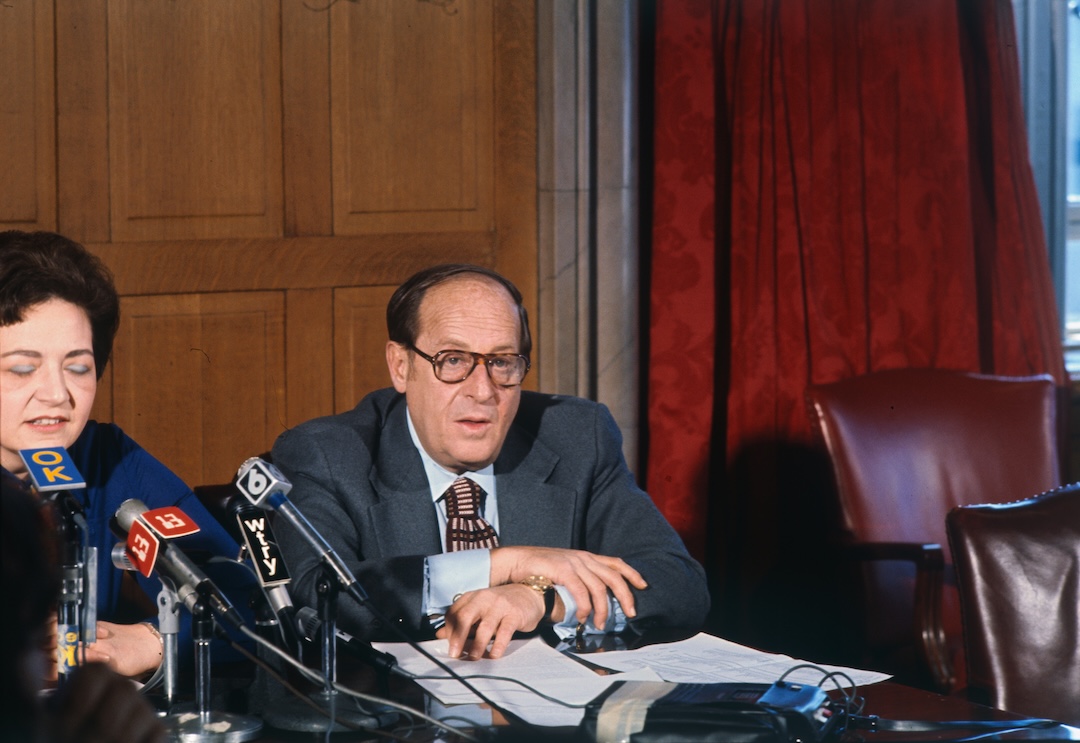
In 1975, the Speaker of the New York State Assembly, Stanley Steingut — a consummate machine politician — introduced legislation to create a state-owned public bank as well as authorize New York City to establish a municipal bank of its own. (Bettmann / Getty Images)
It’s 1975, and Wall Street has just refused to purchase New York City’s short-term notes. It’s nothing less than a coordinated credit strike that instantly lit the match on the worst fiscal crisis in the city’s history. Suddenly unable to roll over its debt, New York teetered on the brink of bankruptcy, even though the banks had happily underwritten the same notes for years — and made millions doing it.
A few weeks later, something remarkable happened. The Speaker of the New York State Assembly, Stanley Steingut — a consummate machine politician — introduced legislation, cosponsored by freshman Democrat Charles E. Schumer and sixty assemblymembers, to create a state-owned public bank as well as authorize New York City to establish a municipal bank of its own. With roughly $3 billion in state deposits sitting in private commercial banks, the state bank alone would have instantly become one of the twenty-five largest banks in the country. It would have had all the powers of a major financial institution: to hold deposits, make loans, and — by no accident — underwrite the municipal bonds and notes that Wall Street was suddenly using as leverage to bring the city to heel.
Steingut, of course, publicly denied that the proposal was retaliatory. But the timing made the truth undeniable. For a moment, New York’s political leadership briefly considered the most profound challenge possible to financial power: reclaiming public credit and putting the ownership of capital itself on the path to socialization.
What happened next — and why it matters now — is a story about austerity, political discipline, and a vision of public finance that New York abandoned just when it needed it most.
The Making of Austerity
The standard tale of New York City’s 1975 fiscal crisis casts it as a morality play about liberal excess: an indulgent welfare state, bloated public payrolls, and irresponsible urban governance finally colliding with economic reality. But historians and political economists like Kim Moody and Kim Phillips-Fein have shown that this story is deeply misleading. The city did not collapse because it was uniquely reckless. It stumbled because the political and financial ground beneath it shifted.
For decades, New York had relied on short-term borrowing to manage cash flow and fund public investment. This was not an innovation of the 1970s. It was a normal feature of urban governance in an era when cities were expected to build housing, infrastructure, transit, and public institutions at scale. The real constraint was never spending — it was revenue.
Then as now, New York City lacked meaningful taxing authority. The state legislature and governor dictated when — and if — the city could raise revenue, even as local needs grew more complex and expensive. When fiscal pressure mounted, the city could not simply change its tax structure. It turned instead to borrowing — not as a reckless gamble but as a rational response to a structural constraint.
At the same time, the city’s tax base was being hollowed out. Manufacturing jobs fled south and overseas in search of cheaper, nonunion labor. Federal funding from Great Society programs began to dry up under Richard Nixon, even as demand for public assistance rose. White flight, driven by discriminatory housing and education policies, further eroded the tax base. Economic development increasingly prioritized corporate subsidies. Gleaming office towers and stadium renovations kicked off even as entire Bronx neighborhoods were burning.
Just as important, Wall Street’s priorities were shifting. By the early 1970s, municipal lending occupied a shrinking place in an expanding global financial system. New York was no longer central. It was governable.
“A Threat to Capitalism”
It was at this moment that Steingut, leader of the state’s lower house — known in New York as the “People’s House” — moved to turn the tables.
Steingut proposed something that, even by the standards of 1970s New York politics, was extraordinary: a plan to remake the financial order in the public’s image. His 1975 bill called for the creation of a state-owned public bank and authorized New York City to establish a municipal bank of its own — institutions designed not to serve private profit but to meet public need.
In a press release that March, Steingut framed the proposal as a direct indictment of Wall Street. He pointed to recent New York City bond offerings carrying interest rates of nearly 9.5 percent, calling them “unreasonably high” and arguing that banks were extracting excessive profits by marketing government debt “at the expense of the taxpayers.” At a moment when bank deposits sat at an all-time high, credit for cities and residential housing had dried up. In Steingut’s view, private financial institutions had failed their “social and economic responsibilities.” The public bank, he argued, was necessary to curb “the powers which banks have abused in recent years” and to stop taxpayers from being forced to “take a bath” so that private banks could profit from public borrowing.
Hearings followed in New York City and Rochester as Steingut’s legislation moved through the assembly. The proposal drew serious national attention and garnered support from major local institutions, including American Federation of State, County and Municipal Employees District Council 37, the city’s largest municipal union. Ralph Nader testified in favor of the bill, as did the president of the Bank of North Dakota — the nation’s only state-owned bank, then and now — alongside labor, civic, and community development leaders.
Wall Street responded with open hostility. A Newsday headline from April 26, 1975 captured the mood: “A State Bank Called Threat to Capitalism.” The warning came from New York Stock Exchange chairman James Needham, who described Steingut’s proposal as an “encroachment” on the free-enterprise system. Although he acknowledged the bill did not authorize a full takeover of banking, he warned that such an outcome “could be the ultimate result.”
Private bankers were even more candid behind closed doors. Later that year, the New York Post obtained a confidential industry memo acknowledging that a New York public bank would likely function effectively — and competitively. The memo warned that such a bank would enjoy structural advantages: access to large public deposits, favorable tax treatment, and the ability to offer credit on terms private banks could not easily match. What troubled them most was not inefficiency but the opposite: what Noam Chomsky has called the “threat of a good example” — the danger that a democratic alternative to Wall Street finance might actually work and expose that banking can be organized around public purpose, not private extraction.
In his testimony in support of the public bank proposal, New York City Council president Paul O’Dwyer didn’t mince words, accusing the banks of a “conspiracy” to politically weaken and humiliate the city. That fear was not misplaced. The public bank proposal passed the assembly but ultimately died in the Republican-controlled Senate. In its place, a new governing order took shape — one in which financial markets, not democratic institutions, set the outer limits of what city government could attempt. The crisis did not merely discipline budgets. It reordered power.
Within a year, that new order was formalized. On March 28, 1976, the New York Times ran a story titled “The New Partnership of the Banks and New York State,” describing how state officials and private financiers had “entered into a new era in government finance.” Out of that partnership came the Municipal Assistance Corporation, the Emergency Financial Control Board, and related oversight structures that institutionalized financial control and austerity.
By the end of the crisis, New York had not only cut services — it had adopted a new governing logic. Cities were now expected to live “within their means,” public budgets were subordinated to financial markets, and ambitious public investment was treated as risky or illegitimate.
Tuition was imposed at the previously free City University of New York. The municipal workforce was reduced, with layoffs of teachers, sanitation workers, and health care staff. Hospitals and mental health facilities closed. Transit fares increased as service declined. Across the city, school funds were slashed, parks deteriorated, libraries reduced services, and public workers disappeared.
New York’s Unfinished Public Bank
This story of New York’s attempt to create a public bank has been largely buried for half a century. With the election of Zohran Mamdani as New York City’s next mayor, it can no longer be ignored. Mamdani has long supported public banking and has for years cosponsored the New York Public Banking Act — legislation that, like Stanley Steingut’s 1975 proposal, creates a legal framework for New York City to establish a public bank.
The next mayor also has an ambitious agenda — one that will cost a good deal of money. Like mayors before him, Mamdani cannot raise those funds on his own. He will need Albany’s approval.
Taxing the wealthy and large corporations is the most obvious route. It’s popular. It matters. But as Daniel Wortel-London argues, it can’t do the work by itself. If the underlying economy stays the same — centered on speculative real estate and private finance — then progressive taxes end up merely chasing problems the system keeps reproducing.
Steingut and his allies weren’t trying to tear the system down. They simply realized just how exposed the city really was to Wall Street’s power. In pushing back, they didn’t invent a grand theory. They were, in fact, being pragmatic in treating public money like public infrastructure, instead of letting it be controlled by private institutions.
In 1975, at the height of the fiscal crisis, the New York State Assembly’s Office of Research and Analysis estimated that a public bank would save the city tens of millions of dollars a year in interest — not by replacing private lenders but by stabilizing rates, underwriting at cost, and cutting out Wall Street’s markup.
Bronx borough president Robert Abrams pushed the idea further, proposing that the public bank sell small-denomination, tax-exempt municipal bonds directly to ordinary New Yorkers. The aim was structural: reduce reliance on private banks, lower borrowing costs, and allow working-class savers to capture tax-free returns long monopolized by Wall Street. Internal estimates suggested this could have saved taxpayers more than $100 million a year — over $600 million in today’s dollars, even before accounting for the vastly larger debt the city now carries, and roughly comparable to the projected annual cost of Mamdani’s free bus program.
Ultimately, these ideas failed not because they were unworkable, but because they never gained the political force needed to overcome Wall Street and its allies. No mass movement emerged around public finance, partly because the subject is arcane, but also because the effort began as a top-down political project rather than a bottom-up demand.
In Money, Power, and the People, Christopher W. Shaw documents the collapse of public banking proposals in New York, California, and Oregon during the 1970s. Reformers had hearings, expert testimony, and institutional support. What they lacked was an organized mass base capable of forcing change through entrenched opposition.
That is the difference between 1975 and now.
Public Banking as Infrastructure for Democratic Control
In New York City and across the country, a growing public banking movement is advancing legislation, forcing major breaks with Wall Street banks, and shifting how cities think about public money. In New York, a cross-section of New Yorkers — community groups, labor unions, housing and climate organizers, worker cooperative member-owners, and community development credit unions — have built a durable coalition to push this vision forward.
The aim is not a public bank for its own sake, but as infrastructure for democratic control — a way to bring land, housing, work, food, and money under collective, community ownership.
This future is not abstract. It is already being built inside the cracks of the current system.
Member-owned institutions like Lower East Side People’s Federal Credit Union, which recently opened a branch in the South Bronx, operate on a fundamentally different logic: governed by their members, rooted in place, and built to strengthen communities rather than strip them of wealth.
The same is true of community land trusts (CLTs), which remove land from speculative markets and place it into permanent collective stewardship. In New York City, CLTs have grown in number from two a decade ago to more than twenty today, operating across all five boroughs and acquiring land and housing for deep and lasting affordability. But their ultimate scale and the depth of affordability they can offer is determined by access to fair, patient capital.
Worker cooperatives too are spreading, even as they are systematically denied access to affordable financing. Each of these models points toward a different economic logic. Each runs into the same structural barrier: a financial system organized to serve private profit first. Public banking is not peripheral to this vision. It is the missing architecture.
This is not to claim that public banks are inherently virtuous. As political economist Thomas Marois has shown through his global mapping of public banks, they are contested institutions, shaped entirely by their governance and mandate. They can reproduce elite power, or they can disrupt it. A public bank designed with democratic oversight and clear public purpose can do what the current system cannot: channel public wealth toward collective need rather than private accumulation.
With an annual budget of $116 billion, the potential impact on New York City’s economy is enormous. Economists at the New School’s Center for New York City Affairs estimate that a New York City public bank could, within its first five years alone, partner with community development financial institutions and other responsible lenders to unlock nearly $6 billion in new lending in historically redlined neighborhoods, create or preserve nearly 18,000 units of affordable housing, invest more than $1 billion in climate infrastructure, and add tens of thousands of jobs in the process.
In 2019, California enacted its Public Banking Act, creating a framework for municipal public banks. It helped move the idea from fringe to mainstream. But the legislation stopped short of removing the legal barriers needed for public banks to hold public deposits and operate at full scale, as the Bank of North Dakota has done for over a century. North Dakota now has the most robust network of community banks and credit unions per capita in the country. New York’s movement is aimed at that level of power: a full-scale public bank that holds public deposits and acts as a financial engine for cooperative and community-led development.
That vision nearly became reality in the last legislative session through the Bank of Rochester Act. The bill would have created the nation’s first full-fledged municipal public bank which means holding public deposits, partnering with local lenders, and directly confronting the legacy of disinvestment in one of the country’s poorest cities. It passed the assembly Banks Committee but, in a familiar echo of 1975, stalled in the state senate — blocked from even receiving a committee hearing, despite a supportive chair — a reminder that banking power still organizes vetoes behind the scenes.
Still, the Rochester effort offers a real source of hope and instruction. Critical to its progress was the active support of Rochester mayor Malik Evans. Now with a supportive mayor in New York City, a strong coalition in place, and an electorate demanding solutions to deepening housing and affordability crises, the question is no longer whether public banking is possible. It is whether this political moment will finally complete the unfinished work.