Digital Sewer Socialism
With the rise of AI slop and overall “enshittification,” it is increasingly the case that the internet is failing to address the public’s needs. What we need is sewer socialism for the digital realm — and it can start at the municipal level.

Community-owned ISPs generally provide cheaper entry-level broadband access than their corporate counterparts. (Matt Jonas / Digital First Media / Boulder Daily Camera via Getty Images)
On January 1, socialist mayors will take office in both New York City and Seattle. That’s a total constituency of nearly ten million Americans. While Zohran Mamdani and Katie Wilson will necessarily be focused on fulfilling their campaign promises around addressing the cost-of-living crisis, their administrations will have the unique opportunity to serve as laboratories for the kind of imaginative policymaking the country badly needs.
One area that could especially benefit from an infusion of political creativity is tech policy. At the moment, the internet is in bad shape. The popularity of words like “slop” and “enshittification” — referring both to AI-generated content and increasingly poorly functioning websites and search engines — gives a sense of how degraded our digital lives have become. Meanwhile, many Silicon Valley capitalists have moved to the Right. Some openly supported Donald Trump’s bid for a second term, contributing hundreds of millions of dollars to the effort. Most swore their allegiance to Trump after he won, donating to the inauguration and heaping words of praise on the president-elect. The “tech oligarchy,” as it has come to be called, is now a MAGA coalition partner.
As the most powerful and dynamic faction of American capital, this is a troubling development. Socialist mayors certainly can’t single-handedly overturn the tech oligarchy. But they can kick-start policy innovations that sketch the outlines of an alternative technological blueprint for their constituents. The power of the tech giants is sustained — at least in part — through the limitations they place on our collective imagination. Their dominance is so absolute that it becomes hard to envision a different way of living with the internet.
Taking practical steps toward upending the status quo in New York and Seattle — which are, incidentally, two of the biggest tech industry hubs outside the Bay Area — would show that another internet is possible and offer encouragement to communities across the country. More ambitiously, it could also erode the influence of the tech oligarchy by nurturing a set of digital experiments that lie outside of their control.
There will be no shortage of thoughtful people in both the Mamdani and Wilson administrations who might undertake such experiments. Mamdani seems particularly attuned to the importance of technology, having enlisted the prominent anti-monopolist Lina Khan as a cochair of his transition team and appointed a technology advisory committee that includes the renowned scholars Ruha Benjamin and Alondra Nelson.
Of course, the immediate task in New York and Seattle will be to deliver on the affordability agenda of the two campaigns. This is not the time for every socialist in the country to start waving their wish list. Still, for those of us who have the luxury of not being in the trenches, it’s a good time to start talking about what a specifically socialist approach to municipal government might look like, especially when it comes to technology.
Fortunately, we have a historical precedent to help us think through this question. As Eric Blanc has argued, the experience of Milwaukee’s “sewer socialists” in the early twentieth century holds lessons for our current moment. Significantly, sewer socialism is a tradition that Mamdani himself has cited as inspiration. “Sewer socialism, to me, represents a belief that the worth of an ideology can only be judged by its delivery,” he said in an interview earlier this year.
The basic insight of sewer socialism is bringing people into your politics by improving their lives in obvious ways. “You win someone’s trust through an outcome” is how Mamdani puts it. The sewer socialists of Milwaukee made the case that municipal ownership of systems like sanitation, water, and power could deliver services more efficiently and more equitably than private ownership. They solved practical problems for their constituents while constructing working examples of a postcapitalist political economy in miniature.
The same method can be applied to the internet. Call it “digital sewer socialism.” Socialist elected officials in New York, Seattle, and beyond can craft policy interventions that increase the quality of life for residents by addressing the difficulties that arise in their relationship with technology. These interventions can be carried out in such a way that, by modeling socialist principles, they win wider support for socialist ideas.
Assembling the Digital Sewer Socialist Stack
Digital sewer socialism might be pursued in various ways. One idea is a local “stack” of publicly and cooperatively owned institutions that provide services of different kinds. Such a stack would have to be assembled piecemeal based on what’s politically viable at any given time. Even so, an integrated approach could help coordinate distinct efforts into a coherent vision. The goal would be the construction of an alternative digital ecosystem that, at least at the local level, can begin to displace the corporate internet.
This ecosystem would be engineered to prioritize different outcomes than those sought by Silicon Valley. Empowerment instead of extraction. Democracy instead of oligarchy. More concretely, the guiding mission of the sewer socialist stack would be twofold: to guarantee the efficient and equitable distribution of digital resources while bringing digital infrastructure, in all its forms, under democratic management. Residents must have the things they need to lead dignified lives and the opportunity to participate in the decisions that affect them.
The sewer socialist stack would be composed of three layers:
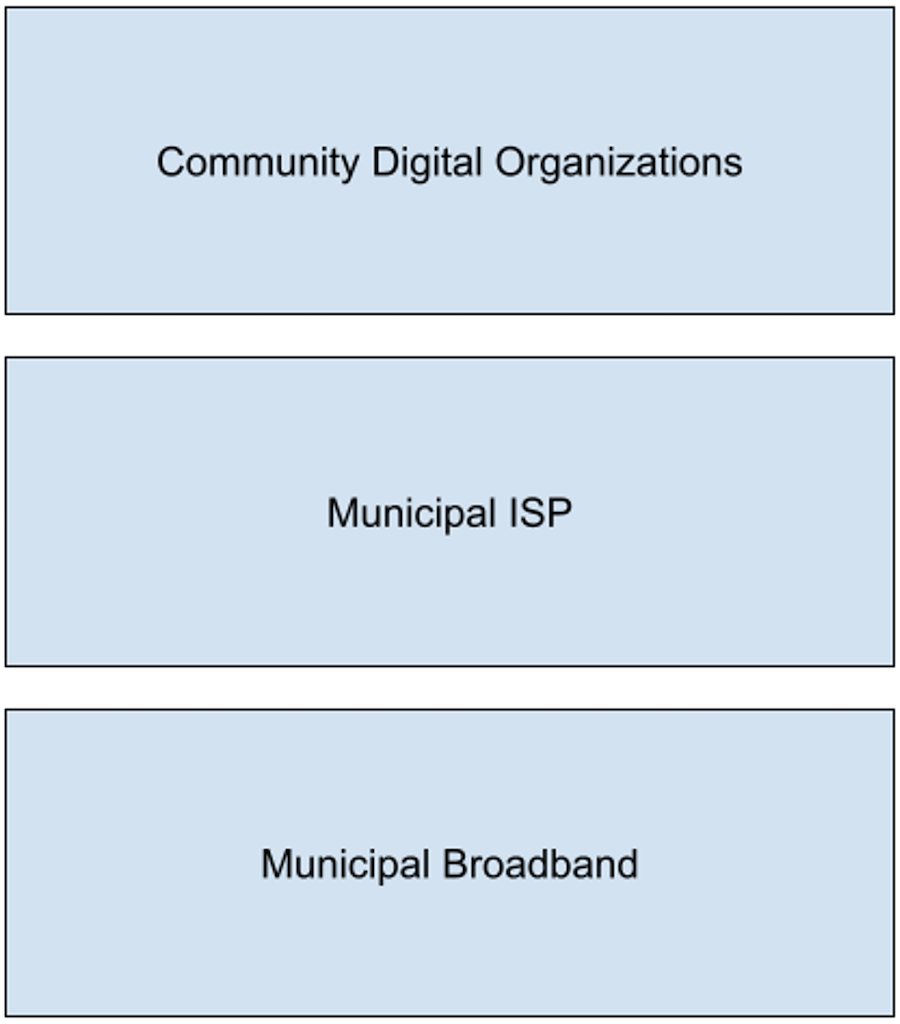
The bottom layer is the city’s broadband infrastructure. This is the physical network of cables and equipment that connects households and businesses to the internet. In the sewer socialist stack, the network is owned and operated by the municipal government.
This ownership structure is already quite common. In fact, hundreds of communities across the country have publicly owned broadband networks. But just because the infrastructure is publicly owned doesn’t mean the municipality also acts as an internet service provider (ISP). One popular model for municipal broadband is an “open access network,” where the network is public but the ISPs that use it to connect consumers to the internet are private.
In fact, the New York City Internet Master Plan, released by Bill de Blasio’s administration in 2020, is a proposal for just such a network. It calls for leveraging city-owned assets like utility poles and rooftops to build out an open-access network for both fixed and mobile broadband, with the aim of ensuring affordable, high-speed internet service for all New Yorkers.
The initiative was cancelled by Mayor Eric Adams in 2022. But the City Council recently enacted a bill requiring city hall to develop a new Internet Master Plan, with the preliminary version to be published no later than November 1, 2026. An “internet advisory board” will be tasked with reviewing draft proposals and making recommendations, with the mayor selecting three of its eight members. The bill was originally introduced by Councilmember Jennifer Gutiérrez, who endorsed Mamdani in the primary, and its cosponsors included all four Democratic Socialists of America (DSA) members on the city council.
The legislation will give the Mamdani administration an opportunity to put forward a municipal broadband strategy in its first year. Through the mayor’s choice of personnel in his technology department — currently known as the Office of Technology and Innovation — as well as his appointments to the internet advisory board, he can shape the city’s new Internet Master Plan. He should use this influence to revive de Blasio’s emphasis on the public ownership of broadband infrastructure, but with an important addition: he should also push for the formation of a municipal ISP.
The city shouldn’t just own the network, in other words. It should be directly involved in the provision of internet service.
Death to the Tyrant Comcast
There are both practical and political reasons for taking this step. Practically, research suggests that community-owned ISPs generally provide cheaper entry-level broadband access than their corporate counterparts. This is because they tend to prioritize social needs, such as quality of service and universal connectivity, rather than profit. The most famous municipal ISP is run by Chattanooga’s local power utility EPB, which traces its origins to the New Deal. It has twice won the top spot in Consumer Reports’s ranking of ISPs nationwide, based on consumer satisfaction surveys.
As a public utility, a municipal ISP can also establish a minimum standard of access. Establishing such a “floor” is especially crucial in lower-income areas, where systematic underinvestment by telecom companies means that even those residents who have the option to buy home broadband service and can afford to do so often endure slow speeds and price-gouging. This practice, known as “digital redlining,” contributes to a crisis of connectivity among working-class Americans. De Blasio’s report noted that nearly 20 percent of New York City residents — more than 1.5 million people — have neither a mobile nor a fixed broadband connection. Nationally, the same percentage of American households lack internet connection at home. This is a scandal, given how important the internet has become for tasks that are required for working-class survival, from accessing government services to applying for jobs.
The best way to address the connectivity crisis is to provide a public option for internet service. In the sewer socialist stack, this function is performed by the municipal ISP that occupies the stack’s middle layer. While a municipal ISP can be paired with an open-access network, it operates on a different logic. The goal of open-access networks is to stimulate more competition in a local broadband market, which can help bring down costs in cities like New York that are dominated by one or two ISPs. But competition is a crude mechanism: it tends to work best for customers who are worth competing for. Many working-class households will remain unprofitable customers no matter how much competition exists. This is where a municipal ISP can be particularly useful.
Beyond its practical value, a municipal ISP also has political benefits. Foremost among them is the fact that a public enterprise can offer communities control over how it is run — something no amount of competition among private firms can ever provide. Democratic governance of a utility can be implemented in a range of ways, from elected governing boards to participatory planning processes. What matters is that residents are involved in decisions about how internet service is being provisioned. Public ownership enables social goals to be pursued directly, rather than relying on the slow and unpredictable mechanism of nudging private firms in a particular direction through incentives.
People Versus Platforms
But digital sewer socialism shouldn’t confine itself to the systems that enable connectivity. It should also take up the more challenging task of changing how we use the internet. In the sewer socialist stack, this undertaking would be performed by an array of community digital organizations (CDO) at the stack’s highest layer. These are cooperative ventures of various kinds, governed democratically by their members for their mutual benefit.
Consider the case of Mensakas, a bike delivery cooperative in Barcelona. It belongs to an international federation called CoopCycle that produces an application for managing orders and coordinating jobs. Mensakas also benefits from public sector support in the form of contracts from the local and regional government. We might imagine similar cooperatives appearing in American cities, offering worker-managed alternatives to the corporate “gig” delivery platforms like DoorDash. Sympathetic municipalities could help nurture this development by funneling a portion of their procurement budget to cooperatives.
For instance, city-owned grocery stores might hire cooperatives to deliver groceries to home-bound seniors. In fact, New York City already has a cooperative that operates primarily as a government contractor: the Drivers Cooperative, which has a contract with the Metropolitan Transportation Authority to provide “paratransit” services to people with disabilities.
There are many other possible forms that CDOs might take. The residents of a particular building, block, or neighborhood might create small, self-governing social networks using software like Smalltown, which aims to offer an online equivalent to classic civil-society “third places” like churches and bars. Another idea is a community “tech hospital” that takes advantage of recently passed “right-to-repair” laws to fix phones and laptops and redistribute refurbished equipment.
CDOs might also devote themselves to the matter of deepening civic engagement, such as through the creation of online forums that enable residents to discuss and propose policy measures, and even come to decisions about how to allocate the city’s resources, drawing on similar efforts in Barcelona and Taiwan.
Most of the work to be done, however, is not technical but political. The real challenge is how to build and sustain organizations that are structured in such a way to expand people’s collective power over the technological conditions of their lives. This power will necessarily be limited and contradictory; worker cooperatives, for instance, still have to survive within capitalist markets, even if they can be insulated from competitive pressures through public support.
The wager of digital sewer socialism is that this is a price worth paying, provided that its institutions are seen as points of departure for an ongoing process. If the worth of an ideology is judged by its delivery, as Mamdani suggests, then municipal broadband, municipal ISPs, and CDOs can help broaden the social base of the Left. This, in turn, can open pathways for the ideology to be more fully realized. If replacing capitalist entities with democratically managed ones visibly improves people’s digital lives, they may be more inclined to support similar transformations in the rest of society.