Kenya’s Floods Kill Because of Government Inaction

The latest floods in Kenyan capital Nairobi killed at least 108 people. This death toll wasn’t just caused by a natural disaster: while wealthier residents were protected from harm, Kenyans living in informal settlements were left to fend for themselves.
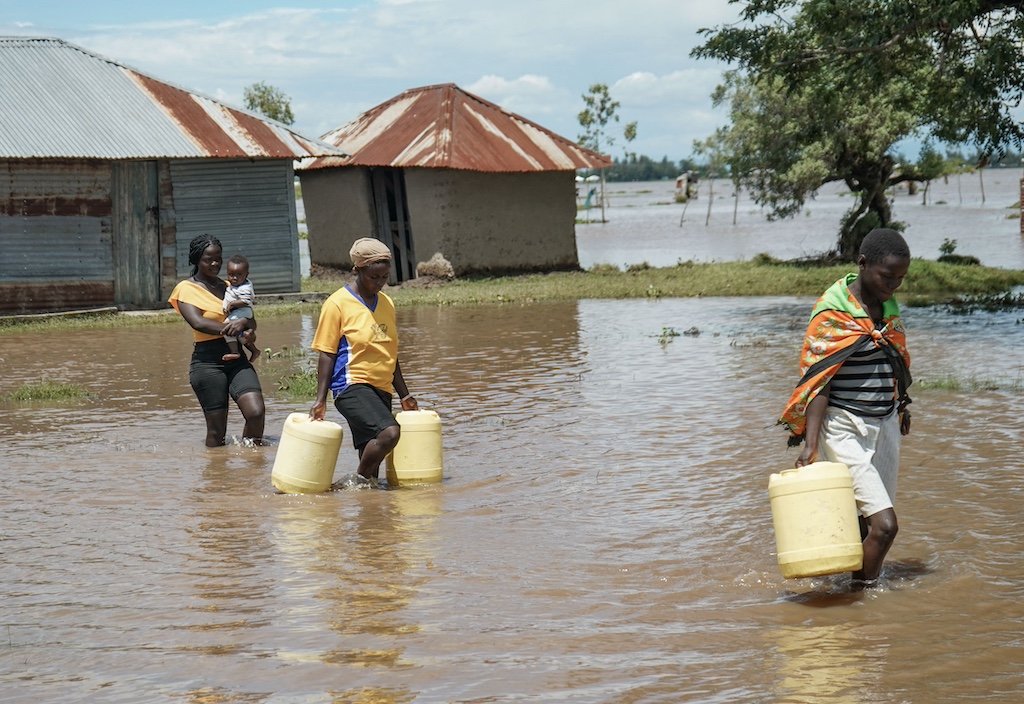
Three women trudge through a flooded street carrying water containers and one child.

The Kenyan state is evicting people from areas hit by recent deadly flooding without providing alternative housing. (Brian Ongoro / AFP via Getty Images)


Extreme weather events are ever more exposing the unsustainability of today’s anarchic global capitalism. When disasters strike, they unfailingly follow deep-seated fault lines in society: which is to say, lines of class. Such is the reality in Mathare, an informal settlement on the northeastern outskirts of Kenya’s capital, Nairobi. In recent years, it’s paid the price of serial mismanagement and a lack of institutional will to equip low-income neighborhoods to cope with environmental disasters.

The floods that hit Kenya early this March killed at least 108 people, displaced tens of thousands of others, and produced unprecedented infrastructural damage. Particularly violent in their first few days, they continued for several weeks. Suffering most were residents of Nairobi’s informal settlements, the so-called “slums”: urban areas lacking permanent housing structures and basic infrastructure, such as rainwater drainage systems, efficient sewage, access to potable water, or public waste disposal. In Mathare alone, there were seven confirmed deaths, not to mention the homes destroyed because of their proximity to the Mathare River — a tributary of the Nairobi River that overflowed during the rains — and the absence of an adequate drainage system.

This wasn’t the first time Kenya was unprepared in the face of extreme weather events, which have by now become common during the rainy season from March through April. Yet the political response hasn’t been based on finding lasting solutions but on a logic of discrimination. This structural inadequacy consistently penalizes those living in marginalized areas, while residents of skyscrapers in neighborhoods such as Parklands or the Central Business District are kept safer.

We saw this already after the severe flooding of April 2024, which caused nearly three hundred deaths, displaced 55,000 families, and killed 11,000 livestock across Kenya. In response to the desperation of Mathare residents hit hard by that disaster, the government evicted 4,000 families and demolished their homes, without providing any alternative housing solution. In October 2024, Justice Ann Mogeni judged these evictions illegal, as violations of the rights to human dignity, security, privacy, and property, ordering compensation for the affected families within 120 days of the ruling. None of these measures, however, has been implemented by the government.

There has been talk of steps to mitigate the damage caused by this March’s disaster and to prevent future ones. Forty-seven to eighty billion Kenyan shillings — around $360 to $600 million — have been promised for an infrastructure plan. Yet the implementation of these measures in “slum” areas remains unclear: in places where no public census exists, and where neither homes nor sewage systems are registered, it is difficult to see how this could be effective without first establishing an urgent, large-scale, and state-led social housing program.

The affordable housing plans of recent years have not brought about a structural change in informal settlements’ living conditions, as the housing units were insufficient and the assignation criteria weren’t transparent enough, considering the lack of censuses on the informal settlements’ residents. Mathare’s inhabitants are concerned that the government’s plan to secure the riverbanks to prevent a new disaster will mean more evictions without other housing being allocated to them. It’s a story they’ve already seen before.

Collective Response

Where the state vanishes, however, practices of mutual aid take root, growing into something like a para-state body. Embodying this collective force is the Mathare Social Justice Centre (MSJC), a space that hosts most of the grassroots welfare programs locally. The center’s building, among the few made of concrete, stands out against the landscape of mobile homes and asbestos constructions. You encounter its building almost immediately along the main road that leads from the city center to the settlement, which mirrors the Mathare River and marks its boundaries. They do legal and social work, but their programs are also about environmental problems and even psychological ones.

One of the immediate responses to evictions is to occupy land, to provide alternative spaces where the displaced can live: “In April 2024, my house was demolished and I had to move in with my daughter, three of us share a single bed in a house of less than five square meters” explains Mary Mothoni. “I occupied the land where I used to live and planted a garden, at least my neighbors and I now have something to eat,” she adds.

“Mary cultivated a garden, other people rebuilt their homes and returned to live there. Occupation is the only way we have to prevent the evicted from ending up living on the street,” explains Sarah Wangari, an activist at the center. “The streets of Mathare are much more dangerous for women; sleeping outdoors means being exposed to gender-based violence in isolated and unlit alleys. We also have a desk for this phenomenon,” she tells Jacobin.

“At the Mathare Social Justice Centre, we try to build a new idea of social justice that aims to advance people not only economically but also socially and politically,” explains Waringa Wahome, a lawyer at the center’s legal desk. “We use the law as a tool that, through the individual cases we follow, allows us to advocate for human rights and socialist politics. I have represented families affected by demolitions on various occasions which, on a smaller scale than those of 2024, occur weekly in this area,” says Wahome.

The need to politicize these processes stems from the fact that even winning a legal case “is not enough to set a political response in motion; the rulings in our favor are most of the time not applied, increasing people’s distrust in the law itself,” she continues. To do this, in addition to legally representing those directly involved during trials, “we organize neighborhood assemblies and try to explain citizenship rights, to build a collective body capable of pressuring the government to respect the laws and improve welfare.” She concludes that “it is difficult to know how many people live in Mathare and how many are evicted, considering that the administration does not carry out censuses and does not keep track of demolished houses; it is the population itself that does so through these neighborhood committees.”

Institutional abandonment also undermines the basic quality of life. “There are no sewers here. Raw sewage is dumped into the streets or directly into the Mathare River, causing immense damage to the ecosystem and the health of those who rely on the river for drinking, cooking, and washing,” explains Anthony Mwoki of the Ecological Justice Network.

His group, linked to the MSJC, has organized wastepickers’ teams to manage domestic trash — 70 percent of which was previously left in the streets. “We sort the waste and sell the recyclables. We’ve managed to jumpstart a local microeconomy: we clean the streets and earn a living simultaneously,” Mwoki says. However, the damage runs deep. “Pollution has penetrated the soil. Even in reclaimed areas, we struggle to grow vegetables. In some spots near the river, we have managed to plant new trees, hoping to also contribute to cleaning the air and the soil,” he concludes.

Political Responsibility

While Nairobi’s so-called slums are marginalized in terms of provisions and infrastructure, they host over 60 percent of the capital’s population, counting about two million inhabitants. A theater of ethnic and religious mixing, these areas are feared by the “other side” of the population — the one in the skyscrapers and the central business district — which routinely stigmatizes them in terms of poverty linked to the microcriminality it associates with these areas. To pity the “slums” is to distance itself from them and shrug off political responsibility.

Yet these same factors have produced some of the idiosyncrasies of Gen Z, who in the last two years has flooded the streets of the capital — now a leading East African financial and commercial hub — bringing demands for welfare back to the center of public discourse. Not content with the imperfect democracy established on paper by the 2010 Constitution, young Kenyans have questioned an economic model built on a rigid class division. The current model leaves little room for social mobility in a country where youth unemployment (among fifteen- to thirty-four-year-olds) stands at 67 percent.

They raise issues like education and health, inflation and the costs of basic necessities, infrastructure in peripheral areas, and policies to tackle growing unemployment. Above all, they want a social housing program. They also demand changes to the tax system, which today privileges large multinationals instead of small businesses. These, and many others, are the questions that have informed the movement, which is not limited to explosions of street action but also shapes a now-widespread political consciousness. It is precisely this consciousness, grown mainly in such areas, that has formed movement leaders and prominent activists.

The latter have been the first to pay the price of the repression with which William Ruto’s government has answered protesters. It’s a method of managing public order that has for decades developed through the indiscriminate use of police violence, both on demonstrations and in the “slums” themselves. “My son was killed by the police in 2017 while returning from work,” says Wangari. “They shot him ten times, claiming he was a thief — false accusations without any evidence to support them.

In recent years, hundreds of extrajudicial killings, beatings, illegal arrests, and forced disappearances have occurred in Mathare,” she adds. “The police come here with the excuse of targeting microcriminality, but when the authorities enter Mathare, they often shoot at eye level, hitting the first young person they encounter, not to mention the kidnappings of activists who have nothing to do with crime,” explains Wangari.

In 2017, she, along with other mothers, founded the Mothers of Victims and Survivors Network through the MSJC, also producing a book of the same name. The group, officially formalized in 2020, brings together family members and survivors of police violence: “We try to support each other and collectively denounce these state crimes; we have reclaimed an area near the river and planted trees in memory of our children. Now that park has become a symbol of anger and union; it reminds us every day of what we have lost and what we have to lose,” the activist tells Jacobin.

In combining the fight for social and civil rights, the MSJC has become a fundamental point of reference, demonstrating that where the state disappears, ordinary people have to fill in. “Our work, however, cannot satisfy the needs of an area where nearly half a million people live. We hope that by showing what we need and implementing concrete models on a small scale, the government will sooner or later follow us and implement them on a large scale. Until then, we will continue to build a political consciousness that holds institutions to account,” Wahome concludes.