Momentum Is Building for Medicare for All

As private health insurers jack up premiums for tens of millions, a majority of Americans now want Medicare for All — even if it entails eliminating private health insurers and raising taxes.
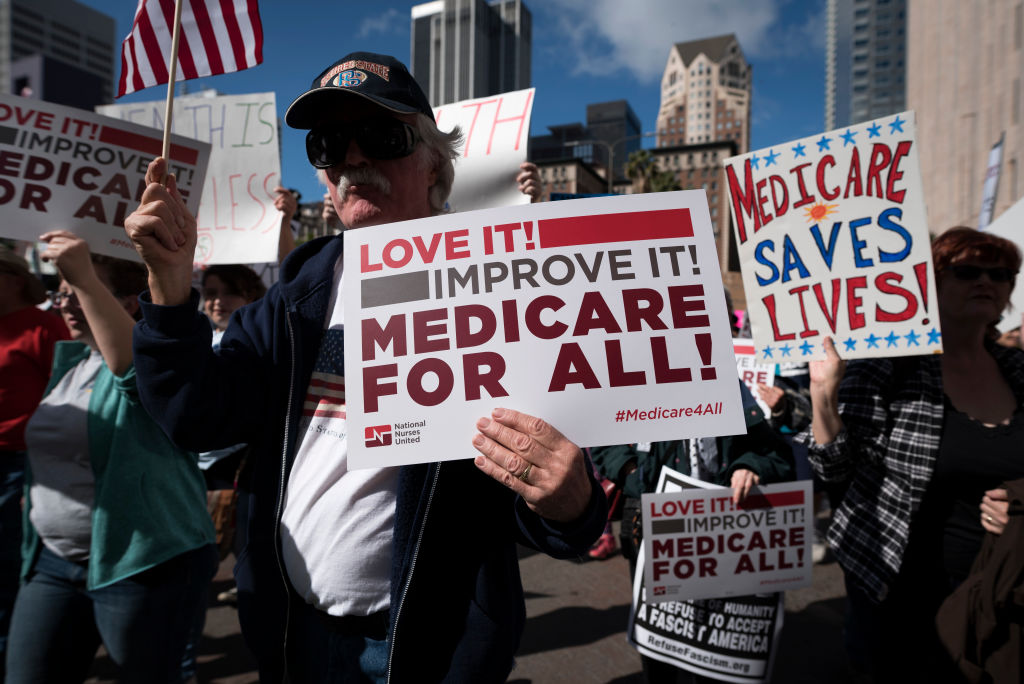
A new poll shows a huge majority of Americans now want Medicare for All. (Ronen Tivony / NurPhoto via Getty Images)

When Medicare for All took center stage in the 2020 Democratic presidential primaries, opponents undercut growing support for the initiative by homing in on how it would raise taxes and eliminate health insurers. Those opponents succeeded: polls at the time showed that while Americans conceptually supported the idea of a government-sponsored system, many didn’t want it to replace private insurance. Surveys showed support for Medicare for All dropped precipitously if the program were to eliminate private insurance.

Soon after, Democratic senator Elizabeth Warren (MA), a Medicare for All proponent, badly stumbled over the tax and private insurance question and lost her front-runner status in the presidential primary polls. With party acolytes still valorizing the Affordable Care Act (ACA) rather than pressing for something better, Democratic voters then nominated avowed Medicare for All opponent Joe Biden, who was elected promising a public health insurance option, and then literally never mentioned it again upon taking office.

That might have been the end of Medicare for All for another generation — except now the ACA is epically and undeniably failing to guarantee “affordable” health care. As private health insurers are now jacking up premiums for tens of millions of Americans, a new poll shows a huge majority of Americans now want Medicare for All — even if it entails eliminating private health insurers and raising taxes.In the survey, 63 percent of Americans said they support Medicare for All, even knowing that it “would eliminate most private insurance plans and replace premiums with higher taxes.” That support was spread across the political spectrum — it’s garnered 78 percent support from Democrats, 64 percent support from independents, and 47 percent (a plurality) support from Republicans. In all, just 29 percent of voters were opposed.

To put the enormity of this change in perspective, consider that six years ago, polls showed that when people were told Medicare for All might eliminate private insurance, topline support for the idea typically dropped. One survey showed that just 13 percent of Americans would support Medicare for All if it eliminated private insurance. So these new numbers reflect a potential fifty-point shift on that key question in just six years.

As Sen. Bernie Sanders (I-VT) might say, that’s yuge. It’s also understandable: to many voters facing ever-higher bills, “eliminate private insurance” now sounds like “eliminate the faceless corporation burying me in paperwork, reducing my coverage, and raising my premiums.”

Of course, when looking at this new polling data, big caveats apply. Comparing different polls with different methodologies is not a perfect apples-to-apples poll comparison. More importantly, these new poll numbers come amid some momentary political asymmetry.

Americans are rightly changing and intensifying their views in response to health care price shocks. But that’s before there’s a Medicare for All bill moving ahead in Congress — which is to say, before the insurance industry has financed another multimillion-dollar ad campaign aiming to scare everyone about the prospect of “death panels” and other bogeymen if the government dares extend to everyone what the country already provides to seniors.

Would Medicare for All fare better in the 2028 Democratic primaries and have a real chance of passing with a new administration in 2029? It’s hard to say.

On the one hand, it’s fair to expect that insurance-bankrolled Democrats’ use of the ACA as a weapon against Medicare for All will have somewhat less efficacy these days when everyone is experiencing the downsides of the ACA’s foundational decision to fortify — rather than eliminate — the power of private insurers. The ACA’s loss of political potency seems to be recognized even by the namesake of Obamacare, who previously abandoned his support for Medicare for All and marginalized the idea while he was president, but who has now shifted his rhetoric.

On the other hand, this is the world of the Master Plan, which has deregulated the campaign finance system and legalized bribery. So you can never underestimate the power of money to buy elections, buy legislation, and buy a massive propaganda campaign to sow doubt among voters.

You can already see that in miniature right now. Even as support for Medicare for All now surges, Republican lawmakers and Democratic leaders in Congress are busying themselves with passing legislation demonizing “the horrors of socialism.”

That vanity bill may look like merely an attack on New York mayor-elect Zohran Mamdani — but amid a health care crisis, it’s also undoubtedly a callback to President Ronald Reagan’s infamous red-baiting attempt to block Medicare itself from ever being created.

Like Reagan back in 1961, today’s politicians and their paymasters see the shift in health care politics. But rather than doing their jobs and solving the actual crisis that’s medically looting and bankrupting millions of Americans, they are instead focused on trying to preemptively distort the political discourse so that change isn’t possible.

If past performance predicts future results, then they’ll succeed. But this time around, the health care emergency is so dire that the past may be less predictive and more prelude to a very big set of long-overdue changes.