Colombia’s Ban on Coal Exports to Israel Is in Danger

Colombia proved that a nation could ban energy shipments to Israel’s war machine. Fossil capital is trying to ensure that no other state dares to do the same.
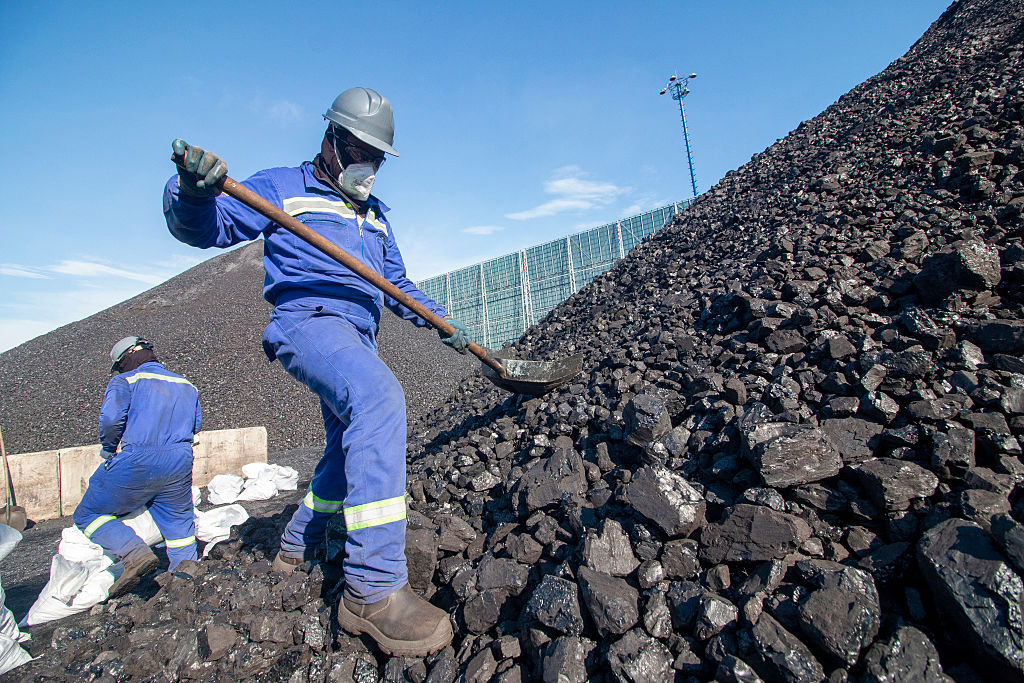
A man with a shovel standing on a large mound of coal.

After Colombia successfully halted coal shipments to Israel’s war machine, South Africa kept Israel’s coal plants burning. (Schneyder Mendoza / AFP via Getty Images)


On July 24, 2025, the Malta-flagged bulk carrier Fortune left Puerto Drummond on Colombia’s Caribbean coast with 93,297 tonnes of thermal coal in its holds, bound for Hadera. Later that day, Gustavo Petro declared that not another ton of Colombian coal would reach Israel, denouncing the loophole that had allowed the trade to continue under the embargo initiated in 2024.

Six hundred fifty thousand tons of Colombian coal went to Israel in 2025, all of it from Puerto Drummond. Decree 1047 had announced an embargo, but it had not stopped the ships. Petro’s order to the navy to intercept further shipments enforced the 2024 ban that the first legal decree alone had failed to accomplish. The July 24 shipment would be the last.

Colombia’s coal embargo attempted to turn solidarity with Palestine into an interruption of fossil supply, and the reaction to it reveals the legal and commercial machinery built to prevent such interruptions from proliferating.

In the months that followed, Drummond exploited a contractual opening left inside the decree; mining multinational Glencore shifted its route through South Africa, the country that brought the case against Israel for genocide before the International Court of Justice; investment lawyers began preparing arbitration claims under treaties written for precisely this situation; and, with general elections quickly approaching, the Colombian right promised to reverse the ban that Petro built.

The embargo — at least in its second iteration — worked. That is why the available instruments of fossil capital have been brought to bear against it, exposing the limits that the neoliberal order imposes on national sovereignty and even human rights.

The Loophole

Colombia’s embargo came in two stages. The first declared the rupture; the second made it truly effective.

Decree 1047 was signed on August 14, 2024, and entered into force five days later. It prohibited exports of thermal coal to Israel. The decree came weeks after the International Court of Justice (ICJ), in its advisory opinion of July 19, 2024, held that all states must not recognize as legal the situation created by Israel’s unlawful presence in the occupied Palestinian territory and must not render aid or assistance in maintaining it. Colombia had participated in those advisory proceedings; with Decree 1047, it sought to translate that obligation into trade policy.

But the decree preserved the commercial trade it purported to end. It exempted shipments already covered by customs authorizations, free-trade-zone movement forms, supplier certificates, and legal transactions concluded before the decree took effect, while creating a registry for companies claiming “consolidated legal situations” or “legitimate expectations.” Coal could therefore keep moving if exporters could show that their rights had been fixed before the embargo.

The result was a slowdown rather than a stoppage. Colombia’s own amending decree later acknowledged that, from August 2024 through April 2025, the country exported 1,072,412 tons of coal to Israel, just a 39 percent drop from the 1,752,321 tons shipped over the previous eight months. Cerrejón, Glencore’s operation in La Guajira, says its last shipment to Israel left on August 3, 2024, before Decree 1047 took effect. Drummond continued. Activists monitoring the trade identified twenty-eight Drummond ships sailing directly to Israeli ports between October 2024 and April 2025.

The first embargo placed human rights above commerce. But it allowed existing contracts to survive.

The hard break came with Decree 0949 on August 28, 2025. It amended the ban to cover all exports of thermal coal to Israel “without exception” and repealed the articles protecting previous contracts. This halted the flow of Colombian coal to Israel. Then the counterattack began.

Investment Law as Discipline

Drummond Company, Inc., headquartered in Birmingham, Alabama, operates under the protections of the United States-Colombia Trade Promotion Agreement, which entered into force on May 15, 2012. Chapter Ten gives investors access to arbitration and protects them against violations of the minimum standard of treatment and uncompensated expropriation.

Glencore stands in another treaty channel. The relevant instrument is the Colombia-Switzerland bilateral investment treaty (BIT), signed in 2006 and in force since 2009. Glencore plc is incorporated in Jersey of the Channel Islands, but Glencore International AG, a Swiss group entity, has already brought treaty claims against Colombia under that trade agreement. Both companies operate inside legal structures through which investors can test claims against a coal embargo.

This testing is a primary function of investment law. Multinationals do not need to win every case; they need litigation to enter into the calculations of ministers, lawyers, and officials before they act.

In March 2026, Petro announced that Colombia would leave the international investment arbitration regime, warning that the country had roughly fifty-two trillion pesos, approximately $14 billion, at risk in such disputes. Exit, however, is not accomplished by declaration. Colombia would have to denounce the International Centre for Settlement of Investment Disputes (ICSID) Convention and renegotiate or terminate the investment provisions contained in its treaties and trade agreements, many of which contain survival clauses that keep investor protections alive for ten or twenty years after withdrawal.

Before announcing its intention, Bogotá tried a narrower route. In 2025, the United States and Colombia issued a Free Trade Commission interpretive note reaffirming the state’s right to regulate in the public interest, including environmental protection. The note did not abolish the regime but tried to carve out breathing room inside it.

Petro can denounce arbitration. But fossil capital inhabits treaty time, and treaty time is built to outlast governments.

A contradiction is written into the same legal order. The ICJ advisory opinion affirmed the duty of states to not aid or assist Israel’s unlawful presence in occupied Palestinian territories. But investment treaties and trade agreements allow fossil corporations to seek compensation for lost contracts from states that act on that duty. Colombia wrote that legal hierarchy into its original embargo, Decree 1047: humanitarian obligation in principle, investor expectation in practice.

The Coal Chain

In 2023, Colombia exported around three million metric tons of coal to Israel, about 5.4 percent of its total coal exports. It was used to feed an electricity system still materially dependent on coal-fired generation. According to the Israeli Electric Corporation’s own financial reports, as documented in the Palestinian Institute for Climate Strategy’s Black Gold, Red Hands report, 33.5 percent of its electricity generation came from coal in the first nine months of 2024, and by 2025, it was at 26.2 percent. Despite phaseout plans, security concerns following the June 2025 war with Iran pushed the coal-to-gas conversion timetable back further.

The Israeli grid is national; it is not divided into innocent and guilty circuits. Israel’s electricity system supplies both Israel and illegal settlements through the national grid. Moreover, the central grid renders the line between civilian and military infrastructure null and void. Coal burned at Hadera and Ashkelon enters the infrastructure of occupation as electricity.

On the Colombian side of the chain, the coal has already passed through other forms of violence. In La Guajira, the Wayuu people have contested Cerrejón for decades over water rights, displacement, and environmental harm. The Arroyo Bruno case concerns the diversion of a tributary of the Ranchería River for the mine. In Cesar, Drummond’s name evokes a history of anti-union and paramilitary violence: In 2013, a former contractor was sentenced to thirty-eight years for organizing the 2001 killings of two labor leaders, and the judge ordered prosecutors to investigate Drummond executives.

The embargo made this supply chain visible: Wayuu territory, the Cesar coalfields, Puerto Drummond, Hadera, Ashkelon, and illegal settlements. The commodity form normally keeps these places apart; the embargo pushed them into the same political field.

The Reroute

Stopping coal from leaving Colombia did not stop coal from reaching Israel. It changed the source. Israel replaced Colombian coal with South African coal, mined in the Mpumalanga fields and shipped from the Richards Bay Coal Terminal, sometimes by the same multinationals.

A supply chain analysis based on LSEG shipping data, which covers 122 shipments and 6.6 million tons between October 2023 and February 2026, highlights the three phases of rerouting. Before the decree, Colombia supplied 51 percent of Israel’s thermal coal and South Africa just 11 percent. After the decree but before naval enforcement, South Africa’s share surged to 45 percent as Drummond exploited the loophole and Glencore, which ceased Colombian exports, accelerated shipments from South Africa through the Richards Bay Coal Terminal consortium. After Colombia’s naval enforcement, South Africa now supplies 88 percent of Israel’s seaborne thermal coal.

The substitution effect is clear, with South African coal exports to Israel rising to 87 percent year on year to 474,000 tons in the three months ending in November 2025. How did South Africa, one of the world’s most vocal opponents of Israel’s genocide in Gaza, become the supplier that kept Israeli coal plants burning?

South Africa’s Richards Bay Coal Terminal is operated by a consortium that includes involvement from Glencore, ARM Coal, Anglo American plc, Exxaro, Sasol, Seriti, Thungela, and Kangra Coal. The same Glencore that mines coal in La Guajira could supply the same market from KwaZulu-Natal. The rerouting was not only commercial, as the Palestinian Institute for Climate Strategy notes, with at least eight covert shipments of South African coal totaling roughly 751 kilotons being delivered to Israel on Greek-managed vessels using false destinations and automatic identification system (AIS) shutdowns to conceal delivery.

Mametlwe Sebei, president of the General Industries Workers Union of South Africa, has stated, “As a country which took Israel to the ICJ, we cannot again supply coal to Israel, which keeps its electricity grid on, supporting the industrial military complex it uses in carrying out the genocide.” South African Federation of Trade Unions (SAFTU) has called on workers to refuse to handle Israel-linked shipments. Trade Minister Parks Tau, by contrast, has invoked the possibility of a challenge from the World Trade Organization (WTO), although Colombia, also a WTO member, has faced no formal WTO challenge over its ban.

The case shows the limits of a national embargo against a fungible commodity. When one state closes a route, another terminal can serve the buyer. The embargo cannot, therefore, only target the exporting state. It has to include the mines, terminals, traders, insurers, charterers, ports, and investment treaties through which the trade is made durable.

An Embargo in One Country

Colombia’s first-round presidential election will take place this Sunday. Iván Cepeda is widely described as the continuity candidate of the Left, the successor to Petro, while right-wing candidates have attacked Petro’s climate and foreign policy agenda. A nullity action against the coal decree has already been admitted before the Council of State.

If the world’s first successful fossil fuel embargo in solidarity with Palestine is undone within two years, other governments will read the writing on the wall: interrupt a fossil supply chain in the name of international law and your bill will arrive through courts, treaties, rerouted ships, or even national elections. That is how regulatory chill operates. It does not need to prohibit policy in advance; it teaches the next government to fear the cost.

The Santa Marta conference on transitioning away from fossil fuels, held in April 2026, opened a new space for discussing fossil fuel phaseout, including investor-state dispute settlement and a just transition. But voluntary road maps cannot solve the problem Colombia exposed. A state cannot phase out fossil fuels, impose embargoes, or shut down extraction while investment treaties keep treating fossil profits as rights.

The lesson of Colombia’s coal embargo is logistical. If international law is to become more than text, the embargo has to travel from Bogotá to Richards Bay, from decree to dockside, from one government’s decision to coordinated pressure across the ports, unions, insurers, and traders through which fossil capital moves. It has to spread faster than capital can reroute.

State sovereignty is necessary. But it cannot carry the embargo alone.

Colombia proved that a state could cut a fossil artery to Israel’s war machine. Fossil capital is trying to make sure that no state is ever allowed to do it again.