Colombia Is Showing the World How to End Israeli Impunity

President Gustavo Petro’s efforts to halt the genocide in Gaza have brought Colombia into conflict with the neoliberal order. To hold Israel accountable, nations will have to challenge their free-trade agreements and reclaim their economic sovereignty.
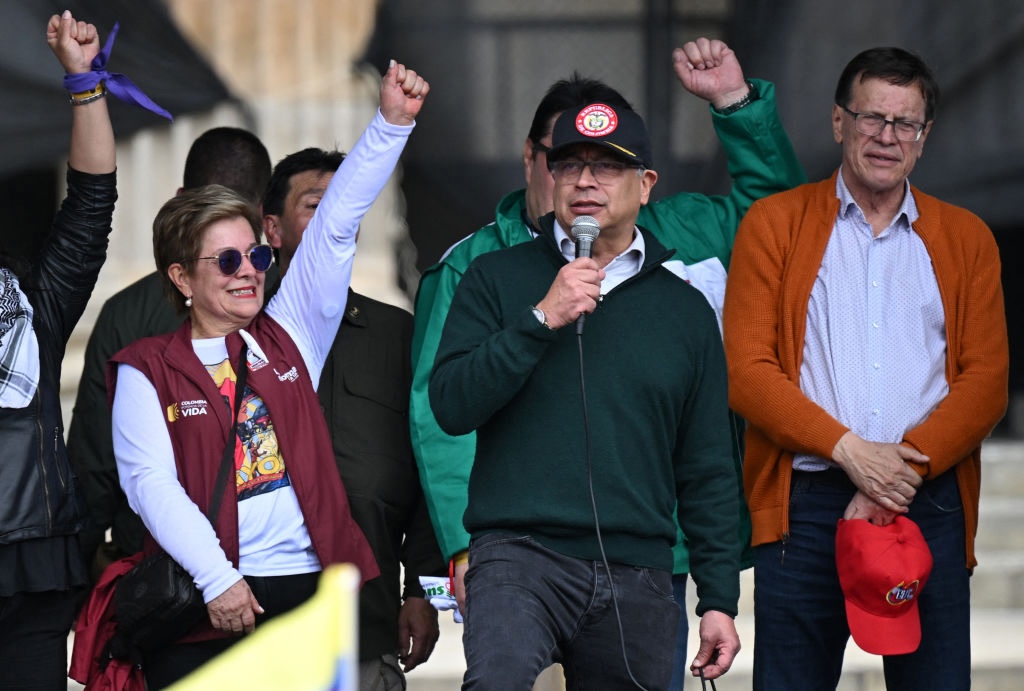
Gustavo Petro has severed diplomatic ties with Israel, suspended the purchase of Israeli weapons, and banned the export of coal to the country. (Raul Arboleda / AFP via Getty Images)

Since losing his US visa for comments he made at a pro-Palestine rally in New York City, Colombian president Gustavo Petro has not backed down.

After Israel illegally intercepted the boats of the Global Sumud Flotilla on October 1, Petro immediately denounced the kidnapping of two Colombian citizens aboard and ordered the expulsion of the entire Israeli diplomatic delegation from his country. He also announced that Colombia would move to abrogate its Free Trade Agreement (FTA) with Israel, a legally difficult process that his government has already begun.

The move to cancel the FTA put Petro once again at the vanguard of a global movement to end Israeli impunity. Since the beginning of Israel’s genocidal response to the October 7 attacks, Colombia’s first left-wing president has done more than any other world leader to pair his condemnations with concrete actions. Pushed from below by a powerful Palestinian solidarity movement in Colombia, Petro has severed diplomatic ties with Israel, suspended the purchase of Israeli weapons, and banned the export of coal to the country.

For these moves, Petro has been hailed as a model around the world. Nevertheless, as interviews with Colombian Palestinian solidarity activists reveal, there is still much to be done if the country is to completely sever economic, cultural, and political ties with the genocidal state. To do so, the administration will have to confront the strict regulations of international financial institutions, investor courts, and governmental bodies, as the fights over the coal ban and FTA reveal.

The Coal Ban

In the immediate aftermath of the October 7 attacks, Petro quickly established himself as a leader with a clear moral vision on the issue of Palestine. He forcefully denounced Israel’s dehumanization of the Palestinians, denounced Israeli terrorism, and decried the West’s double standard in supporting Ukraine while denigrating Palestine. Petro’s response — informed by Israel’s own role in perpetuating violence in Colombia in the 1970s and ’80s — quickly deepened as Israel’s genocidal response continued unabated. In late February 2024, he suspended the purchase of Israeli arms; a few months later, he severed diplomatic ties.

But Petro’s most consequential move came with his decision to ban coal exports to Israel. After announcing the policy in June of 2024, the government signed a formal decree in August that framed the embargo as an effort to ensure that Colombian coal would not in any way fuel the bombing of Palestinian children. It marked one of the first concrete attempts by any state to challenge the material economy of the war as a means to enforce the legal framework of genocide prevention.

The decree, however, had loopholes. While activists affiliated with Colombia’s Palestinian solidarity movement welcomed the ban, it soon became apparent that it was ineffective. Provisions in the decree protecting preexisting contracts allowed exports to persist, undermining the government’s stated intent and allowing coal exports to continue apace in the year after its signing. It fell to activists from across the country — including the boycott, divestment, and sanctions movement (BDS) and organizations like Tadamun Antimili — to monitor and enforce compliance and push for a new decree.

In its battle to completely end the export of coal to Israel, Colombia’s vibrant Palestinian solidarity movement drew upon the same powerful coalition that had successfully pushed for the first decree — a coalition that has not yet been successfully replicated elsewhere. Trade unions in the coal industry, indigenous and Afro-Colombian movements resisting extractivism in their territories, and urban activists marching in the streets came together to expose the government’s ongoing complicity, pushing the issue onto the national and international stage. As part of a national strike in late May 2025, indigenous communities blocked coal mines under the banner of “no more coal for genocide” and labor unions marched with Palestinian flags in cities across the country.

Momentum grew for a more robust coal ban in early July, when a report by UN Special Rapporteur Francesca Albanese specifically cited Glencore and Drummond — two foreign coal companies operating in Colombia — for their role in supplying Israel’s wartime economy. Weeks later, Colombia hosted a meeting of the Hague Group, which has been working to coordinate international sanctions and embargoes against Israel. Colombia’s Palestinian solidarity activists held parallel events urging the government to close loopholes and implement a full, enforceable embargo.

On August 28, the government modified the original decree, issuing a new version that closed the regulatory gaps. According to Helena Mullenbach Martínez, cofounder of the Resist Glencore campaign and an organizer with the Global Energy Embargo for Palestine, the new decree has been much more effective, anchoring the coal ban in Colombia’s obligations under international law to prevent and sanction genocide.

Even still, the government and allied social movements have had to keep up the pressure. To enforce compliance, Petro directed the armed forces to turn back ships departing with coal bound for Israel, a move celebrated by Mullenbach as key to the new decree’s initial successes.

Powerful multinationals like Drummond have been working hard to convince labor unions and indigenous organizations that the coal ban will harm them. “Drummond has launched front groups to oppose our work,” said Mullenbach. In response, in the coal-producing parts of Cesar and La Guajira, the organization has launched what they call “the largest Pro-Palestine marches to date.”

This powerful coalition of campesinos, indigenous groups, environmental activists, and labor unions has faced obstacles beyond the coal companies. Indeed, the coal ban has been the subject of scores of lawsuits filed by opposition parties and multinational corporations, even as the Ministry of Commerce has reiterated that the government’s ban is consistent with the UN Charter, the Genocide Convention, and the regulations of the World Trade Organization.

Opposition parties have also stood in the way of the attempts of BDS activists to cement the policy into law, a key goal given the fast-approaching presidential elections and the prospect of a new administration quickly overturning the decree.

The government’s position has remained unambiguous: the ongoing genocide is a crime against humanity and thus warrants implementing measures like the coal embargo. This is the same argument Petro has made to justify the cancellation of Colombia’s free-trade agreement (FTA) with Israel. In late September, he declared that “trade is not above life.”

Free-Trade Agreement

Colombia’s FTA with Israel was signed in 2013 and finally entered into force in August 2020. During these five years, the agreement has not led to any deepening of investment or diversification of exports, and the consensus is that the FTA has not been significantly beneficial for the Colombian economy. Yet given that coal has made up the vast majority of Colombian exports to Israel (82.5 percent in 2024), the battle over the FTA may seem insignificant.

To the contrary, the stakes couldn’t be higher. They call directly into question the norms of the so-called rules-based international order. Perhaps for this very reason, critics have vehemently attacked the move. To downplay the significance, they have argued that terminating an FTA is largely rhetorical bravado with little legal basis. They have also claimed that it must be approved by Congress and would trigger a complex renegotiation process that would only serve to undermine the main goal of such treaties: investor confidence.

The government and its allies have argued that they have the right to terminate the FTA. Indeed, Article 15.4 of the Colombia-Israel FTA clearly states, “Any Party may withdraw from this Agreement by means of a written Diplomatic Note to the other Party.” On September 30, the Ministry of Commerce formally requested that the Foreign Ministry send such a diplomatic note to Israel, notifying it that Colombia is terminating the agreement.

If Colombia follows through, it would not be defying international law but acting in accordance with it. The Genocide Convention obliges all states to prevent and halt genocide “by all means reasonably available.” As Petro has argued countless times, severing trade ties with a state credibly accused of committing genocide must be understood not as a breach of legal obligations but as their fulfillment. In this sense, Petro’s move goes beyond moral posturing as it translates the language of international justice into state policy.

Colombia’s decision could set an important precedent for other countries that maintain free-trade agreements with Israel yet seek to align their foreign policy with their legal obligations under the Genocide Convention. Although the region’s other progressive leaders, such as Mexico’s Claudia Sheinbaum and Brazil’s Luiz Inácio Lula da Silva have condemned Israel’s actions in Gaza, neither government has taken steps to suspend economic or diplomatic ties. If successful, Petro could provide them with the playbook to do so.

Because of the larger stakes of this battle, the decision to terminate the FTA with Israel must also be understood within the broader realignment of Colombia’s trade policy under Petro. His government has repeatedly criticized the country’s free-trade and bilateral investment treaties, calling them a “bloodbath” that exposes Colombia to investor-state dispute settlement (ISDS) mechanisms. Under ISDS, multinational corporations can sue states before closed international tribunals with no mechanism for appeal, a system many describe as neocolonial.

Over the past decade, Colombia has faced twenty-three arbitration suits — including from Glencore itself — totaling $13.2 billion in claims. Civil society groups and fifty-four members of Congress have called for the country to withdraw from ISDS altogether to curb corporate power and defend national sovereignty.

Petro has gone a step further on this path, announcing his intention to suspend the FTA with the United States. While the move was framed as a response to recent tensions with the Trump administration over US drone strikes in the Caribbean (some of which have killed Colombian citizens) and the imposition of tariffs, Petro had been discussing the renegotiation of the FTA for months as part of a broader reorientation of Colombian trade away from the United States. The FTA with the United States was also the primary means through which multinationals were suing the Colombian government for its coal ban.

The suspension of the FTA with Israel — and partially with the United States as well — is not only a gesture of solidarity with Palestine but part of a broader effort to reclaim economic sovereignty. It challenges the assumption that trade liberalization and investor protection — two pillars of the neoliberal economic order — are untouchable.

Deepening the Break With Israel

While parts of Petro’s larger agenda vis-à-vis Israel may have to wind their way through international courts, the government has also pursued a slate of minor policies to further sever ties with Israel. Many of these have been concentrated in the defense sector. The government blocked Israeli participation in an upcoming defense conference, developed its own domestically made rifle so as to cut its dependence on the Israeli Galil, and made moves toward refurbishing its aerial fleet with Swedish Saab planes instead of the Israeli Kfir jets upon which it has relied.

The government has also vowed to go further, issuing in August a wide-sweeping decree that calls for the promotion of the Palestinian cause in international forums as well as a review of public contracts with the Israeli government, many of which remain in force.

According to Pablo Robles, a member of BDS Colombia, the government still has contracts with Elbit Systems, Israel’s largest weapons manufacturer and a long-standing target of the BDS movement worldwide. Colombia’s thirteen active contracts include plane maintenance, the provision of communications and interception networks, and the construction of a national police surveillance system.

BDS activists are optimistic that Petro will continue to push the envelope, especially given the Palestinian solidarity movement that can pressure politicians who resist.

The Battle for Sovereignty

Petro’s decision to cut economic and diplomatic ties with Israel is not simply a solidaristic or moral gesture. Rather, it is the concrete expression of an understanding of economic sovereignty, international law, and Global South–led multilateralism as mutually reinforcing fronts with the same horizon of struggle.

As Petro’s stance on Palestine steers Colombia away from decades of alignment with US economic and security interests, both domestic and international pressure on his government have intensified. At the same time, Washington has grown more aggressive in asserting control across the hemisphere — including carrying out lethal, extrajudicial drone strikes in the Caribbean — laying bare both the limits to Colombia’s sovereignty and the urgency of Petro’s efforts to bolster it.

In the battle to end Israeli impunity — and in doing so, rewrite the rules of the international order — Petro has been accompanied by a Palestinian solidarity movement unique in its effectiveness. Colombia’s own violent conflict and the role of the Israeli state and multinational corporations in exacerbating it make the movement to end the country’s complicity in Israel’s genocide all the more potent.

Fail or succeed, Petro’s willingness to raise the bar by taking concrete actions to end the genocide has revealed that it is possible to meaningfully confront Israeli impunity. It has also revealed that this battle is inextricably bound up in the defense of sovereignty and the articulation of a new geopolitical order where the United States cannot unilaterally enable domination and violence as the world helplessly watches on.