Gustavo Petro’s Last Push to Phase Out Fossil Fuels
Colombia hosted a global summit on phasing out fossil fuels last month. Gustavo Petro’s left-wing government is confronting powerful oil and mining interests, but making Western countries follow suit is not easy.
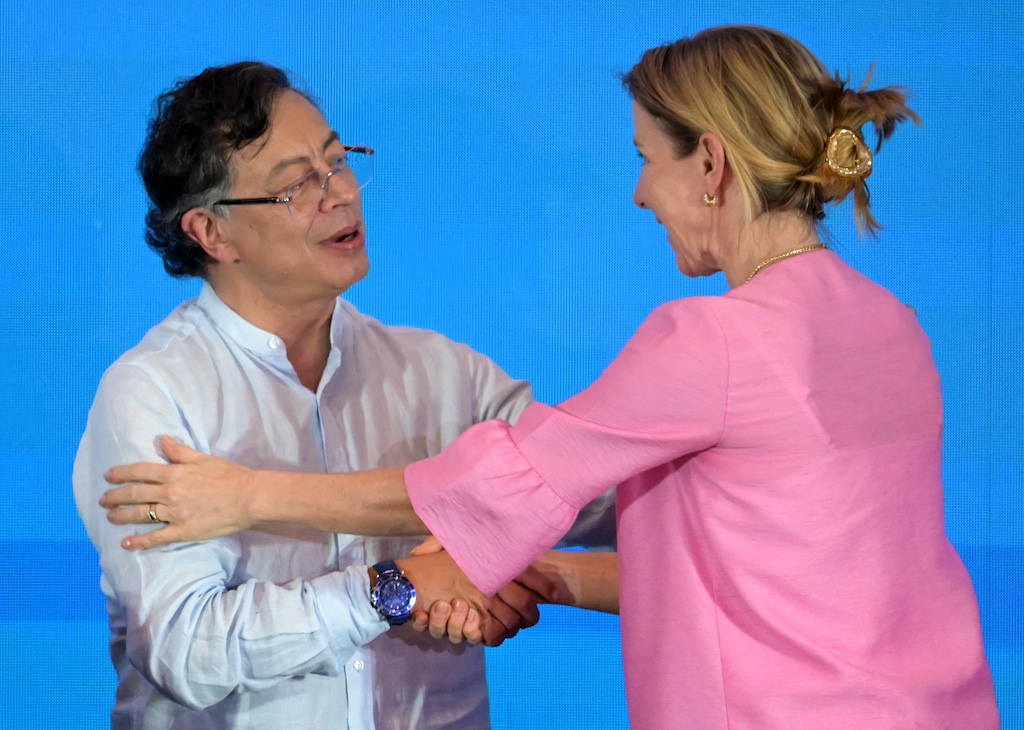
One of Gustavo Petro’s final acts as Colombia’s president has been to push for a break with fossil fuels, resisting multinationals’ projects for new mining development in Colombia. (Raul Arboleda / AFP via Getty Images)
The Caribbean port city of Santa Marta sits at the foot of the Sierra Nevada mountains in Colombia’s Magdalena department. Along its shoreline runs the Drummond terminal, named after the coal multinational that operates it, where a railway juts out into the sea, loading export ships with coal hauled from vast open-pit mines in the neighboring Cesar region, near La Loma. From April 24 to 29, delegates from fifty-eight countries gathered here for the first international conference on phasing out fossil fuels, in a region where the realities of extraction are impossible to ignore.
Coorganized by Colombia and the Netherlands, the summit brought together governments, unions, indigenous peoples, frontline communities, scientists, and activists seeking to move beyond the limits of international climate negotiations and chart a just transition. The conference was divided into three chapters: an academic track, a people’s summit, and “high-level” interministerial talks — all converging at the end of the week, through designated representatives, in joint working sessions.
But what a “just transition” looks like does not carry the same meaning, nor weight, for all participants. If the Santa Marta summit laid bare the costs of fossil fuel dependence, it also exposed the divisions that remain over the scale of economic and political transformation required to break free from fossil capitalism’s stronghold.
Pent-Up Frustrations
Driven by growing frustration with the limits of United Nations climate negotiations, the conference, officially titled Transitioning Away, aimed to push discussions on fossil fuel phase-out further than the UN’s COP (Conference of the Parties) process has so far allowed.
“For the past thirty years, fossil fuels weren’t even mentioned at COPs,” said Tzeporah Berman, founder of the Fossil Fuel Non-Proliferation Treaty, a civil society initiative now endorsed by eighteen nation-states, including Colombia, and hundreds of subnational governments. Most of them are small island states in the Pacific region, particularly vulnerable to rising sea levels, such as Vanuatu, Fiji, or Samoa.
Several of these countries, including Tuvalu, declared energy emergencies last month due to severe fuel supply shortages and skyrocketing prices exacerbated by global conflicts. “The government has to shut down at 3 p.m. every day to save energy. We are doing what we can, but we can’t solve this problem alone,” said Tuvaluan minister Maina Vakufua Talia at the introductory plenary.
While the Santa Marta conference built on proposals advanced by the Fossil Fuel Non-Proliferation Treaty, its scope has expanded outside the initiative to include major hydrocarbon powers such as France, Canada, the United Kingdom, and Germany. However, it does not include the United States, China, India, or Saudi Arabia.
The relative absence of Global North countries from the treaty initiative raises questions about real engagement within Santa Marta’s self-described “coalition of the willing.” Those contradictions were perhaps best embodied by the Netherlands: the Dutch government approved new gas extraction projects in the North Sea the very week it was cohosting the conference in Santa Marta. It has also come under fire from Climate Justice Flotilla activists for appealing a court ruling in The Hague that found the Dutch state had failed to adequately protect residents of Bonaire, a Dutch Caribbean territory, from the impacts of the climate crisis.
According to Berman, however, minority coalitions have historically driven global change, citing nuclear nonproliferation and land mine bans as precedents. “Santa Marta is our Porto Alegre — it needs to be,” maintained Joel Wainwright, referencing the World Social Forum’s attempt to build alternatives to dominant economic models. The coauthor of Climate Leviathan, Wainwright attended the summit as a “proud partisan of the climate justice movement.” Such moments of convergence matter — if not to solve the energy crisis in a single conference, then to restore momentum, solidarity, and political energy to a movement often marked by fragmentation and fatigue.
Colombia’s Climate Diplomacy
Under left-wing President Gustavo Petro, Colombia has sought to position itself at the forefront of climate diplomacy. The government has not only opened space for demands long pushed by NGOs and civil society — kickstarting this direct confrontation on fossil fuels, responsible for 75 percent of global greenhouse gas emissions — but also taken steps domestically to align with that agenda.
In recent months, Colombia has moved to halt more than three hundred prospective fossil fuel projects, including forty-three oil blocks and over 286 mining applications, notably by banning extraction in the Amazon region. In March, Petro also announced the country’s withdrawal from the Investor-State Dispute Settlement (ISDS) system, which allows multinational corporations to sue governments over policies affecting their investments. Over the past decade, Colombia has faced twenty-four such claims totaling more than $13 billion: roughly 11 percent of its annual budget.
The decision to halt further extractive expansion is significant for a country ranked as the world’s fifth-largest coal exporter. Fossil fuels account for over 50 percent of all Colombian exports, making the economy highly dependent on extractivism and thus also vulnerable. With 99 percent of production destined for export, this changed course demonstrates that political will can go a long way in advancing the energy transition.
Yet that approach still remains fragile. With elections looming this May 31 (and Petro is ineligible for reelection), a potential opposition victory could see a return to extractivist policies. While Petro’s left-wing supporters are placing their hopes in candidate Iván Cepeda, his conservative opponents have signaled their intention to double down on fracking and oil if elected.
While Petro’s agenda has made this issue a top priority from the start of his term, the push to diversify the economy and energy reliance has only intensified with the US and Israel–led war in Iran.
“Security” and “energy sovereignty” were recurring buzzwords in official speeches, emphasizing the urgency to develop and rely more on renewables.
Global Witness along with the Guardian have recently revealed that the world’s top hundred oil and gas companies banked more than $30 million every hour in unearned profit in the first month of the US-Israeli attack against Iran — adding to the billions accumulated since the start of the war in Ukraine.
For Irene Vélez Torres, Colombia’s minister of the environment, “fossil fuels have always been used as a weapon for geopolitical domination.” Although Petro’s government moved in 2024 to halt coal exports to Israel, the question of regulating exports to countries violating international law remained largely absent from high-level diplomatic debates.
The contrast was stark with civil society, where unions, NGOs, and activists addressed the issue at length within the people’s summit. In their collective statement, the Palestinian Institute for Climate Strategy underlines that “fossil fuels are being routed, traded, insured, and weaponized through systems of war, occupation, and colonial power. Any transition framework that cannot confront that reality will fail its most basic test.”
The Limits of Technocracy
Techno-optimism — and the persistence of “green” market strategies — has not yet seemed to have run its course. A clear divide emerged in Santa Marta between grassroots civil-society calls to move away from “false solutions” and green capitalism, and a more technocratic approach emphasizing market-led and technological fixes.
Hydrogen, nuclear expansion, carbon capture, carbon pricing, and carbon trading were listed among solutions by policymakers, academics, and ministers from countries including Singapore, Sweden, and the Netherlands.
For Wim Carton, a political ecologist whose work with Andreas Malm examines how carbon offsetting shifts responsibility rather than meaningfully reducing emissions, this reflects a deeper problem. “It’s often assumed that markets will solve the crisis if properly incentivized,” he said. “But that overlooks power relations, vested interests, and the ways demand is actively constructed by fossil fuel companies.”
Communities present at the People’s Summit consistently emphasized that the transition must be understood first and foremost as a social and political transformation, rather than a purely technological one.
Meanwhile, Johan Rockström, head of the scientific panel, outlined a vision centered on policy design, financial mechanisms, and technological innovation — including artificial intelligence — to navigate political and socioeconomic constraints.
So have the people’s summit messages been lost in translation?
María Reyes, a climate and human rights activist with the Alliance of Non-Governmental Radical Youth (A.N.G.R.Y), participated in high-level sessions as a youth representative. She described discussions at these private sessions being focused on collaborations such as JETP (Just Energy Transition Partnership) agreements, which she criticized as “a strategy for colonial control.”
JETPs are agreements in which Northern governments fund energy transitions in Southern countries, primarily through loans. Critics argue that they deepen debt dependency — already a major constraint on climate policy in the Global South — while reinforcing unequal financial and political relations under the guise of climate cooperation.
“A Global North country invests in a Global South country in exchange for influence over regulations, laws, and infrastructure,” she explained. “There’s still a lot of confusion between cutting emissions and phasing out fossil fuels. And for us as children and youth, it’s important to insist: the problem isn’t just emissions, it’s the extractive logic at the root of the system.”
Still, the gathering marked a hopeful turning point: not because it resolved the question of how to phase out fossil fuels but because it forced the issue into the open. Questions of debt cancellation and the ending of fossil fuel subsidies (currently amounting to $1.2 trillion each year) were discussed, and participants agreed to present road maps for progressive phaseouts. Whether these road maps will prove more effective remains an open question.
The next conference, scheduled for 2027 in Tuvalu and cohosted by Ireland, will build on this first gathering and is intended to complement rather than replace the UN process.
Santa Marta’s attempt to confront the fossil fuel economy marks a significant step toward what Torres has called a new “global climate democracy.” Yet the continued dilution of key debates may well slow an already overdue process. In particular, issues such as militarization and human rights violations risk being sidelined in favor of “green finance” and investment opportunities.
Scientists are already warning that a “super El Niño” could further intensify extreme weather events and push global temperatures to record highs in the coming year. In a world increasingly shaped by war, geopolitical rivalry, and impunity, openings for cooperation remain vital. But they should do more to integrate Global South and indigenous perspectives, alongside the more radical demands needed to confront the expansion of fossil-fueled authoritarianism.