The Scottish National Party Is Facing a Political Crisis
The SNP has dominated Scottish politics for well over a decade, but Nicola Sturgeon left her successor, Humza Yousaf, with a dubious legacy. The party now risks being overtaken by Labour, even though support for Scottish independence remains solid.
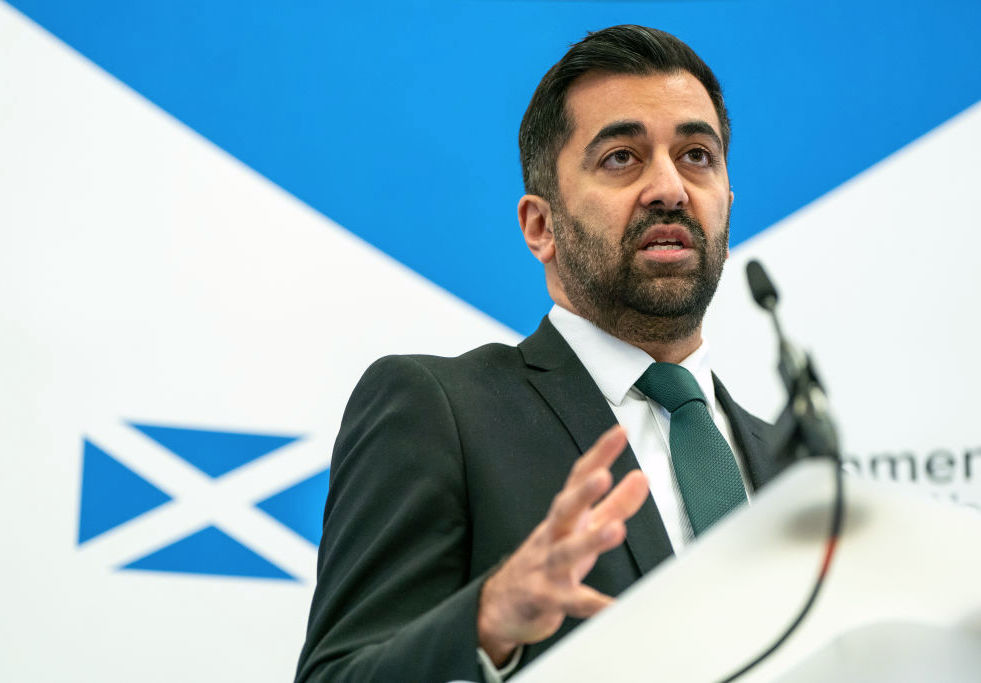
Humza Yousaf, first minister of Scotland, speaks at the University of Glasgow on January 8, 2024, in Glasgow, Scotland. (Peter Summers / Getty Images)
Is the Scottish National Party (SNP) built to govern during periods of prolonged economic stagnation? At its electoral peak between 2011 and 2021, everything about Scottish nationalism, from its obsession with green industrialization to its relentless European para-diplomacy, screamed “progress.” During the 2014 independence referendum, the central slogan of the Yes campaign was “Scotland’s future in Scotland’s hands.”
However, the optimism of those years has been lost beneath a blanket of British depression. The UK is drifting in and out of recession. After a decade-and-a-half of Conservative retrenchment, Britain’s infrastructure has buckled. Housing costs in major British cities, including Edinburgh and Glasgow, remain prohibitively high. No country in Western Europe registers lower levels of public trust in political elites than the UK.
Against this backdrop, the SNP has played at best a mitigating role, sometimes using the limited powers of the Scottish Parliament to pursue progressive reform but just as often railing against the shortfalls, real and imagined, of the Westminster system. Over time, Scottish voters have grown tired of the constitutional buck-passing. Seventeen years after the first SNP government was inaugurated at Holyrood in 2007, incumbency, as much as corruption or incompetence, has snared the separatist agenda.