Before the Punk Rockers, There Were the Working-Class Teds
British class society had a dress code: the rich could be flashy, but workers were expected to wear a drab uniform. In the 1950s, England’s working-class Teddy Boys and Girls boldly donned pompadours and velvet, giving birth to modern British subculture.
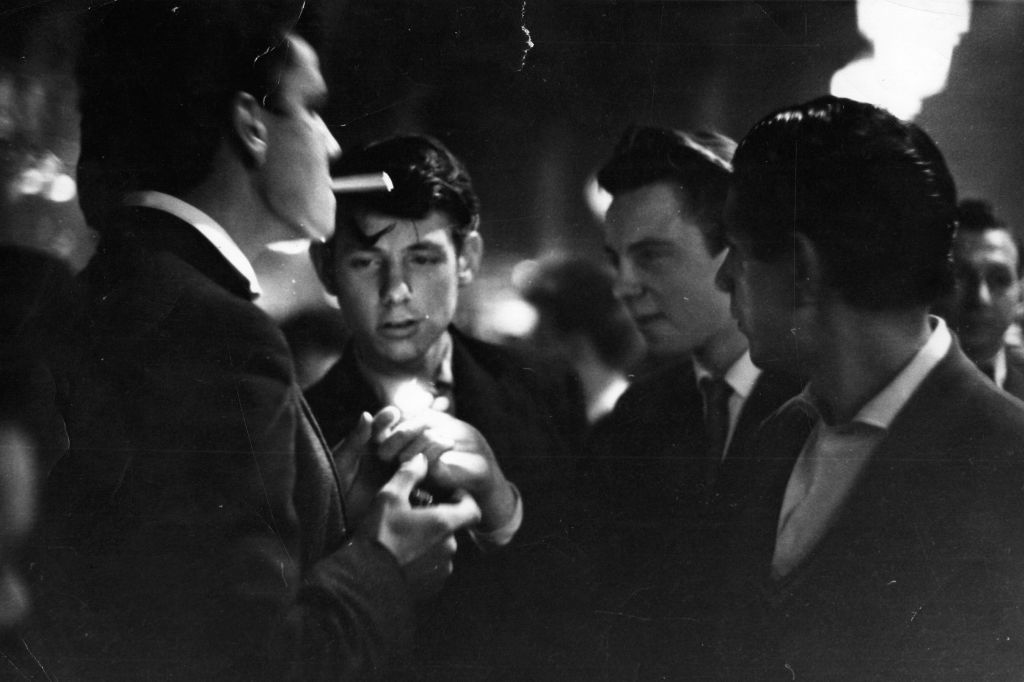
Before the Beatles, before the Stones, before the Sex Pistols, there were the Teddy Boys — working-class kids dressed irreverently like Edwardian aristocrats who lit the fuse on every British youth subculture that followed. (Alex Dellow / Getty Images)
- Interview by
- Meagan Day
In the early 1950s, working-class teenagers in London started showing up to dance halls in long drape jackets with velvet collars, drainpipe trousers, and pompadour hairdos. Their look approximated the aristocratic Edwardian styles then in fashion on the expensive Savile Row, but slightly askew, knocked together by backstreet tailors on the cheap. These kids were called Teddy Boys, Ted being short for Edward, and they scandalized postwar Britain. The press painted them as violent thugs, and politicians fretted over their malign social influence.
Max Décharné’s Teddy Boys: Post-War Britain and the First Youth Revolution (Profile Books, 2025) is the first book to give the Teds the full treatment. Décharné presents the Teddy Boys less as a criminal menace than a class provocation. World War II had so significantly reduced the population of working-age men, Décharné explains, that Britain in the early 1950s was approaching full employment. Teenagers could leave school and expect to get a well-paying job straightaway — and if they didn’t like it, they could quit and find another. The result was a cohort of working-class youths with unprecedented spending money and self-respect.
As Décharné explains in the following interview with Jacobin’s Meagan Day, British class society had always been marked by a rigid dress code. Eccentricity was for the aristocracy; workers were meant to dress in a drab, mud-colored uniform and blend into the background. In medieval times, wearing clothes above one’s station was an actual crime. The Teddy Boys’ and Girls’ real offense, then, was breaking class decorum by dressing in luxe, attention-grabbing clothing, a privilege of self-expression long reserved for British elites.
The flashy style and irreverent attitude of the 1950s Teddy Boys and Girls laid the foundation for the mods, punks, and everything that came after in subcultural Britain and beyond. Paul McCartney remembered knowing John Lennon as “the local Ted” before they formed the Beatles. Vivienne Westwood and Malcolm McLaren opened a shop to sell Teddy Boy clothing before going on to spotlight the Sex Pistols and invent the punk aesthetic. It’s impossible to envision the evolution of counterculture without the influence of the Teds.
I don’t think many Americans will have even heard of the Teddy Boys.
No, I’ve long been aware of that. It was very much an English thing. It never even made it to Europe, only to the Republic of Ireland. Irish teenagers would come over for three or four months and go home with a fat pay packet. And while they were here, they would absorb the culture and see these clothes in particular, and they’d go, “That’s for me, thank you very much.”
The Republic was incredibly conservative and very worried about what the Catholic Church would say. Some of the press in Ireland was actually even more vicious about the Teds than the press over here, because they didn’t understand it. But again, it was a purely working-class thing here, and it was a purely working-class thing there.
I only know about it from coming across these pictures of Teddy girls in the 1950s, dressed very much like Edwardian boys, which seemed strange and striking enough to catch my attention.
Yes, the astonishing pictures that Ken Russell, later famous as a film director, took for Picture Post in January 1955. Picture Post is very significant. It was the equivalent of Life magazine, which is to say it prided itself on really great street photography, war photography, documentation. It had come out of World War II, and so when the war stopped, it started focusing on home life here. The woman who wrote the great early article for Picture Post about Teddy Boys, which was essentially defending them, a year before the Teddy girls piece, was named Hilda Marchant. She had been a war correspondent, traveling with the troops, seeing the concentration camps being found, all sorts of really hardcore stuff.
Marchant was sympathetic to these young men — and then, later, young women — who were dressing up like this. She thought, really, what’s the problem? After everything everybody’s been through over here, the massive bombing of London and many other major cities, it’s just clothes. They were so young — some of them were thirteen, fourteen years old. Hilda Marchant didn’t find them scary, as so many people did. She found them at dance halls, went up and talked to them. The Teddy girl photographs taken by Ken Russell were in various poor parts of London. He went to the East End, he went to Elephant and Castle — places that were virtually destroyed by the saturation bombing in the war. Some of those photographs of Teddy girls were taken in the literal rubble.
What did the backdrop of the bombings have to do with the rise of the Teds?
Well, this was my parents’ generation. They both grew up during the war in social housing — what over here is called a council house. In America, you’d say that’s the projects. In Memphis, Elvis Presley grew up in the Lauderdale Courts, which was a housing project. Quite a nice one, low-rise, but it was government housing basically. And that’s what my parents came from. My dad told me that he could recognize every kind of military plane from below — whether it was a German plane or a British plane, whether it was a bomber. They could tell from the sound it made, from the shape of it, because they’d seen so many of them coming over, dropping the bombs or flying after them to try and stop the bombs dropping.
The Teds and Teddy girls were born in 1940, ’41, ’42. And by the time they started causing trouble for society, they’d had ten years or so of growing up in ruined streets, playing on bomb sites, playing on dangerous abandoned buildings, things that were likely to collapse that you weren’t supposed to go anywhere near. There was a lot of unexploded ordnance still hanging around. The country was bankrupt. We did not have the Marshall Aid that the United States provided to get Germany back on its feet. Germany got rebuilt. My wife is German, and I used to live in Berlin for many years. My street in Berlin was completely trashed in the war, but it had been restored. We didn’t have the money over here to do that. London was bomb sites.
So you’ve got these resentful kids growing up in poverty with the idea that nobody cares about them. They were expected to be sensible, join the workforce, be quiet, and not call attention to themselves. They didn’t do that, and it upset absolutely everyone. By dressing in flash clothing, they were seen to be getting above their station. It drew intense scrutiny and suspicion from the upper classes, the middle classes, politicians, the media, and also their own working-class parents, whose mentality was: play the game, blend in, don’t make a fuss.

I mentioned Elvis because there are important parallels. Before he went national in the summer of 1956, Elvis was touring regularly down south; people like Buddy Holly in Lubbock, Texas, already knew about him. And he was scandalizing people by wearing flash clothing. It was coming from Beale Street, the R&B tradition — literally the pimps were dressing like that in Memphis. It was not respectable. He was getting beaten up for this. In his early years in the South, Elvis’s car was being dynamited by white supremacists who thought: You are dressing like the people from across the tracks, you are imitating the black pimps, we don’t trust you, you should be shut down immediately.
The Teds caused quite a similar reaction over here. The press portrayed them as a menace, as violent thugs. Yes, there was violence among them, but then I’m an old punk rocker from the 1970s. There was violence at a lot of the Ramones gigs I went to as a teenager, too, and the same fuss in the press. I really recognized the moral panic and being looked down on. I felt in the book that I had to say what the country was like at the time, in order to contextualize the extreme reaction from the church, the media, and the politicians.
When we talk about getting above their station, there’s something about the sartorial expectations placed on the working class at this moment. What was the paradigm that the Teddy Boys came and exploded?
We’ve always had this tradition of the great English eccentric, but it’s reserved for the upper class. The last few years of the eighteenth century were the era of the dandy. These were enormously wealthy people who would go and gamble at the gentlemen’s clubs up and down Piccadilly. They would brag about losing a hundred thousand pounds in one card game of an evening — and I’m not talking about a hundred thousand pounds now, I’m talking about a hundred thousand pounds then. They were often Lord so-and-so, Lady so-and-so. It was considered okay and acceptable for these people to dress up in anything they liked.
There was a guy called the Green Man of Brighton. He was a friend of Beau Brummell in about 1810 — Brummell being the chief dandy, the most famous one. The Green Man of Brighton was a wealthy aristocrat. He dyed his hair green more than two hundred years ago. He drove around in a green carriage. He had his horses dyed green. He had all of his servants dressed up in green livery. And British society knew how to deal with that. “Oh, he’s just an eccentric. He likes to hang around in his castle and fire a gun out of the window at the peasants.” That was okay.

If you were an eccentric in the upper class, that was fine. But if you were working class, absolutely not.
The working class was expected to dress in a sort of mud-colored uniform, then?
Yes, and it’s important to understand that by breaking this rule, the Teds had no friends in the upper classes. The civil service did not hire anybody between 1950 and 1954 who had not gone to either Oxford or Cambridge. Most of the BBC — we only had one TV channel until 1955 — most of the newspapers, the people running all of that, the journalists, the presenters, everybody had been to Oxford or Cambridge. They were the supposed opinion formers. And they were horrified by these working-class kids dressing in Edwardian aristocratic clothing.
I do a huge amount of newspaper research for my books. I like contemporary opinions. And it’s all astonishingly negative, the press about the Teds. Whereas if you go forward ten years, where suddenly the Rolling Stones are supposed to be the bad boys — and by the way, they’re old Teddy Boys, in the same way that most of the British Invasion bands are; John Lennon’s an old Teddy boy, Paul McCartney’s an old Teddy boy — these supposed bad boys are being invited out by the aristocracy. They’re being asked to parties with Lord and Lady So-and-So’s son or daughter. They were embraced by upper- and middle-class society very quickly.
That never happened with the Teds. You would never have found somebody in the press, aside from the Picture Post of course, saying, “I understand these kids, because my thirteen-year-old son is a Teddy boy.” Their thirteen-year-old son would’ve been a jazz fan. The upper class has a long tradition of loving jazz here. Louis Armstrong, Duke Ellington, Cab Calloway — they toured over here a lot, right from the word go. Some of those early jazz bands literally played at Buckingham Palace in the 1920s. Jazz was accepted straight away. It was mass market, very popular. The BBC would broadcast it from the mid-twenties onward. But rock and roll was regarded as about as welcome as Covid-19 was five years ago. It was the new plague, and everyone should run away screaming. That was the kind of press rock and roll got.
So the Teddy Boys are very intimately related to American rock and roll?
They embraced it hugely when it came along over here. But they’d already been going for about three years by then. They were fully established here in London before we’d ever heard of rock and roll.

I should explain simply: Where does the name come from? Ted is short for Edward, because they wore Edwardian clothing. Edward VII was the son of Queen Victoria. She died in 1901, and he died in 1910. So it’s basically the first decade of the twentieth century. There was a big nostalgia for that era after World War II. We’d been punched in the face by the first world war, and then just recovering from that and punched in the face by the second. A lot of people of a certain age were looking back at their youth and thinking, that Edwardian summer before the war, that was before it all went to hell. Those people were getting nostalgic, writing memoirs, and there was a fashion revival. It was the same distance away in time from them as the 1960s are for us now.
Brideshead Revisited was written in 1945 — so this would’ve been exactly the moment. And not only is that an Edwardian fantasy, but it’s actually a fantasy about an aristocratic eccentric in Edwardian times. Who carried an actual teddy bear around, no less!
Yes. If you’d have tried carrying a teddy bear around in the East End, you wouldn’t have gotten to the end of your street before winding up in hospital. The films being made over here, the great films made by the Ealing company — Kind Hearts and Coronets, stuff like that — they were all set in Edwardian times.
The Paris fashions from 1945, as soon as the war ended, went crazy. Christian Dior and several of the others, like Balmain, completely stole the look of 1910. It was dubbed by journalists “the New Look.” I always call it a new look inside granny’s wardrobe, because that’s what it was. It was not new in the slightest. Over here, people couldn’t really dress like that because clothing was rationed. You couldn’t go and buy twelve yards of fabric for a bustle or a train or whatever. But the styles still became really popular: Edwardian women’s hairstyles, the nipped-in waists of the jackets, velvet collars.
There was a hugely successful women’s clothing fashion revival from 1945 through the rest of the decade. And by 1949, Savile Row — the most expensive men’s tailoring you could get in this country — was thinking, okay, if women have adopted this, let’s sell it to the men. So they started marketing narrow trousers, long coats, and velvet collars. They were still trying to sell it with a bowler hat, which in America you’d call a derby hat.
The Teds didn’t go for any of that. Your hair was important — greased back, big pompadour, that sort of thing. And really, it’s a weird thing that this attempt to sell expensive Edwardian fashions was adopted by working-class kids from the East End and South London. They saw these pictures in the papers and started going to their local tailor, saying, “Here, mate, can you make me one of these? And I want a velvet collar.” They were getting made-to-measure clothing, but from a backstreet tailor — usually a very good one. The upper classes pretty soon dropped the Edwardian styles once they found that working-class kids had adopted the look.
Before then, working-class people would have just worn the clothes that were available to them. Something changed — the disposable income, the mass photographic media exposing everyone to the fashions of the rich, the emboldened sense of self that would allow you to ask a tailor to help you emulate them. Talk about that revolution.
There’s a great late-Victorian book set in the poorest part of London, in the East End, called A Child of the Jago by Arthur Morrison. It’s set in a couple of streets near Liverpool Street Station. These were streets you would not walk down because you would not emerge if you weren’t from those streets. Incredibly dangerous, basically. The young people there lived on stealing, housebreaking, mugging people, coshing people with a nine-bar over their head and dragging them into alleys.
They had money in their pockets. And there’s a line or two that I quote from the book — this is 1896 — where they go to their local tailor around the corner and they say, “I want a fancy stripe down there, I want this many buttons, I want all of this.” Essentially, they were imitating the kind of exaggerated clothing they had seen at the music halls — the vaudeville places where comedians always dressed in exaggerated getups. They were called Flash Boys, or Spivs. So the working-class flash thing had happened before. But the kind of people who could afford it in the East End tended to be on the outside of the law. That’s where they got their money. They’d stolen it.
It’s kind of similar to the pimps Elvis was imitating, right? In terms of flash clothing and being on the other side of the law.
Absolutely. And there were always racetrack gangs — in the 1920s and ’30s, the dodgy people who would make money out of the business of horse racing. Gambling at racetracks was legal in the 1930s, but there were all sorts of dodges. Graham Greene’s wonderful novel Brighton Rock is about the racetrack gangs. They played dirty, carried razors, sometimes carried guns, and they were dressed flash. They had to have disposable income in order to do that.
The difference after World War II was that it wasn’t people outside the law wearing flash clothes. Actually, while the press made out like they were another dodgy gang, the reason the Teds had extra cash was quite the opposite: Britain after the war had nearly full employment.
If you take a huge group of working-age men and send them to war to die, and then you also lose a lot of civilians in the bombing, that’s a large chunk of the workforce gone. So when the 1950s started, the country ended up in a situation that employers generally never want to see happen, which was basically full employment. I’ve spoken to a lot of people, including relatives of mine, and it’s an absolute fact that you could leave school at fifteen and walk straight into a job the first Monday morning. And it would be a well-paid job, because if the employer didn’t treat you well, you could tell the employer exactly where to get off at lunchtime and walk around the corner and get a new job by one o’clock in the afternoon. The wages had to be high enough to keep people happy.
So they had money. They spent it on dancing, going to the cinema three or four nights a week, and hanging out in coffee bars. And they could go and pay the equivalent of, say, several hundred pounds these days on a jacket and some trousers. Imagine getting bespoke clothing when you’re fourteen or fifteen. How long would you wear it? Only about a year, because by then it’s gone out of fashion or you’ve worn it too many times. You’ve gone dancing in it, you’ve gone jiving in it. Before they knew about rock and roll, they would go to big band jazz. Glenn Miller, the uptempo swing, jitterbugging — very acrobatic stuff. You wanted these clothes to look pristine, the way people get with trainers these days, “box fresh.” As soon as they’ve got a mark on them, you’d buy new ones.
Some of these guys wound up with a wardrobe full of bespoke, very flash clothing. And the girls started doing that too. If you look at the Ken Russell photographs, you’ll see that all of them are dressed differently. There was no uniform. If you look at a proper Teddy boy photograph from 1953 or ’54, or the guys on the front of my book — that’s a dance hall here in Tottenham, in North London, May 1954, and they’ve all just left school, and every one of them has a different suit. Some have got six buttons, some have got two. Some have a velvet collar, some haven’t. Some have got a string of pockets down there. You can tell they’ve each gone into their own tailor and said, “I want this, this, this, this.”
The reason I’m saying May 1954 is that the first American rock and roll record to make it into the British charts was December that year — Bill Haley & His Comets, their cover of Big Joe Turner’s “Shake, Rattle and Roll.” So what are these guys dancing to in that dance hall? It’s big band jazz. But by that stage, Teddy Boys were so notorious that you were lucky to even get allowed into a dance hall. They had big signs up saying, “Anyone wearing Edwardian clothing can’t come in.”
So there were two different ways for the working class to get enough disposable income to buy tailor-made clothing and emulate aristocratic eccentrics. One was criminal or borderline-criminal activity, and the other was full employment. And it turns out that the latter was considered a bigger menace to society than the former.
Yes, that’s absolutely correct. I’ve never lived through an era like the one I was investigating in the early 1950s, when employers were actually scared of their teenage workforce — scared that they would just walk out the door and leave them in the lurch. That was the backdrop to the entire phenomenon of the Teds.
It seems these working-class teenagers were so much more emboldened than their parents, or really any previous generation.
There’s something I quote in my book from a very pompous conference of academics and sociologists, around 1961 or 1962, reported in the respectable press — the Guardian and the Times. The lecturer at one point says that up until the end of the 1940s in this country, people dressed in a uniform. He’s not talking about a military uniform. The upper class had its eccentricities, but there were also standards. That was the whole point of Savile Row clothing. You were supposed to be able to tell someone was really upper-class by these little intricacies of tailoring.
Meanwhile, this lecturer at this conference said, the working class had their uniform, but it was supposed to be neutral colors. You were supposed to blend in. You were not supposed to call attention to yourself. There were laws in this country in medieval times against breaking this uniform code. If, as a working-class person in the fifteenth and sixteenth centuries, you were found wearing expensive clothing, you could get prosecuted for it. Certain colors were reserved for the aristocracy — scarlet, things like that. Anything that just looked good, basically. The working class was supposed to dress in mud colors. Up until about the eighteenth century, it could get you arrested for imitating your betters, as it would be called.
That attitude was still hanging around in the 1950s. It really offended the upper-class people who had gotten into the men’s Edwardian revival at the end of the 1940s and then found themselves reading about these street kids who dressed like that.
One funny thing was that the prime minister at the time, late 1950s, was Harold Macmillan. He was a genuine Edwardian, reared in Edwardian times. And he actually sponsored a few boys’ groups in the East End. He went around to one of these youth clubs where there was a group of Teds, all still at school. His speech to them got reported in the press. He was quite remarkably open-minded for the era. He said, “I suppose we’re all Edwardians together.” But usually, there was just resentment that these kids had stolen a fashion they had no right to.
It reminds me of the concept of stolen valor, when people cause great offense by wearing military uniforms when they’ve never served.
That’s a very good analogy. In fact, I’ll tell you about Jimi Hendrix when he came over here. Chas Chandler from the rock band the Animals found him in New York, brought him over, and took him down Carnaby Street, where vintage secondhand military clothing of the extravagant type was popular. Victorian hussars’ uniforms, things with all the gold braid — they were popular among the mods and the fashionable crowd in ’66.

That’s where all the great pictures of Hendrix wearing those jackets come from. He didn’t arrive from America wearing that. He found that down Carnaby Street. And there were lots of outraged letters and even questions asked in Parliament about people being prosecuted for impersonating the military.
So it starts with Edwardian aristocracy and it extends to other sacred cows like military officers. It reminds me of Sgt. Pepper’s Lonely Hearts Club Band and the psychedelic military uniforms, and how unthinkable that would’ve been not a few decades prior.
Those were deliberately cartoons of military costumes. That photograph was taken just off the King’s Road in 1967. You see that iconoclasm in mid-1960s films made over here, the ones that are trying to be trendy. They’ll go into somebody’s flat, and if there’s anything old there, it’s usually been subverted. Like those beautiful wind-up gramophones from the twenties with the extravagant horn — lovely things — you’d usually see them in a ’60s film having some cheap Day-Glo paint slopped all over them.
And by the time we get to the 1980s, it’s gone all the way to lampooning the pre-Victorian elite with the New Romantics.
You can see four or five of the early New Romantics in David Bowie’s video for “Ashes to Ashes.” He went down to one of the main clubs and rounded some of them up. They got their clothing from ecclesiastical clothing suppliers who were literally making clothing for Catholic bishops and priests. That’s what they’re wearing in that video.
You can really see the influence of the Teds on that whole ethos. Can you talk about the afterlife of the Teds? How responsible are they for the subcultures that came after?
You have your Teds at the beginning, then in 1955 and ’56, we get the full blast of American rock and roll over here. And this country loved American rock and roll. It adopted it wholesale, to the extent that even after a lot of people like Bo Diddley, Little Richard, and Johnny Cash went out of fashion in America, once the British Invasion came along, what were those guys doing? They were coming to Britain and touring all the time, playing to huge crowds. This is why the early Beatles tours and the early Stones tours, they’re supporting Roy Orbison, they’re supporting Jerry Lee Lewis. The love for ’50s rock and roll never died over here. And the Teds were always around, all the way through when I was growing up.
I’m from Portsmouth, which is a tough dockyard town on the south coast of England, where the Royal Navy is based. You always had Teds walking around. And by the time you get into the early 1970s, suddenly you’ve got a ’50s rock and roll revival. A lot of the bands on our main music program, Top of the Pops — the glam rock bands that came up at the same time as T. Rex and early David Bowie — many of those bands are wearing Teddy boy drape jackets, brothel creeper shoes, slicked-back hair, doing three-chord songs that are looking back to the 1950s. And at the same time, what are we seeing at the cinema? The breakthrough film from George Lucas, American Graffiti, looking back to the ’50s. The double soundtrack LP to that was a huge hit over here, forty tracks of American rock and roll.
At the same time, Malcolm McLaren and Vivienne Westwood start up down the wrong end of King’s Road in 1971 selling Teddy boy clothing — three or four years before they find the Sex Pistols. They’ve got a shop selling very retro gear, one of the only places you could actually buy that sort of thing. In fact, Glen Matlock, the original bass player of the Sex Pistols, the reason he first walked into that shop in 1973 as a teenager was that he’d heard it was one of the only places you could get a pair of Teddy boy shoes.

And early punk rock over here has got so much in common with first-generation ’50s rock and roll. The idea was, let’s get away from the progressive rock, the five-hour guitar solos, the long-haired hippie stuff. Let’s keep it short, nasty, two minutes, get in, get out. It’s supposed to be for dancing, not sitting. I have a friend, he was at university in the late 1960s, and he was astonished that in my university days we used to jump around to the band. He said, “No, no — everyone’s lying around on the floor, and the band would be up there usually sitting on cushions, and this huge haze of marijuana smoke hovering three feet above the ground.” Punk was harking back to the rock and roll thing of the 1950s. It was for people who wanted to jump around, who couldn’t sit still.
So there are a lot of people my age who got into ’50s rock and roll and the general ’50s look in the 1970s — whether dressing as a Ted or getting vintage American clothing from the time, dressing the way Eddie Cochran or Gene Vincent would’ve dressed. That was in the DNA of punk. The Teds were the ones who latched onto rock and roll. They had the haircuts, the flash clothes, and the music taste. And that influence has never gone away, regardless of all the successive waves of music since.
What inspired you to write this book?
On a personal level, my uncle — my dad’s brother — was a Teddy boy. And he was great. In the old days, when I was a teenager, I said, “What was it like for you?” And he said, “Well, essentially everyone hated us, but no one gave us any trouble. We would go downtown on a Saturday just to stroll around, and it was like the parting of the Red Sea.” Everyone just got out of their way. Not because of anything they’d done, just all this rubbish people had read in the newspapers saying these people are dangerous.
That was my personal inspiration. I knew he was just an absolute sweetheart who loved the music and loved the clothes, and that’s why he was into it. You can see him in my parents’ wedding photograph in 1957. He’s the one at the end doing his best James Dean sneer, trying to look cool with a superb haircut. The Teds were people like that, and their attitude arrived in the culture to stay.