The Jewish Labor Bund Stood Against Zionism

Molly Crabapple’s new book, Here Where We Live Is Our Country, recovers the story of the Jewish Labor Bund — a socialist movement that opposed both assimilation and Zionism, and whose warnings about ethnonationalism have not lost their urgency.
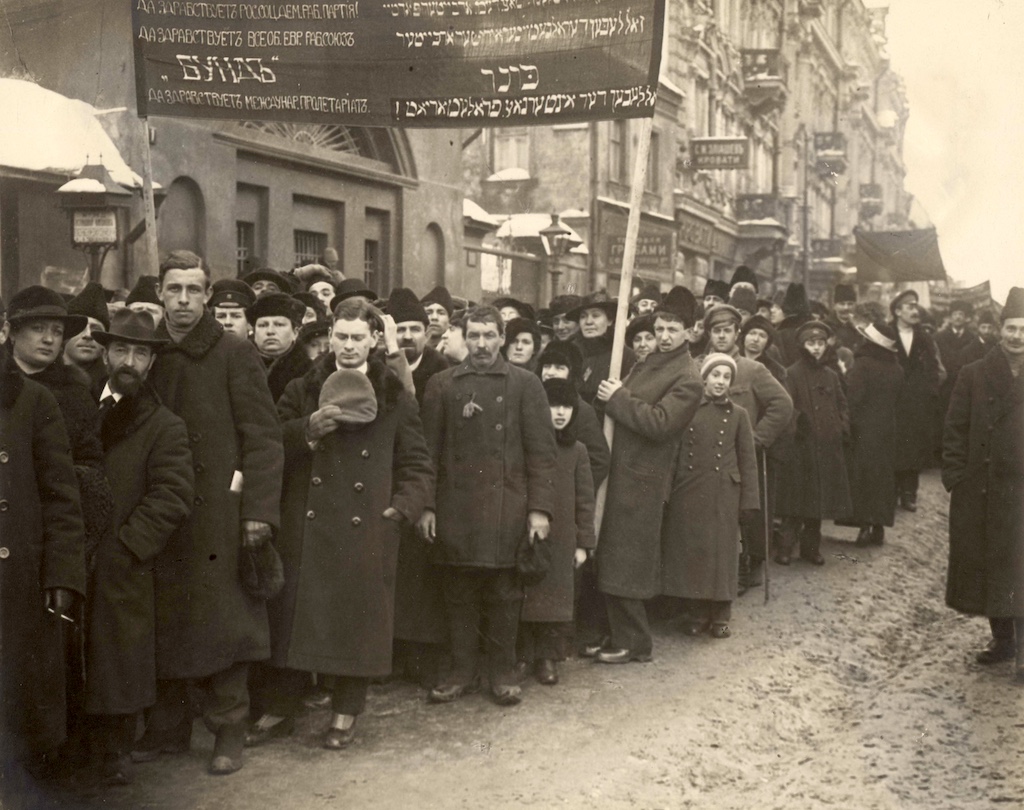
A rally of the Jewish Socialist Labor Bund in 1917 in Moscow, Russia. (Livejournal / Wikimedia Commons)

Jewish Labor Bund groups are springing up throughout the United States and Europe.

Until recently, this was a phrase you could only have found in a primary historical document, perhaps a newspaper in 1905. The Jewish Labor Bund, once a collection of anti-Zionist, democratic socialist organizations largely concentrated in Eastern Europe, was all but destroyed by the Holocaust and postwar Stalinist repression. The group’s message, language, passion, and very existence seemed to have been swept into the trash can of history.

But today, the Bund is in fact growing. New chapters have formed in several cities in the United States, alongside several in Europe. Yiddish is even making a small comeback as new Bundists immerse themselves in the language of their ancestors and family history. Political values long considered antiquated and taboo have returned with a thunderous resonance, especially as the conditions of our modern world raise new questions of identity and class. Where the Bund has long been regarded as a historical artifact, it’s now reasserting itself as a living tradition.

Molly Crabapple’s new book, Here Where We Live Is Our Country: The Story of the Jewish Bund, arrives right on schedule. The book is rooted in Crabapple’s own family history — she discovered the Bund through her great-grandfather’s paintings — but it reaches far beyond the personal to provide a sweeping popular history of the Bund and its world. Here Where We Live Is Our Country is a story of constant change and adaptation to the dialectical forces of history, a robust telling of tenacious resistance to antisemitism and fascism and the horrors wrought by both.

Each chapter gradually conveys the Bund’s trajectory, from the Pale of Settlement in the Russian Empire to the ghettos of Eastern Europe during World War II. Most vitally, Crabapple presents the Bund’s course as a constant counterforce to the rising tides of fascism and despair. The book is ultimately a detailed window into the Bund, its ideological vision, its quest for Jewish autonomy, and a modern world that still longs for what the Bundists fought for almost a century ago. It is an excellent story, and an increasingly urgent one.

The Birth of the Bund

Here Where We Live Is Our Country begins its story of the Bund in the 1890s with the Vilna Group, an underground organization of Jewish social democrats who spread socialist and Marxist teachings to Jewish (and some non-Jewish) workers in plain language. They translated texts into Yiddish, snuck pamphlets into factories and mills, delivered impassioned speeches, organized strikes, and secured tangible benefits for workers.

Most vitally, they argued against both assimilation and Zionism. Their place was among the working class of all creeds and races in the country where they resided, which at this time was the Pale of Settlement, the western part of the Russian Empire where Jews were allowed to live. Autonomy was necessary, as were protections against discrimination and segregation — but by and large, the movement was focused on building class-based politics. And soon, this message of class consciousness and resistance caught fire all throughout the Pale.

From the Vilna Group emerged the original Bund, and from the Bund came countless figures drawn into the great upheavals of the twentieth century. During the early part of the century, the Bund was often based in an exiled revolutionary milieu where leaders like Vladimir Medem and Pati Kremer found themselves trying to adapt to various new strands of nationalism and ideological competition. Ethnonationalism was ascendant, as were emerging strands of communism slowly taking on a Marxist-Leninist bent. Figures like Giuseppe Mazzini, Theodor Herzl, Vladimir Lenin, Leon Trotsky, and other historical titans all knew and corresponded with the Bund.

For the most part, the Bund wanted nothing to do with the emerging Zionist movement, even going so far as to ban Zionists from joining the organization. As for Lenin, Medem and other influential Bundists viewed him as a dictator-in-waiting. Lenin’s faction was pugnacious, uncompromising, and quick to label ideological partners as enemies of socialism. Uneven splits between Bundists and Leninists in the Russian Social Democratic Labor Party (RSDLP) eventually led Lenin to refer to his faction as the majorityites and the Bundists as the minorityites, nicknames that are far more recognizable in their native Russian: the Bolsheviks and Mensheviks.

In Russia, the tsar’s disastrous handling of World War I paved the way for revolution. Millions of Russians were dead, and conscripts found themselves serving on front lines that were severely underequipped and demoralized. Discontent spread across the country, ultimately forcing the tsar to resign and a new provisional government to emerge. Bundists, alongside other leftist groups, used this opportunity to revolt and organize, and soon they had a part to play in this new system by serving on worker councils and in provisional leadership.

Finally legal and in the open, the Bundists now had an opportunity to shape their country and their home. They lived by the value of doikayt, or hereness — meaning that they refused to consider themselves a people apart, regarding their country of residence as their home and yoking their fate to that of their neighbors. They began to imagine finally building the Russian state of their dreams. Autonomy, socialism, and democracy were seemingly on the horizon.

During this brief period, the Bundists did not advocate radical change or redistribution, instead following Karl Marx’s view that Russia was not ready for socialism. They prioritized moderation and a stronger footing in the ongoing war, even as the average Russian soured on gradualism. But as the war grew more costly, hundreds of thousands more soldiers died, and severe shortages roiled the nation, the Bundists soon found themselves outflanked on their left by Lenin. The Russian people demanded an end to the war, plentiful bread, and distributed land, and this is exactly what Lenin and his Bolsheviks promised in their speeches.

In October of 1917, the Bolsheviks launched a coup and took control of the provisional government. Within months, Bundists were once again under threat, with secret police and government repression closing in. Antisemitism persisted, and the revolution brought little in the way of democratic autonomy. Some Bundists chose to integrate into Lenin’s Communist Party in order to gain momentary peace. Those who dissented faced either imprisonment or exile. Many fled, again becoming refugees in the Pale.

Brothers and Sisters in Work and Need

The Bundists who fled to America arrived in the midst of the first Red Scare, as the government cracked down on left-wing movements and their overseas connections. Antisemitism and anti-Slavic sentiment fueled new anti-immigrant legislation and a growing unease about conditions in Europe. As the contradictions of postwar Europe emerged, the United States remained aloof, chasing the imaginary ghost of communist subversion while doing nothing to prepare for what lay ahead. For a time, American Bundists were limited in their actions.

Meanwhile, the European Bund was making real gains, especially in Poland. Electorally, the party performed well in local elections despite ongoing pogroms and right-wing campaigns. Democratic Poland, gradually going the way of the dodo, faced increasing internal pressures as “blood and soil” nationalism gained control over institutional organs of power. Paramilitary groups committed wanton violence. Far-right student organizations attacked Jewish and leftist students trying to attend class. Political parties shifted further and further right in attempts to placate the country’s emerging fascist elements. And, all the while, the Bund remained firm.

Beyond engaging in electoralism, the Bund drew on its long-standing roots in self-defense operations and mutual aid to support its communities. Armed Bundists defended against pogroms, intimidation, unfair labor practices, and neighborhood disputes. Through the organizational and communication skills of people like Bernard Goldstein, a militant union organizer, the Bund was able to consistently defend polling places, meeting groups, and various vital figures from state-backed violence and nationalistic fervor.

Through mutual aid operations, the Bund operated food pantries, schools, old-age homes, credit unions, and various co-ops that helped provide a social safety net and economic opportunities for local residents. Amid rising fascism and calls for Zionist immigration to Palestine, the Bund unequivocally declared its opposition to leaving the homeland. They refused to allow discrimination or political divergence to destroy their values. Labor power, democratic solidarity, and cultural autonomy were the goals, and through cooperation with the Polish Socialist Party and other left groups, the Bund argued repeatedly for building a counterforce to the far right.

To the Bundists, Poland was their home because they lived there, and no amount of violence or ethnonationalism from either side would convince them otherwise.

Bundism and Zionism

Across Poland, Bundists refused to cooperate with or allow Zionists into their ranks. Increasingly, they saw in Palestine the same blood and soil nationalism that was imperiling their lives back home. Zionist labor unions, cooperatives, and neighborhoods in Palestine forbade Arab Palestinians from joining, thus creating race-based tiers and codes that were bound to breed conflict and resentment. Many Bundists also viewed Zionist cooperation with the far right — especially regarding Jewish immigration to Palestine — as conceding the logic that Jews did not belong in Europe, and lending legitimacy to the ethnostate as a political model.

In response to the Bund’s opposition, Zionist organizations lambasted the Bund as weak and as enemies of Zion, or Israel. The Bundists, they claimed, were self-hating Jews who wished for their own destruction and had to be cut off from their regional and international connections. Brawls between Bundists and Zionists were common, as were intellectual screeds and journalistic combat. The disagreements between the two sides were not amicable, and as conditions in Poland deteriorated, tensions only grew worse. Crabapple describes this tension from the Bundist perspective effectively and with little room for equivocation:

While the Bund fought for Jews’ place in Poland, the Zionists sided with a government trying to force Jews from their homes. While the Bund called protest strikes against pogroms, [David] Ben-Gurion and [Ze’ev] Jabotinsky pranced on Polish stages, giving speeches that supported the pogromists’ demand for Jews to leave. After Polish foreign minister Józef Beck said that three million Jews must be deported, Zionist leader Chaim Weizmann smiled and shook his hand.

Of course, Crabapple’s narrative is not apathetic, either. She wholeheartedly understands the organic appeal that Zionism had among Europe’s Jews, especially those in Poland. She writes:

The darker things got for Jews in Poland, the more seductive Palestine seemed. While some potential immigrants were drawn by visions of national rebirth in their biblical homeland, for many others, it was merely a way out of Dodge. “Zionism drew its vital juices from defeats and catastrophes,” wrote the Bundist leader Emanuel Nowogrodski. With immigration to America cut off and Poland averaging an outbreak of violence a week, even apolitical Jews turned up at the Warsaw offices of the Jewish Agency, the Zionist organization that chose among prospective immigrants to Palestine, to apply for a coveted entry permit.

Crabapple’s account of the interwar period does not sugarcoat the atrocities slowly brewing nor does she paint the Bund as infallible. The Bund’s Marxist orthodoxy and refusal to cooperate with nonsocialist Jewish organizations — including Zionists and religious groups — sometimes left it isolated when unity might have served it better. During the war, this sectarianism likely delayed joint armed resistance in the ghettos.

But Crabapple’s depiction also shows an organization that relentlessly and heroically tried to win over Poles and fellow non-Jewish socialists. Despite pogroms, betrayals, discrimination, growing legal segregation, and far-right violence, the Bund never relented on its multiracial vision of democratic socialism and international solidarity. It operated with an enduring faith in fellow Poles and in the ability of material contradictions to cut through the fog of racialized hate. This faith was tested again and again, as Poles repeatedly fell back on racism and antisemitism. But in more than a few cases, humanity emerged triumphant over the seductions of fascism and violence.

As World War II and Nazi persecution came to full fruition, Bundists set aside their factional divisions and joined Zionists, communists, and other resistance groups in launching attacks on their occupiers. In Warsaw, fighters in the Jewish ghetto launched a massive uprising, killing hundreds of Nazis. But despite these organized actions, the underground movements could not sustain their operations against the Nazi onslaught. By the end of the uprising, most of the ghetto was demolished through the hellish combination of artillery barrages, air munitions, and flamethrower battalions. Over 50,000 Jews were killed as a result, with most of the remaining survivors sent to concentration camps.

The war’s end brought unfathomable destruction and chaos. Ninety percent of Poland’s Jews had been killed in the Holocaust. Survivors who returned to their communities found their apartments, businesses, and neighborhoods occupied by Poles who had been granted ownership by the Nazis. Most Poles refused to give back the confiscated properties, and as tensions grew, pogroms and targeted attacks returned. Vicious ethnonationalism persisted. The Bund, decimated by the war, tried its best to counteract these challenges, but in the end, it was simply overwhelmed.

The Bund, Remembered and Revived

Since the end of World War II and the establishment of Israel, many have looked back on the Bund with contempt and criticism, labeling the movement naive, uncompromising, and weak. But while the Bund lost, it was not a failure. As Crabapple writes, “Failure is what happens to those overcome by their own faults and errors. To lose is to succumb to greater force.”

The Bund had faults and internal problems, just as any organization does. But fundamentally, it did not collapse because of brewing contradictions or internal dysfunction. It lost because it simply could not counteract the gargantuan force of European fascism. Fascism, like fire on dry brush, spread quickly and with great intensity through Europe. It killed everything in its way and launched a conflagration predicated on territorial annexation and ethnonationalist supremacy.

Six million Jews died in this fire, as did tens of millions of non-Jewish Eastern Europeans. The Bund didn’t fail because of a lack of strength or commitment or even strategy; it lost to a force of history that enveloped and decimated an entire continent.

The fact of that defeat does not render the Bund irrelevant. Instead, as Crabapple shows, old ideas are now being rejuvenated for a world in desperate need of them. The Bund’s predictions on Zionism and ethnonationalism have largely come true, and with disastrous consequences. Rather than decades of peace and reconciliation, Zionism within Israel has moved further right in response to insecurity and regional hostility. As Crabapple notes:

In 1938, [Bundist] Henryk Erlich wrote, “If a Jewish state should arise in Palestine, its spiritual climate will be: eternal fear of the external enemy (Arabs); and eternal struggle for every bit of ground with the internal enemy (Arabs). . . . Is this a climate in which freedom, democracy, and progress can grow? Indeed, is it not the climate in which reaction and chauvinism ordinarily flourish?”

This climate of perpetual reaction has resulted in millions of Palestinians being locked behind the walls of apartheid. In Gaza, most of the strip has been demolished through the hellish combination of artillery barrages, air munitions, and Israel Defense Forces (IDF) battalions. Over 70,000 Palestinians have been killed as a result, with most of the remaining survivors sent to refugee camps and tent cities. The strip is systematically depleted, with hospitals, schools, vital infrastructure, and energy sources being decimated. In the West Bank, Palestinians have been placed into local ghettos, with their freedom of movement and speech comprehensively restricted.

Roving paramilitary gangs of far-right settlers attack and intimidate Palestinian ghettos and face virtually no consequences. Illegal settlements are continuously allowed and retroactively legalized, with Palestinian autonomy being eroded brick by brick and farm by farm. Little stands in the way of further annexation, and with each new settlement, a Palestinian state becomes more difficult to imagine. Israeli society will not permit an autonomous Palestinian state nor will any subsequent Israeli government allow settlements to be dismantled. The project is fixed, the Palestinian issue is almost settled, and the only thing standing in the way of finalization is Palestinian resistance.

This is where the Bundists’ growing relevance lies. The Bundists criticized ethnonationalism and liberal accommodationism for their ability to marginalize entire populations and destroy class consciousness. The Bundists saw in Russia, Poland, and practically all of Europe what the failures of capitalism and nationalism could mutate into and unleash. Liberal democracies failed to address material inequalities and cratered toward fascism, unleashing spirals of violence and racialized hate that devoured millions of lives and destroyed any possibility for class solidarity.

Within Israel, the Bundists saw the same project unfolding. Ethnonationalist hatred was not reserved for Europe alone; it could emerge from any culture or society. The oppressed could become the oppressor, distant populations could be subjugated, and the same horrors of the past could again be repeated without any lesson being learned. Bundists didn’t oppose Israel because of its promise of Jewish cultural autonomy; they instead saw within its emerging DNA the same underpinnings that had ravaged Europe and much of Jewish culture. Their opposition to Zionism, if anything, was an effort to spare future populations the same kind of bloodshed they had experienced throughout their lives.

The world that gave rise to Bundism will never return. But a world that remembers its principles and carries them forward as a compass for left politics is indeed possible. Class-based calls for solidarity, universalism, and democracy have not lost their power. The project of maintaining cultural autonomy against assimilation while simultaneously opposing separatist ethnonationalism is as necessary as ever.

Our world, while not exactly similar to the interwar period, faces a multilayered crisis driven by inequality, economic panic, and the reassertion of flagrant imperial power on the global stage. Divisions over class, race, and religion are being stoked for political and military gain, and liberalism again finds itself facing the tranquilizing drug of accommodation and compromise. The structure of our world is different, but the principles and ideals that the Bund fought for, and the conditions that shaped them for generations, remain relevant.

Crabapple’s Here Where We Live Is Our Country is a worthy contribution to revolutionary history and well-timed illumination of the Bundist worldview for contemporary generations. At the heart of that worldview is the motto itself — a commitment to class solidarity against the forces of racial separation and cultural animus that threaten to drive us apart.