Jeffrey Epstein Encouraged Peter Thiel's Political Journey

Peter Thiel has gone from reclusive billionaire to high-profile political overlord. Hundreds of emails show that that journey was encouraged and facilitated by the late billionaire who considered him a “great friend”: Jeffrey Epstein.
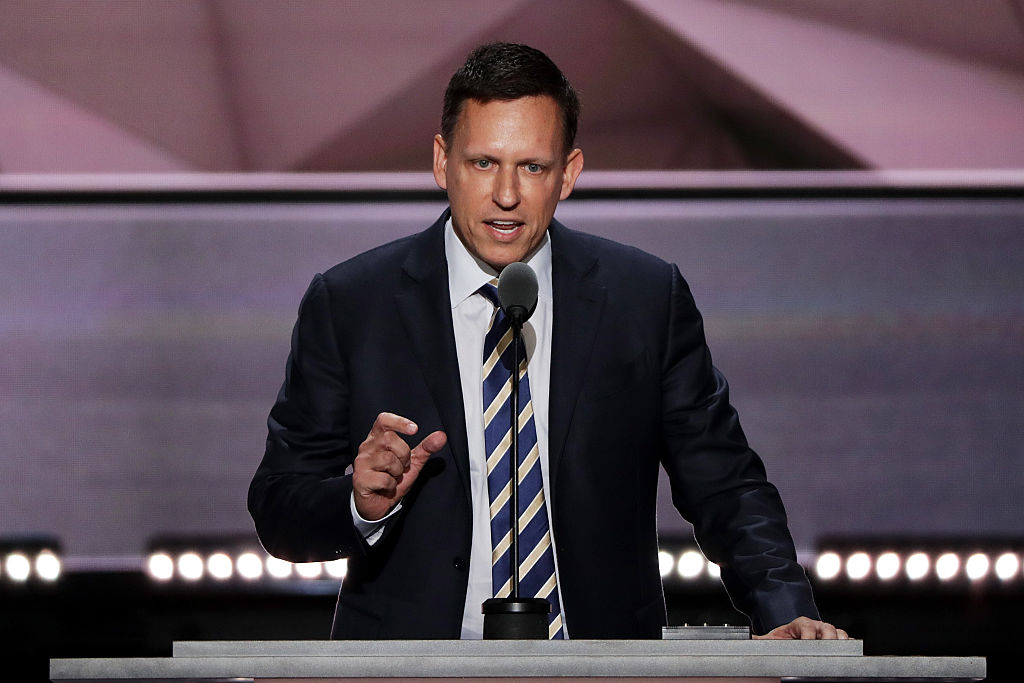
Peter Thiel speaks at the Republican National Convention in July 2016.

The Epstein files reveal extensive, friendly, encouraging correspondence between far-right billionaire Peter Thiel and Jeffrey Epstein. (Alex Wong / Getty Images)


It wasn’t so long ago that Peter Thiel was a reclusive figure, so protective of his privacy that he bankrolled a lawsuit to ruin the news outlet that publicly revealed he’s gay. A decade later, the fifty-eight-year-old Thiel no longer avoids the political spotlight.

Over the past decade, Thiel has become an increasingly active and vocal right-wing political donor. Central to this is his close, more-than-decade-long relationship with his former employee and protégé J. D. Vance, the vice president and Donald Trump’s likely successor as leader of the Republican Party, whose political ascent — first to the Senate, then into Trump’s good graces, and finally the vice presidency — Thiel has bankrolled and facilitated. As recently as a month ago, the two men reportedly sat down for a private dinner in the vice president’s residence.

Thiel’s close relationship with Vance and other young right-wingers all but ensures that the tech billionaire will continue to shape politics and policy for many years — decades, if his technological plans to extend his lifespan work out. And, in spite of Jeffrey Epstein’s mysterious death seven years ago, it ensures the same for the quiet influence of the billionaire pedophile, who private emails show was not only good friends with Thiel but encouraged Thiel’s involvement in right-wing politics.

Among the millions of Epstein-related documents released by the Department of Justice so far are hundreds of email exchanges between Epstein and Thiel that show the deep, symbiotic friendship between the two men. In return for Epstein’s favors and tax advice, Thiel provided investment insights and served as something of a reputational shield. When Thiel expressed a growing interest in geopolitics, Epstein encouraged his curiosity, setting up meetings with officials and political power players at home and abroad. After Thiel became part of the 2016 Trump campaign, Epstein urged him to grow his influence within Trumpworld and advised him on how to do it.

As with his friendship with former Trump mastermind Steve Bannon, Epstein’s emails with Thiel show the late billionaire’s knack for ingratiating himself with the powerful and influential, particularly those who might have sway in the White House of his former “closest friend,” Trump. In Thiel’s case, it’s a knack whose effects may be felt in the political landscape for a long time to come.

“Will Peter Thiel Be Around?”

It’s not clear exactly when Epstein and Thiel became friends. Emails suggest the two had no relationship in February 2013, the date of an audio recording unearthed earlier this year in which Epstein advised his friend, then-outgoing Israeli Defense Minister Ehud Barak, to get involved with Thiel and his surveillance firm Palantir.

For years, Epstein unsuccessfully tried to connect with the tech billionaire, at that point best known for cofounding PayPal and later selling it to eBay for $1.5 billion — at least ten separate times between August 2009 and November 2012, according to emails reviewed by Jacobin. Other times, people in his circle offered to make an introduction, his primary conduit being Ian Osborne, a former British fixer who was well connected, and well invested, in Silicon Valley.

Emails suggest that what may have initially drawn Epstein to Thiel was his interest in creating an alternative financial system. In one of the earliest Epstein documents that mentions Thiel, an August 2009 email from Epstein to literary agent John Brockman requesting that they be brought together, Brockman told him that he would need a reason for the sit-down to happen.

“Idea is now is the time for a new financial alternative, that is what PayPal started as,” Epstein replied. (Jacobin has, as usual, cleaned up Epstein’s often borderline-incomprehensible grammar.)

Another mutual acquaintance, computer scientist Ben Goertzel, an early champion of AI, dangled the prospect of personally interacting with Thiel as a way to get Epstein to the Singularity Summit, a yearly gathering of AI superintelligence enthusiasts, in October that year. Thiel “wanted to start his own currency outside the scope of nation-states,” Goertzel told him.

The vision Epstein had in mind bordered on the goofy. He told a friend years later that he thought Facebook could be the basis for that alternative system, in which Facebook “friends” would trade “favors.” Silly as it sounded, Epstein was dead serious, pitching the idea personally to Thiel two separate times years later. It appeared to be related to his interest in cryptocurrency, as suggested by an April 2016 email to Thiel about former Obama economic adviser Larry Summers joining the effort.

“Larry Summers is now on board with rethinking the financial system, digital currency etc.,” he wrote Thiel. “He will join with us in concocting a plan. Fun.”

Epstein’s interest in Thiel was undeterred by the fact that several of his acquaintances were far from impressed by the PayPal founder. Brockman warned him that Thiel disliked democracy and considered the granting of voting rights to women and the poor a mistake. Another contact told him that while she had once found Thiel interesting, after seeing him speak about Singularity, she decided she “didn't think he knew what he was talking about and lost interest.” Epstein acknowledged that while most of the big names on the Singularity side were “goofballs,” there did seem “to be a kernel of an idea here and there, even if by accident.”

The two men seem to have finally connected in March 2014, thanks to another Epstein associate from the tech world: Reid Hoffman, whom Osborne had once charmingly described to Epstein as the “fatty at LinkedIn.” Emails indicate that Hoffman set up the meeting between the two men that month at his house, seemingly at Epstein’s nudging.

“Will Peter Thiel be around, as you said he was in your first circle?” Epstein somewhat thirstily emailed Hoffman at the start of that month.

“Does My Bad Press Give You Pause?”

Once the two connected, they appear to have become fast friends. Thiel and Epstein exchanged constant emails, regularly met and talked on the phone, collaborated on business ventures, and discussed everything from politics and science to investment possibilities — as in one now-notorious email exchange about Brexit, in which Epstein seemed to revel in the “return to tribalism” and “collapse” that it heralded.

By the time their friendship was in full swing, Epstein’s crimes against underage girls were years old. In fact, they had become national and global news at the start of 2015, after Prince Andrew and Alan Dershowitz were named in a lawsuit against Epstein that alleged he had run an underage sex ring.

Roughly two weeks after that lawsuit made global headlines, Thiel emailed Epstein, telling him that if he made it to Miami at the end of the month, “I'll stop by your island!” Eight days after that, as the unflattering headlines and public denunciations piled up, Epstein followed up.

“Does my bad press give you pause?” he asked.

“If I was intimidated by bad press, I would not have gotten anywhere in life,” Thiel replied. “But I do hope that you're holding up well, and that the cycle won't go much further.”

“Do you have any sense on whether this press cycle is going to keep excalating [sic]?” Thiel asked eighteen minutes later. “It would be [good to] compare notes at some point, on strategies on this sort of stuff . . . ”

Copious reporting on the Epstein documents shows there were many wealthy and influential people who were willing to simply ignore Epstein’s crimes to maintain a friendly relationship with him. But few actively passed on their sympathies about the bad press — bad press that was, after all, about the sexual assault Epstein had committed against underage girls. Fewer still, if any, requested that he pass on to them the lessons he had learned from the unsavory episode for weathering public controversies.

In this email chain, Thiel appears to do both.

Just like with his close friendship with Steve Bannon, Epstein lavished Thiel with generosity. He proposed flying the billionaire to the Virgin Islands in his helicopter, offered to connect him with “the top sleep doctor in NY” (“I would like you to stay alive,” Epstein told him), and encouraged and advised him on buying a private plane. “We need to hang out way more often,” Thiel told him in one of these exchanges.

Early on in their friendship, Epstein suggested speaking with Thiel or one of his advisers to give him financial advice.

“I suspect your personal tax regime can use some tweaking,” Epstein emailed him. “Yes, this would be awesome,” replied Thiel. “I *never* question your judgment on tax-related issues,” he reiterated a few months later. Another time, Epstein informed Thiel he would be discussing cryptocurrency at a meeting with the Treasury Department and what appeared to be the Internal Revenue Service’s chief legal adviser, and asked him if he had any questions he wanted asked.

Epstein in turn solicited investment advice from Thiel. He at one point floated giving him $50–$100 million to invest, which Thiel gladly accepted (“Whenever someone offers you money out of the blue, you should always take it :),” he wrote) and proposed they discuss where best to put it.

Epstein asked for Thiel’s thoughts on an offer to invest in Spotify, as well as the prospect of investing in Thiel’s own company, Palantir, with Thiel advising he hold off until they discussed it later. A month after that, Thiel arranged a meeting between Epstein and his two fellow cofounders of venture capital firm Valar, counseling the convicted sex offender to invest between $10 and $20 million into a new fund they were starting.

“I thought your insight into the Israeli startup world was great,” Epstein emailed Thiel later that month on Christmas eve.

At one point, Thiel’s business partner, Blake Masters, at Thiel’s request, sent Epstein a physical copy of the book the two men had cowritten. “I know he’d love to hear what you think . . . lt'd be great to meet you sometime in NYC. Warm Regards, Blake,” the note read. (Eight years later, Masters ran a failed Senate campaign in Arizona on a supposedly pro-family platform, costing Thiel $20 million.)

In the case of one business venture, Epstein leaned on his relationship with Thiel to overcome how reputationally toxic his name had become.

In a July 2018 email exchange, Epstein and Bitcoin developer Jeremy Rubin strategized how exactly they would have him invest in Bitcoin mining startup Layer1 while keeping his identity under wraps, since Rubin worried “otherwise potential investments Googling your name might get spooked (especially given SF politics).” When the company refused to move forward until they knew who they were getting in bed with, Epstein instructed Rubin to be honest about who he was and to tell them “I am a major investor with Thiel, they can ask him.”

“They're not bothered, they'll chat with Thiel,” Rubin reported back after the conversation.

“Playing With Donald”

As the pair’s friendship deepened, emails suggest Epstein encouraged Thiel’s growing interest in politics.

“Trump delegate? Fun,” Epstein emailed him a day after Thiel’s name popped up in a Trump campaign filing in California in May 2016.

Thiel quickly became one of Trump’s most high-profile supporters, garnering attention not just because of his sexual orientation, but because of his status as an outlier in a Silicon Valley that generally leaned liberal and Democratic. Throughout that year’s July and August, during which Thiel appeared in a speaking slot at the Republican National Convention (RNC), Epstein emailed him praise and encouragement, calling him a “star,” and asking him, in response to a recent article about him, if he was “enjoying raising your public profile.”

“Not really . . . need to stop this!” was Thiel’s somewhat unsurprising reply. Though it’s unclear exactly which article Epstein was referring to, two weeks earlier, his accountant, Richard Kahn, had sent him a now-infamous report alleging that Thiel was funding a project to prolong his life by transfusing young people’s blood into his own veins.

Epstein appeared eager to make sure Thiel, his new friend, grew his influence with his old friend, the future president of the United States, through a mutual friend: real estate investor Tom Barrack, who would end up serving in both of Trump’s administrations.

“Don’t know how well you know Tom Barrack he is great,” Epstein emailed Thiel a week before he was due to speak at the final night of the RNC, directly before Barrack, who was himself the last speaker before Trump was introduced. “He will be a speaker at the convention,” Epstein explained when Thiel told him he didn’t. “He runs Colony Capital. Solid, great real estate judgement. Donald’s fund raiser.”

An email exchange from the end of August that year suggests Barrack and Thiel may have connected at the RNC, something Epstein urged Thiel to seize on to cultivate greater influence within Trumpworld.

“Tom Barrack really liked you, he told me the conversation in the green room,” Epstein emailed Thiel. When Thiel asked if he had thoughts on the race, Epstein told him: “Lots, and you should be closer. So that your advice is considered.” The two men then turned, at Thiel’s request, to a phone conversation on Signal.

A few weeks later, Epstein offered to call Thiel while Barrack was visiting him. What appears to be a list of calendar items from Epstein’s computer dated to late 2016 includes an hour-long meeting that October, which involved all three men and someone who appears to be former Israeli Prime Minister Ehud Barak, another close Epstein associate. Once Trump won, Thiel would end up serving on the then-president-elect’s transition team.

Epstein remained interested in his friend’s ongoing influence within Trumpworld.

“Are you still playing with Donald?” Epstein asked him six months into Trump’s presidency. Kahn regularly kept his client abreast of news about Thiel, passing on to Epstein, on the day of the 2017 inauguration, a CNBC story about Trump possibly tapping the PayPal founder to serve as US ambassador to Germany and, seven months later, a Buzzfeed article reporting unflattering comments Thiel had privately made about the administration.

“Read the Buzzfeed article. Careful!” Epstein emailed Thiel the same day. “Donald is vindictive, especially when it is pointed out that he is not the smartest person in the room. Or it is just made obvious.”

“Yes, agreed . . . Will call later today, sorry I'm so overdue,” Thiel replied.

Thiel did take more care from there on. His public comments about Trump and his administration were invariably, carefully positive, as when he defended Trump’s frequent lies as mere “exaggerations of the truth” that were par for the course in politics (“I liked your Trump exaggerations not lies,” Epstein emailed him). By the end of 2018 Thiel was again an extravagantly generous donor to Trump’s coming presidential campaign.

Steve Bannon, the president's former Svengali, was another Trump insider Epstein tried to connect Thiel with. Bannon’s close relationship with the late pedophile was one of the major revelations of the first round of DoJ document releases, but more recently released emails suggest Epstein’s efforts to ingratiate himself with Bannon began earlier than previously thought.

According to a November 2016 email exchange between Kahn and Brock Pierce, a crypto investor who once called Bannon “my right-hand man for, like, seven years,” Pierce had consulted Epstein’s accountant about the cryptocurrency exchange Coinbase. Kahn emailed Pierce that Bannon should “talk privately with Jeffrey,” since Epstein “knows more about international finance than anyone on Trump’s team, by a long way,” with Pierce responding that he would “work on getting us all together.” Emails show Epstein instructed his accountant to follow up by suggesting Thiel be thrown into the mix.

“Please communicate with Jeffrey, who is also close to Peter Thiel,” Kahn dutifully emailed Pierce. “Jeffrey thinks Peter is really thoughtful.”

Later, once Epstein had teamed up with Bannon in earnest to try and create an oligarch-funded movement of right-wing populism, he tried several times to get the two men in a room together, and may have succeeded at least once. In one case, he suggested the trio could “discuss response to tax cut criticism” — specifically, work on talking points pushing back on the portrayal of Trump’s tax cuts as a handout to the rich.

Yet for all this work to connect Thiel with Trumpworld, Epstein could also be disdainful toward the tech billionaire. When Larry Summers emailed him a list of possible Treasury secretary picks for Trump shortly after the 2016 election, Epstein dismissed the inclusion of his “great friend.”

“Peter Thiel autistic, no global sense,” Epstein told Summers.

“Many Interesting People”

It wasn’t just Trump. Epstein regularly proposed to introduce Thiel to a variety of influential political players, often in the fields of foreign policy and intelligence. Jacobin has previously reported on Epstein’s successful efforts to connect Thiel with Ehud Barak, efforts that produced a business relationship that prefigured Thiel’s current partnership with the Israeli military. But it went far beyond that.

Epstein appeared particularly set on connecting Thiel with Bill Burns, the future CIA director who at that point was at the tail end of his stint as deputy secretary of state for Barack Obama. “Best and most respected diplomat in the admin, you should meet him, he conducted the secret Iran negotiations, kept them secret for a year and was involved in the most sensitive of missions for years,” Epstein told Thiel. “I can set up when you are avail.”

Between May and October 2014, emails suggest that Epstein made at least five attempts to get the two together in the same room, including a September 13 meeting that, according to a text exchange between Burns and Epstein, the diplomat had to back out at the last minute because of work.

“Please give my best to Peter, and look forward to another opportunity to meet soon,” Burns texted him. One of those times, with Burns’s permission, he put the two in touch directly, telling them they “would enjoy each other.”

“Peter, look forward to meeting, and sorry I wasn't able to come to NY last month,” Burns emailed Thiel three days later. “Jeffrey, many thanks for making introduction.”

“Bill — likewise, on this end. Look forward to meeting in person!” Thiel replied.

Another former Democratic official meant to attend that weekend was retired senator Bob Kerrey, whose former role on the Senate Intelligence Committee Epstein specifically advertised to Thiel, and who enthusiastically agreed to the meeting (“I think both [dates] work but let me double check with Jen!” Kerrey replied, referring to his firm’s executive assistant). “Sunday lunch with Kerrey would be great,” Thiel told Epstein.

Kathryn Ruemmler (“former Obama counsel for five years,” as Epstein pitched her) was likewise invited to a dinner with Thiel that weekend. “You should meet,” Epstein told her that month, as he tried repeatedly to connect the two. “Any of your spook friends might want to attend,” Epstein emailed her about a June 2015 meeting he proposed, referring to connections Ruemmler may have had in the intelligence world.

Epstein was similarly eager to introduce Thiel to Tom Pritzker, hotel billionaire and executive chairman of the foreign policy think tank Center for Strategic and International Studies (CSIS), and a contact he had tried to connect with others in his circle on the basis of a shared hostility on China. Epstein would insist to Thiel that Pritzker was “a good contact for you,” even as CSIS’s hawkish outlook clashed with what Thiel as late as 2019 described as his belief that “the US should have a less interventionist foreign policy.” Epstein took the rare step of putting the two in touch directly (“have fun”) while Thiel was visiting Pritzker’s hometown of Chicago in October 2014, and nudging Thiel when he failed to respond to Pritzker’s outreach.

“What types of people would you find most appetizing?” Epstein emailed Thiel a year later. “Europe, Mideast, Russian. Politics. Science. Woo.”

“Kind of obsessed with politics this year . . . Russian/European always interesting,” Thiel replied.

Epstein fed Thiel’s growing interest in politics by trying to introduce him to a parade of foreign government officials, many of them European. A year earlier he had taken the rare step of connecting Thiel directly with Sergei Belyakov, a former Russian official and graduate of the country’s spy academy, who later told the pedophile that Thiel’s insights on subjects like the Russian economy had been “very helpful.”

Belyakov wasn’t the only Russian official. Epstein tried several times to have Thiel meet decorated and long-serving Russian diplomat Vitaly Churkin (“Russian ambassador, most involved, he and [Russian Foreign Minister Sergei] Lavrov control,” as Epstein put it to him), including a month before Churkin’s death in 2017. “Sorry you are not here, Vitally [sic] Churkin debriefing on Syria, wild,” Epstein emailed Thiel in late September 2016.

It’s not clear if a meeting with Churkin, who served as Russia’s Permanent Representative to the UN until the day he died, ever happened, though an October 2016 schedule shows a lunch meeting involving the trio. Elsewhere, in December 2017, Epstein told Maria Drokova, a Kremlin-sponsored activist who became a prominent Silicon Valley venture capitalist, she would meet Thiel when Epstein visited her.

“I've been learning from him through his books/speeches,” she replied. “Seems like he has very certain political plans now . . . ”

Other European officials Epstein tried to connect Thiel with included longtime friends and associates like Norwegian diplomat Terje Rød-Larsen; Slovakian conservative politician Miroslav Lajčák (“great friend would like to do big things”), whom Epstein and Bannon viewed as the future European leader of Bannon’s right-wing movement; and then–Council of Europe Secretary General Thorbjørn Jagland (“I think if you want Europe . . . He has the best understanding of reality on the ground. And I will vouch for your discretion,” Epstein told Thiel), who Epstein tried to arrange Thiel to meet at least four times between 2014 and 2017.

At least three times, in 2014, 2015, and 2018, Epstein invited Thiel on the week that the United Nations General Assembly (UNGA) was convening, dangling the possibility of encountering various power players: “foreign ministers,” “many of the worlds [sic] leaders,” the “head of Nobel Peace Prize committee staying with me.”

“Many interesting people,” Epstein told him about the convening of the UNGA in 2018. “What is your major focus now?”

In spite of Thiel’s professed interest in European politics, Epstein also tried to put him in touch with leaders in Asia beyond Israel’s Barak: “Sultan from Dubai,” which likely referred to businessman Sultan Ahmed bin Sulayem; then-Mongolian President Tsakhiagiin Elbegdorj, attending a UN summit in New York at the time; “the Qataris,” including “his highness”; and Anil Ambani, an Indian businessman connected to the far right government of Narendra Modi. In late May 2017, Epstein suggested individually to both men that they meet each other.

Other times, Epstein dangled the possibility of meeting the “new head of DAVOS,” as he put it — meaning, Norwegian politician Børge Brende, who had become the president and CEO of the World Economic Forum (Brende resigned two months ago over his relationship with Epstein). And as he invited Thiel to his New Mexico ranch, he casually mentioned that also in attendance would be “some presidents next week.”

“There are no people for miles and miles,” he told him. “No eyes, just peace and quiet.”

It’s Epstein’s World

We can’t say to what extent Epstein was responsible for Thiel’s deepening involvement in politics and Trumpworld. But from the vantage point of 2026, we can safely say that his wish came true.

Thiel’s relationship to both Trump and his vice president now leaves the tech billionaire well positioned to shape the Republican Party and a future GOP presidency, and to enact the vision he and Vance planned out many years ago, of a political takeover by an aristocracy of right-wing business elites. Meanwhile, we’re seeing in real time what it looks like to have a Peter Thiel interested in and able to influence geopolitics, with the billionaire supplying and ardently defending the Israeli genocide, and his firm aligning itself with an interventionist, pro-war Washington foreign policy.

For many years, Jeffrey Epstein shaped our world in ways we never knew. He may well continue to do so even in death.