Mark Zuckerberg Wanted to Keep in Touch With Jeffrey Epstein

Despite his later denial, Facebook founder Mark Zuckerberg wanted to keep a line open to Jeffrey Epstein. Emails between the two suggest that the world of the Big Tech elite is less a back room of evil geniuses than rich dullards discussing goofy ideas.
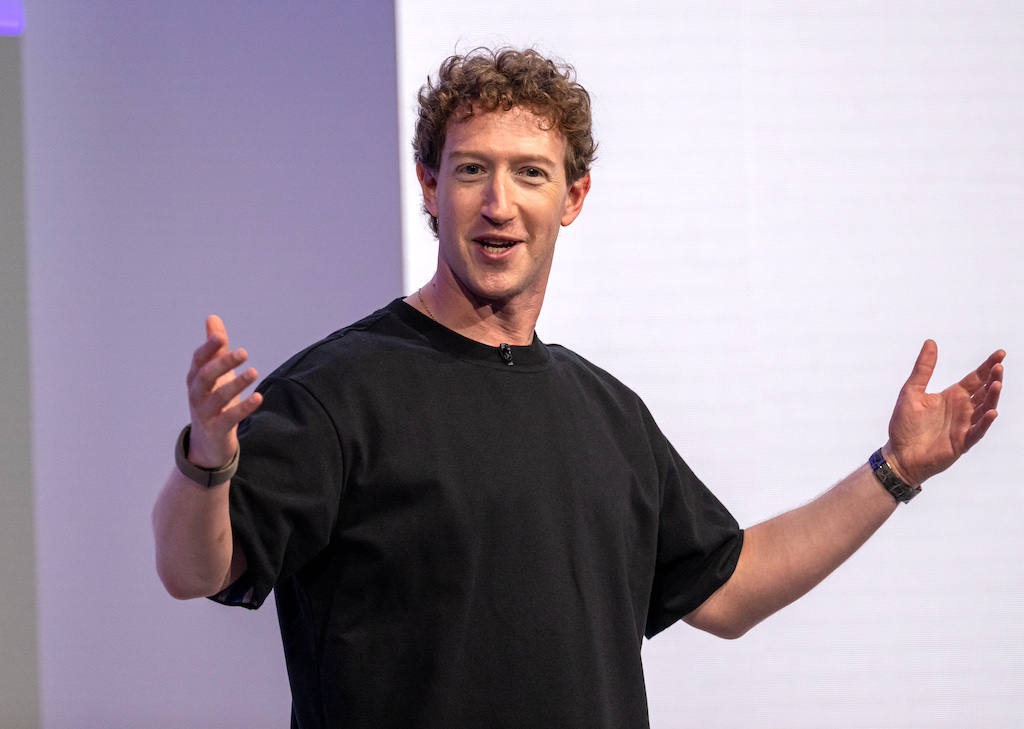
According to emails, Mark Zuckerberg was eager to stay in touch with Jeffrey Epstein after meeting him. (David Paul Morris / Bloomberg via Getty Images)

Among many others, there are three themes that run through the Jeffrey Epstein disclosures released by the Department of Justice (DOJ) recently: that the rich and powerful people who denied having any connection to the billionaire pedophile were often a lot friendlier with him than they let on; that these members of the elite are, it turns out, far from the geniuses we’re told they are, calling into question why we let them hoard impossible amounts of wealth and make far-reaching decisions affecting our lives; and that Epstein had a knack for ingratiating himself with, and securing influence over, these individuals partly by impressing them with his own supposed brilliance.

You can see all three of these in the emails that surround a secretive August 2, 2015, dinner featuring Epstein and a host of Big Tech oligarchs, including Meta CEO Mark Zuckerberg. The dinner, first revealed by Vanity Fair back in 2019, has become one of the biggest Epstein-related stories of the past week, after a photo of the gathering and several emails related to it were unearthed, revealing that a who’s who of the tech sector — a number of whom have become major Donald Trump backers, as the entire industry has lurched far to the right — was there, including Peter Thiel, Elon Musk, and Zuckerberg.

The DOJ’s three-million-document Epstein trove lets us piece together more details about the little-known dinner. But for anyone who is hoping they shed light on malevolent world-takeover plans or unspeakable crimes, it turns out what they reveal is something much more banal but no less concerning: a Big Tech elite that is more “oblivious rich guy” than “evil genius,” and that was easily impressed and charmed by a prolific sex criminal because he was able to project the illusion of brilliance.

Meta and Michelin Stars

For one, the emails give us a little more sense of what exactly the relationship between Zuckerberg and Epstein was. Zuckerberg’s team pointed to a 2019 statement his spokesperson had already issued about the dinner the first time it was reported on: “Mark met Epstein in passing one time at a dinner honoring scientists that was not organized by Epstein. Mark did not communicate with Epstein again following the dinner.”

The emails show this is not quite accurate. Three days after the dinner, on August 5, Epstein’s longtime assistant Lesely Groff sent Zuckerberg’s longtime chief of staff Andrea Besmehn the cell phone number and email address of the registered sex offender along with her own contact details, noting that “at the party Mark requested Jeffrey send his contact details to him.”

“Could you please pass the below on to Mark?” Groff wrote.

“Noted, with thanks,” Besmehn wrote back.

That email thread was then forwarded to Zuckerberg himself.

A separate email shows Epstein instructing an assistant the same day, although apparently at a later time, to do this exact thing, likewise saying that “Mark asked me to give him my contacts.”

In other words, the email exchange suggests that the Facebook founder was, at least initially, eager to stay in touch with Epstein after meeting him at the dinner, and that contrary to the 2019 statement, did have subsequent contact with the convicted sex offender, albeit indirectly through his assistant, who was grateful to receive his details.

The two were also put directly in touch via an email from billionaire LinkedIn founder Reid Hoffman, who had organized the gathering, and whom Epstein had emailed the night of the dinner asking for Zuckerberg’s email address. “Jeffrey, Zuck,” Hoffman wrote three days later; “email connections from the Ed Boyden dinner — so that convo can continue.” Jacobin has reached out to Meta with a request for comment and will update this article if we receive one.

Epstein’s eagerness to be in touch with Zuckerberg seemed to contrast with his attitude toward the tech billionaire a few years earlier. Various emails show attempts to connect the two that apparently didn’t work out, attempts that Epstein did not always seem fully enthusiastic about.

“If you thought Zuckerberg was worth the time I could fly and pick you up in San Fran or fly you there,” Epstein told Ian Osborne, a former British fixer well connected in Silicon Valley, in August 2012.

In a May 20 exchange with an unnamed woman, Epstein, in a typically casually racist exchange, declared that Zuckerberg was “gay,” seemingly because he was married to an Asian woman.

“I [sic] kind of surprised how many Americans like Asian girls, in Russia it is a dif situation,” the woman wrote back.

“I told you, they like Asian [sic] with small breasts,” Epstein replied.

Other emails reveal the full guest list for the dinner, held at the now-closed two-Michelin-starred Baumé restaurant in Palo Alto, which Hoffman — a major Democratic donor and a friend of Epstein’s who appears frequently in the files — had “bought out” for the occasion.

Besides Musk, Zuckerberg and his wife Priscilla Chan, billionaire Peter Thiel, Hoffman, and Boyden, the MIT neuroscientist in whose honor the dinner was held, there are four other names on the list: Desiree Dudley, Boyden’s colleague at MIT and a mentor at Thiel’s private foundation; Michelle Yee, philanthropist and Hoffman’s wife; Joichi Ito, the venture capitalist and Epstein associate who headed the MIT Media Lab at the time; and Navaid Farooq, Musk’s former college roommate.

“High Intellects”

Meanwhile, what exactly was that dinner “convo” about? Other email exchanges, it seems, make it possible to piece together. For instance, on the same day as the exchange above, Epstein’s assistant sent Besmehn a YouTube link to a lecture by famed mathematician Mikhael Gromov to pass on “to Mark from Jeffrey.”

Another email from that same day, this time sent directly from Epstein to Zuckerberg makes specific reference to what the pair talked about, with Epstein making clear that his email was meant to be a “response to the question that he posed to me. Re connectivity.”

“If the goal is reducing poverty, I would postulate that there are much easier ways than connectivity, much,” Epstein wrote to Zuckerberg. “Trust, taxes, and transactions each need to be a fundamental part of a new system. Social contracts at the end of the day, FYI.” (Jacobin has cleaned up Epstein’s often error-ridden writing for readability).

In the email, Epstein gently criticizes a 2007 Economist article that he told Zuckerberg “appears to have formed the basis for your conclusion re: profit,” calling it outdated. The article claimed that when fishermen in the Kerala region of India started using mobile phones in the late 1990s, profits rose and prices fell — which, the magazine argued, in turn proves that government intervention in the economy isn’t necessary for prosperity, just private sector innovation and more “connectivity.”

Two days earlier, in an email to himself, Epstein had been more scathing about the article, whose text he had copied and pasted in full. “I am not a big fan of reductionism,” he wrote.

In other words, it appears that Zuckerberg had made a goofy argument that poverty could be eradicated by more “connectivity” — an idea even Epstein himself seemed to treat with disdain — and that he based this on an Economist article from eight years earlier about fishermen getting mobile phones that he had, presumably, read one day.

It seems one of the wealthiest and most powerful men in the world, who is actively reshaping both our politics and the way our brains work, has his thinking about the world shaped and informed no differently than your uncle killing time in a doctor’s office.

For his part, Epstein — who got an eleventh-hour invite to the apparently long-planned dinner after emailing Hoffman that he was in town for a different event — seemed to have his own discrete goals for coming to the gathering. He told several associates that the dinner was because Zuckerberg and the other tech oligarchs there like Musk “all want info on money,” specifically their “need to learn to spend it,” and he urged another friend, Joi Ito, who was also attending, to help him “get Zuckerberg to chime in on a new financial system.”

“Facebook already has a friends concept, and trading favors would be very complex to stop,” Epstein explained.

The idea of making Facebook the foundation of a new financial system based on swapping favors is barely more coherent or sensical than the idea that poverty can be eliminated by more “connectivity.” Yet it apparently didn’t stop Zuckerberg from being impressed by Epstein and wanting to stay in touch. Nor did it stop Hoffman from reporting to Epstein that his wife declared him “the most conversational of the high intellects” at the dinner.

The Perils of Oligarchy

It’s not clear whether and to what extent Epstein and Zuckerberg communicated in the years that followed.

After departing California to his ranch in New Mexico the day after the dinner, Epstein invited Zuckerberg to visit, telling him it was “a pretty unusual and private place,” and he told Hoffman he had also suggested to Zuckerberg at the dinner that he visit him in New York during the opening of the United Nations General Assembly, where there would be “world leaders,” “finance ministers,” and “fun dinners lunches etc.” He later told Hoffman that he had “reached out” to Zuckerberg but “have not heard back.”

There are no email replies from the Meta CEO to Epstein in the tranche that’s been released. The only other suggestion of contact is from three years later, when Epstein suggested to his friend and former Barack Obama White House counsel Kathy Ruemmler that she “drop a note to Mark or Sherl [sic]” — almost certainly former Meta executive Sheryl Sandberg — that they “see eye to eye,” and that “we can have fun, do great things, and together really contribute to change.” Ruemmler and Epstein then debated whether the note was “too eager” and what level of “eagerness” was appropriate for the outreach.

The whole thing gives us a peek into a world that none of us generally get to see: a world where self-styled “high intellects” with more money than they can spend in a lifetime buy out extravagantly expensive restaurants all to themselves, to have private conversations about supposedly world-changing ideas. It is also a world that turns out to be remarkably shallow, where someone’s expertise in a specific field — investing, programming, or, say, rockets — leads them to believe they are experts on everything and, more important, that they have a right and a duty to reshape the world as they see fit.

This can all seem harmless when the ideas this elite are enamored with are silly, like fighting poverty with “connectivity” or turning Facebook into a new personal favor-based financial system. But with a number of the August 2015 dinner attendees having moved sharply rightward since the Obama era — and with even the prominent Democratic donor among them serving as a deep-pocketed foe of the party’s insurgent left wing — it’s not hard to see how a naive interest in out-of-the-box future-defining ideas can quickly become more sinister. Epstein — with his rampant sexual predation and his interest in a variety of fringe sciences, including eugenics and impregnating scores of women to seed the human race with his DNA — is only the most extreme and disturbing version of this.

Sometimes the oligarchic elite use the unaccountable power we’ve let them build up to almost get to space or pretend to be good at video games. Sometimes, they use it for eugenics and to try and put human beings permanently out of work en masse. Either way, it begs the question: Are these really the people we want shaping our politics, culture, economy, and lives?