Steve Bannon Was Much Closer to Epstein Than You Realize

Steve Bannon’s whole pitch is that he’s leading a movement against a decadent, borderless elite. Except according to newly released messages and emails, that movement has been heavily reliant on the most decadent, borderless elite of all: Jeffrey Epstein.
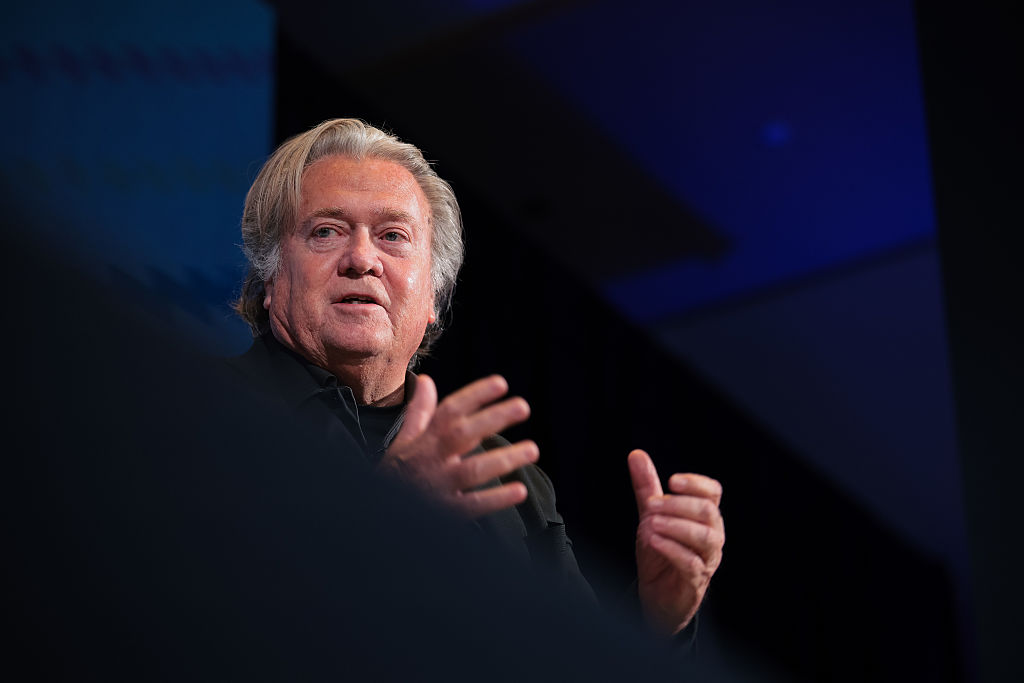
Newly released documents show that Steve Bannon’s supposedly working-class rebellion against a decadent elite had as a sounding board the most notoriously decadent and criminal elite of all: Jeffrey Epstein. (Kayla Bartkowski / Getty Images)

There’s a famous scene in the 1974 film Chinatown where protagonist Jake Gittes confronts the film’s puppet master villain, Noah Cross, the wealthy tycoon responsible for a greed-driven water shortage in the San Fernando Valley, and who — spoiler — raped and impregnated his own teenage daughter.

“How much better can you eat? What could you buy that you can’t already afford?” Gittes asks him.

“The future, Mr. Gittes,” Cross tells him.

The scene is at the heart of the film’s warning about extreme wealth, its limitless accumulation, the undue power it brings, and the way it perverts — literally and figuratively — both the person who holds it and everything he touches. It holds more than a few parallels, in other words, to the real-life story of billionaire pedophile Jeffrey Epstein, who excitedly wrote out almost the entire exchange between Gittes and Cross in an April 2018 text message to his new friend, former Donald Trump adviser Steve Bannon, only as an analogy to the exciting possibilities of the cryptocurrency industry.

“Interesting crypto, everyone wants in,” Epstein texted.

“It’s the future mr goetz (Chinatown),” Bannon replied, badly misspelling the name of Jack Nicholson’s private eye while helpfully slipping in the name of the movie he was quoting, prompting Epstein to write out the Gittes-Cross dialogue. “Love this film,” Bannon replied.

In many ways, the person most illuminated by the Epstein documents released last month by the House Oversight Committee isn’t even the billionaire pedophile himself, but Steve Bannon, whose communications with Epstein are laid bare at length in the disclosures. And the staggering obliviousness of that text exchange, in which both Epstein and Bannon appear to identify themselves with the movie’s ultrawealthy rapist villain, is the fundamental hypocrisy of Bannon’s larger project in microcosm: a working-class rebellion against a decadent elite led entirely by well-connected and powerful people, and secretly backed by the most notoriously decadent and criminal elite of all.

While the identity of those messaging with Epstein in these logs has been redacted, Bannon is identifiable through a number of ways: discussions of the documentary he was making about the late sex offender; specific reference to Bannon’s public statements, political activities, and physical location; references to past conversations between the two; and certain “Bannonisms” found throughout his conversations with Epstein, like his frequent refrain of “Yes yes yes.”

What these text archives show is not just how close and intimate Bannon’s friendship was with Epstein in the last years of the pedophile’s life, a full decade on from Epstein’s conviction. They show how integral Epstein was to the entire political project Bannon was trying to get off the ground: a populist rebellion against a corrupt elite that was quietly being backed by a sex-obsessed billionaire notorious for preying on young girls. And they give us a firsthand look at the way that Epstein leveraged his elite connections to curry influence with the world’s rich and powerful.

“Whatever is Good For You — I’m In”

Despite dribs and drabs about their relationship coming out over the years — like an August 2018 New York Post report about Bannon secretly visiting Epstein’s Upper East Side townhouse to get funding, the first public mention of the relationship between the two — Bannon has tended to be coy on the subject. When New York Times columnist James Stewart claimed that Epstein had once asked him to go to dinner with himself, Bannon, and Fire and Fury author Michael Wolff, Bannon denied ever attending.

In fact, one email thread shows Wolff trying to get all three of them together as early as October 2017. And the relationship went much further than the odd dinner. As Epstein told one of his associates in early 2018, he and Bannon had “become friends.”

Yet it turns out even that undersold it. The two carried on a deep and abiding friendship: discussing events, people, and politics; strategizing for Bannon’s political work; engaging in mutual backslapping; complaining about the #MeToo movement; and giddily exchanging jokes, gossip, and often nauseating banter.

In those conversations, Bannon regularly soft-pedaled Epstein’s crimes and gave him free public relations advice.

“We must counter ‘rapist who traffics in female children to be raped by worlds [sic] most powerful, richest men’ — that can’t be redeemed,” Bannon texted Epstein three months before he was arrested, in reference to the movie he was making about the sex offender. “Can’t redeem unredeemable — you are a lot of things, which we will show — but you are NOT that.”

The criticism of Epstein was a “crazed jihad,” Bannon told him, adding that he had “never seen anything like it.” In one exchange, someone who appears to be Bannon chided Epstein for the “terrible terrible terrible statement” his lawyer had put out as part of a settlement to avoid a trial where three of his victims were set to testify against the billionaire.

“Who the f-ck advises u!!” he wrote. “Your deal allows the girls to ‘go tell their stories’!!!”

It wasn’t the only bit of advice Bannon gave the billionaire on the matter. When Epstein flagged that the Department of Justice was investigating the notorious “sweetheart deal” he had gotten in Florida, Bannon advised him not to respond, as it “makes it way worse.”

Just two weeks before Epstein was arrested on child sex trafficking charges, Bannon celebrated the news that Epstein’s notorious 2007 plea deal — which not only gave Epstein himself a slap on the wrist despite investigators finding dozens of victims, but conferred immunity on “any potential co-conspirators,” too — had been allowed to stand. “Dude’IIII [sic]. Is this real. Tell me this is real,” he texted. “Epic epic epic.”

It’s worth stopping and thinking about this for a second. Bannon, who used his podcast to promote QAnon and claimed to be battling the world’s criminal elite, was trying to help the world’s most notorious sex offender, a billionaire, with his tarnished image and celebrating that neither he nor anyone he conspired with would face justice.

If it wasn’t for the fact that Epstein was an unrepentant sex offender and for Bannon’s odious politics — so odious that even his pedophile friend repeatedly half-joked that he was a Nazi — the relationship between the two was almost sweet. Epstein, who at one point dubbed himself Bannon’s “cornerman,” kept track of Bannon’s mentions in the press and passed them on to him, and often sent him unsolicited praise and encouragement for his media appearances.

“I thought you were great on Anderson [Cooper],” he told Bannon after a March 2019 CNN appearance. After Epstein wished him luck for a coming ABC News interview, Bannon emailed him early the next morning.

“Did u watch?” he asked.

“Of course,” replied Epstein. “Epic.”

Bannon seemed conscious of the fact that his friendship with the notorious sex offender was not a good look. In one August 2018 exchange, they discussed ways that Bannon could physically visit Epstein in New York, either “under the cover of darkness” or to otherwise avoid being seen. “Do u have access that’s not the front door — they have 24/7 surveillance on u,” Bannon texted.

For his part, Epstein was committed to both Bannon and his project. “Whatever is good for you — I’m in,” Epstein emailed him in July 2018.

As he had texted someone else — likely Trump’s former communications director Anthony Scaramucci — earlier that day, “I’d really like Donald to triumph.” This was almost certainly not to do with any friendly feelings toward Trump, whom Epstein only spoke about with disdain in the released documents, but to the extent that it benefited Bannon: Epstein often shared articles and talking points, sometimes celebratorily, indicating Bannon’s continued influence over White House policy after his August 2017 resignation.

To that end, Epstein spent the summer of 2018 repeatedly pressing a seemingly reluctant Bannon to get a health checkup from his personal, elite doctor, warning him not to “put your head in the sand” and that it was better to catch any health issue early — because if he fell ill, “it all goes to shit.”

“I need you alive and healthy for the long game,” Epstein texted him later that July. “No you no movement, simple math. … You will get everything in the office. No press, my private area. Chest X-ray full blood. You can go in 24/7.”

“You are important in many ways, no more though than to yourself,” he texted Bannon a few days later, urging him not just to say he would book the appointment, but to actually do it. “One of the advantages of the global elite, is that they live longer,” he told him.

“Lucifer with a stroke. Bent horns and all doesn’t look so good,” he texted him a month later.

The Bomb Thrower and the Bomb Maker

That “long game” was Bannon’s so-called economic nationalist movement, the brand of anti-immigrant, anti-China populism that he pitched as taking on the “donor class” but was, in reality, financed by that very donor class — including Epstein himself, arguably its most depraved member.

A June 2018 exchange between the two illustrates how they viewed each other’s roles in Bannon’s movement. “No problem — a lot exploded yesterday and today,” Bannon told him after Epstein apologized for a last-minute change of schedule.

“Said the bomb thrower,” replied Epstein.

“To the master bomb maker,” Bannon wrote back.

That “bomb-making” often involved flying Bannon around the world. “How does it feel to have the most highly paid travel agent in history?” Epstein asked him at one point. Sure enough, many of their texts consisted of Epstein asking where Bannon physically was at any given time, where he was going, and whether he could meet — and sometimes vice versa — before offering to buy him plane tickets or charter a jet to take him somewhere: to Venice, Vienna, Yemen, Dubai, or to the various locations where Epstein owned residences, namely Paris, New York, Florida, and New Mexico. He repeatedly paid for flights for not just Bannon but his whole entourage, in one instance offering to let both Bannon and his “boys” stay in his Paris apartment.

“If you are going to play here, you’ll have to spend time, Europe by remote doesn’t work. Lots and lots of face time and hand holding,” Epstein emailed Bannon in July 2018. “It’s doable, but time consuming, there are many leaders of countries we can organize for you to have one on ones.”

A day later, he counseled Bannon that “meeting the leaders of Europe BEFORE he possible [sic] implodes is only good for many reasons,” in an apparent reference to Trump, who was looking down the barrel of difficult midterm elections.

Epstein detailed the exact length of time and frequency Bannon should travel to the continent if he wanted to be most effective.

“The fear is that you gin up their hopes and emotions and then abandon them. I think you want to be an insider, not an outsider flying in and out,” Epstein wrote.

“Agree 100%,” Bannon wrote back. “How do I do that???”

“We can talk about at your convenience,” Epstein replied.

These flights were usually connected to meetings with various powerful people in Epstein’s prolific rolodex that he wanted Bannon to take. Sometimes they were business titans, like Palantir founder Peter Thiel, Overstock CEO and founder Patrick Byrne, or, in Epstein’s words, “owner Ferrari/Fiat,” whom he suggested Bannon meet in London. They included former Wall Street Journal editor-in-chief Gerry Baker, and famous intellectuals like Noam Chomsky, Richard Axel, James Watson, and Misha Gromov.

Often they were political figures, spanning GOP operatives like Ken Starr and major Democratic bundler Brad Karp, chair of white-shoe law firm Paul, Weiss. It also included heavyweight world leaders like Saudi government officials, India’s far-right prime minister Narendra Modi, then–Council of Europe secretary general and former Norwegian prime minister Thorbjørn Jagland, and French politician Jack Lang (“a great friend,” according to Epstein). In one exchange with Bannon, Epstein brought up Mongolia — which was “caught between China and Russia,” had a “trillion dollars of resources in the ground,” and was “in desperate need of help,” he said — as a key counterweight against China.

“You would like the president. Batuga,” Epstein wrote, misspelling the name of then-Mongolian president Khaltmaagiin Battulga. “He is willing to see you.”

A June 2018 exchange between Epstein and the International Peace Institute’s then-president Terje Rød-Larsen — a Norwegian diplomat who helped mediate the Oslo accords and whom Epstein considered “a very very close and great friend” — shows the billionaire working his contacts to Bannon’s benefit. In it, Larsen runs a draft on email by Epstein that he appears to be sending to Austria’s then-chancellor Sebastian Kurz, an anti-immigrant Islamophobe loosely allied with Hungarian prime minister Viktor Orbán, offering to introduce him to Bannon. (Larsen would later resign his post in 2020 over a personal loan he had taken from Epstein that became public knowledge).

Bannon, Larsen wrote, “behind the scenes still is one of the most insightful and influential players in Washington (and very close to the President),” and “a very astute and extremely well informed analyst and player” whom Kurz “will find it very useful to meet.”

“You might add that if he is in Paris. He is welcome to join for dinner,” Epstein commented on the draft. A month after this, Epstein informed Bannon that “Kurz wants to meet you.”

“I want to meet him,” Bannon replied.

While Epstein often bugged Bannon to come to Europe, in September 2018, he tried to get him to drop his Europe travel plans and come to New York instead, for the United Nations General Assembly, where there would be “every foreign minister,” as well as “Davos Guys,” “China guys,” and “Middle Easterners.”

“It’s the Super Bowl. And you are off to play in a college game in Europe,” Epstein told him.

Sometimes, Epstein advised him on how to make the most of these encounters, like a series of meetings in Norway in May 2019, including with Larsen, in which he counseled Bannon to, Epstein-like, leverage his connections to and knowledge of key Trump appointees.

“I suggest focus on Europe. Salvini, Orbahn [sic], Movement, etc.,” Epstein told Bannon. “I want you to be seen as trusted advisor rather than spook. … You can give him insight into Pompeo and Bolton.”

Epstein repeatedly worked to arrange meetings between Bannon and former Qatari prime minister Hamad bin Jassim bin Jaber Al Thani — identifiable through not just his nickname “HBJ” but allusions to his apartment in Paris — as well as unknown man named Jabor who appeared to be connected to him.

“When you see Jabor you can tell him, I told you he is my Arab brother,” Epstein texted Bannon in November 2018. “And tell HBJ that I told you that he and [former Israeli prime minister] Ehud Barak are head and shoulders above the rest. They will then know you are family.” Later, he advised him the “trick” was to “make it personal — this is what ‘I’ need, want, would appreciate.”

“Mideast people respect YOU, more than the policies, Trump, or you as the head of a movement,” Epstein told him. “They will do things for YOU, rather than for the ‘we.’”

Bannon appeared particularly wowed by Al Thani. “Incredible meeting,” he texted Epstein afterward. “Really impressive guy.”

“HBJ loved it. Said you and he were able to speak shorthand,” Epstein replied.

“Yes: he was everything u said and more,” Bannon texted back.

But the figure both men were particularly enamored with was former Slovakian foreign minister Miroslav Lajčák, a major political figure affiliated with the country’s increasingly conservative ruling SMER party, and who Epstein counted as a “friend.” Epstein and Bannon’s text logs are littered with at least a dozen offers or attempts to connect the two, with Epstein at one point going so far as to offer to send a plane to pick Bannon up in Washington to fly him to meet himself and Lajčák. The longtime Slovak diplomat would “guide the EU project if you like him,” Epstein told him in March 2018, and he repeatedly proposed getting the three of them together so they could “strategize.” Bannon clearly found the introduction worthwhile.

“Miro is exactly the type of guy that will take this entire movement to next level,” he texted Epstein that month.

“Yes, I am working on a security blanket for he and family, his true concern,” Epstein replied.

“He may [sic] my head blow up — with your comment,” Bannon told Epstein a year later. The two were incredulous at the successful Slovakian presidential candidacy of Zuzana Č aputová, a political novice who had come out of the liberal NGO world, and who Bannon said Lajčák could and should have beaten.

“Miro would be president today if he had listened to me,” Bannon texted Epstein. “Need to turn Miro into a nationalist sovereignty leader. . . . It’s a joke this woman won.”

Bannon’s affinity for Lajčák was somewhat head-scratching, given that it was under Lajčák’s tenure as president of the UN’s General Assembly that the body drafted what would become popularly known as the UN migration pact, a target of ire for various Bannon allies — including Orbán, Kurz, and even the Trump administration itself. As various conservative European governments rejected the pact in 2018, the trend spread to Slovakia, where Lajčák, complaining the issue was “being hijacked by populists, xenophobes, and nationalists,” threatened in November to resign if the country’s political leadership also left the pact.

“I might have to do it to protect my professional and personal integrity,” Lajčák explained to Epstein in a text that day. “I will totally lose credibility if Slovakia withdraws and I stay silent.”

“I think your position is just,” Epstein told him, somewhat incongruously given his backing for Bannon’s anti-immigrant agenda, before sending him a series of suggestions for talking points to sell his position.

Two-Way Street

As he lavished Bannon with help, what exactly was Epstein getting out of the friendship, beyond adding to his collection of prominent and influential people?

Epstein clearly enjoyed touting his friendship with Bannon and emphasizing Bannon’s influence in the White House, to his elite associates. Eight months after Bannon had left the Trump administration, Epstein sent “Jabor” a New York Times extract stating that Trump’s “moves against China represent a policy victory for his excommunicated aide.” Epstein emailed Emirati tycoon Sultan Ahmed bin Sulayem in February 2018 that he and Bannon “have become friends you will like him,” only for the businessman to shoot back that “Trump doesn’t like him.”

“Dont belive thepress [sic],” Epstein replied.

At times, Epstein used his closeness to Bannon for inside information on policy that might be useful for business.

“What do you think the likelihood of additional tariffs Jan 1?” Epstein texted him in November 2018. “Any progress at G20.”

“Trump needs a ‘win’ and is getting huge pressure from Mnuchin/Kudlow Wall Street faction but everybody else saying no deal possible markets keep crashing will all depend on Trump’s mood,” Bannon wrote back.

Another was the opportunity to build his influence by connecting his friends and associates to a potentially ascendant movement he was helping to build — or to use Bannon’s connections to insert them into positions of power. Shortly before he was arrested, Epstein pushed Bannon to use his White House connections to help Lajčák secure the post of deputy secretary general of NATO.

“NATO would like to check choice of Miro with DC,” Epstein texted Bannon. “Should he contact [then-national security advisor John] Bolton or [then-secretary of State Mike] Pompeo?” He nudged Bannon again four hours later when he got no response.

“Pompeo and [then-State Department director of policy planning] Kiron Skinner,” Bannon replied. “Let me work it.”

A day later, Epstein informed Bannon he was “meeting Council of Europe head Thurs. to push” Lajčák.

“Working Miro,” Bannon replied.

Fortunately for Epstein, the Council of Europe head he was meeting — Thorbjøn Jagland — was, in Epstein’s words, “a great friend.” He regularly met with Epstein and even stayed with him at his Paris apartment, and at one point in 2016, emailed him that “if Trump wins in US I’ll settle on your island.”

Bannon updated Epstein roughly three weeks later that “I’m working Pompeo for support.” But the “problem” for Lajčák, as Bannon explained to Epstein after his billionaire friend gave him another nudge about the “time sensitive” matter, was that “their country,” meaning Slovakia, “is nothing burger — Poland and Baltic important.”

Lajčák’s NATO bid ultimately went nowhere, but Epstein’s efforts to help him with it show the potential value that being connected to the billionaire pedophile brought — a value that Epstein had himself advertised to Lajčák eight months earlier, as the then-Slovak foreign minister prepared to meet Pompeo at the State Department. Epstein appeared to suggest that Lajčák mention to the then-secretary of State that he had spoken with Bannon, because “they are very close. And I think it will break the ice.”

“Pompeo, one of the few that can get across and has the respect still of Trump,” Epstein texted him a day later. “Steve brought him from obscurity, a Tea Party member into the limelight.”

“Really? I didn’t know that,” Lajčák replied.

Epstein the Adviser

Bannon in turn also got something out of the friendship beyond Epstein’s connections and money, at times treating Epstein like something of an informal adviser.

Bannon queried Epstein about whether the strength of the US dollar showed confidence in the American economy, whether the dollar was strong that particular day, what he thought about Facebook’s brief foray into cryptocurrency, what his contacts thought about French president Emmanuel Macron’s election chances.

“If you need more talking points — ping me,” Epstein texted him after one of these exchanges.

At one point, Bannon asked Epstein for “three major points” he would make at the Economist’s Open Future Festival event that he was set to attend the next day. “Brilliant brilliant brilliant,” was his response to Epstein’s suggestions, requesting that he “help me develop that argument” for the event, which would fall on the tenth anniversary of the Lehman Brothers collapse (though Bannon did not end up using Epstein’s talking points in the heated discussion the next day).

“Wat[sic] does this mean,” Bannon emailed Epstein in August 2018, attaching a ZeroHedge article about the dollar’s strength and disappearing liquidity. After Bannon excitedly sent him a Wall Street Journal op-ed (“Big deal”) claiming that Robert Mueller’s Russiagate probe would be invalidated due to evidence of some political bias among FBI investigators, Epstein forwarded it (“I htink [sic] weak. Thoughts?”) to former Obama White House counsel Kathryn Ruemmler for her take (which was even more scathing than his).

At times, Bannon — who was meant to be the one with the inside track on the Trump presidency  — appeared to be getting information on the goings-on at the White House from Epstein.

“Djt. Now really down on Pence,” Epstein told Bannon in March 2019.

“How did u hear and why is he,” Bannon texted back, with Epstein relaying, among other gossip, that Trump viewed his vice president as disloyal and thought Pompeo would be better in the role.

Mostly though, Epstein’s advice came unsolicited. Epstein told Bannon what to say if he was accused of racism and how to better rhetorically reframe his pitch on “economic nationalism”; he gave him an elevator pitch on Trump’s successes and gave him cheery talking points on the economy to pass on to Larry Kudlow. “I’m back Wed. (Thiel coming). We can discuss response to tax cut criticism,” he texted in August 2018, complaining that the negative media coverage of Trump’s handout to the rich was misleading and how to sell it as a positive.

Several times, Epstein offered to help Bannon establish a press arm for his right-wing movement, noting that “the media co. has lots of advantages. Source privilege etc.” The traditional NGO structure “gives you little. And is old thinking,” he explained to Bannon, granting a state tax deduction at the cost of having to make public filings, while “having a press/news base” offered much more.

“Press. Private. Protected. Access, legal niceties. (Salaries. Etc),” he told Bannon. “Think of it as a battle plan. You have made great strides. Forged ahead. At some time you stop and build a fort to protect your gains. Press equiv. To walls. NGO eqivalent [sic] to moat.”

But most of the duo’s conversations were far less serious. The faux-witty banter between the two was often juvenile and offensive. At one point, for instance, Bannon referred to Europe as “Eurabia.”

“More like yourlabiia [sic],” Epstein replied. “I am Arab-ed out. They are so much like women.”

“The worst aspects of women,” said Bannon.

“Bingo,” replied Epstein.

Another time, Epstein mentioned that he was hosting “some Africans” in Palm Beach for some unspecified advisory purpose.

“The front of my house looks like Black Hawk Down,” he told Bannon.

“LMAO!!!” was Bannon’s reply.

The two joked about a May 2019 interview Bannon did with Fox Business‘s Trish Regan, brought up by Epstein because her sign-off at the end of the segment sounded like a double entendre. “She is a lot hotter than I remember — she was also so wet at the end of that interview,” Bannon texted him.

“Eleanor Roosevelt is hotter than you remember,” replied Epstein.

“I love her — because she loves p-ssy more than me,” replied Bannon.

At one point, Epstein offered Bannon to use his private island or Palm Beach home (“the house invite is sincere and not made often”) anytime that he “and a ‘Ms Miller’ want some privacy” — apparently a joking reference to a woman Bannon was seeing. That soon turned into a back-and-forth about Grace Kelly, who Bannon said “was filthy.”

“Yes, if it were today she would have had an ‘easy pass’ installed on her,” said Epstein.

“Just a good ‘main line’ Catholic school girl,” replied Bannon.

When Epstein invited him to bring “Ms. Miller” to his ranch a month later, Bannon informed him they were now on “hiatus.”

“Ok, I’m sure you have a deep bench,” Epstein wrote.

“Exact opposite that’s why she is back on the bench women are a total distraction,” Bannon texted back.

The exchanges go beyond ordinary levels of crassness. After all, Bannon was leeringly describing women and talking about sex with a man who even at that point was understood to be one of the most prolific sex abusers in recent history.

The president was a frequent target of mockery. Bannon thought Trump was “a moron,” “the worst negotiator in human history,” had “lost it,” and — according to Michael Wolff, who passed on to Epstein “the full download” he got from Bannon one night earlier — “an idiot.” The two repeatedly mocked Trump’s claim that he was “a very stable genius,” shared reporting about Trump’s poor mental state and his porn star lover’s unflattering description of his penis.

It was a delicate balancing act Bannon was keeping up with the president, whom Bannon held in such disdain but had been a useful tribune for what Bannon saw as rightfully his movement. In June 2018, he dismissed Epstein’s suggestion that he hash out his differences with Trump’s influential son-in-law, Jared Kushner.

“To do that shows that DJT [Trump] is center of gravity of this movement and not me — will never do — they are transitory figures — the DC game is to succumb to that — it’s why I never did before joining campaign — I could have been the Trump whisperer years ago — avoided on purpose,” he explained.

A year later, Bannon explained to Epstein why he made two other men, including a little known but decorated Iraq war veteran, the face of his nonprofit-led push to build a US-Mexico border wall using private donations, even though, in reality, he was the one leading the effort.

“I’m the chairman but I push those 2 plus the construction guy as national heroes,” he wrote. “I also can’t seem like I’m running Trump’s nose in his own incompetence.” (Bannon and three others would ultimately be convicted and sentenced to prison for defrauding the initiative’s donors to the tune of hundreds of thousands of dollars, though Bannon and only Bannon would be saved thanks to Trump’s pardon).

Later, he fretted to Epstein about the release of Wolff’s second Trump White House tell-all, which Epstein, who got an advance look at the book, told him contained “lots of Steve quotes. Lots,” and which he hoped would not “stir up too much trouble.” Among the details contained were Bannon’s disparaging views of Trump and privately working against him.

“How bad am I going to get lit up???” texted Bannon.

“Probably like the last time,” Epstein told him, referring to Wolff’s first, heavily Bannon-quoting book, which had caused a rift between the president and his former adviser and saw Bannon have to give a groveling public apology to the Trump family.

“Like last time!!!!” replied Bannon.

A Colossal Fraud

Jeffrey Epstein is dead, but from all indications, Steve Bannon will be with us for some time. When the former Trump strategist next reenters the political arena, it would be a dereliction of duty — from both the press and politicians — to allow him to skate by without taking him to task for the glaring, brazen hypocrisy at the heart of his political project.

It’s bad enough that Bannon cultivated a close friendship with, let alone tried to rehabilitate the image of, a notorious sex offender whose victims Trump’s own Justice Department says numbered at least a thousand, to the point of ogling women with him. But Bannon continued to paint himself as leading the charge against a corrupt, criminal, and “globalist” elite for the ordinary working man, while palling around with, happily getting the assistance of, and accepting free flights from a borderless billionaire with fake passports and who owned homes — and abused young girls — in multiple countries. There is a simple term most people would use for that: a complete and utter fraud.