Reflecting on New York City’s Largest Nurses’ Strike
After weeks of nurses picketing in the freezing cold, New York City nurses concluded their biggest-ever strike last month. Jacobin spoke to a striking nurse leader about their fight against intransigent employers and a hostile governor.
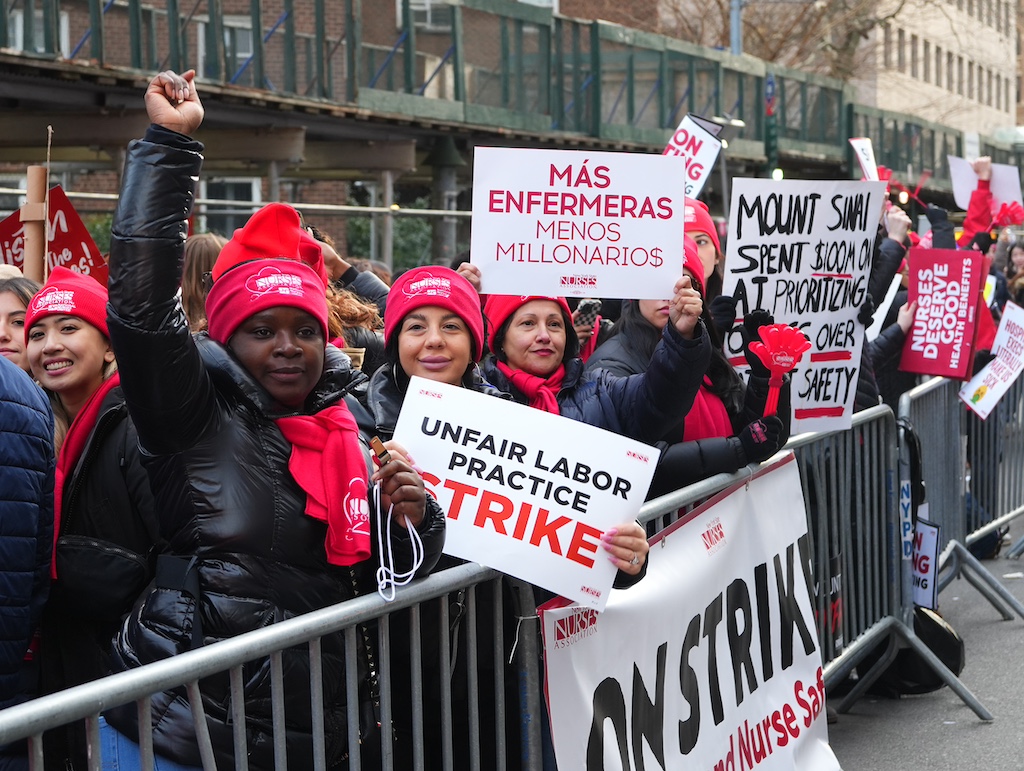
The historic nurses' strike in New York City was a brutal confrontation between nurses and their employers that saw nurses stay out for over a month. (Liao Pan / China News Service / VCG via Getty Images)
- Interview by
- Nick French
This winter saw the largest nurses’ strike in New York City’s history and one of the biggest in US history. On January 12, 2026, 15,000 nurses represented by the New York State Nurses Association (NYSNA) walked out across the city’s three biggest private sector hospital systems: Mount Sinai, NewYork-Presbyterian, and Montefiore.
The strike was a brutal confrontation between nurses and their employers that saw nurses stay out for over a month in the freezing cold over issues including safe-staffing requirements, workplace violence protections, and health care benefits. Nurses at Mount Sinai and Montefiore (often referred to as “Monte”) ratified agreements with the hospitals on February 14, while NewYork-Presbyterian (“Presby”) nurses stayed on strike for another week, ratifying a contract on February 21.
The conflict saw both New York governor Kathy Hochul and New York City mayor Zohran Mamdani enter the fray. Hochul issued and repeatedly extended an executive order allowing the hospitals to more easily hire travel nurses to weather the walkout, while Mamdani took the step of joining the nurses on the picket line — uncharacteristic of a sitting mayor.
The strike also highlighted tensions between NYSNA’s upper leadership and rank-and-file nurses: NewYork-Presbyterian nurses overwhelmingly rejected an initial tentative agreement that was recommended by top NYSNA leaders over objections from their elected bargaining committee, and 1,500 of them subsequently signed a petition calling for a disciplinary investigation into the union’s executive director and president.
Jacobin’s Nick French recently spoke with Michelle Gonzalez, a longtime rank-and-file nurse and an elected leader of NYSNA’s executive committee at Montefiore, about the strike. They discussed what the nurses won (and didn’t), the role of Gov. Hochul in the strike, and divisions and challenges within the union itself.
What were your main contract issues? How did they end up leading to a strike?
The key issues of this contract campaign were staffing, safety, and space. Our proposals included improving current staffing ratios, improving safety in the facility for patients and workers, and increasing space for our overcrowded emergency room.
As nurses, our responsibility is to provide safe care to our patients, and when having to care for too many people, the level of care that our patients receive suffers. And you want to feel like you can actually provide the care that patients deserve. In 2023, we won staffing-enforcement language that allowed us to go into an arbitration process with the hospital and demand financial penalties in cases where the hospital was not meeting the required nurse-to-patient ratios for a given shift. That language has been put to the test over the past year. We have won millions of dollars in payments for our nurses, and it has led to serious improvements in staffing.
One of the problems is that, when we do file complaints about short-staffing, the employer has been able to drag the process out for months and months. So we were seeking to strengthen the language to ensure that we can get through the arbitration process in a timely manner. We were also trying to get the hospital to hire more staff to cover shifts when nurses take their breaks, and also to further improve nurse-to-patient ratios in some units.
But Sinai and Monte were actually trying to dilute the staffing-enforcement language we won in 2023 and weaken our process. That language was hard fought, and any rollbacks were nonnegotiable for our members.
Another main issue in this contract fight was workplace violence. We were looking to negotiate language that, in the event that a nurse is assaulted and injured on the job by a patient or a patient’s family member, that the time the nurse is out of work as a result would not come out of their sick day bank — there would be a separate bank of time off. A lot of people, including the hospital administration, don’t understand how lengthy and difficult it is to file for workers’ compensation, and that most people who are out for a month or less are not going to fill out a workers’ comp application.
In the end, the hospitals didn’t just dare us to go out on strike — they walked us out to a strike. They were very much dragging their feet in the months leading up to our strike deadline — and we had always said that we would not bargain after our contract expired.
One of the hospitals’ threats was that they hadn’t given health insurance to Mount Sinai and Presbyterian; and the night before we went out on strike, and the days before we went on strike at Montefiore, we had been begging to come to an agreement on our pensions. I remember telling members, no hospital in its right mind is not going to sign off on pensions.
They were threatening to cut your pensions?
Yes. I said, there’s no way they’re not going to sign off on pensions. There’s no way they’re not going to sign off on health insurance. Maybe it’ll be minutes before the evening of January 12, when we were slated to go on strike, but they’re going to sign off.
They did not sign off. They didn’t sign off on our pensions, and they didn’t sign off on the health insurance [for Sinai and Presby]. That said, were our pensions really at risk? I would like to say no, but I think they were using it as a threat to say, settle with what we’re giving you now — which included erosions of our current contract language about financial penalties for safe-staffing violations — and we’ll sign off on your pension, and that’ll be the end of it. Which they knew we weren’t going to do.
What was the organizing like at Montefiore leading up to the strike? What sort of cross-hospital coordination was there, if any?
At Montefiore, we did a lot of work building a [hospital-level] contract action team (CAT) structure. Each hospital has its own structure; the general strategy is that you should have at least one CAT member for each shift for each hospital unit. The goal in this contract campaign was to have at least two leaders for each shift for each unit. So when we started off the contract campaign in August, September, we had around 250 members in that CAT structure at Montefiore.
[Building the structure] started around February 2025, with putting out surveys that we use to get an idea of where the membership is at and what the priorities are. Some of the priorities that come out of those conversations later become our platform [for contract negotiations].
We started building CATs from the surveys, because you start to ask people to perform a simple task: Can you hand these surveys out for me, have a one-on-one conversation with somebody, ask them how they’re feeling? It’s an assessment tool as much as it is a way of getting information out to the membership. That was the beginning of us cultivating a CAT structure, and that continued over the next few months as we brought other items to the membership.
Over the summer, we were continuing to build those relationships with our CATs as an executive committee and inviting them to come see contract proposals or listen in on planning [for bargaining]. As a committee, we were trying to make sure that the key CAT members were as involved as possible. But I do think, retrospectively, that there was more space to have involved our CATs even more, in an effort to be transparent and to build more leaders.
That could have started more in August, when we were doing some of the proposal writing. We had done the surveys and gotten the results, and then we were trying to cultivate these proposals, and we didn’t feel like we had much time to discuss and ask for feedback. We were more just showing our CATs the proposals — like, this is where we’re at with the proposal around workplace violence — rather than asking for feedback, which is one of the things that I have regrets about.
Retrospectively, we wish we had more time to have gone over proposals with our CATs, to go over the details with a fine-tooth comb. But we also felt like we were under a time crunch; we had a month till we got started with our official contract campaign with the employer.
As the months passed and we got into November and December, CAT members were starting to form their own coalitions among themselves, as a layer of leadership; and CATs at different hospitals, from Mount Sinai and Presby and Monte, began talking to each other. That was something that developed from the rank and file, from the ground up. I’m very happy and proud about that happening, because it helped to support a lot of the rank-and-file efforts after that point.
You spoke a little to the coordination between nurses at different hospitals.
As a bargaining unit, Montefiore has tried to make sure that we collaborate with our fellow hospitals throughout the private sector. Generally, we have conventions once a year where NYSNA nurses throughout the state are invited to come to discuss different issues across the organization. There’s an opportunity to bring resolutions forth and to try to bring change in the union.
Usually as a bargaining unit, we tell the members who come with us — our delegates, who usually also become CAT members — that our role in those conventions is to try to make friends. What we mean is, talk to other hospitals, get an idea of how they’re feeling. What is it that they want to gain out of this contract campaign? We would even give people a notepad and be like, “Go get people’s names and numbers. Let’s build our network outside of just Montefiore.” That’s been a part of our culture at Montefiore for the last few years, at least since the 2023 campaign.
That was the beginning of us building a framework for collaboration among the private sector nurses and anybody else who wanted to be involved. Because, of course, we also want friends in the North Country, we want friends everywhere. But there was a very intentional goal of building those networks over the last few years as a bargaining unit. And it takes time, because to build a relationship, you have to build trust. We’ve done some of that work with some of the other systems. We have relationships with Montefiore Nyack, with Montefiore New Rochelle, with Montefiore Mount Vernon.
Since the campaign was coming up, we were trying to focus on the fifteen hospitals that were part of the New York City private sector negotiations, including the safety-net hospitals [smaller hospitals that disproportionately serve poorer patients].
In other places, we already had relationships. So we were able to lean into those. Montefiore already had a relationship with BronxCare, because it’s a Bronx hospital — one of the safety nets here. And we already had friends in NewYork-Presbyterian and Mount Sinai. We were making sure that we were communicating with each other as far back as June and July 2025.
This coordination was actually very difficult and controversial. In the last contract campaign, union staff reprimanded bargaining committee members at different hospitals for trying to talk to each other. And at NSYNA conventions, members have repeatedly put forward proposals to foster communication across facilities, and each time these resolutions have failed because of one-sided arguments that we can’t do this because of members’ concerns about their data privacy.
So when coordination among Sinai, Presbyterian, and Monte started happening openly last summer, it was initially seen as controversial. And we were constantly asking for better coordination among all twelve facilities that were going into bargaining, but the staff seemed to want to keep actual campaign strategy away from collective decision-making spaces. All we got were monthly meetings where most of the time was taken up by facility report-backs and very few actual decisions were made.
Given all that, I’m proud of the fact that Monte, Mount Sinai, and Presby were able to coordinate so well. That is always hard when you’re talking about facilities that have different levels of strength, different organizing practices, and different organizing practices.
What was your experience of the strike itself like at Monte? You all were out for five weeks, in a historically long stretch of extremely cold weather.
The intention of the hospital during the strike was to break us. They wanted to break the spirit and morale of the nurses; they wanted to stoke infighting among us. I believe they thought that they were going to break us around February 1, which was when Montefiore nurses lost our health insurance. I think the hospital was hoping that on February 1, our membership would crash and burn.
Being out on strike has shown us that our members are really resilient. We got an idea of how resilient nurses are through COVID-19, but I think sometimes even nurses forget how tough and bad–s we are. We went to fight an employer that has no moral scruples. They don’t care about the patients or the workers. All they care about is money.
I think it was very disheartening for nurses, who had worked the last twenty or thirty years for the hospital, to realize that their employer didn’t give two sh–s about them. And to see some of the messaging it was sending throughout the hospital really hurt nurses. There was a doctor, a nurse faculty leader, who wrote a comment on LinkedIn that she later deleted; nurses took screenshots of it because they were so upset. It said something to the effect of, “It’s been a pleasure working with the travel nurses. These are what true nurses look like. It looks like not abandoning your patients.” There were so many insults in that messaging.
When nurses are fighting for a contract, we also want to work. We want to be with our patients. And with Montefiore not bargaining a fair contract for so long, nurses were like, I don’t know how to feel about this. We were thinking, we’re not even asking for that much. We’re asking for more nurses. We’re asking for safety. And we’re asking to have more space for our patients so they’re not on top of each other in emergency rooms and hallways.
Nurses knew that they were out on strike for very valid reasons, but we couldn’t understand how an employer would be so derelict in not wanting to improve the standards for patients. But the nurses held each other up. We reminded each other why that fight was important and that we were fighting for the community.
We had escalating actions while we were out on that picket line. After we’d been on strike for four weeks, it was clear we were already way overdue on escalating pressure beyond the picket line. To keep morale up but also to put more heat on decision-makers — including the boss and Governor Kathy Hochul — we needed more actions.
So rank-and-file nurse leaders put together bigger and more visible actions — four big events over five days. We did some bird-dogging of our different hospital CEOs. Then there was the Brooklyn Bridge march, the march from Grand Central Station to the governor’s office, and the rally in Times Square.
Those were very much rank-and-file-led actions, led by the CATs — the first one being the Grand Central Station march to Governor Hochul. That had no involvement from NYSNA’s upper leadership. They did not want us to do things that were going to put Hochul in a bad light, even though she had signed this executive order [making it easier for the hospitals to hire temporary and out-of-state nurses during the strike], and the membership was pissed. [Union leadership was overlooking that] and saying, “Governor Hochul is not a decision-maker; she’s not who’s going to sign the contract. So we’re not going to march on Hochul.”
Can you say more about that? What was Hochul’s role in this strike? How did you and other nurses understand that?
Governor Hochul’s role was standing with the hospitals and the lobbyists and the corporations. New York City has a robust network of public hospitals and a robust network of [private sector] safety-net hospitals that had settled their contracts and would continue to be open. Rather than the hospital corporations being forced by the strike to make changes to their operational plans, Hochul empowered these hospitals to maintain their operations and their bottom lines through these executive orders that made it easier for travel nurses to get authorization.
I imagine that is one reason the strike dragged on for so long. In 2023, nurses at Montefiore and Mount Sinai won major victories after just three days on strike. Why were the employers able to hold out for so much longer this time around? Was it mainly because of the executive orders, or were there other factors at play?
Governor Hochul’s executive orders were one of the main factors that enabled the hospitals to prolong the strike and keep nurses outside for as long as they did.
Another reason is that the hospitals were more prepared this time around. In 2023, they did not believe that we were going to go out on strike. The dynamic back then was one of surprise, not just to the hospitals, but to the upper leadership of NYSNA. What we were able to accomplish in 2023 was due to the effort by the nurses of Montefiore and Mount Sinai to continue the contract campaign. This time, the hospitals made a correct assumption that the nurses would probably go out on strike. And they planned accordingly, by saving up months’ worth of revenue to hire scab labor — altogether the hospitals spent more than $100 million on travel nurses during the strike.
How did you feel about the role that Mayor Zohran Mamdani played in the strike? He took the unprecedented step, for a New York City mayor, of joining nurses on the picket lines.
I appreciated that, but I am disappointed. I feel like he could have done more to support the nurses. I thought there was sometimes a false equivalence in the way he spoke about the strike, when he said that “both sides need to come back to the table,” when in fact it was the hospitals stonewalling in negotiations with us. I didn’t appreciate that, and I don’t think many nurses did. And then he endorsed Hochul for reelection as she was continuing to use executive orders to undermine the strike.
How did you feel about the contract that Monte signed in the end?
I’m still processing the contract. I do think there were wins; I wish they felt bigger and more substantial. I try to remind myself that we’re up against a behemoth, and the wins include how empowered our membership has become. The wins include watching our CATs really take ownership of a contract campaign.
Another win is that we were able to negotiate with the employer that they’re going to open a new unit, to replace some of the med-surg [medical-surgical unit] beds that we’ve lost over the last few years. That’s pretty big. That is probably going to take a long time to come to fruition because the language isn’t very strong.
But again, I’m disappointed. There was so much more that I wish we had accomplished with this campaign. Our employers, these hospital megacorporations, have truly shown that they don’t care about their patients or their workers. I wish we were able to improve more of the staffing ratios and to improve the number of nurses that are at the bedside to provide patient care.
I’m also frustrated because of what happened with our workplace violence proposal. We had initially just asked: Is it possible to create the separate bank of time off for nurses who were assaulted on the job? Management said no and rejected the proposal completely. We were forced to bargain against ourselves because the hospital was so intransigent on this issue. We kept fighting up until the end, until the night we settled, asking, “Can we do 37.5 hours in the case of court, or for medical purposes, with a note being provided?”
I get so frustrated because at the end we dropped so much. We went from saying twenty-four months to twelve months to “just give us a week of time off that doesn’t come out of our sick bank.” And they refused it up until the end. The employers were willing to lose money to bring us to our knees. Nurses don’t play with members’ lives the same way bosses play with patients’ lives.
We were also hampered by lead negotiators on the union side having sidebars with bosses or mediators without us, suggesting settlements nurses didn’t agree with. This led to various so-called breakthrough moments that ultimately went nowhere, because we weren’t even in the room when the “breakthrough” elements were floated. The union would then create pressure on the rank-and-file leaders, throwing all the worst-case scenarios at us based on things management or mediators might have hinted at or said to them. But we weren’t there, so we couldn’t interpret the situation for ourselves.
At NewYork-Presbyterian, striking nurses voted overwhelmingly to reject the first tentative agreement, which NYSNA leadership held a vote on despite objections from the bargaining committee. Afterward, 1,500 Presby nurses signed a petition demanding a disciplinary investigation into two of the union’s top leaders. Can you say a little more about these dynamics?
One example is that we gave strike notice on January 2, and NYSNA settled contracts at the safety-net hospitals the following week. The safety-nets were settled with a clause that gave them the average of the pay increases secured by all the private sector hospitals. That means whatever wage increases Montefiore, Presby, and Mount Sinai got in our contracts would determine what increases safety-nets would get. That was done without telling Presby, Mount Sinai, or Monte.
I got frustrated, because the union leadership made a decision that the fight was going to be on the backs of NewYork-Presbyterian and Mount Sinai nurses — without giving anybody the opportunity to say, “Maybe we should fight this together. Let’s get through a ten-day strike notice and go out on strike together,” because that would be the best move strategically.
That decision to settle the safety-net contracts in that way was done without our knowledge. Throughout bargaining, it felt like there were a lot of inappropriate conversations happening behind closed doors. There was no transparency with those deals over the last six weeks.
To top things off, around February 7, NewYork-Presbyterian Executive Committee’s had been given the same mediator proposal that Mount Sinai and Montefiore received. Even though we were not bargaining at one table, mediators put a proposal together that included all of the hospitals. The NewYork-Presbyterian Executive Committee had discussed with the union leadership that the proposal wasn’t going to meet the demands of their membership. Their membership had gone out on strike to get improvements in staffing ratios and staffing enforcement, and to get job security protections because they had suffered major layoffs the previous summer.
Union leadership did everything in its power to tell Presby nurses to settle that evening. They said, if you walk away from the mediator proposal, we don’t know how long this is going to take. It could be months. You could get replaced. There might be an impasse that leads to the employer’s last offer being implemented.
Presby nurses made the decision to not move forward with that contract; they went back to their strike line. Then, on Tuesday, their executive committee received an email ten minutes prior to NYSNA emailing all of the NewYork-Presbyterian nurses. The message said that the organization had determined that the democratic thing to do was to allow the members to vote on that mediator proposal .
It was very disheartening. I think, even though Monty and Mount Sinai had begun to vote to ratify the contract, it caused a lot of our members to question: “Wait, is this the same leadership that we have? And have they been doing this to our bargaining committees too?” So there has been a lot of trying to talk to members about who the NYSNA board is and how it gets elected. Even though I’m really angry at what the upper leadership did, it has allowed our members to realize that the union leadership needs to change.