Governor Kathy Hochul Is Undermining Striking New York Nurses
As a historic nurses’ strike enters its fourth week, New York governor Kathy Hochul has protected hospitals from the strike’s impact by making it easier to hire scabs and doing little to stop executives from dragging out a fight over staffing and safety.
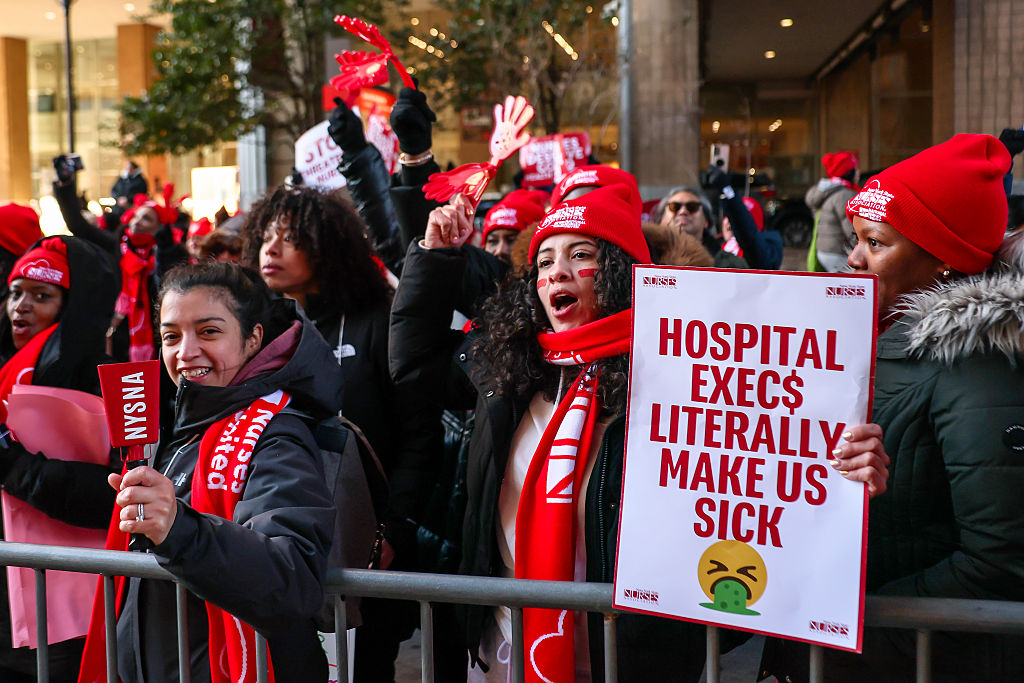
The New York City nurses strike has entered into week four. It has become a test of physical, financial, and political endurance, and now pits the nurses against Democratic governor Kathy Hochul. (Michael M. Santiago / Getty Images)
On Monday morning, with temperatures below freezing, New York City nurses began the fourth week of the largest nursing strike in the city’s history, which has seen some fifteen thousand nurses across multiple Montefiore, Mount Sinai, and NewYork-Presbyterian facilities walk off the job.
Hundreds of nurses kicked off the week by gathering near Grand Central Terminal and marching to Governor Kathy Hochul’s nearby office, aiming pressure at a state leader who has repeatedly extended an executive order allowing hospitals to more easily hire temporary and out-of-state replacement staff (referred to in union parlance as “scabs”), blunting the leverage of the work stoppage. Nurses’ demand is specific: Hochul should not extend the executive order again, removing a measure that has made it easier for hospital systems to staff around the strike. The latest extension expires today.
The striking nurses, represented by the New York State Nurses Association (NYSNA), walked off the job at private hospitals across New York City on January 12. The strike does not include all NYSNA members statewide, nor nurses at public hospitals like those in the NYC Health + Hospitals system, who work under separate contracts.

Bargaining between NYSNA and hospital management began months before those contracts expired at the end of 2025, stretching through the fall without an agreement. Nurses say hospital executives refused to agree to enforceable safe-staffing standards and meaningful protections against workplace violence, framing the dispute as a patient-care crisis and a retention crisis at once. When negotiations failed to produce a deal, nurses voted to strike, walking out in mid-January after giving notice.
Four weeks in, the dispute has become a test of physical, financial, and political endurance. Nurses have been striking through sub-freezing temperatures, snow, and wind, standing for hours outside hospital entrances. Some pickets are seeing thinning numbers as exhaustion and financial pressure mount, even as nurses continue to maintain a presence at every major facility.
“We’ve been outside, without health care, without pay, in the cold, holding our picket line strong,” Montefiore nurse Goodness Iheanachor told News 12 Brooklyn. Another nurse, Judy Gonzalez, described management warnings that nurses who did not return by a deadline would lose their health insurance, adding that hospital leadership “thought we would freeze to death.”
As negotiations stall and hospitals continue to rely heavily on replacement labor, nurses have escalated. They marched to Hochul’s office to call for an end to Executive Order 56, which Hochul issued just days before the strike began. It suspends and modifies licensing and staffing rules for health-care workers statewide, giving hospitals greater flexibility to hire temporary and out-of-state staff. The short length of the latest extension is a sign that pressure is registering.
Nurses argue that keeping the order in place has directly weakened their leverage by allowing hospitals to substitute replacement labor for striking nurses rather than return to the table with binding concessions. NYSNA says hospitals have paid temporary “traveler” nurses as much as $10,000 per week and spent more than $100 million on replacement staffing, even as executives claim they cannot afford enforceable staffing standards or serious violence-prevention measures.
The executive order is the most concrete way the state has intervened in the strike, but it fits a broader pattern in how Governor Hochul has positioned herself. She has made a point of portraying herself as a progressive ally, publicly embracing Mamdani and affirming nurses’ right to strike. Yet in practice, her actions undermine them. She has acted quickly to stabilize hospital operations while declining to apply comparable pressure on executives to settle a contract over staffing and safety, effectively insulating management from the costs of a strike.
That mirrors how Hochul has resisted efforts to tax the wealthy or meaningfully challenge corporate power in New York, even as she has leaned on progressive symbolism to shore up her political standing. In the nurses’ strike, that tension has become unusually clear: rhetorical support for labor on the one hand, and state policy on the other that makes it easier for hospital executives to wait workers out.
Nurses are also pressing Mayor Zohran Mamdani to go further than his visible support thus far, urging him to publicly call for the state to let the order expire and mobilize his coalition to join their picket lines in active support of the strike.

One could imagine the mayor doing more than urging his supporters to reinforce picket lines. He could convene a bloc of elected officials to publicly press the governor to stop helping hospital executives undermine strikers’ leverage. Mamdani also has city agencies at his disposal and could direct them toward greater scrutiny of the health care industry, reviewing hospital systems’ relationships with city contracts and signaling increased oversight toward a powerful sector, with the threat of losing some of those contracts looming over the hospitals. Doing so could substantiate the mayor’s commitment to one of the nurses’ key demands around staffing ratios, which limit the number of patients for whom a nurse can be tasked with caring and is a citywide policy issue.
In a further escalation, some hospital executives have also threatened to permanently replace strikers if they don’t end the walkout. Under federal labor law, employers generally may permanently replace economic strikers in certain circumstances, while unfair labor practice strikers “can be neither discharged nor permanently replaced.” Those legal distinctions are not academic to nurses on the line. Threats of permanent replacement don’t have to be carried out to reshape a strike; they’re part of the broader effort to make staying out feel impossible.
The union has emphasized that the strike is not primarily about wages. NYSNA says the core demands are safe staffing, protections against workplace violence, and retaining experienced nurses at the bedside. In late January, NYSNA reached agreements with Mount Sinai and NewYork-Presbyterian to preserve NYSNA Plan A health benefits without cuts, removing one major bargaining obstacle, while staffing and safety provisions remain unresolved.
The push for enforceable staffing standards is grounded in extensive research. An analysis of New York State staffing legislation modeled significant reductions in patient harm under safer nurse-to-patient ratios. Another multistate study likewise found that lower nurse staffing levels are associated with worse patient outcomes. NYSNA members have secured some of the strongest safe-staffing language in the country, which enables them to bring violations to arbitration, allowing an arbitrator to fine hospitals for not having enough nurses working on a shift. The money goes to the nurses who worked while short-staffed.
This has resulted in significant penalties for hospitals. In 2024, alone Mount Sinai paid $2 million in fines, leading the hospital to hire hundreds of additional nurses to avoid future penalties. But nurses say management is now proposing changes to contract language that would make arbitration a more tedious process, a recipe for weakening the enforceability of safe-staffing ratios.
Understaffing is a cost-cutting strategy in a labor-intensive industry where health care employers face structural incentives to control labor costs even as demand for care grows. That makes the financial posture of the hospital systems a central part of what nurses are fighting over. The gap between what management says it can’t afford and what it chooses to fund is stark. In 2024, NewYork-Presbyterian CEO Steven Corwin saw his pay rise to $26.3 million — about $72,000 a day — while Montefiore CEO Philip Ozuah made $16.7 million and Mount Sinai’s CEO Kenneth Davis took home $8.4 million. These are sums that could staff units, fund violence prevention measures, and cover a settlement.
Health care employers are among the most powerful organized interests in state politics, a relevant baseline when considering why Hochul has repeatedly extended an order that erodes the basic leverage of a strike. If Hochul lets the order expire, it won’t “end” the strike, but it will end one of the mechanisms that has helped hospital management undermine it. What happens next will say a great deal about whose time and leverage the state is prepared to protect.