New York City Nurses Have Launched Their Biggest-Ever Strike

Nearly 15,000 nurses are now on strike at three New York City private sector hospitals, in the largest nurses’ strike the city has ever seen. Nurses say they are striking to end understaffing that burns out nurses and endangers patients.
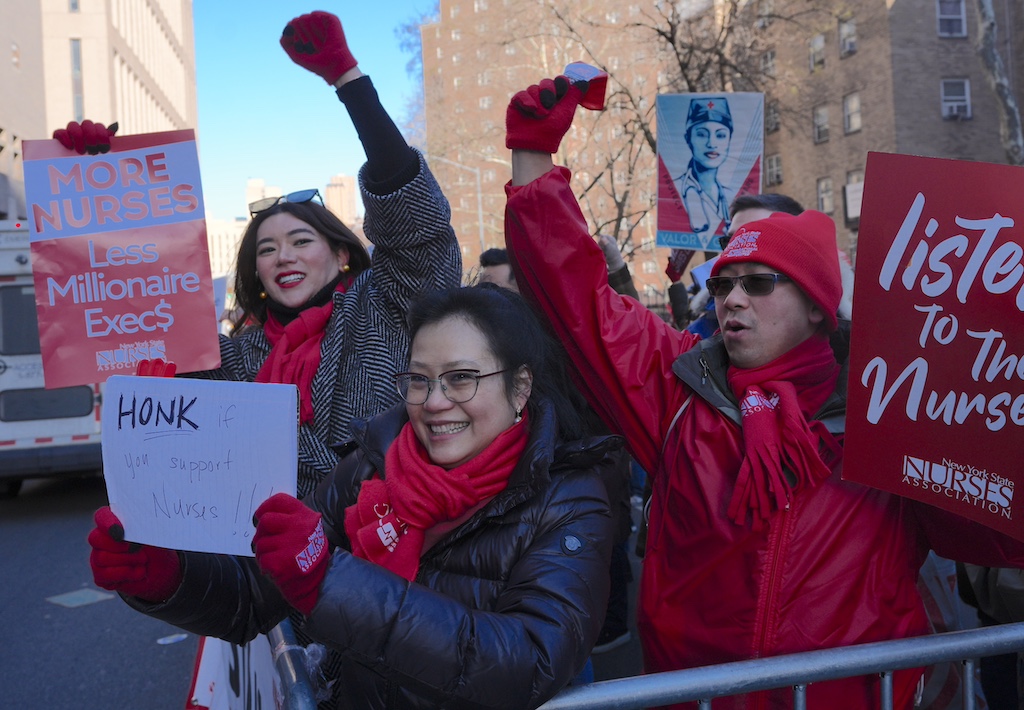
New York City nurses say employers are refusing to address their demands to end dangerous understaffing and to protect nurses and other staff against workplace violence. (Selcuk Acar / Anadolu via Getty Images)

Interview by
Sara Wexler

Yesterday nearly 15,000 nurses launched a strike at three private sector hospital systems in New York City. Nurses represented by the New York State Nurses Association (NYSNA) have walked out at multiple campuses of Montefiore Einstein Medical Center, Mount Sinai Health System, and New York–Presbyterian Hospital in the largest nurses’ strike in the city’s history and one of the largest in the history of the United States.

Nurses say that the hospitals are stonewalling them on key proposals. Those include demands around safe-staffing ratios; nurses say understaffing is a major issue that leads to burnout of staff and worse patient care. Nurses are also attempting to establish better protections against workplace violence for hospital staff and to resist cuts to their health care benefits, among other demands.

Earlier today, Jacobin contributor Sara Wexler joined nurses on the picket lines at Mount Sinai’s Morningside campus. She spoke to nurses there about their key contract proposals, why bargaining has broken down, and fighting back against their employer’s union-busting efforts.


Sara Wexler

Why are you all on strike today?

Simone Way

We are on strike currently because our employers will not guarantee health care benefits for their nurses. They will not guarantee investing into our pensions. They will not guarantee workplace violence protections for all of the staff here.

They will not guarantee safe staffing enforcement for the nurses here. And we know for a fact when staffing is low, errors are made by nurses, and patient care is diminished. Management is also not entertaining, at this current moment, any wage proposals that we have given them.

Yashira Martinez

We’re fighting at this moment for safe staffing. It’s unfair, but we don’t have any patient-to-nurse ratios in the Emergency Department. So we’re fighting for the safety of the patients. We’re fighting for our sanity at the end of the shift and for our health care to remain the same. We have nurses that are near retirement, fighting out here daily, fighting for their health care pensions to continue fairly.

We are obviously fighting for wages because we are definitely underpaid and overworked. It’s been a dream of mine to become an ER nurse, and I feel fulfilled in that sense. But it would feel even better if we were heard, if we were seen, and if we were under a fair contract.

Marvin Duncan

The working conditions and the lack of patient safety is something that is really bothering us. This is why we’re out today, and possibly for the entire week, to ensure that we’re able to receive proper patient conditions, conditions that are conducive for healing and conditions that are conducive for providing the care that patients need in this community.

Having a nurse taking care of fifteen patients while they need to attend to traumas is beyond something I can really imagine. Nurses should receive ratios that are reasonable and not ratios that would put their licenses in jeopardy.

Sara Wexler

What have contract negotiations been like leading up to this point?

Shella Dominguez

We started negotiating last September. The employer has not given us a lot of agreements. We still have a lot on the table that needs to be discussed, like safe staffing; we haven’t agreed on that. [Or on] workplace violence protections, which we really need, because a lot of nurses — not only nurses, but also other staff members — have been affected by violence inside the hospital. 

The employer sometimes takes a break for a long period of time [during bargaining] — two to three hours we’re waiting at the table. And the last few days of negotiations, management hasn’t really sat at the table and talked to us.

Simone Way

It has been very interesting coming to the table with our management. We started [contract bargaining] in September. But we have meetings with management every single month on staffing and labor issues. One of [those meetings] is a requirement by New York State, and the others are meetings that we participate in as nurses on the executive committee for the union.

When we meet with management every single month, we have a lot of the same issues. We talk about staffing every month. We’ve brought nurses from multiple units in-person to testify and tell about the situations on their particular units, and we advocate for them to increase staffing on those units. A lot of times it’s for nurses, but it could also be for ancillary staff like the attendants that help us to do our jobs. And management looks at us as if we have three heads. They have no responses for the things that we bring to the table; they do not address them.

So us getting to this point is not foreign to them. We just presented a lot of the same things that have been unresolved over the year to them at the bargaining table in hopes that [we could resolve some of these issues], and they will not discuss it. Anything that costs this institution a financial component, they will not entertain. When we tell them that we want [better] staffing: “That’s economic, and we’re not talking about economic [proposals].” That is their response. If we talk to management about something noneconomic, it can take us two to three sessions to iron out one little thing, and they will nitpick on every piece of language.

We tried to get a proposal across to them in regard to what we call “nonnursing functions”: nurses waste a lot of time doing things that we shouldn’t be doing, because they have other entities in the hospital to do it, like nurses cleaning beds. That’s what Environmental Service does. So why are nurses doing it? We were speaking to them about that for a very long time. We went back and forth for three sessions, and they could not come to an agreement with us on those things. They got hung up on the word “or” because we put in there that you couldn’t do something except for an emergency, and they wanted us to insert or remove the word “or.”

Three sessions they wasted over that. And when I say three sessions, that means management comes in, we meet in the mornings at 10 a.m., we present things to them by noon, they go out, they say, “We’re going to go to lunch; we’re going to caucus.” And then they might come back at 2 p.m., and then they leave at 3 p.m. because they claim, “I have a meeting.” Somebody has a meeting, and then they leave with no resolution, and then they call us at 5 p.m. and say, “We’re not returning.”

So we may get two to three hours of effective talking back and forth, but nothing is getting done. They’ve done this since September. This has been their MO.

So when the governor says something like, “Nurses need to negotiate, and the hospitals need to negotiate with the nurses,” she doesn’t know what she’s talking about. We show up every day. We come in on time; we leave late. We leave at eight o’clock, nine o’clock. Management has been gone, has left the building, and they do not engage with us, even through a mediator.

There’s nothing left for those nurses to do besides walking out and going on strike. They have pushed us to this point because they won’t talk about anything. The only thing they want to talk about is slashing our health care. And the minute we agree to that, we set a precedent for New York State in allowing big companies to cut the health care benefits of their employees, in all unions.

Sara Wexler

What did the organizing look like leading up to this? How did you all go about organizing with each other such that you now have 15,000 nurses?

Shella Dominguez

When we started negotiating, we got our nurses involved. The union has this contract action team, which has met once a week since we started negotiation; before negotiations started, the contract action team would meet once a month. So when we started negotiating, we would meet once a week, and we voice the topics to our contract action team so they can disseminate information to our fellow nurses.

We made our negotiation as transparent as we can. So we opened a Zoom link for every nurse to attend, and we encourage everybody to attend in person. If they cannot attend or if they’re working, we encourage them to sign onto the Zoom and listen all throughout the negotiation.

Simone Way

The contract action team [is made up of] volunteers from every unit. We try to get three or four from each unit. The more the merrier is what we feel. We have meetings with the executive team; we have meetings every week, but the closer we got to striking . . . we can have meetings every day if we need to. So the executive team gives the contract action team the information about what goes on at the table for them to disseminate, whether or not it’s verbal. We have group chats, group texts; we have paper flyers, booklets, handouts. We have all kinds of information that we transmit to the members.

Not only that, but outside of the information that we give to our contract action team, we have weekly — and recently daily — meetings of what we call the “labor bargaining unit.” The labor bargaining unit is the entire membership. Every nurse in the hospital that is a NYSNA member at both of our [hospital] sites is invited to a Zoom call. The other day we had 700 to 800 nurses on the call because they want to know what’s going on. And all of our members are there with their executive team, and we are putting the message forth about everything that is going on.

So it’s a very extensive [effort] to reach people, but not just one thing. It has to be multiple things when it comes to organizing. There are times I’ve met with my contract action team during my lunch break. I said, “Let’s all go to lunch at this time. Let’s meet in this room. I’m buying pizza for everybody, and we’re going to strategize.”

That’s what we do because the hospital does its very darnedest to prevent us from communicating. They don’t want us on another unit, giving out any information if it’s not our break time. And even if it is our break time, I’ve had my directors in my hospital see me walking around with a plain generic envelope that has information in it, and they’re like, “What’s in that envelope, Simone?” And I’m like, “What’s in your pocket? What are you asking me that for?” They say, “I just wonder what’s in there. Where are you heading to today?” I said, “I have business to take care of. Remember, I’m a NYSNA rep. That means I have nurses to represent.” And I just leave it there because sometimes they want to know what unit I’m going on so that they can call the manager there to find out if what I’m saying is true or not.

So they are spying on us; they’re trying to watch what we do. They’re trying to curtail how we move, and we cannot allow that. They want to break this union. This is an effort, I believe, that is a national effort to break unions.

Yashira Martinez

Organizing for most of us was scary. It was a few months of fear: fear of retaliation, fear of staying with no health care, fear of staying with no pay, and most of all, fear of being unheard at the end. NYSNA has done a wonderful job [providing] us with information and our legal rights, and it has given us the confidence to stay here as long as we have to.

Marvin Duncan

Being a new nurse to this system, I had never gone on strike before, but NYSNA was able to come in and alleviate our fears. They were able to make us more confident despite not receiving a salary, but we know what we’re fighting for, and it’s for better patient safety, better patient care.

Sara Wexler

How has management reacted since you started the strike? Has there been retaliation against membership?

Simone Way

There definitely has been retaliation at some of our hospital sites in regards to the strike. At our main hospital campus, which is on the East Side, almost everyone on the executive committee that represents NYSNA has [faced] discipline and suspension. At this hospital, we have not had any [disciplining of] our executive team committee, but I can say that there are nurses being disciplined in the hospital this contract season.

Within ten days of our serving a strike notice, management has been very heavy on disciplining nurses for different things. They know that the nurses cannot receive the type of representation that they deserve because we, who usually represent them at these hearings for multiple things, are in negotiations. Nurses need a union rep to do fact-finding — like if somebody said that a nurse was arguing with someone in the hallway, things like that. If someone said that you came in at this time, we would have to investigate it. And some of these things might be minor, but instead of it being a minor situation with a verbal or written warning, it winds up being a final warning or suspension pending investigation.

It’s hard to correlate it to union activity because of the way they disguise it, but nurses have been being disciplined heavily during this time. We can’t say right out that it’s because we served a strike notice or because nurses are going on strike, but we can say that it’s been a little exorbitant — to the point where NYSNA had to contact the hospital and tell them that during a certain period of time, all of that activity had to cease. If nurses or managers needed delegates for fact-finding or anything, all of that had to go on hold. Any discipline had to go on hold because we can’t represent nurses — we’re at the table.

Shella Dominguez

As soon as we served the strike notice, management sent a letter to our union reps that they can no longer go onto the hospital premises. So as this executive committee, we have to do our best to disseminate information with our members. And executive committee members have to be very careful not to come in on our days off or on our break, and not [go to] a different unit where we’re not working, because we might be reprimanded.

Simone Way

I’m glad that Shella brought that up, because I forgot to say that our paid employees for NYSNA were told that they could not enter the building, and that if they were found entering the building, the hospital would have them arrested. This was sent out in an email. It also said that the members of the executive committee, if we were found in the hospital during times that we were not scheduled to work, even though we are employees of the hospital, would be subject to discipline as well. So that is an immediate threat.

Sara Wexler

What would the hospital you want, that you’re fighting for, look like?

Simone Way

To me, that would look like true collaboration and respect for the work that nurses do every single day — being allowed to participate and add our lived experiences with patients. Having our bosses want to know and care about what we think and taking the time to see if the information we give them is practical and might help make this whole organization a better place to work and a better place for patients to be cared for.

I think that when nurses feel heard and they feel respected, they want to come to work. They enjoy what they do. That is evident in the type of care that they provide for their patients, and it will only be better for the patients.

Shella Dominguez

To add to what Simone said: better staffing, better guardrails on workplace violence. A lot of our staff members have been affected by workplace violence. They’ve been out of work for weeks or sometimes months because of it. Better health benefits and retirement [benefits] for our retired nurses.

Yashira Martinez

It looks like safe patient-to-nurse ratios. It looks like the wages that we deserve. It looks like our health care, if it’s not getting better, at least maintaining what we have now. No changes to our health care or to pensions. It means feeling secure when you hit retirement age, or the phase in your life when you’re ready to retire, and saying, “I am safe. My family’s safe.”

It looks like we’re safe in our workplace, literally safe and not being attacked — and if we are, we’re backed up by management and the entire corporation. It looks like having break nurses [i.e., extra nurses on duty to cover patients when some nurses take their breaks]. That’s what it would look like for us. Specifically for the Emergency Department, it looks safer generally. It looks like: we are not burned out. It looks like: on the weekend, on all our days off, we can enjoy our family and not need two days of rest from one shift.

It looks like we can wholeheartedly say, “Today I gave it my all, and I made a difference.” Not: “My gosh, I couldn’t take care of or go take a look at this patient because I have seventeen others.” It’s unfair, and we’re just looking for fairness.

Share this article

Contributors

Simone Way is a nurse who serves on the board of directors of the New York State Nurses Association (NYSNA) and a member of the NYSNA executive committee for Mount Sinai Morningside.

Shella Dominguez is a nurse at Mount Sinai Morningside.

Marvin Duncan is a nurse in the Emergency Department at Mount Sinai Morningside.

Yashira Martinez is a nurse in the Emergency Department at Mount Sinai Morningside.

Sara Wexler is a member of UAW Local 2710 and a PhD student at Columbia University.

Filed Under