The Right’s Civilizational New World Order

Civilizationalism, the idea that world politics revolves around culturally bounded civilizations led by great powers, is energizing the Right on both sides of the Atlantic. It is key to the effort to dismantle universalism and remake the international order.
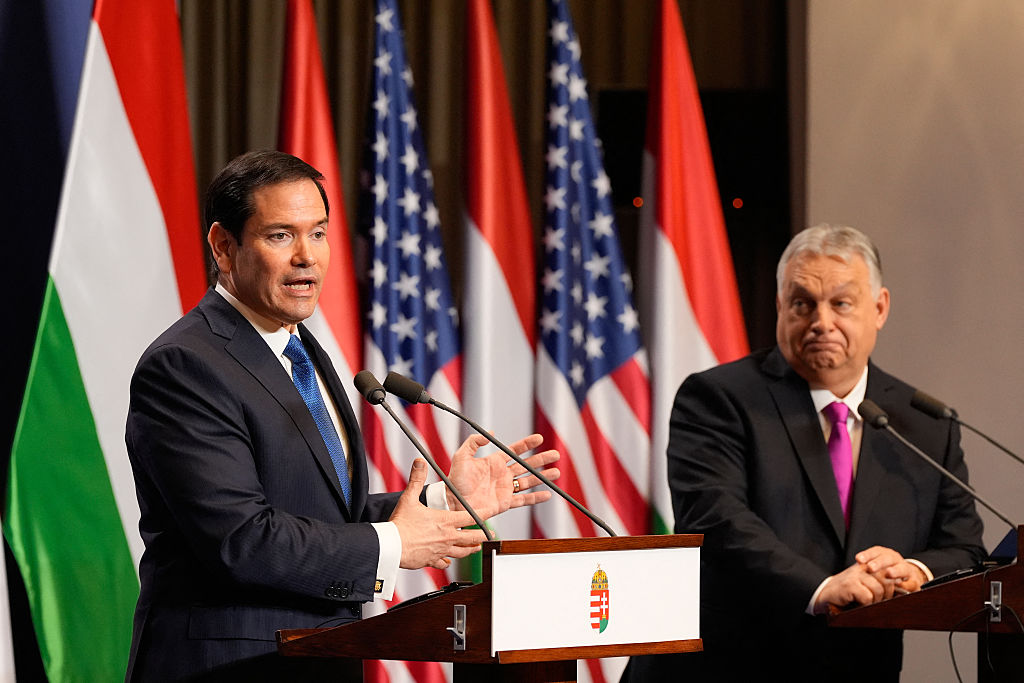
From Trumpism to the European right, civilizationalism has become a burgeoning framework for politics. Its adherents want to replace the liberal international order with a system organized around culture, power, and hierarchy. (Alex Brandon / POOL / AFP via Getty Images)

Few documents have captured the attention of foreign policy elites like the 2025 US National Security Strategy (NSS). Released quietly in early December, it quickly prompted praise in Moscow and Beijing, while provoking dismay and even anger among America’s allies in Western Europe and beyond.

At its core, the NSS lays out a civilizational view of world politics. The world should be seen as a series of civilizational complexes centered around great powers that anchor their civilizations and exercise hegemony in their regions. The West is not just a geographic location: it is a distinct historical and cultural sphere. Crucially, this civilization is threatened less by external military threats than it is from dangers within — the corrosive culture and politics of liberalism and the economic and social dislocations and depredations of market globalism. This is a strikingly divergent and, in many ways, troubling vision of world politics. The universalism underpinning liberal globalism and human rights is explicitly rejected. Developing ties between sovereign states united by a common civilization and exclusionary cultures is its priority.

Despite the NSS’s notoriety, the ideas put forward in it are not new. They were declared by Donald Trump in 2016 and proclaimed by J. D. Vance in his widely noted speech at the Munich Security Conference, eleven months before the NSS saw the light of day. Nor are they uniquely American. Civilizationalism is the dominant geopolitical discourse of radical conservatives across Europe. To understand the power and popularity of civilizationalism, we need to see it as a political strategy as well as a set of ideas. Empowering radical conservative actors at home, and supporting novel strategies abroad, civilizationalism is part of a broader attempt to fundamentally restructure the international order.

Manufacturing Civilizational States

Civilizationalism represents a form of transnational politics operating in different but mutually reinforcing ways in domestic and foreign policy on both sides of the Atlantic. In the United States, it is tied to what one commentator has called the “battle for the Right’s post-Trump future.” At its heart is a struggle over American national identity: whether the United States is a “credal” nation defined by a commitment to universal values open in principle to all, or whether it is — or should be — a country defined and dominated by the values and lineage of “Heritage Americans.” Civilizationalism gives ideological form to this more exclusive understanding of American identity. It is not surprising that Vance has been one of its primary proponents. Claiming a civilizational identity internationally — and having it recognized and echoed by other conservatives, such as Hungary’s president Viktor Orbán — is also a way of reinforcing that claim domestically.

At the same time, civilizationalism also serves to reshape debates over the future of US foreign policy and the country’s place in the world. For decades, the fundamental choice in these debates was between internationalism and isolationism, with the latter cast as ideologically narrow and strategically unrealistic. Civilizationalism provides a third option, that of America as a civilizational state — a great power at the center of a wider, culturally congruent region.

It also enables novel diplomatic initiatives and strategies. If international relations are defined not just by the interactions of formally sovereign states, but by civilizational fates, this justifies treating states differently depending on their commitment and importance to the civilization. Again, the NSS makes this clear, stressing the need for the United States to support radical conservative governments. It also opens up new tactics unconstrained by norms of sovereign noninterference, such as overt support for, or contact with, civil society actors and political parties ideologically aligned with the current administration. Whether this involves publicly haranguing European governments for civilizational backsliding, formal financial support for right-wing think tanks, encouragement for Canadian separatists, or even staging seemingly innocuous holiday gatherings between the vice president and civilizationalist allies on the British right in rural Oxfordshire. The result is a diplomatic strategy that skirts the traditional boundaries of sovereign noninterference at the same time that it calls for more assertive (civilizational) sovereignty.

Civilizational Fortress Europe

On the other side of the Atlantic, civilizational politics also plays a central role in the radical right’s domestic campaigns against liberalism and struggles for the future of conservatism. This is particularly apparent in the UK, where the Reform Party is campaigning to replace the Conservative Party as the standard-bearer of the Right, with the collusion of right-wing former members of the Conservatives and with clear support from the US vice president.

On the continent, assaults on “globalist EU elites” and calls to reassert exclusive national identities, values, and interests have been a staple of right-wing political rhetoric for years. However, appeals to Western civilization now play a prominent role in attempts to reconcile nationalism with Europeanness, offsetting charges of unrealistic national autarky by crafting an alternative Christian or Enlightenment-based European civilization. This vision provides a degree of international unity while excluding its civilizational others, particularly Islam.

These ideas have also allowed the radical right to move from rejecting the EU to seeking to reform it as a bulwark of civilizational Europe and its sovereign nations. Importantly, this is not just a pan-European discourse. Much of the European radical right is also Atlanticist and Western, constantly seeking to draw support for their cause by allying with the American right. In these accounts, the NSS shows America’s desire to save Europe and its Western civilization from the liberal elites destroying it. This framing provides radical right parties not only with fodder for their traditional attacks on those elites, but also with the claim that only by moving to the political right can Europe ensure that the United States remains committed to the continent’s economic and military security. From this position, the conclusion is obvious:

Despite Washington’s cautious warnings, EU elites will not change — that much is now evident. Instead, they are accelerating along the same downward trajectory. In doing so, they are undermining the one remaining alliance that could anchor them in an increasingly volatile and shifting global order — an alliance without which Europe’s economic and diplomatic power will only continue to diminish.

Tying themselves closely to ideological partners on the other side of the Atlantic, the European right thus seeks to reap electoral advantage as well as support and legitimation from abroad.

Universalism on the Back Foot

In sum, what we are seeing across right-wing politics is not an expression of a civilization or civilizational state that already exists in any simple sense. Rather, it is the use of civilizational claims in political struggles at home and abroad, alongside the development of novel transnational strategies that seek to influence political identity, electoral politics, and foreign policy.

The civilizational strategy has limits. So long as civilization and sovereignty seem to fit seamlessly together, the obvious tensions between them can be negotiated. But when the core civilizational state acts like a unilateralist great power, violating sovereignty in the name of national interests, the difficulties become almost impossible to paper over. The designs of the Trump administration on Greenland — and the consternation they caused among parts of the European hard right — are a textbook illustration. But the Right’s opponents should not take too much comfort from these tensions.

The outrage on the European right is tied to the American challenge to the sovereignty of Denmark, a European state and NATO ally; similar disquiet is less likely in response to interventions in Central America and the Caribbean. Moreover, divergences can be strategically massaged without conceding the goal of reforming the geopolitical relationship. Marco Rubio’s speech at the 2026 Munich conference was, at one level, more conciliatory. But his subsequent visits to Slovakia and Hungary, two countries with right-wing governments most at odds with the EU, made the underlying message clear.

The strength of the Right’s civilizational narrative is reinforced by the fact that a traditional liberal response to a counter-civilizational argument based on universalism has been undermined not only by the Right, but also by critics on the Left and in the Global South, who connect it with Western imperialism. The difficulties faced by the EU Commission in attempting to craft a counternarrative demonstrate the challenge, as well as the risk, that pursuing such a path may inadvertently amplify the civilizational arguments of its opponents. Civilizationalism is suddenly everywhere in the rhetoric of international affairs. That alone should alert us to the likelihood that its popularity is not innocent.