Jürgen Habermas Showed What Philosophy Could Be
The death of Jürgen Habermas has left philosophy and the Left poorer. Central to his work was a profound critique of irrationality in all its forms. Taken seriously, his philosophy provides an indispensable guide in the struggle against oppression.
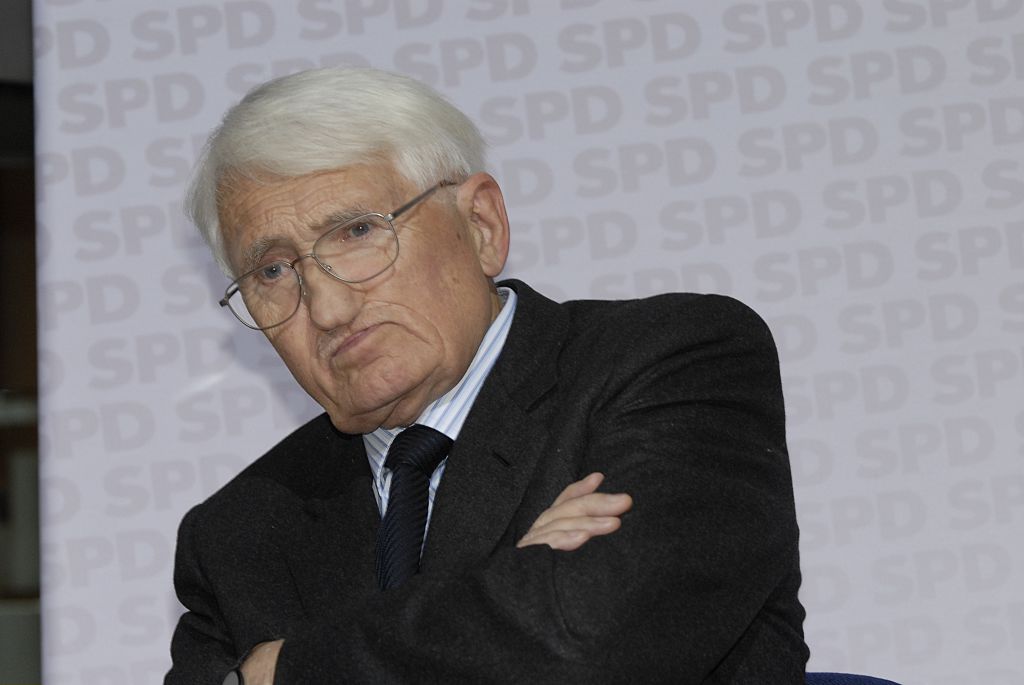
The philosopher Jürgen Habermas, who died on Friday, understood himself to be a socialist until his last days. He recognized that the Left could not abandon a vision of the good society, although he often overlooked liberalism’s failings. (ullstein bild via Getty Images)
After more than seventy years writing and thinking about democracy, capitalism, and the possibility of emancipatory politics, the German philosopher Jürgen Habermas died on Friday, age ninety-six. For a generation of political theorists and philosophers, his work was a touchstone. The author of over thirty books, he was interested in fundamental questions about how we ought to live together without domination and exploitation. But much of his writing is today underread and misunderstood.
I read Habermas around when I was twenty years old and an undergraduate studying policy management at Carleton University in Ottawa. Never an especially attentive policy analyst, I preferred spending my time resolving a never-ending existential crisis brought about by my wavering Catholic faith. Right after I graduated from high school I started reading philosophy, without paying all that much attention to its political content. From the very beginning, I was attracted to the most reactionary thinkers. It’s not too much to say I absorbed Carl Schmitt, Friedrich Nietzsche, and especially Martin Heidegger like a sponge. They combined a religious intensity with a covert kind of elitism. This alloyed perfectly with my broody angst nurtured by years of dealing with demanding customers as a cashier. Heidegger et al. struck me as visionary thinkers who gave the middle finger to the kind of very polite, very Canadian liberalism my country was and is rightly known for. In another world I probably stuck with them and walked a very sinister path.
Habermas would seem an unlikely philosopher to cure anyone of their attraction to hard-right thinking. His writing is anything but visionary and striking. Abandon all hope of thunder-and-lightning aphorisms and musings like “God is dead!” or “What is the meaning of Being?” Stick around to learn about the Peircean turn to post-metaphysical thinking through a transition to pragmatism and ordinary language philosophy. Never one to have a proper estimate of his abilities at any time, I jumped right into what everyone said was Habermas’s most important and challenging book: the two volume Theory of Communicative Action. Immediately I thought it was the most boring work of theory I’d ever read. Who the hell did this? What was the point of the endless meandering about Max Weber, Talcott Parsons, and just about every other social theorist and sociologist under the sun? Where was the book’s editor? Why couldn’t Habermas just get to the point and explain why ideal speech situations and undistorted communication ought to be the foundation of a good society? How else could I start listing off “thoughtful” reasons why his stodgy democratic procedures were weak sh-t when confronted with the intense spiritual malaise of modernity?
Then something began to click. The more I read the book, the more begrudgingly impressed I became by the sheer learning on display. Of course this was an easy thing to be impressed by as a young guy with intellectual pretensions. But what really struck me was just how careful and nuanced Habermas was whenever he was dealing with an argument. It was important to him to get Weber, Parsons, Karl Marx, and others “right,” and to situate himself in relation to them, because they were great teachers and were owed that level of respect. Moreover, theoretical honesty required acknowledging your debt to them and building upon and criticizing their achievements in a spirit of refining knowledge.
Around the same time I started taking classes with two Carleton professors who identified heavily with Marx and Habermas. Both of them were hugely formative influences and I owe quite a bit of who I am to them. They were deeply opposed to the Iraq War and drew attention to Habermas’s tireless activism against it. This was something that really stuck with me, as did my new mentors’ deep empathy and lack of elitism. What struck me is how they took ideas as seriously as a lot of the right-wing philosophers I read, but were far less prone to speculative grandiosity and self-flattery. Inspired by Habermas, they thought a good philosopher was someone who made their case to the reading public as clearly as possible and let the people decide what was right or wrong based on the strength of the arguments. Of course they weren’t naive about the many ways communication and dialogue were distorted and manipulated by the media, rhetoric, and irrational attachments. But then the solution was precisely to think of solutions to those problems, rather than just chalking it up to a perennial swinishness on the part of the inauthentic masses.
A Life of Many Minds
Habermas was born in Germany in 1929. This was an eventful time in world and German history, and the shocks of the era forever stamped his philosophy. Due to a 1939 law mandating membership, Habermas was drafted into the Hitler Youth and was forced to participate in the Nazi war effort as a teenager. Forever after the philosopher referenced these formative events. It’s not too much to say that his entire body of work is motivated by a passion for inoculating society against any authoritarian impulses. Habermas studied philosophy in the 1950s and gained early fame in 1953 for a series of op-eds criticizing Heidegger and Heideggerians for failing to acknowledge the existentialist’s proximity to the Nazi regime. This lifelong commitment to anti-fascism and denazification became a staple of his public interventions into German life. In 1956 Habermas joined the Institute for Social Research, which came to be known as the Frankfurt School, and was profoundly influenced by Theodor Adorno, Max Horkheimer, and other luminaries of the emerging critical theory. From that day on, Habermas was a man of the Left, although he was wary of extremism in all its variants.
In 1962 Habermas published his first important work, The Structural Transformation of the Public Sphere, inaugurating a tradition of publishing dense but interesting books with aggressively dull titles. The core of much of Habermas’s later thought can be found in this early work, Despite its being short compared to the later tomes. Very much a philosophically guided study of social theory, Structural Transformations denaturalizes the idea of the “bourgeois public sphere” by showing how changing material conditions enabled a new class of intellectuals, philosophers, and journalists to emerge, figures who would go on to spearhead the Enlightenment and its revolutions. They were dismissed and feared by conservatives like Edmund Burke for spreading the “polluted nonsense of [the] most licentious and giddy coffeehouses.” Habermas thought differently. In the public sphere he saw the germ of a democratically organized social life. Instead of political and religious authorities dictating ideological truth, morals, and law from the top down, these were to be rationally debated on and decided from the bottom up. This later became foundational to both liberal and socialist aspirations for political and economic democracy.
From the late 1960s onward Habermas continued to produce major works. Knowledge and Human Interests was a major step forward in his intellectual development. Drawing on Marx, Freud, and the German idealist tradition, Habermas tries to understand the connections between what we know (or think we know) and what we want. Unlike his mentor Adorno, Habermas held out hope that it might be possible to understand ourselves better and so recalibrate our interests more rationally. Legitimation Crisis also sketched out the basics of Habermas’s political theory. It examined how various crises occur in capitalist societies and called for a tighter integration of different systems’ spheres with civil society so they could be directed by the citizens that these systems governed. This included the economy and the state.
The 1980s and ’90s were Habermas’s imperial phase. It saw the publication of three gigantic works. The most important was his two volume opus, Theory of Communicative Action, which explored how sources of rational discourse in the lifeworld had been colonized by systems of domination. This undermined our capacity to organize society in the interests of all. While producing his own philosophy, Habermas also sought to reinterpret the history of his disciplining, producing the sweepingly polemical The Philosophical Discourse of Modernity and Between Facts and Norms. The former book was very critical of a long line of modern philosophers, from Georg Wilhelm Friedrich Hegel through Nietzsche to Michel Foucault. Initially trying to ground reason in various theories of how the individual subject could gain rational knowledge, philosophers eventually gave up and embraced new forms of left- and right-wing irrationalism that Habermas thought abetted authoritarian politics. With no resources left to make reasoned arguments and have them prevail, political and moral issues were either to be settled by visionary authoritarians imposing their will on the masses or giving up on the idea of building a shared world together.
Between Facts and Norms was a major work of political theory. In it Habermas extended his philosophical emphasis on rational communication to argue for establishing a highly democratic and egalitarian state. Here Habermas showed his immense range by engaging in a dialogue with analytical thinkers like John Rawls, Ronald Dworkin, and others. Many then and now (including me) have been critical of his political philosophy for moving too far away from the sharp edges of critical theory and Marxism. In caricature there’s an almost hyper-professorial quality to it; the belief that political life should look like the perfect graduate seminar. Reasonable people will convince one another, and the better argument will prevail. This characterization is unfair to the richness of Habermas’s position, but it’s an accusation that resurfaces because there’s some truth to it.
In the 2000s Habermas’s work increasingly focused on defending international law and dialoguing with various religious traditions. The Yugoslav civil war and 9/11 alerted him to the enduring power and danger of nationalist and religious fundamentalism, and he saw both crystallize in the George W. Bush administration’s unilateral decision to indulge in messianic nation-building in Iraq. Philipp Felsch, in his recent book The Philosopher: Habermas and Us, reminds readers that Habermas never ceased identifying as a socialist. But his was a socialism that by the 2000s was unapologetically reformist, even if willing to learn from the radical left. In essay collections like Divided West Habermas saw a lot of good coming from the project of European unification, provided the project moved in a more democratic direction and worked to uplift poorer states.
By the 2010s many thought that Habermas, well into his eighties, was set to enjoy a well-deserved retirement. They would be proven wrong. If the 1990s saw Habermas at his most unthreateningly inoffensive, the 2020s saw him mired in surprising controversy. Affirming many leftists’ worst impressions of him, Habermas soft-pedaled criticism of Israel during the Gaza conflict and expressed concern over use of the term “genocide” to describe what was happening. This led to an extensive discussion where he was defended and criticized for adopting a benign tone toward Israel that he did not extend to countries like the United States, at least in part stemming from feelings of responsibility to the country resulting from having lived under and been forced to participate in the Nazi regime.
This late political intervention affirmed critics for whom Habermas had abandoned the critical legacy of the Frankfurt School to become a defender of the status quo. Interestingly this came at a time when his philosophy was regaining its radical bite. In 2019 Habermas released what can only be described as a second magnum opus: his three book Also a History of Philosophy. I reviewed the volumes here and needless to say they’re works of staggering scholarship and intellectual generosity. Also a History of Philosophy is a gigantic work so dense and multifaceted that it simply steamrolls over any objections you might have on this point or that. But it’s more than a mere history of philosophy. What becomes clear throughout is that the more optimistic Habermas of yesteryear was gone. While he only lightly references current events, Habermas makes clear that his final great work was a last maximum effort to recover and defend the rational, progressive, and inclusive project of modernity against a growing number of powerful reactionary enemies.
It is telling that Marx once more occupies an important and positive place in Habermas’s story. Once harshly criticized in the Philosophical Discourse of Modernity, by Also a History of Philosophy Marx is promoted to being the Enlightenment figure par excellence, the thinker who singularly restored reason’s vital critical, even revolutionary, power. One saw glimpses of Habermas the critical theorist return, now considerably more pessimistic that liberal legal procedures and international NGOs could get the job of Enlightening done. In the face of mounting oligarchic manipulation and ramped up xenophobia, reason needs stronger weapons. Habermas deserves to be criticized for a lot. I’ve already mentioned his tendency to stay faithful to the radical edges of critical theory. He was right to see the relentless pessimism and purely “negative” quality of critical theory as a dead end for the Left. Some positive project had to be on offer. But Habermas’s decision to soften his critique of capitalism (at least until the end) and an ongoing tendency to underestimate and undertheorize the appeal of the political right were both theoretical failures. They meant Habermas was always too distant from really understanding the appeal of mythological and aristocratic doctrines; the yearning to elevate one’s self and one’s tribe above the vulgar masses. His philosophy has few effective tools to respond to these enduring reactionary yearnings. Moreover, Habermas made many bad political calls. The soft-pedaling of the Israel-Gaza war and its human rights atrocities is just one of many examples.
But for all that, Habermas remains an inescapable thinker on the Left. In his book length interview, Things Needed to Get Better, one gets a real sense of how much Habermas tried to live his values personally. He was always willing to dialogue with others, unfailingly tried to present his views for assessment by the public, and worked hard to be precise and clear in his writing. These weren’t just personality quirks. Habermas understood that the job of a left-wing philosopher, even if he wants to write recipe books for the cook shops of the future, isn’t to be a visionary prophet or even a voice for the voiceless. It’s to do what little he can to give the voiceless back their voice so we can create a shared world together. That Habermas sometimes didn’t live up to this ideal wouldn’t have surprised him. He was more aware than most of the ethical demands this egalitarian and democratic spirit put on us. Habermas always tried to be the kind of person he thought a philosopher ought to be. To the end he struggled for things to get better in the realm of ideas.