When German Socialists Mobilized Against Genocide in Namibia

German imperialism was responsible for the first genocide of the 20th century in its Namibian colony. The country’s socialist movement spoke out vehemently against the atrocities, offering solidarity across the barriers of race and geography.
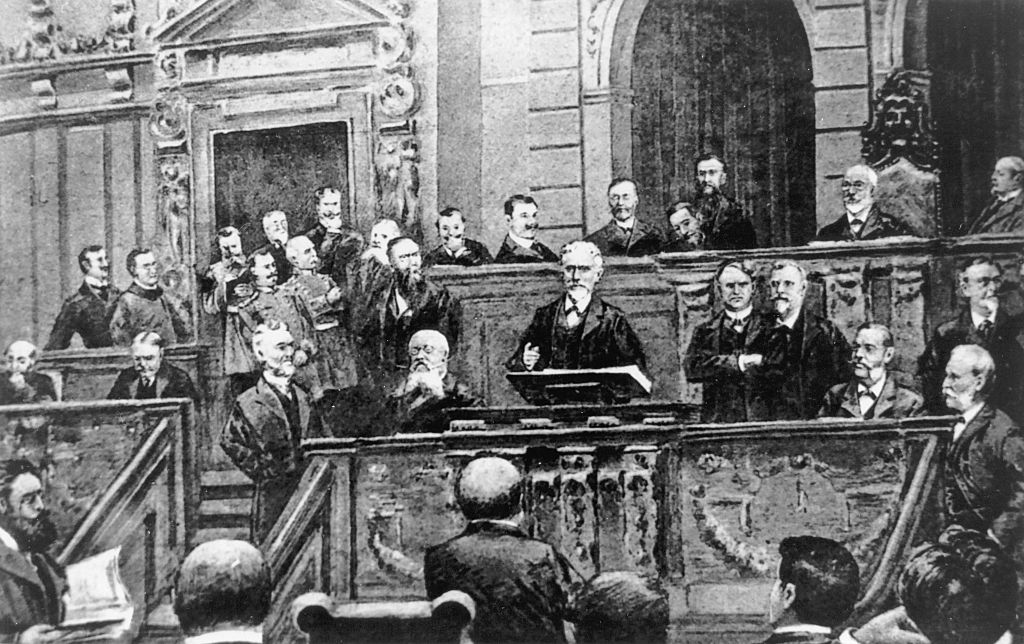
When the people of Namibia rose up against German rule, the socialist leader August Bebel compared them to the ancestors of modern-day Germans who fought against the Roman Empire. His praise for the uprising enraged Germany’s colonial lobby. (Ullstein Bild via Getty Images)

It was the first genocide of the twentieth century.

In January 1904, the Herero people of Southwest Africa (today’s Namibia), who had been under German rule for just twenty years and who were losing control of their lands and cattle to German settlers, rose up against the colonizers, killing about a hundred Germans. The German government responded by sending an expeditionary force under General Lothar von Trotha, a veteran of colonial wars, to reinforce the German garrison in the colony.

By August, Trotha was in a position to attack the lightly armed Hereros with artillery and machine guns, defeating them and driving them into the Kalahari Desert. In October, Trotha issued what became known as his “extermination order,” which included the following words:

The Herero people will have to leave the country. Otherwise I shall force them to do so by means of guns. Within the German boundaries, every Herero, whether found armed or unarmed, with or without cattle, will be shot. I shall not accept any more women and children. I shall drive them back to their people — otherwise I shall order shots to be fired at them.

In the same month, the smaller Nama ethnic group joined the uprising. Trotha issued a similar extermination order directed at them. It was not until early 1907 that the German colonial troops succeeded in brutally crushing the uprising with overwhelming military force.

Of some 80,000 Herero, it is estimated that 75–80 percent died: some were killed in combat, while others died of hunger and thirst after being driven into the desert. Over half of the 20,000 Nama were also killed.

How did the German Social Democratic Party (SPD), the fast-growing socialist party representing an ever larger proportion of Germany’s working class, react to these events? Was it captured by nationalism and pro-imperialist interests, or did it uphold principles of internationalism, anti-racism, and human rights?

Empire and Revolt

The German Social Democrats had emerged from twelve years of illegality in 1890 far stronger than they were before their banning and had adopted an explicitly Marxist party program in 1891. They gained a greater share of the vote in successive elections up to 1903, when they won nearly a third of the votes cast — three million in total.

This made them the party with the highest number of votes in the country, although the unfair and unreformed electoral boundaries of Reichstag constituencies left them with only the second-highest number of seats in parliament. Buoyed by these successes, at the Dresden Party Congress in September 1903, the party’s leader, August Bebel, confidently predicted a triumphal march toward the achievement of a socialist society.

Shortly after the outbreak of the rebellion, the German government requested funding for an expeditionary force. In the debate in the Reichstag on January 19, 1904, August Bebel blamed the German colonizers and their mode of colonial rule for the rebellion, arguing that the Herero were as justified in rising up against the German invaders as the ancient Germanic tribes had been justified in resisting the Roman Empire — an argument designed to provoke the chauvinistic German nationalists on the political right.

The Social Democratic Reichstag members abstained from the vote on credits for the expedition, arguing that they did not yet have enough reliable information on the causes of the war just a week after its outbreak, and were unwilling initially to vote against assistance for German settlers. (The government was strident in its insistence that the funds were necessary to defend German civilians, including women and children — four women had been among the one hundred killed in the initial uprising.) Nonetheless, given their opposition to colonialism in principle, the Social Democrats refused to vote for the expedition.

Opposition to Colonialism

The older historiography on the attitude of German socialists to colonialism focused largely on the right-wing, revisionist side of the party and its sympathies for imperial expansion. In reaction to this, Jens-Uwe Guettel has written about “the myth of the pro-colonialist SPD.” In fact, both the SPD party program and the majority of party members were firmly opposed to colonialism.

In part, this was for fiscal reasons: the vast majority of the Imperial German budget was spent on the army and navy, and colonies were an additional charge. The imperial government relied heavily on indirect taxes on foodstuffs and consumer goods, which were largely paid by working Germans, to cover these expenses.

However, in addition to the financial arguments, German Social Democrats also opposed colonialism on the grounds of internationalism and respect for the rights of self-determination of peoples, and because colonialism was associated with exploitative capitalist practices and corruption.

The anti-colonialist views of the Social Democratic Party are demonstrated not only by the speeches of party leaders like Bebel and official resolutions of party congresses. Police surveillance reports of workers in Hamburg pubs record their hostility to colonialism. At party branch meetings in Berlin, rank-and-file members roundly condemned the pro-colonialist views of right-wing party figures.

“Barbaric Methods of War”

Bebel partly based the party’s decision to abstain on the vote to fund the military expedition to South West Africa in January 1904 on a lack of information. Two months later, he had more information to go on, and he found it alarming. In the Reichstag, Bebel raised questions about the conduct of the war, especially concerning the treatment of Herero prisoners of German troops and the fact that none were reported to have been taken alive.

A year after the war’s outbreak, Bebel was even more forthright in his condemnation of the conduct of the war. He spoke at length about Germany’s responsibility for the uprising, exposed cases of mistreatment of the African population by the colonial regime, and defended the right of the Herero to fight for their independence. He also denounced the “barbaric methods of war” of the German forces under General Trotha.

In December 1906, shortly before the government dissolved the Reichstag early to commence a nationalistic election campaign that targeted the Social Democrats for their unpatriotic opposition to the colonial war, Bebel continued to pillory the conduct of the war in parliament and to argue that the Hereros were justified in rebelling against the loss of their lands and cattle.

He also explicitly denounced the German Army’s campaign of extermination and annihilation — the word genocide did not then exist — reading out General Trotha’s “annihilation order” on the floor of parliament and condemning the way in which Hereros had been driven into the desert to die of thirst and hunger.

Lampooning the Army

The Social Democrats did not confine their opposition to the war in South West Africa to speeches in parliament. The party had an extensive array of newspapers and periodicals, which could reach millions of readers.

For example, the illustrated satirical magazine Der Wahre Jacob (“The Real Jacob”) had a print run of around 200,000 during this period, which may have brought it to a million readers when one counts large working-class households and copies available in pubs and reading rooms frequented by party members. The party also had several dozens of daily newspapers, including the Berlin-based Vorwärts, which passed a circulation of 100,000 copies a day during these years.

The party press campaigned strongly against the war, despite the ever-present threat of politically motivated prosecutions for offenses such as insulting the army. Anti-militarism was a constant theme of the German socialist press until the very eve of World War I. Der Wahre Jacob carried frequent cartoons mocking the officer corps and attacking the conduct of the military in the colony.

One finds cartoons showing an aristocratic Prussian officer in full retreat before a crowd of Herero fighters and General Trotha being outwitted by Herero evading capture. In response to a report that Trotha had offered 5,000 marks for the head of rebel leader Samuel Maharero, the magazine printed an alleged reply from Maharero: “I wouldn’t give you five Marks for the head of a Prussian general.”

Shield and Sword

Not all of the magazine’s depictions of the war were in a humorous vein. There were also images that drastically depicted German atrocities in South West Africa. One cartoon from January 1905 showed an African being held by a German soldier while another soldier bayoneted him. A missionary looks on, blessing the scene and forgiving the perpetrators. Other images depicted mass shootings of Africans.

While Der Wahre Jacob lampooned the German officer corps, it was still sympathetic to the plight of the ordinary soldier in a conscript army notorious for brutal discipline. German soldiers were shown as cannon fodder, their bodies lying in the desert among the bodies of slain Africans.

Der Wahre Jacob depicted the Herero and Nama as peoples conducting a justified fight for their own rights against an inherently unjust and oppressive colonial system of rule. Echoing August Bebel, the magazine compared Hendrik Witbooi, the Nama chief who waged a guerrilla campaign against German rule, with the German national hero Arminius, or Hermann, of the Cherusci, who defeated the Romans at the battle of Teutoburg Forest in 9 CE.

A graphic expression of solidarity with the Herero and Nama in their resistance to German rule was to be seen on the front cover of Der Wahre Jacob in January 1907. This was a couple of weeks before the national elections that the government chose to fight as a pro-imperialist campaign against the Social Democrats.

An allegorical female figure representing socialism, wearing the revolutionary red Phrygian cap and holding a shield and sword, is shown defending a group of Africans against German colonialism, personified by Colonial Secretary Bernhard Dernburg and Chancellor Bernhard von Bülow. The image is a direct parody of a notorious racist print designed personally by Kaiser Wilhelm II calling on Europeans to defend themselves against the “Yellow Peril,” referring to the rising power of Asia.

Exposing Genocide

Social Democratic press coverage of the war was not limited to Der Wahre Jacob, or its Munich-based counterpart, the illustrated Süddeutscher Postillion (“South German Postillion”). The party’s flagship paper, Vorwärts, condemned the abuses that the Herero and Nama had suffered at the hands of German colonists. By the end of 1904, it was outspoken in reporting on “the annihilation of the Herero” by General Trotha.

The left-radical Leipziger Volkszeitung (“Leipzig People’s Paper”) was also militantly anti-colonialist and vocal in condemning the conduct of the war. In the Prussian provincial city of Posen (today’s Poznań), Rosa Luxemburg ran critical commentary on the war for the Polish workers of the province in the Polish-language Gazeta Ludowa (“People’s Newspaper”).

There were limitations to the position of the German Social Democrats on South West Africa. It remained on a rather theoretical and vicarious level: as one delegate at the 1904 Bremen Party Congress pointed out, the party had no local delegates in the colony. The difficulty of communications and the exigencies of war precluded any direct contact between the party and the Herero or Nama peoples. However, newspaper reports of Bebel’s Reichstag speeches did reach Germans in South West Africa.

Some of the humorous cartoons of Africans in the socialist press reflect the stereotypical graphic conventions of the time, although these are outweighed by depictions that counter the increasingly racist imagery that appeared in Germany during the war. The party publications emphasized the humanity of the Herero and Nama and upheld their right to revolt.

There was also a minority on the right of the Social Democratic Party that was inclined to justify colonialism on the grounds that it was spreading economic development and therefore contributing to raising the “civilizational level” of the colonized peoples. But the majority of German socialists vigorously rejected this reasoning.

In the face of a concerted campaign of nationalistic and racist hysteria against African insurgents, German Social Democrats spoke out against the distant genocide, a crime that did not yet have a name in international law, and condemned the oppressive colonial regime that the Imperial German government was imposing on a distant people. Few German socialists would ever meet a member of the Herero or Nama peoples, but they spoke out in defense of their human rights and their right to rebel.