In Denmark, the Center Did Not Hold
Tuesday’s Danish election punished the Social Democrats as well as their center-right government partners. The result again showed voters’ distaste for managerial coalitions spanning the neoliberal center ground.
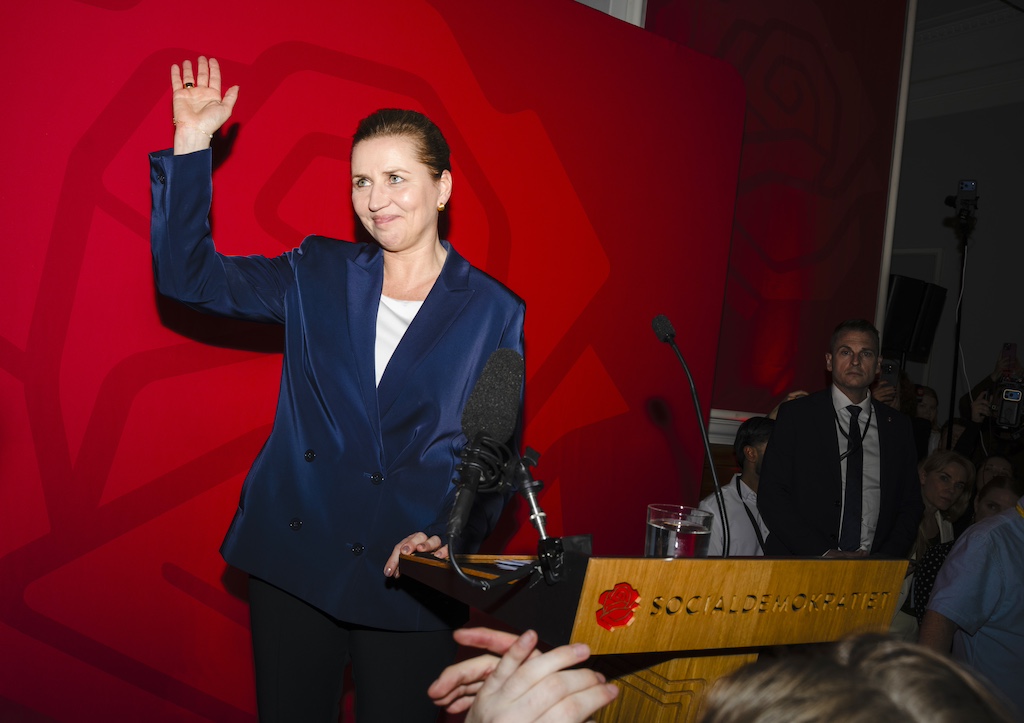
At the election, the Frederiksen government was sharply rejected at the polls.(Nichlas Pollier / Bloomberg via Getty Images)
Denmark is not known for politically active billionaires. Yet when, in February, the Danish Social Democrats, under prime minister Mette Frederiksen, proposed a 0.5 percent annual wealth tax on the country’s richest 1 percent, the business response was both swift and furious.
Firms poured millions into advertising campaigns ahead of the March 24 general election. Billionaires and CEOs took to the press threatening to leave the country, while all the major employers’ organizations and the largest firms, like Maersk, issued dire warnings of massive job losses and investment slowdown.
The wealth tax proposal was part of the Social Democrats’ attempt at a pivot to the Left, focusing their electoral campaign on economic inequality and other economic justice issues, in order to win back some of the voters lost after four years in a historically unpopular centrist coalition with parts of the Right.
This pivot, however, seemed to come too late and lack credibility. On Tuesday, the Frederiksen government was sharply rejected at the polls.
The Social Democrats remained the largest party, but their 21.9 percent vote share marked a historic low for a party that once routinely commanded close to 30 percent. Their coalition partners fared no better: Venstre, the traditionally dominant center-right party with a strong rural base, faced its worst result since the nineteenth century. Collectively, the ruling coalition fell well short of a parliamentary majority. It was the worst loss in seats for any sitting government in over fifty years.
Most of the Social Democrats’ lost support went not to the far right but to the Left. The most significant gains came from the Socialist People’s Party (SF), which secured approximately 12 percent of the vote and twenty seats, ending as the second-largest party in a historically fragmented parliament.
The Red-Green Alliance also saw gains, reaching 7 percent after a campaign focused on economic issues and the cost of living. Together with a small green party, Alternativet, these further-left forces now have a combined parliamentary strength equivalent to the Social Democrats’ own. Combined with recent gains in municipal elections, including a left-wing mayor in Copenhagen, this marks a further decline in the Social Democrats’ long-hegemonic position on the Left in Denmark.
The overall result has been a fragmentation of the political landscape. Twelve parties are now represented in parliament, with only the Social Democrats significantly above 10 percent. Neither the broad-left (“Red”) nor right-wing (“Blue”) bloc has a majority, meaning that former Prime Minister Lars Løkke Rasmussen, with his centrist Moderaterne, stands to be kingmaker. Coalition negotiations are set to be very complicated.
The Nordic Model Under Pressure
The election campaign was dominated by issues around the cost of living and inequality. Denmark, once one of the most egalitarian countries in the world, has seen four decades of rising economic inequality. Much of this has been driven in recent years by the unequal distribution of asset ownership.
The top 1 percent have profited from a stock market boom, with record corporate profits going to national champions like shipping giant Mærsk and Novo Nordisk, which in the aftermath of the launch of Ozempic became the most valuable company in Europe by market capitalization. At the same time, a decade-long rise in real estate prices has left many young people unable to access housing, while at the same time enriching owners of houses and apartments in Copenhagen and other large cities.
It was in this context that Frederiksen made the wealth tax the main policy of her campaign, a modest tax on the top 1 percent to be spent on public education. A month prior, the proposal of a wealth tax was adopted by powerful Danish union federation FH as a key political demand, alongside pension reform.
The proposal enjoyed wide popular support across a range of polls, but a fierce mobilization from Danish billionaires and the business world, supported by the right-wing press, pressed the defenders of the proposal onto the defensive. It remains unclear whether the proposal will survive coalition negotiations with centrist parties.
The campaign against the wealth tax had great similarities to the previous year’s business mobilization against Norway’s Labor Party, which had increased that country’s wealth tax on the wealthiest to 1.1 percent. It was even the same lobbying firms who organized the campaign. This raises the question of a broader radicalization of the Scandinavian business class.
Traditionally, the core of this elite had been relatively moderate in its outlook, favoring accommodation with the unions and the welfare state. If this recent turn to political activism is sustained, it may mean a destabilization of the corporatist foundations of the Nordic model.
A worrying historical parallel, can be found on the other side of the Øresund strait. The Swedish program of wage-earner funds in the 1980s provoked a forceful mobilization by the Swedish employers’ organization, which in subsequent years poured large sums into defeating the funds as well as supporting a broader program of liberalization, much of which was implemented following the financial crisis of the early 1990s.
A European Pattern
Denmark now sits squarely within a broader European pattern where traditional bloc politics are breaking down but no stable alternative has yet emerged. The likely outcome is prolonged and difficult coalition negotiations, with the possibility of another cross-bloc government spanning the left-right divide, despite the clear electoral losses for its participants. The more decisively voters move away from the center, the more reliably institutions tend to reproduce it.
Notably absent from the campaign, despite this turbulent political context, were the issues that dominated Danish politics throughout the 2000s and 2010s. Immigration has largely disappeared as a decisive electoral factor. This is the result of Frederiksen’s longstanding policy of pursuing one of Europe’s strictest immigration regimes, aiming to make the right to asylum and entrance as difficult as possible within the scope of Denmark’s human rights obligations.
The strategy successfully neutralized the issue from the Right, but it came at a cost: it led Frederiksen to alienate herself from the mainstream of European social democracy, while the Social Democrats’ identity as a party of the broader left eroded, likely accelerating the drift of voters toward SF and the Red-Green Alliance.
Foreign policy also played a surprisingly minor role, despite the recent existential crisis over Greenland. The threats from the Trump administration dominated the political scene for weeks. Yet virtually all parties, including the far-right Danish People’s Party, which earlier flirted with Trumpism, rallied to a hard line in defense of Greenlandic territory, removing it as a point of differentiation between them.
The Left’s Dilemma
It will probably take several weeks before a new governing coalition is in place. It seems overwhelmingly likely that Frederiksen will continue as prime minister, despite the electoral losses for her party and government. But the result represents another step in the slow disintegration of the large popular parties of the center left and center right. The Social Democrats and center-right Venstre collectively now represent less than a third of the votes, a far cry from their former dominance as leaders of competing blocs.
For the Left, the position is a precarious one. The Socialist People’s Party will aim to enter government with the Social Democrats, despite the dismal experience of their last participation in a center-left coalition from 2011 to 2015, which ended up splitting the party.
The Red-Green Alliance faces a more delicate situation. Without a majority for the broad left, and with reliance on Rasmussen’s centrists, it will be difficult to hold Frederiksen to her many left-leaning campaign promises. The Social Democrats usually move rightward when in government.
In the face of another round of price rises on energy and basic goods, there is little sign that a new centrist government will face a more forgiving electoral landscape than the last one. The question remains whether it will be forces on the Left or on the far right that mobilize the voters disillusioned by the traditional parties.