Just Think of Wuthering Heights as a Barbie Offshoot
Emily Brontë’s novel deserves a more sophisticated approach than Emerald Fennell’s Wuthering Heights.
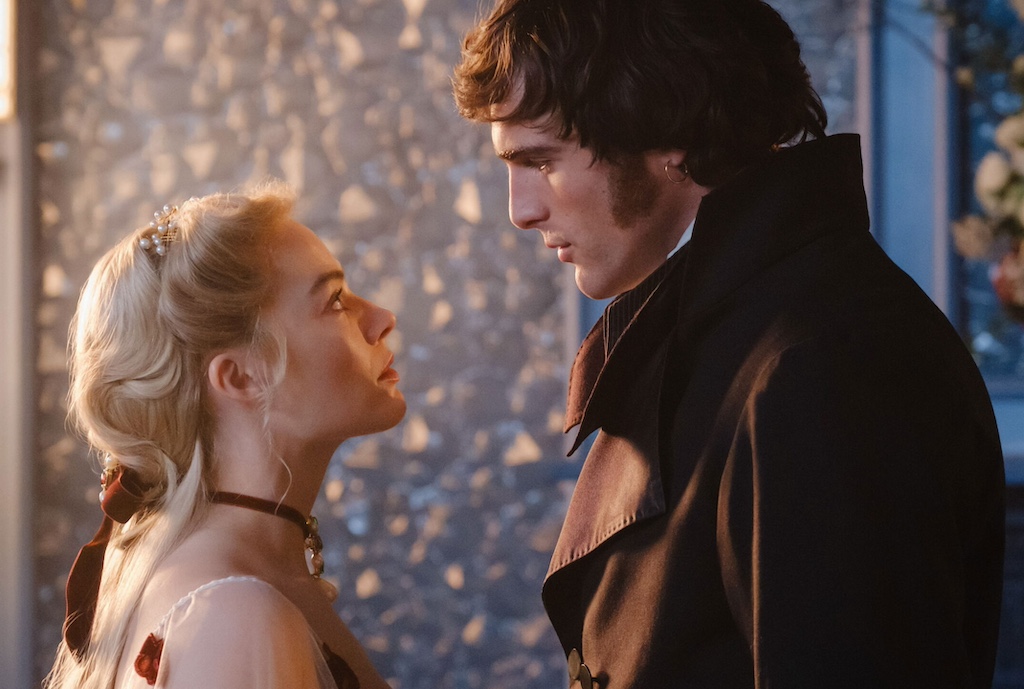
Still from Wuthering Heights. (Warner Bros.)
By the time you actually see Emerald Fennell’s Wuthering Heights, if you wind up committing that mad act, you might be surprised at how you’ve exhausted the strength of your scorn on the previews. They played relentlessly for months before the film’s premiere and were so stupendously silly that, if you’d read Emily Brontë’s novel, you discovered how high your eyebrows could actually rise on your forehead in registering poleaxed disapproval.
But it’s hard to keep that kind of raging disdain going. A weary cynicism overtakes it that is the only way to cope with the Emerald Fennells of the world.
At age forty, she has the sensibility of a horny, giggling fourteen-year-old, so her Wuthering Heights is exactly what such a case of arrested development would produce. Fennell’s on record as wanting to honor her first titillated reading of the novel at age fourteen. So hotties Heathcliff and Cathy, when not stiffly playing dress-up in a series of absurd costumes meant to represent old-timey people of no specific period, shag their way across the moors to the tunes of Charli XCX.
It’s not that the period erotic appeal of Wuthering Heights isn’t commonly acknowledged. In an episode of The Simpsons, for example, when the family finds themselves in a survivalist TV reality show placing them in the recreated year of 1895, Homer assesses Marge’s interest in sex that night by suggesting, “Maybe I could wuther your heights?”
But that represents the apex of sophistication compared to Fennell’s approach.
Her idea of a great film opening is to start with the sound of rhythmic panting and grunting on the soundtrack, and just when you’re convinced you’re about to see an enthusiastic act of copulation, she gives us a first shot of a man being hanged, strangling and kicking at the end of a rope. The eager mob watching this grisly spectacle, including the child Cathy Earnshaw (Charlotte Mellington) and her paid companion, young Nelly Dean (Hong Chau), are all aroused to note that the dying man has an erection, and pretty soon spectators are practically humping at the foot of the gallows.

Fennell’s eagerness to establish basic human savagery and the relationship between sex and death is overstrained here since, in the nineteenth century, that relationship was plenty clear in everyday life, in grim fates much more common than public hangings.
Women died in childbirth quite regularly, and infant mortality was rife. See The Testament of Ann Lee for a gruesome montage conveying how continually married women had sex, got pregnant, risked their lives struggling through bloody childbirth, saw their babies die, had sex, got pregnant, risked their lives struggling through bloody childbirth, saw their babies die, and so on. Also, incurable venereal disease ran rampant, and you only have to read about what dying of syphilis was like to make you amazed that anyone ever had the nerve to have sex at all.
Since Wuthering Heights rolled into theaters as the big Valentine’s Day feature this year, it’s been doing well with its target audience: women hunting for romantic thrills at the cinema. They were ringing up my ticket before I even asked for it, assuming every woman there was showing up for Wuthering Heights. And indeed, I saw the movie with an all-female audience, from clusters of teenage girls to gangs of gray-haired women. There were just two embarrassed middle-aged men present, acting like TV sitcom husbands dragged there unwillingly. It was disconcerting to feel part of such a trite, old-fashioned, gender-binary scenario in the year 2026.
Both spectacularly miscast in the lead roles as impoverished rural English aristocrat Cathy and her mysterious laboring-class inamorato, Heathcliff, Margot “Barbie” Robbie and Jacob “Frankenstein” Elordi do the best they can. But since Fennell has reduced their characters to soap opera stick figures, there’s nothing much for them to play.
Robbie has an essentially modern persona, and she’s never less convincing than when playing an entrapped nineteenth-century woman getting trussed up in her corset — the tiredest cliché of period films — and masochistically demanding that it be laced “tighter, tighter.” As for Elordi, he’s never persuasive as the ultimate blackhearted Byronic antihero. He’s tall and dark and looks good in sideburns, but that’s the extent of it. He’s like one of male models who poses for the cover art on bodice ripper romances.
And that’s clearly how Fennell wants it, since she has no stomach for Heathcliff’s near-demonic sadism that terrorizes the Yorkshire countryside. She gives Elordi dialogue announcing how rough and sinful he is, a very devil of a fellow, but she keeps telegraphing his softness and suffering through Elordi’s dark boyish eyes. Fennell makes ridiculous the chilling part of the novel in which Heathcliff, seeking revenge for the loss of Cathy, marries the besotted younger sister of Cathy’s rich, landed husband, Edgar Linton (Shazad Latif), as a way of tormenting all of them simultaneously.
As Heathcliff takes out his rage and frustration on his helpless bride Isabella (Alison Oliver) in Fennell’s film, she finds it all a huge turn-on. Of course she does! In Fennell-land, everything is a Saltburn-ish sex game.
If you watch the 1939 William Wyler version of the film, Isabella (Geraldine Fitzgerald) is soon reduced to a silent housebound wraith as the result of Heathcliff’s abuses, which are all censored and left to the imagination, while Laurence Olivier’s Heathcliff convincingly glories in his twisted revenge.
Olivier wasn’t always an effective film actor unless a director pushed him past a tendency toward stage-trained hamminess — and Wyler pushed him, drawing on the actor’s vast, cold arrogance to convey Heathcliff’s limitless cruelty. But in Fennell-land, Isabella soon has the upper hand of Heathcliff because her appetite for depravity is so much greater than his. He can’t keep up. These lower-order upstarts who think they can compete with the British elite when it comes to kink!
Also Saltburn-ish is Fennell’s reconceiving of the character of Nelly, the servant and unreliable narrator of Emily Brontë’s novel, who’s turned into a malevolent schemer here, her hateful machinations practically bringing down two elite households, the Earnshaws and the Lintons. Fennell can’t seem to wrap her head around how Heathcliff and Cathy, trapped and driven mad by imprisoning systems of race, class, and religion, could’ve destroyed their love and wrecked their lives unless someone was melodramatically plotting against them. So Nelly the sinister servant contrives elaborate ways to keep them apart.
But not too far apart. There are still all those sex scenes to get through.
It’s hardly worth going through all the ways that Fennell seems unable to convey key aspects of the novel, but just a few examples point out her approach to the material. As she points out in interviews, she had the title “Wuthering Heights” put in quotation marks to emphasize that this is her own Wuthering Heights, not Brontë’s. And Fennell’s Wuthering Heights has no use for the supernatural scenes involving Cathy’s ghost haunting the moors or the strange spectral quality of the landscape itself — Fennell pumps fake fog into it and calls that good enough.
The transgressive nature of Heathcliff and Cathy’s love at almost every possible level seems beyond Fennell’s ability to dramatize. Heathcliff’s uncertain race or ethnicity is completely erased, though he’s often described disparagingly as a dark “gypsy” in the novel, making his changeling-twin relationship with Cathy more forbidden, especially once it turns “incestuous” as they mature. Their comingling of souls is practically at a demonic level, making it a shocking climactic moment when Cathy declares, “Whatever our souls are made of, his and mine are the same. I am Heathcliff!”
But not in Fennell’s version, in which Cathy says the lines without any great emphasis, as just another way of expressing big feels. Wyler had a flash of lightning and a clap of thunder accompany that line, as if the old Protestant God Himself protested.
Where Fennell places her emphasis is on production design, particularly houses and interior decoration, plus costumes. The Earnshaw manor house is a strange black edifice like Mordor, aligned with the rocky edifices on the moor but collapsing inwardly as Cathy’s dissipated father (Martin Clunes) drinks and gambles away his fortune. After her mercenary marriage, when Cathy moves to the Linton estate, she finds herself trapped inside it like an overdressed doll.

In case you don’t get the implication, Fennell has Isabella childishly dedicated to an elaborate doll house, making as a wedding gift an opulent Cathy doll to place inside it. Even more grotesquely, Cathy’s husband, the respectable Edgar, has the master bedroom redone to match Cathy’s complexion, even to the point of having the freckle on her cheek recreated as a pale brown blotch on the pink padded wall.
As the idle Mrs Linton, poor Margot Robbie has to wear a succession of clownish outfits that function as a punishment for her sinful act of selling herself in marriage to a wealthy man. One looks like it’s made of cellophane and another features what appears to be a shiny red rubberized hoopskirt. Her Barbie training in wearing many outfits, some quite outlandish, probably helped her carry this off.
Actually, the whole film is probably best enjoyed as a kind of offshoot of Barbie. Call it “Wuthering Heights Barbie,” featuring the famous doll boxed up in a tightly corseted nineteenth-century gown with BDSM accessories like whips and hangman’s nooses and horse’s bridles. It’s also sold with an elaborate new Barbie’s Dreamhouse, the glamorously dreary Gothic version, with a dark-haired Ken in heavy sideburns grinning fondly at Barbie from the doorway. And Fennell has thought of practically all the sex positions those blank-eyed dolls can be put into, with their arms that go up and down, and bendy joints, and heads that turn all the way around!