No Other Choice Is Another Masterpiece by Park Chan-wook
Park Chan-wook's No Other Choice is a shocking, innovative, and darkly comic film about the pressures of life under capitalism. It’s more proof that the Oldboy director is nothing less than a cinematic master.
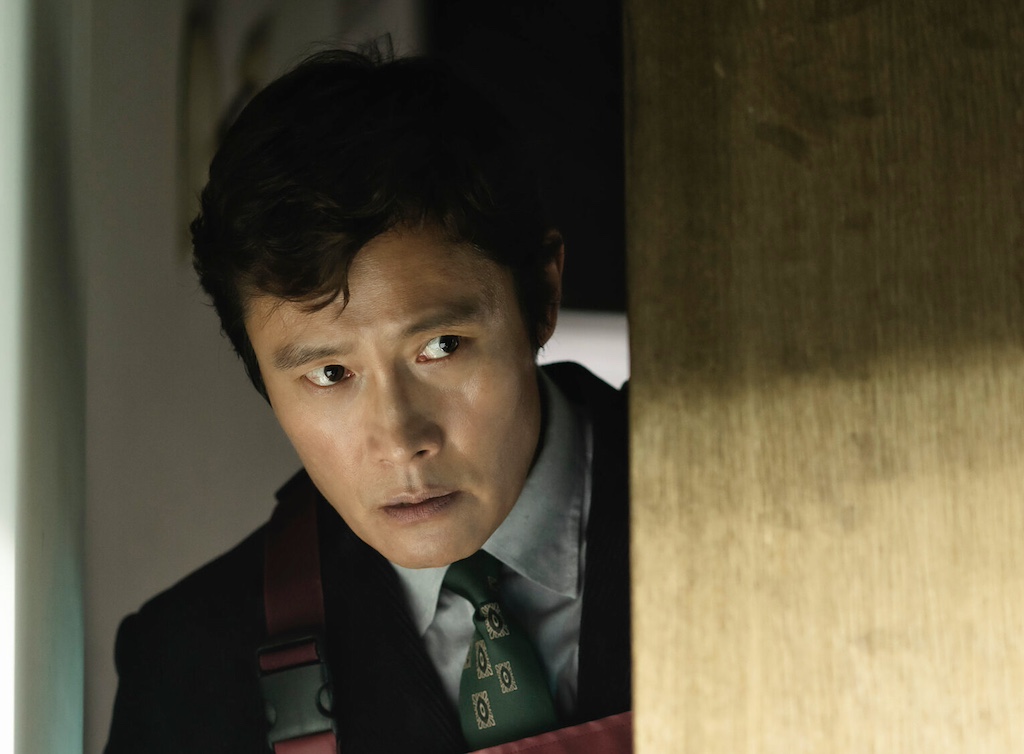
Lee Byung-hun in No Other Choice. (CJ Entertainment)
I expected the intense hype surrounding Park Chan-wook’s No Other Choice would, when I finally saw it, inevitably make it less exciting no matter how good it actually was. But the hype can’t even touch it. It’s a great film that works in such unexpected ways, you can’t really anticipate what you’re going to see from a typical summary. It’s one of those rare films that discombobulates you and silences your glib responses.
Based on Donald Westlake’s 1997 novel, The Ax, previously adapted by Costa-Gavras with his 2005 film, The Axe, Park’s No Other Choice is about an affluent paper mill manager, Yoo Man-su (Lee Byung-hun), who’s devoted to his family, his idyllic home, and the intensive work he performs on the job. We see him just before the life-wrecking blow falls, when he’s on the patio barbequing the family dinner in the summer heat, appreciating his happy situation but looking forward to the cooler fall weather on the way. With ironic prescience, he murmurs, “Come on, fall.”
But after the mill is taken over by an American company, he abruptly loses his job for refusing to lay off his highly trained coworkers. Crushed, Man-su is determined to find other work within three months so he can go on tending his plants in the greenhouse he built himself; his homemaker wife, Lee Mi-ri (Son Ye-jin), can continue her tennis lessons and dance lessons; his teenage son can lounge around pricing the latest tech gadgets; his neurodivergent daughter, Ri-one, a gifted cellist, can work with a more advanced music teacher; and the family’s two golden retrievers can carry on gamboling around the yard.

But intense competition in the labor market plus his severely dented self-confidence means he’s still doing low-paid retail warehouse work over a year later while continuing to hunt for a scarce managerial position in a paper company. The family is driven to desperate extremes. Mi-ri engages in severe cost-cutting — she even gives away the family dogs, saying, “There are too many mouths to feed.” It’s an alarming line daughter Ri-one repeats in a disturbing singsong voice.
But soon it’s clear the house will also have to be sold, and that’s the last straw for Man-su. He’d worked hard to recover the house, which had once belonged to his parents, and he can’t face losing it again. Realizing he’ll have to take drastic measures, Man-su echoes the American boss who said, when preparing a ruthless round of firings, “No other choice.”
Man-su decides to eradicate the competition. He creates a false job-hiring ad for a paper mill manager in order to gather applications and figure out who his top competitors are. Those three he plans to murder, presuming he’ll then be hired as the last fully qualified man standing.
From there, you might think you know what you’re in for in terms of expeditious black comic murders. But it doesn’t go that way at all. Each murder involves a specific, protracted process, undermined by the fact that Man-su identifies with these other men that he’s targeting. In order to do each murder, he gets to know too much about their homes, wives, children, backgrounds, and how much they’ve suffered to get as far as they got in their careers, only to lose it all.
The first murder is naturally the clumsiest and takes the longest. Man-su zeroes in on Goo Beom-mo (Lee Sung-min), a talented papermaker who’s become an alcoholic during his long search for another job in a fast-shrinking field. Nearly getting caught while spying on the rural Goo home, Man-su gets to know the man’s unhappy wife, A-ra (Yeom Hye-ran), who’s cheating on him. And Man-su’s identification with Beom-mo becomes ever more troubling, as Man-su begins to suspect Mi-ri is also cheating on him, and his own dark history as an overworked, abusive alcoholic is revealed.
Man-su’s first murder attempt is so messy, it descends into mistaken identity and a protracted slapstick comedy sequence in which the question becomes, who will murder whom by the end of this scrum? If you can’t handle wild tone shifts, a radically veering narrative, and startling segues between scenes — some such artfully composited shots and bold editing choices, you’ve never seen the like of them before — you won’t be able to appreciate this film.

The few bad reviews No Other Choice has gotten reflect outmoded expectations of something smoother and more conventional, a kind of filmic “well-made play” that continues to haunt the imaginations of far too many critics. This film is going for a visceral representation of life under capitalism, without resorting to mere polemics. That means both the tragic and the surreally ludicrous are represented in a rapid pile-on of mad events in such a way that the ground seems to heave under the characters’ feet.
Any nostalgia you might have, about, say, an earlier era of industrial capitalism when a necessary labor force made workers at least potentially powerful, gets undercut brutally in No Other Choice. Images of those skilled paper-mill workers and their beautiful, satin-smooth products are subverted later with shots of giant machinery hacking down forests and transporting loads of timber across highways jammed with traffic.
Director Park goes for such a savage take on humanity’s ruinous time as “stewards of the earth,” even Man-su tending his bonsai tree — twisting and binding its small branches — is shot in such a sadistic close-up, you’re made to wonder, not for the first time, what is wrong with us as a species.
Human-made beauty coming out of widespread savagery, wreckage, and pain, is one of No Other Choice’s unexpected themes that only fully emerges by the very end. The narrative is haunted by the consciousness of terrible human history contained within literal buried bodies beneath characters’ homes, fertilizing their trees, and getting dirt on their shoes. And atomization, the process by which we are all forced apart into terrifying isolation, so that we each wind up playing a lone hand against the impossible forces of our own creation, has rarely been illustrated with such powerful imagery and narrative clarity.
You have to see it. Park had exceptionally high ambitions for No Other Choice, as he made clear in an interview way back in 2019:
I have had a lifetime project to make a film titled The Ax, Park said in an open talk with Greek-French director Costa Gavras, held at the Busan Cinema Center on Sunday, at the Busan International Film Festival. “I’ve not yet started filming, but I wish to make this film as my masterpiece.”
Well, he did it.