Israel’s West Bank Occupation Is a Danger to Women
Women in the West Bank face daily harassment by Israeli settlers and troops. While Israel often paints itself as more forward-thinking on women’s rights, its occupation crushes Palestinian women’s autonomy and exposes them to violence.
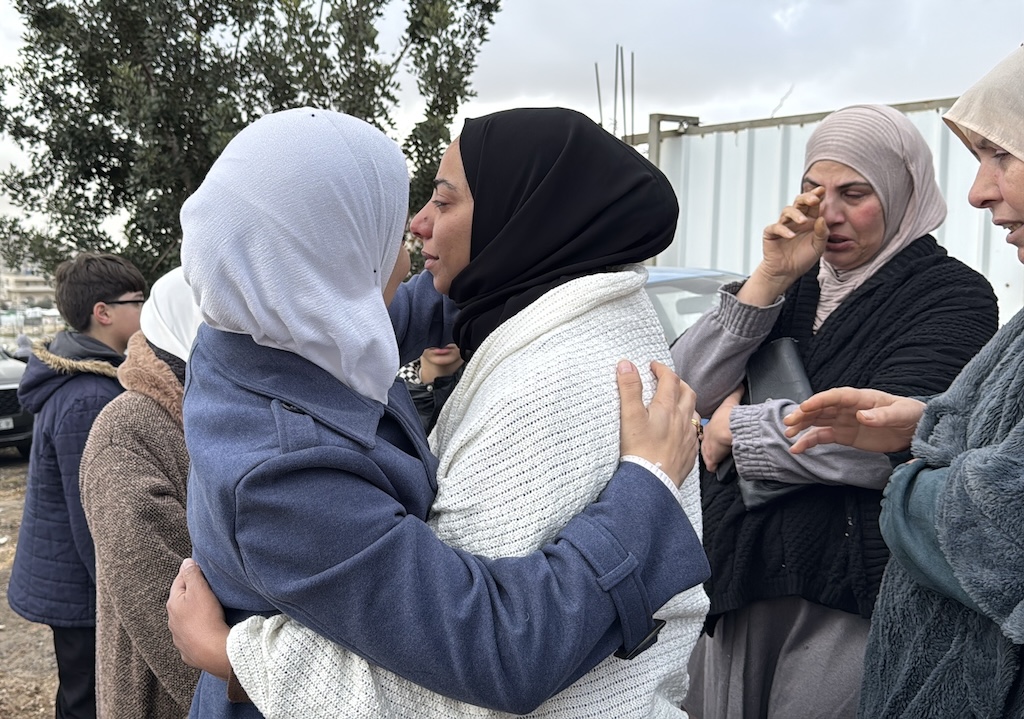
Israel often presents itself as a champion of women’s rights. In the West Bank, the harassment of Palestinian women by Israeli settlers and troops tells the opposite story. (Hisham K. K. Abu Shaqra / Anadolu via Getty Images)
Being a woman in Palestine means experiencing violence on two parallel tracks. There is the violence inflicted by the Israeli state, its military and settlers. There is also the violence perpetrated by men, whether soldiers, settlers, or husbands. Beyond the most visible manifestations of the Israeli occupation — arbitrary executions, home demolitions, land confiscations, and forced displacement — it also slowly tears away at the fabric of Palestinian society.
Palestinian feminists and social workers have long recognized the connection between internal violence, sustained by patriarchal cultural codes, and external violence imposed by the Israeli army and settlers. This relationship operates on multiple levels, making the work of feminist organizations extraordinarily difficult. On the one hand, the daily harassment and attacks endured by West Bank communities steadily reduce women’s participation in social life, forcing them back into the home. On the other hand, collective trauma and individual humiliation intensify interpersonal violence and the gradual erosion of emotional bonds. The effect is that violence is passed down from the powerful to the vulnerable — with women and children bearing the brunt.
“Where the occupation is most severe, particularly in Area C [the fully Israeli-controlled area of the West Bank], in refugee camps, or in cities like Hebron that contain settlements, we see a significant increase in gender-based and child violence compared to Area A,” explains Khawla Al Azraq, director-general of the Palestinian NGO Psychosocial Counseling Center for Women (PSCCW). This applies both to violence by occupation forces and to violence within families. This was true even before October 7, 2023: according to a PSCCW report published four weeks earlier, five women in Hebron reported being stripped and threatened with weapons and dogs by Israeli soldiers in front of their children. At the same time, worsening living conditions contribute to rising rates of post-traumatic stress disorder which, in the absence of a public system for addressing psychosocial trauma, often feeds into violence turned inward, against family members.